
- Release Year: 2016
- Platforms: iPhone, Nintendo Switch, PlayStation 3, PlayStation 4, PlayStation 5, PS Vita, Windows Apps, Windows, Xbox One, Xbox Series
- Publisher: Brimstone Games AB
- Developer: Brimstone Games AB
- Genre: Action
- Perspective: Diagonal-down
- Game Mode: Single-player
- Gameplay: Party game
- Average Score: 84/100
Description
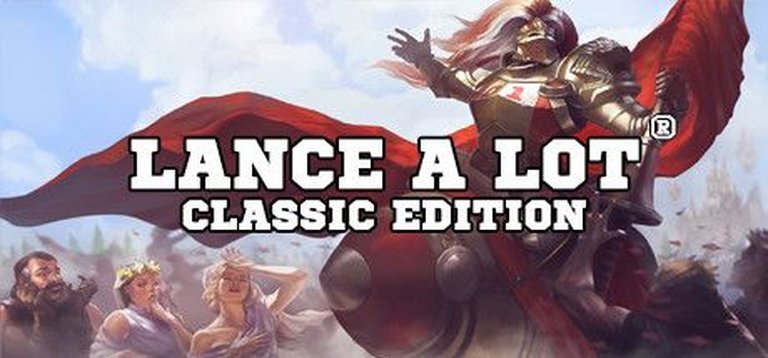
Lance A Lot: Classic Edition is a chaotic local party game where up to four players engage in rocket-powered jousting battles. Set in whimsical aerial arenas, players control knights mounted on rockets, aiming to topple opponents with precise lance strikes while navigating physics-based environments. With customizable mutators and fast-paced, friendship-testing gameplay, it combines medieval charm with absurd humor for a competitive multiplayer experience.
Where to Buy Lance A Lot: Classic Edition
PC
Lance A Lot: Classic Edition Reviews & Reception
steambase.io (85/100): A triumphant return to form for the series.
pepe.deals (83/100): A triumphant return to form for the series.
barter.vg (83/100): A triumphant return to form for the series.
raijin.gg (85/100): A triumphant return to form for the series.
Lance A Lot: Classic Edition: Review
Introduction
In an industry saturated with multiplayer shooters and sprawling open-world epics, Lance A Lot: Classic Edition (2016) carved out a niche as a gloriously chaotic local party game. Developed by Swedish studio Brimstone Games AB (formerly Rocket Hammer), this rocket-jousting battler distilled competitive multiplayer into a single, electrifying mechanic: one-hit kills. Boasting accolades like GAMER’S CHOICE at the 2016 Swedish Game Awards and a cult following among couch co-op enthusiasts, the game embraced simplicity over scope. Yet, beneath its whimsical facade lay a fraught development history, technical constraints, and canceled dreams of online play. This review posits that Lance A Lot: Classic Edition remains a flawed but foundational entry in the indie party-game canon—a testament to the raw joy of physics-based mayhem, even as its legacy was eclipsed by its own Enhanced Edition.
Development History & Context
Studio Vision & Constraints
Brimstone Games AB conceived Lance A Lot as a 3-month passion project to cut their teeth on game development and attract publisher interest. Built in Unity, the team—led by designer Erik Asmussen and programmer Rikard Lindström—leveraged the engine’s physics systems to create tactile, momentum-driven combat. However, the studio’s inexperience with netcode proved disastrous. Initially promising online multiplayer post-launch, Brimstone canceled it in March 2017, citing “fundamental network issues” rooted in physics synchronization and hit detection. Asmussen admitted in a Steam post:
“Rewriting the movement and physics code would’ve taken months… We preferred to make a great local game than a mediocre online one.”
The decision crystallized their pivot toward refining local multiplayer, a move validated by the Very Positive Steam reception (83% of 55 reviews) but one that limited commercial reach.
The 2016 Indie Landscape
Lance A Lot debuted amid a resurgence of local multiplayer indies like Overcooked and Crawl. Its focus on accessibility—supporting four players on a single keyboard or controllers—aligned with a market hungry for pick-up-and-play experiences. Yet, it launched without AI bots, a critical omission that alienated solo players. Technologically, targeting modest specs (Intel i3, GTX 460) ensured accessibility but constrained visual ambition, leading to simplistic textures and animations later overhauled in the Enhanced Edition.
Narrative & Thematic Deep Dive
Lance A Lot discarded narrative pretense for pure thematic camp. Players embodied color-coded knights (Dragon Knight, Royal Champion, Forest Guardian) battling across floating arenas like the thorny Enchanted Lake or explosive Rocket Valley. The absence of backstory or dialogue reframed knights as avatars of competitive chaos, channeling a medieval-toybox absurdity reminiscent of Joust (1982).
Themes orbited honor through demolition. Mutators like “Explosive Lances” and “Low Gravity” twisted jousting into slapstick ballet, where triumph hinged on mastery of physics-driven momentum. This minimalism worked: the lack of narrative depth focused players on emergent rivalries—friendships “ruined,” per Steam’s tagline, by pixel-perfect lance strikes.
Gameplay Mechanics & Systems
Core Loop & Combat
At its heart, Lance A Lot was a fighting game disguised as a party title. Players maneuvered rocket-mounted knights with twin-stick controls: one stick for movement, the other to angle lances. Combat revolved around precision timing—striking an opponent’s lance tip dismounted them instantly, while mistiming left players vulnerable. Environmental interactions amplified the chaos:
– Destructible trees (patched in April 2017) that regrew after 30 seconds.
– Rocket Hammers to stun foes or trigger map-altering events (e.g., launching rockets in Rocket Valley).
The “one-hit kill” rule created tension akin to Nidhogg, rewarding reads over reflexes.
Modes & Progression
Four modes offered variety:
1. Free-for-All: Last-knight-standing brawls.
2. Duel: 1v1 tournaments.
3. King of the Hill: Capture zones amid artillery fire.
4. Capture the Flag: Physics-driven objective chaos.
Yet, progression was barebones—no unlockables or skill trees. Mutators (“Custom Rules”) provided replayability, letting players tweak gravity, lance length, or match duration.
UI & Controls
The radial menu for mutators felt intuitive, but Classic Edition’s UI suffered from placeholder minimalism—addressed in Enhanced Edition’s overhaul. Controller support (recommended for 3-4 players) was seamless, though keyboard play cramped more than two.
World-Building, Art & Sound
Visual Design
Lance A Lot: Classic Edition evoked a low-poly arcade aesthetic, with knights rendered as chunky, cel-shaded figures and arenas as floating dioramas. Maps like Winterhold (a snowbound ruins) and Crossroads (a desert canyon) embraced archetypal biomes but lacked detail—textures were flat, and foliage rudimentary. Post-Launch updates (e.g., the Dragon Knight’s redesign) sharpened visibility amidst chaos.
Sound Design
The game’s audio balanced whimsy and impact:
– Lance clashes reverberated with metallic clangs.
– Rocket thrusters hummed like overclocked kazoos.
– A festive, synth-heavy soundtrack evoked Monaco’s heist vibes.
Sound cues were critical for off-screen strikes, though lack of voice acting muted personality.
Reception & Legacy
Launch & Critical Response
Classic Edition launched to niche acclaim, praised for its “addictive local multiplayer” (Steam user reviews) but criticized for limited content. Its 83% Very Positive Steam rating (55 reviews) reflected this duality—players adored the chaos but lamented the lack of bots and online. Awards from the Swedish Game Awards (2016) buoyed its profile, yet commercial performance was modest (3,770 units sold by 2026, per Raijin.gg).
The Enhanced Edition Divide
The September 2017 release of Lance A Lot: Enhanced Edition—a free upgrade for Classic owners—cemented its legacy. Adding AI, eight maps, and graphical polish, Enhanced supplanted Classic, which was delisted but later bundled. This bifurcation fragmented the player base, with Classic becoming a curio for purists who preferred its “simpler” controls.
Industry Impact
Lance A Lot’s physics-driven jousting presaged hits like Gang Beasts, while its mutator system echoed Screencheat’s rule-bending. Brimstone’s transparency about canceling online play—a cautionary tale for indie studios overpromising—earned community goodwill. Culturally, it remains a benchmark for local-multiplayer design, proving that rocket-powered lances could forge unforgettable rivalries.
Conclusion
Lance A Lot: Classic Edition is a time capsule of indie ambition and limitation. Its razor-sharp combat loop and physics-driven slapstick still exhilarate, but the absence of online and AI stunted its reach. Yet, as a testament to couch co-op’s enduring magic, few games distill competition into such pure, jubilant anarchy. While the Enhanced Edition refined its vision, Classic remains essential for historians of multiplayer design—a flawed gem that launched knights, rockets, and a studio’s legacy into the stratosphere. 7/10; best enjoyed with three friends and a disregard for broken controllers.