
- Release Year: 2003
- Platforms: Windows
- Publisher: Shaven Puppy Ltd.
- Developer: Puppygames
- Genre: Action
- Perspective: Top-down
- Game Mode: Online PVP
- Gameplay: Arcade, Shooter
- Setting: Futuristic, Sci-fi
Description
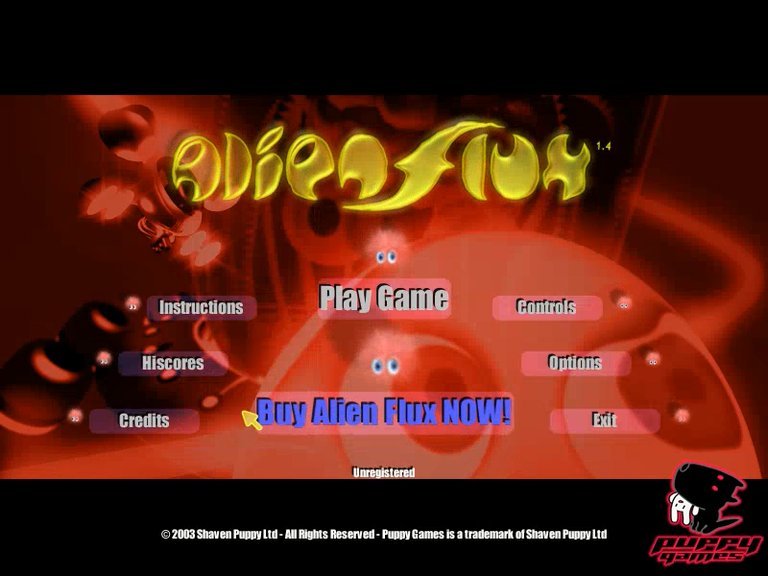
AlienFlux is a fast-paced, top-down arcade shooter set in a sci-fi universe where players defend adorable ‘fluffies’ from relentless waves of fifth-dimensional aliens. Commanding an armored spaceship equipped with lasers, bombshocks, and power-ups like temporary invulnerability or increased firepower, players strategically protect eight fluffies per level while battling 16 alien types and epic boss fights across 100 chaotic stages. Unique mechanics like rescuing trapped fluffies from protective bubbles and climbing online leaderboards add depth to this colorful, chaotic defense mission.
AlienFlux: Review
Introduction
In an era when indie studios were still fighting for oxygen in a room dominated by AAA behemoths, AlienFlux (2003) emerged as a defiant, neon-soaked love letter to arcade purity. Developed by the fledgling UK studio Puppygames—founded by childhood friends Caspian Prince and Chaz Willets—this top-down shooter tasked players with defending adorable, spherical “fluffies” from interdimensional aliens with nothing but reflexes and a laser cannon. While it never achieved mainstream recognition, AlienFlux crystallized a design philosophy that would define Puppygames’ later work: minimalist mechanics elevated by psychedelic artistry and punishing depth. This review argues that AlienFlux remains a cult-classic artifact of early 2000s indie resilience, blending taut arcade action with a disarmingly bizarre aesthetic that still resonates today.
Development History & Context
The Birth of Puppygames
Founded in 2002–2003 by programmer Caspian Prince (né Rychlik-Prince) and artist Chaz Willets, Puppygames operated as a passion project long before “indie” became a marketing buzzword. Prince, who handled programming, sound, and design solo, leveraged Java—a language praised for its cross-platform accessibility but often maligned for gaming—to build AlienFlux. The studio’s name, “Shaven Puppy Ltd.,” hinted at their irreverent ethos, while collaborations with forums like JavaGaming.org and nods to Jeff Minter’s Llamasoft underscored their DIY roots.
Technological Constraints and Ingenuity
Released in 2003, AlienFlux emerged alongside titles like Geometry Wars, yet its Java foundation imposed unique limitations. The game’s visual intensity—a kaleidoscope of particle effects and neon hues—pushed contemporary hardware, especially on Windows, Linux, and Mac, where cross-compatibility prioritized accessibility over optimization. Mouse-and-keyboard controls were non-negotiable in this era before ubiquitous gamepad support, demanding precision that mirrored classic PC shooters like Smash TV.
The Gaming Landscape of 2003
The early 2000s saw a resurgence of arcade-inspired titles as digital distribution democratized development. Shareware models dominated indie releases, and AlienFlux adhered to this tradition: a free demo with a purchasable activation code (later rendered obsolete when Puppygames removed the game from sale). It competed for attention in a saturated market, yet its absurd premise—defending fluffies from “lime jelly”-inducing bubbles—set it apart from sterile military shooters.
Narrative & Thematic Deep Dive
A Minimalist Parable of Protection
AleinFlux’s narrative is deliberately skeletal: aliens from the “fifth dimension” seek to liquefy eight defenseless fluffies per level, and you, piloting a lone spacecraft, must intervene. Dialogue is nonexistent; story beats unfold through escalating enemy designs and environmental tension. The fluffies—voiceless, spherical mascots—embody innocence, while their captors, the “bubbles,” evoke body-horror via grotesque transformations.
Thematic Undercurrents
Beneath its cartoonish surface, AlienFlux explores themes of futility and persistence. With 100 levels and no narrative progression, the game mirrors Sisyphus’ struggle: success is temporary, death inevitable. The “bubble” mechanic—where players must time attacks to free captured fluffies—doubles as a metaphor for redemption: even failure (a fluffy’s capture) can be reversed with perfect timing. This cyclical structure critiques arcade traditions while reveling in them.
Character as Abstraction
Characters exist purely as functional archetypes: the fluffies are McGuffins, the ship an extension of player will. Bosses—four in total—lack backstory but compensate with screen-filling menace, their designs riffing on Gradius-esque bio-mechanical horror. The absence of traditional storytelling focuses players on the existential rush of survival.
Gameplay Mechanics & Systems
Core Loop: Tension and Salvation
Each level begins identically: eight fluffies scattered across a sterile arena, waves of aliens spawning at intervals. Players maneuver with arrow keys, firing lasers (left mouse) or deploying “bombshocks”—screen-clearing nukes—at right moments. The genius lies in the “bubble” system: when aliens attack a fluffy, they encase it in a shield. Destroy the bubble mid-capture to save the fluffy; hesitate, and it dissolves into goo. This mechanic transforms passive defense into active triage, demanding split-second decisions.
Progression and Power-Ups
Power-ups drop randomly:
– Fuzzy Dice: Spawn bonus fluffies (up to 12).
– Rapid Fire: Temporarily boosts attack speed.
– Invincibility: A brief shield against damage.
Weapon variety is sparse—the laser remains your primary tool—but bombshocks act as tactical resets. With 16 enemy types (from creeping “Spore Pods” to screen-dividing “Rifters”) and four screen-filling bosses, difficulty escalates via enemy combinations, not stat inflation.
Control Scheme: Precision and Fragility
Keyboard movement and mouse aiming create a learning curve reminiscent of Robotron: 2084. Momentum-based drifting complicates evasion, ensuring collisions feel punitive. The UI is Spartan: a lives counter, score, and fluffies remaining. This minimalism amplifies tension—players inhabit the ship’s fragility.
Flaws: Repetition and Scale
The 100-level structure overstays its welcome. Later stages recycle enemies with minor palette swaps, and the lack of environmental variety (every arena is a flat plane) undermines visual novelty. Without a save system, marathon sessions became mandatory for completionists—a relic of pre-autosave design.
World-Building, Art & Sound
A Psychedelic Nightmare
Artist Chaz Willets rendered AlienFlux in a seizure-inducing palette: electric pinks, toxic greens, and pitch-black voids. Fluffies resemble sentient cotton balls, while aliens fuse H.R. Giger biomechanics with Katamari Damacy absurdity. The top-down perspective abstracts violence into a ballet of light—lasers slice through swarms, explosions scatter pixelated viscera—but the whimsy never dilutes menace.
Sound Design: Hypnotic Dread
Caspian Prince’s soundscape merges chiptune euphoria with industrial clangs. Laser bursts ping like arcade coins; bombshocks detonate with sub-bass thunder. The absence of music during lulls heightens paranoia, while boss fights erupt with frenetic synth loops. Charlotte Rychlik-Prince’s “additional sound effects” add tactile feedback—fluffies squeak when saved, bubbles pop like gelatinous orbs.
Atmosphere as Gameplay
The audiovisual chaos isn’t ornamental—it’s informational. Enemy attack patterns telegraph through color shifts (e.g., a pulsing red bubble signals an imminent grab). This synesthetic design rewards perceptual acuity, turning the screen into a lethal instrument panel.
Reception & Legacy
Launch and Contemporary Reviews
AlienFlux slipped under mainstream radar post-launch, its commercial footprint limited by Puppygames’ obscurity and the shareware model. IGN’s 2004 Mac version preview praised its “fast, fun, and furious” gameplay but lamented its niche appeal. Player reviews were nonexistent on aggregators like MobyGames—a testament to its muted cultural penetration.
Puppygames’ Evolution
Though AlienFlux faded, it established Puppygames’ template: stylized shooters (Ultratron), RTS hybrids (Revenge of the Titans), and a commitment to Java’s cross-platform potential. Caspian Prince’s later work on Minecraft (as a contributor) and collaborations with industry veterans like Adam Martin (Tribal Trouble) trace back to lessons learned here.
Industry Influence
While not a direct influencer, AlienFlux foreshadowed indie trends:
– The “Save the MacGuffin” Trope: Games like Pikmin and Overcooked! refined this premise.
– Psychedelic Aesthetics: Geometry Wars and Nex Machina echoed its visual maximalism.
– Bite-Sized Arcade Structure: Its 100-level grind presaged mobile gaming’s obsession with micro-challenges.
Conclusion
AlienFlux is a paradox: a game both of its time and stubbornly out of step with trends. Its punishing difficulty, repetitive structure, and Java-engine quirks deter casual players, yet its artistry and mechanical purity exemplify indie gaming’s scrappy ethos. Today, it stands as a relic—a vibrant, flawed testament to an era when “indie” meant coding in basements and trusting players to embrace absurdity. While not a masterpiece, AlienFlux deserves recognition for its audacious vision: a game where saving fluffies from interdimensional goo felt like the most urgent mission imaginable. For historians and masochists alike, it remains a curious, chromatic footnote in the shooter canon—proof that even the smallest studios could shoot for the stars.
Final Verdict: A cult-classic curiosity—best appreciated as a time capsule of early 2000s indie ambition.