
- Release Year: 2002
- Platforms: Windows
- Developer: Creed Malay
- Genre: Adventure
- Perspective: Side view
- Game Mode: Single-player
- Gameplay: Graphic adventure, Point and select
- Setting: Comedy
Description
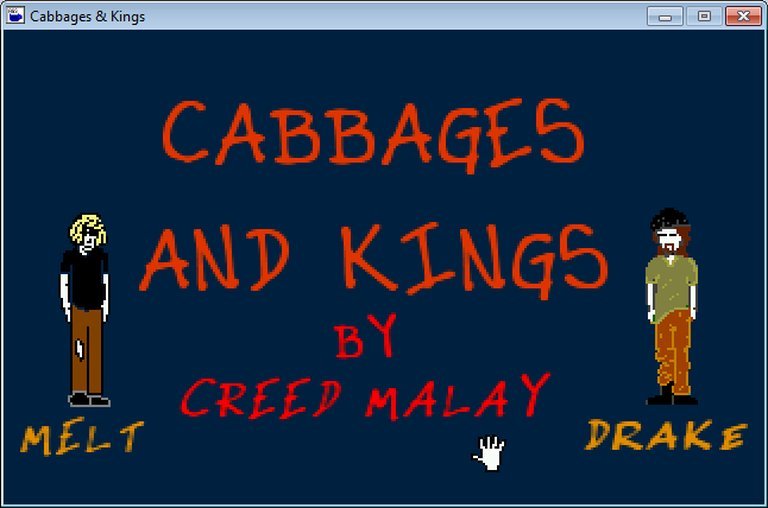
Cabbages and Kings is a classic point-and-click adventure game released in 2002. Players take on the roles of Melt and Drake, two friends struggling to pay rent to the nefarious Baron Wolfgang. The game involves exploring a town, interacting with its inhabitants, and collecting items to uncover the Baron’s evil plans while finding the money needed to pay rent. The game is part of the Reality-on-the-Norm series and has a sequel titled Kittens & Cacti.
Cabbages and Kings Reviews & Reception
forums.matrixgames.com : I like the game very much and enjoy it greatly.
Cabbages and Kings: A Quirky Relic of the Early Indie Adventure Boom
Introduction
In the early 2000s, as the gaming industry pivoted toward 3D blockbusters, a quiet revolution was brewing in the corners of indie development. Cabbages and Kings (2002), a whimsical point-and-click adventure by Davy Stedham (aka Creed Malay), emerged from this landscape as a love letter to the genre’s golden age. Though overshadowed by commercial giants, the game carved out a niche with its absurdist humor and DIY charm, embodying the creative spirit of Adventure Game Studio (AGS)-fueled projects. This review argues that Cabbages and Kings is a culturally resonant artifact—a flawed but earnest indie gem that reflects the era’s technological constraints and narrative ambition.
Development History & Context
The AGS Revolution and Indie Ingenuity
Developed using Chris Jones’ Adventure Game Studio (AGS), Cabbages and Kings was born from a toolkit that democratized game creation in an era before Unity or Unreal Engine. AGS, while limited to 2D sprites and rudimentary scripting, empowered small teams like Stedham’s to craft narrative-driven experiences. Released in July 2002, the game arrived alongside a wave of AGS titles (Ben Jordan: Paranormal Investigator, 5 Days a Stranger) that revitalized the adventure genre.
A Trilogy Unfulfilled
Part of the Reality-on-the-Norm series—a loosely connected universe including Intergalactic Life 2.0 (2002) and Mika’s Surreal Dream (2002)—Cabbages and Kings was envisioned as the first chapter of a trilogy. Its sequel, Kittens & Cacti, never achieved the same visibility, leaving Melt and Drake’s saga incomplete. This unfulfilled ambition mirrors the struggles of many indie devs in an era before digital storefronts provided sustainable platforms.
Narrative & Thematic Deep Dive
A Satirical Romp Through Absurdity
The game follows penniless roommates Melt and Drake as they scramble to pay rent to the scheming Baron Wolfgang, uncovering his “evil plans” along the way. The narrative revels in absurdity: dialogue brims with slapstick humor and meta-jokes, while the cast of townsfolk—implied to be eccentric by the game’s comedic label—likely serves as caricatures of small-town politics.
Of Cabbages and Capitalism
The title, borrowed from Lewis Carroll’s The Walrus and the Carpenter, hints at themes of economic disparity and bureaucratic farce. Baron Wolfgang embodies predatory landlordism, while Melt and Drake’s desperation mirrors early-2000s anxieties about precarious living. Though lacking in depth, the story’s satire echoes contemporaries like Monkey Island but with a distinctly lo-fi edge.
Gameplay Mechanics & Systems
Classic Point-and-Click, Warts and All
As a “classic icon-based adventure,” Cabbages and Kings adheres to genre staples:
– Inventory puzzles: Collect items like sealing wax (a Carroll reference) to progress.
– Dialogue trees: Conversational choices likely drive minor branching, though the linear structure suggests limited impact.
– Side-view navigation: AGS’s default perspective limits environmental immersion but streamlines interaction.
Flaws in the Formula
While functional, the game reportedly suffers from opaque puzzles and repetitive fetch quests—common pitfalls of AGS titles. The UI, though serviceable, lacks the polish of LucasArts or Sierra classics, and the lack of recorded player reviews suggests frustration may have outweighed charm for some.
World-Building, Art & Sound
A Pixelated Playground
The side-view environments, typical of early AGS games, likely feature static, hand-drawn backdrops with minimal animation. Townsfolk sprites would have been rudimentary but expressive, leaning into exaggerated expressions for comedic effect.
Soundscapes of Silence
No specifics exist about the soundtrack, but contemporaneous AGS titles relied on MIDI tunes or cheeky sound effects. The absence of voice acting—a budget-driven choice—forces the writing to carry the humor, a risky bet given the hit-or-miss nature of indie comedy.
Reception & Legacy
A Forgotten Footnote
Despite its ambitions, Cabbages and Kings left little mark on release. MobyGames lists no critic or player reviews, and its sequel’s obscurity suggests minimal commercial traction. Yet its existence matters: the game exemplifies the AGS community’s DIY ethos, paving the way for later indie darlings like Gemini Rue or Primordia.
Influence on the Indie Landscape
The game’s use of public-domain literary references presaged titles like Alice Is Dead, while its focus on rent-related trauma eerily foreshadows modern hits like Night in the Woods. Though mechanically unremarkable, it stands as a testament to the creativity unleashed by accessible tools like AGS.
Conclusion
Cabbages and Kings is neither a masterpiece nor a tragedy—it’s a time capsule. Its janky systems and incomplete trilogy speak to the limitations of its era, but its humor and heart capture the rebellious spirit of early indie development. For historians, it offers a glimpse into a pivotal moment when bedroom coders kept the adventure genre alive. For players, it’s a curiosity best appreciated as a labor of love, warts and all. In the pantheon of video game history, it earns a modest but deserving place: a cabbage among kings.