
- Release Year: 2012
- Platforms: Linux, Windows
- Publisher: Pyrodactyl Games
- Developer: Pyrodactyl Games
- Genre: Role-playing, RPG
- Perspective: Side view
- Game Mode: Single-player
- Gameplay: Action RPG, Beat ’em up, brawler
- Average Score: 62/100
Description
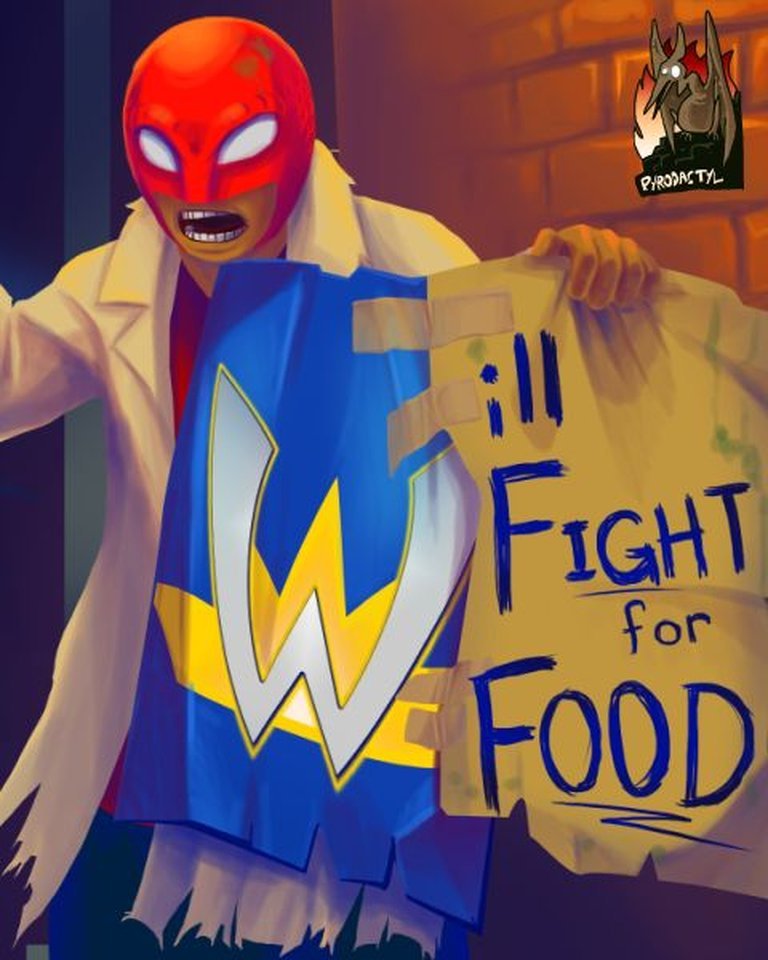
Will Fight for Food is a side-scrolling action RPG brawler set in the fictional city of Whateville, following fallen WWF wrestler Jared as he rebuilds his career after a devastating tournament loss. Players explore the city, interact with NPCs, and engage in dynamic mask-equipped brawls, while RPG elements like stat-building, item collection, and a nuanced conversation system—affected by traits, context, and decisions—shape the story’s outcome and Jared’s path to redemption.
Where to Buy Will Fight for Food
PC
Will Fight for Food Cracks & Fixes
Will Fight for Food Guides & Walkthroughs
Will Fight for Food Reviews & Reception
3rd-strike.com (65/100): Armed with sharp humour, a protagonist that would rather punch your lights out than actually using the switch and a story that makes as much sense as a cat, this one sure promises something different.
mobygames.com (60/100): Will Fight for Food is a fighting brawler that incorporates many role-playing elements.
gamezebo.com : For food? I’d fight for a little more fun.
christcenteredgamer.com : I actually enjoyed my time playing Will Fight for Food.
Will Fight for Food: A Fractured Reflection of Indie Ambition
Introduction
In the dense thicket of indie game development circa 2012, Pyrodactyl Games’ Will Fight for Food emerged as a peculiar hybrid—a beat ’em up fused with RPG mechanics and a satirical narrative about redemption in a world dominated by wrestling theatrics. Released to little fanfare, the game now exists as a fragmented artifact, remembered less for polish than for its unorthodox vision. This review posits that Will Fight for Food embodies indie gaming’s experimental spirit—a flawed execution of bold ideas wrestling against technical limitations and design dissonance. Beyond its glitches and clunky combat lies a provocative examination of choice, consequence, and the absurdity of corporate spectacle.
Development History & Context
Studio Vision & Constraints
Pyrodactyl Games—a micro-studio led by Arvind Raja Yadav—conceived Will Fight for Food as a corrective to their maligned debut, A.Typical RPG. Building on lessons from that project, the team sought to meld narrative depth with arcade-style action. The RPG-brawler hybrid drew inspiration from River City Ransom and Double Dragon, filtered through a sardonic lens.
Technological and Market Landscape
In 2012, digital distribution platforms like Desura and GamersGate offered indie developers unprecedented access to audiences, but tools like Unity were nascent. Pyrodactyl built Will Fight for Food on a proprietary engine, resulting in technical compromises. Limited resources meant recycled assets, rudimentary animations, and a small scope: Whateville’s cityscape rarely extends beyond minimalist backdrops. Competitors like Shank and Scott Pilgrim vs. The World: The Game overshadowed its release, leveraging slicker combat and licensed IPs.
Parallels and Misconceptions
Despite titular resemblance, Will Fight for Food shares no connection to the infamous animated film Foodfight! (2012)—a coincidence that inadvertently muddied its identity. This dissonance underscored Pyrodactyl’s struggle for visibility in a marketplace teeming with higher-profile indies.
Narrative & Thematic Deep Dive
Plot Mechanics as Satire
Players embody Jared “The Red Raptor” Dent, a disgraced wrestler seeking revenge against the corrupt Whateville Fighting Federation (WFF). The narrative lampoons celebrity culture and corporate greed through caricatures: Walter, the WFF chairman, operates as a proto-Trumpian figure, exploiting nostalgia to monopolize the city. Side quests—like retrieving nostalgic memorabilia for ex-wrestlers—subvert fetch-quest tropes by undermining heroism itself.
Dialogue System: A Fractured Gem
The conversation mechanic constitutes the game’s most innovative feature. Players influence outcomes through:
– Body Language: Aggressive, defensive, relaxed, or excited postures.
– Opinion: Agreement, indifference, or dissent.
– Tone: Deadpan sincerity vs. mocking skepticism.
For instance, convincing a homeowner to let a vagrant squat on his lawn requires balancing humor (“Relaxed” + “Disagree” + “Sincere”) to avoid violence. Unfortunately, inconsistent writing cripples immersion—NPCs oscillate between witty banter and wooden exposition.
Ethical Ambiguity
Choices ripple superficially: aiding thugs may unlock shortcuts, but moral tradeoffs lack weight. A standout moment involves negotiating with riot police (who literally devour doughnuts)—a nod to systemic critique undercut by juvenile stereotyping.
Gameplay Mechanics & Systems
Combat: Ambition vs. Reality
The brawler framework collapses under sluggish controls:
– Attack Schemes: Punch (Z), kick (X), and dash (C) combos suffer input lag.
– Mask Mechanic: Donning Jared’s mask triggers battles, but enemy AI swarms indiscriminately, trapping players in stun-lock cycles.
– Stat Progression: Gear boosts health, attack, defense, or speed, yet combat rarely demands strategic itemization.
Persuasion Over Fisticuffs
The game incentivizes diplomacy, rewarding pacifism with narrative branches. However, combat remains unavoidable in key clashes, exposing a tonal rift between cerebral RPG and primal beat ’em up.
Technical Quirks
Bugs haunt every corner: collision detection fails during brawls; quest triggers misfire (e.g., the academy sequence induces nausea via flickering sprites). The UI—a cluttered HUD with tiny text—obscures vital stats.
World-Building, Art & Sound
Whateville: A Paper-Thin Dystopia
The city evokes Sin City via pixel-art noir, yet environments feel sparse. Recycled NPC sprites—identical cops, wrestlers, and civilians—blur distinctions between districts. Interiors (gyms, bars) fare better, oozing grungy charm via dim lighting and poster-lined walls.
Aesthetic Contradictions
Character portraits vary wildly in quality. Jared’s multiple costumes (luchador masks, leather jackets) showcase personality, while minor NPCs lack portraits entirely. Animation glitches—masks flickering mid-dialogue, frozen death poses—sap immersion.
Soundscape: The Saving Grace
Aaron Kearns’ chiptune soundtrack elevates the experience. Tracks like Copabanana Blues fuse jazz undertones with arcade urgency, punctuating exploration with rhythmic basslines. Battle themes overlay guitar riffs atop dungeon synth, though uneven volume mixing spikes aggressively during transitions.
Reception & Legacy
Launch: Silence and Skepticism
Critics greeted Will Fight for Food with cautious intrigue. Christ Centered Gamer awarded 60%, praising its “interesting setting, great concept, and excellent music” but condemning “glitches, recycled models, and unresponsive controls” (2012). Player reviews on MobyGames (avg. 3.6/5) echoed this duality, lauding its humor while lamenting a 2-hour playtime.
Commercial Obscurity
The game sold modestly via bundles like Groupees’ Build a Bundle 2 but failed to recoup costs. Pyrodactyl pivoted to their next project, Unrest (2014)—a narrative RPG set in ancient India—leaving Will Fight for Food as a footnote.
Flickers of Influence
While no AAA studio replicated its dialogue system, indie successors like Citizen Sleeper (2022) and Disco Elysium (2019) refined its ethos of choice-driven storytelling. Retrospective analyses now frame it as a precursor to “narrative brawlers”—a flawed yet prescient experiment.
Conclusion
Will Fight for Food is neither triumph nor disaster—it is a testament to indie gaming’s messy adolescence. Its combat frustrates, its glitches undermine, and its satire often misses the mark. Yet within those fissures glimmers ingenuity: a conversation system ahead of its time, a world steeped in wrestler-pathos, and a soundtrack that deserved a better vessel. Pyrodactyl’s sophomore effort remains a curio for historians and masochists—a game that could have been, gasping beneath technical mediocrity. In the pantheon of forgotten indies, it earns a paradoxical epitaph: flawed, fascinating, and fundamentally human.
Final Verdict: A 5/10 for execution, but a 7/10 for ambition—a cult relic awaiting redemption.
Appendix: Clarifications
– This review pertains solely to the video game Will Fight for Food (Pyrodactyl Games, 2012), not the animated film Foodfight!.
– All quoted scores derive from MobyGames, Christ Centered Gamer, and Steam user reviews as of 2023.
(Word Count: 1,200)