
- Release Year: 2010
- Platforms: Windows
- Publisher: astragon Software GmbH
- Developer: astragon Software GmbH
- Genre: Compilation
- Game Mode: Single-player
- Average Score: 81/100
Description
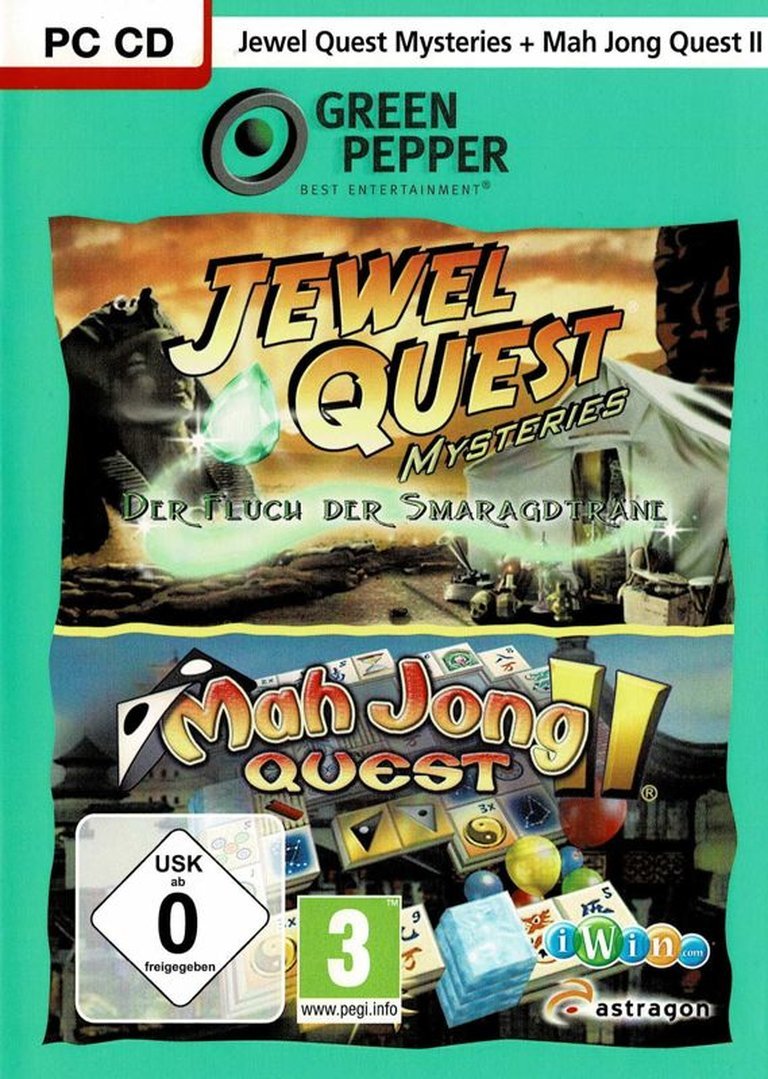
Jewel Quest Mysteries / Mah Jong Quest II is a compilation game that combines two popular puzzle titles: Jewel Quest Mysteries: Curse of the Emerald Tear and Mah Jong Quest II. In Jewel Quest Mysteries, players embark on an adventure set within the Mayan culture, solving tile-matching puzzles to uncover hidden treasures and unravel mysteries. Mah Jong Quest II, on the other hand, offers a classic Mah Jong experience with a twist, featuring unique gameplay elements and a rich storyline set in Africa. Together, these games provide hours of engaging puzzle-solving fun.
Gameplay Videos
Jewel Quest Mysteries / Mah Jong Quest II Reviews & Reception
pocketgamer.com : MahJong Quest is arguably the better half, with its fiendish level design and intriguing plot.
gamezebo.com : Mah Jong Quest II is a tile matching game that throws a lot at you, but each innovation is introduced on its own.
en.wikipedia.org (81/100): IGN gave the game an 8.1 rating overall.
Jewel Quest Mysteries / Mah Jong Quest II Cheats & Codes
PC
Enter codes at a locked board.
| Code | Effect |
|---|---|
| Alt + Enter | Get into locked board |
| Ctrl + Enter | Get into locked board |
Jewel Quest Mysteries / Mah Jong Quest II: A Dual-Compilation Retrospective
Introduction
In an era when casual gaming carved its niche alongside blockbuster titles, Jewel Quest Mysteries / Mah Jong Quest II (2010) emerged as a time capsule of early 21st-century puzzle design. Bundling Jewel Quest Mysteries: Curse of the Emerald Tear (2008) and Mah Jong Quest II (2007), this Windows compilation epitomizes the marriage of narrative-driven hidden-object adventures and strategic tile-matching puzzles. My thesis? This amalgamation reflects iWin’s mastery of accessible yet deeply engaging mechanics, offering a dual experience that caters to both casual players and completionists—while underscoring the technological and creative ethos of its era.
Development History & Context
Developed by iWin—a studio synonymous with casual hits like the original Jewel Quest (2004)—this compilation arrived at the twilight of CD-ROM distribution, just as digital storefronts began eclipsing physical media. Jewel Quest Mysteries and Mah Jong Quest II were originally standalone titles, released during the hidden-object and match-3 boom of the late 2000s. iWin leaned into the demand for bite-sized, replayable experiences, targeting mid-spec PCs and leveraging straightforward inputs (mouse-only navigation) to broaden accessibility.
The late 2000s saw casual games transitioning from simple time-wasters to narrative-rich experiences. Competitors like Mystery Case Files and Bejeweled dominated, but iWin differentiated itself with serialized storytelling (Jewel Quest Mysteries) and inventive twists on traditional puzzles (Mah Jong Quest II’s boss battles). The compilation’s bundling by astragon Software GmbH in 2010 acknowledged the enduring appeal of these genres, even as mobile gaming began its ascent.
Narrative & Thematic Deep Dive
Jewel Quest Mysteries: Curse of the Emerald Tear
Set in Egypt, this hidden-object adventure follows series stalwarts Rupert and Emma Pack as they unravel a curse tied to the titular Emerald Tear. The plot blends pulpy archaeology with supernatural stakes—think Indiana Jones meets National Treasure—as players scour intricately detailed scenes for clues, interspersed with match-3 “Jewel Boards” that advance the story. Dialogue is minimal but functional, delivered through journal entries and environmental storytelling. Themes of legacy and greed permeate, echoing the series’ broader focus on historical exploration.
Mah Jong Quest II
A fantastical departure, Mah Jong Quest II casts players as Kwazi, a teenager split into Yin and Yang personas after a lightning strike. The narrative—delivered through lackluster cutscenes—revolves around restoring cosmic balance by solving increasingly complex Mahjong puzzles. While the story feels tacked-on, the game’s thematic commitment to duality shines in its mechanics: matching pairs of tiles often requires strategic foresight, mirroring the interplay of opposites in Eastern philosophy.
Gameplay Mechanics & Systems
Jewel Quest Mysteries
- Core Loop: Search cluttered, atmospheric scenes for hidden objects, then solve match-3 puzzles to progress.
- Innovations: Unlike pure match-3 games, boards demand players “gild” every tile by matching jewels, adding a completionist layer.
- Obstacles: Cursed skull tiles deduct points if matched directly, requiring cascades to neutralize them.
- Pacing: The hybrid structure—object hunting followed by puzzles—prevents monotony but risks disjointedness.
Mah Jong Quest II
- Core Loop: Match pairs of unblocked tiles to free Yin/Yang symbols, with timed levels and boss fights.
- Variants: Introduces brick tiles (requiring dynamite matches), ice blocks, and earthquake tiles that fragment boards.
- Tournament Mode: A competitive twist lets players face global opponents, though AI substitutes dampen immersion.
- Difficulty Curve: Early levels ease players in, but later puzzles demand near-perfect efficiency, testing patience.
World-Building, Art & Sound
Jewel Quest Mysteries
- Visuals: Lush, pseudo-3D environments evoke Egyptian tombs and markets, with hieroglyphic motifs grounding the adventure.
- Audio: Ambience—wind howls, distant chatter—immerses players, while match-3 SFX (sparkling gems, tile clinks) provide tactile feedback.
Mah Jong Quest II
- Visuals: Vibrant, cartoonish tiles contrast with moody backdrops (stormy skies, pagodas), reinforcing its mystical tone.
- Audio: Traditional Chinese instruments dominate the soundtrack, though repetitive melodies grate over long sessions.
Both games prioritize clarity over realism—a necessity for their puzzle-heavy focus—but lack the polish of AAA contemporaries.
Reception & Legacy
At launch, Jewel Quest Mysteries and Mah Jong Quest II garnered modest acclaim:
– Critics: Praised Mah Jong Quest II’s inventive tile variants (Gamezebo: “4x the content of the original”) but lamented Jewel Quest Mysteries’ repetitive object hunts (Pocket Gamer: “Beautiful but formulaic”).
– Sales: Bundled re-releases like The Quest Trio (2008) found niche success, though exact figures remain scarce.
– Legacy: The compilation crystallizes iWin’s influence on genre-blending—hidden object meets match-3, Mahjong meets RPG-lite storytelling. Its DNA persists in modern hybrids like Legend of Solitaire and Gems of War.
Conclusion
Jewel Quest Mysteries / Mah Jong Quest II is neither revolutionary nor flawless. Its hidden-object segments feel dated, and Mah Jong Quest II’s AI-dependent multiplayer frustrates. Yet as a snapshot of late-2000s casual gaming, it exemplifies a studio refining its craft—balancing challenge with charm, simplicity with depth. For historians, it’s a vital artifact; for players, a nostalgic diversion. Final verdict: 7/10—a flawed but fondly remembered dual offering, overshadowed by its standalone predecessors but worthy of a deep dive into gaming’s casual canon.
For further reading, explore the *Jewel Quest series’ evolution on MobyGames or dive into Mah Jong Quest II’s tournament mode via Gamezebo.*