
- Release Year: 2009
- Platforms: Windows
- Genre: Adventure
- Perspective: 3rd-person (Other)
- Game Mode: Single-player
- Gameplay: Puzzle elements
- Setting: Detective, Horror, Mystery
Description
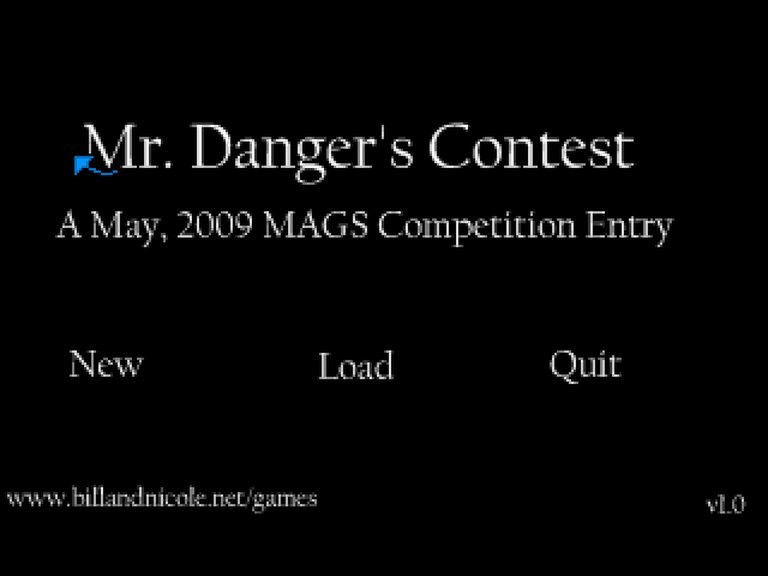
Mr. Danger’s Contest is a classic point-and-click adventure game released in 2009. Players take on the role of James McManus, a man with the unique ability to control magnetic fields, allowing him to manipulate metal objects. Invited by the enigmatic Mr. Danger, James competes in a high-stakes challenge against other special individuals, with the winner standing to gain millions of dollars. The game features a mix of puzzle-solving and detective/mystery elements, all wrapped in a horror atmosphere.
Mr. Danger’s Contest Free Download
Mr. Danger’s Contest Reviews & Reception
jd-adventuregamereviews.blogspot.com : The game does a good job of making you want to play on to see what and why things are happening, which is of course of paramount importance in any mystery story.
adventuregamestudio.co.uk : This is an entry to the May, 2009 MAGS competition. I took some time off from working on Murran Chronicles #3 to do this light hearted investigative drama/sci-fi/comedy mixture, and really enjoyed it.
Mr. Danger’s Contest: Review
Introduction
In the shadowy corners of indie gaming history lies Mr. Danger’s Contest, a 2009 freeware point-and-click adventure that blends mystery, horror, and dark humor into a compact, enigmatic package. Developed in just one month for the MAGS (Monthly Adventure Game Studio) competition, this cult classic—crafted by Bill Garrett—stands as a testament to the creativity of small-scale game development. While constrained by its short development cycle, the game delivers a gripping narrative, inventive puzzles, and a distinctly offbeat atmosphere. This review argues that Mr. Danger’s Contest is a flawed yet fascinating artifact of indie gaming’s early days, offering glimpses of brilliance amid its rough edges.
Development History & Context
- Studio & Vision: Created solo by Bill Garrett using Adventure Game Studio (AGS), Mr. Danger’s Contest was a passion project developed during a break from his Murran Chronicles series. Garrett aimed to merge investigative drama, sci-fi, and comedy, inspired by campy horror films like House on Haunted Hill (JD’s Review; AGS Forum).
- Technological Constraints: Built in AGS at 320×200 resolution (scaled to 640×400 for readability), the game’s visuals and audio were limited by the engine’s capabilities and Garrett’s self-admitted reliance on a “trusty PC microphone” for sound design (AGS Play Page; Archive.org).
- Gaming Landscape: Released in 2009, the game arrived alongside the rise of creepypasta horror (e.g., Slender Man’s debut that same year) and a burgeoning indie scene. Its freeware model and participation in MAGS reflected the era’s DIY ethos (Wikipedia; MobyGames).
Narrative & Thematic Deep Dive
- Plot: Players control James McManus, a loner with magnetic field manipulation abilities, lured to a mansion by the enigmatic Mr. Danger. Competing against other “special” individuals for a cash prize, McManus uncovers a deadly conspiracy. The story subverts B-movie tropes with sudden tonal shifts from humor to horror (JD’s Review; MobyGames).
- Characters: Despite its short runtime, the game introduces quirky contestants like a telekinetic chef and a pyrokinetic artist. However, depth is lacking—their backstories are hinted at but never explored, a casualty of the game’s brevity (JD’s Review).
- Themes: The game interrogates greed and exploitation through its deadly contest, while McManus’ isolation mirrors classic horror protagonists. Lighthearted moments (e.g., absurd dialogue) contrast sharply with grisly deaths, creating unease (AGS Forum; JD’s Review).
Gameplay Mechanics & Systems
- Core Loop: A traditional point-and-click adventure with inventory puzzles and dialogue trees. McManus’ magnetism adds a unique twist—players manipulate metal objects to solve environmental puzzles, though this mechanic feels underutilized (JD’s Review; MobyGames).
- Puzzle Design: Strengths include creative solutions (e.g., using a magnetized key to retrieve a drain plug), but flaws emerge in opaque progression. One infamous pixel hunt in a dark room frustrated players, necessitating monitor brightness adjustments (JD’s Review).
- UI/Controls: Functional but dated. The 320×200 resolution strains readability, and the cursor-based interaction lacks precision (AGS Play Page).
World-Building, Art & Sound
- Visuals: Garrett’s hand-drawn backgrounds excel in creating a claustrophobic mansion atmosphere. Moody lighting and grotesque corpse designs heighten tension, though sprite animations are rudimentary (JD’s Review; AGS Forum).
- Sound Design: A divisive element. Garrett’s DIY sound effects (e.g., metallic clangs, eerie whispers) are charmingly janky, while the discordant music—composed himself—swings between haunting and unintentionally comedic (Archive.org; JD’s Review).
- Atmosphere: The game nails a “haunted game show” vibe, blending campy dialogue with sudden violence. Its low-fi aesthetic enhances the unease, evoking analog horror before the term existed (AGS Forum).
Reception & Legacy
- Initial Reception: Praised for its narrative ambition and puzzle variety, though criticized for pixel-hunting and uneven pacing. The AGS community hailed it as a “hidden gem,” and it became one of MAGS’ most-downloaded entries (AGS Forum; JD’s Review).
- Long-Term Impact: While overshadowed by Slender Man’s cultural footprint, Mr. Danger’s Contest remains a cult favorite among AGS enthusiasts. Its blend of humor and horror influenced later indie titles like Detention and Rusty Lake (MobyGames).
- Controversies: Unlike its creepypasta contemporaries, the game avoided real-world moral panics, though its themes of manipulation resonate uncomfortably post-2014 Slender Man stabbing (Wikipedia).
Conclusion
Mr. Danger’s Contest is a time capsule of late-2000s indie gaming—a rough but earnest experiment in storytelling and design. Its magnetic protagonist, macabre humor, and inventive puzzles shine brightly, even as technical limitations and rushed execution dim their impact. While not a masterpiece, it deserves recognition for pushing boundaries within constraints, embodying the creative spirit of AGS’s golden age. For adventure fans and indie historians, it’s a compelling curiosity—a fleeting glimpse into what one developer can conjure in just 30 days.
Final Verdict: A flawed but fascinating relic, Mr. Danger’s Contest earns its place as a niche classic in the pantheon of indie horror.