
- Release Year: 2000
- Platforms: Windows
- Developer: The Code Zone
- Genre: Puzzle
- Perspective: Top-down
- Game Mode: Single-player
- Gameplay: Cards, Tiles
- Average Score: 68/100
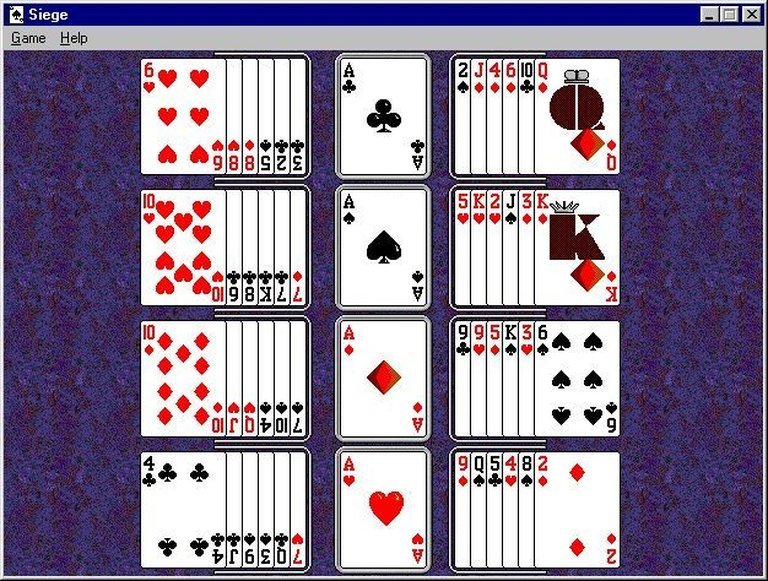
Description
Siege is a single-player solitaire card game developed by The Code Zone, where players aim to build up all cards in each suit from Ace to King on central foundations. Utilizing a standard deck, the game allows players to move single cards between outer stacks, placing them on cards numerically one higher. Featuring mouse-controlled gameplay with fixed window size, Siege includes customizable backgrounds, card backs, sound options, a one-step undo function, and in-game help screens. It was part of a larger game package frequently included in various compilation releases.
Where to Buy Siege
PC
Siege Free Download
Siege Guides & Walkthroughs
Siege Reviews & Reception
denofgeek.com : This is some of the most absorbing and team-bonding play I’ve enjoyed this year.
mobygames.com (68/100): The ability to use a wide variety of troops and the scenario editor mainly.
Siege Cheats & Codes
PC
Enter these codes while playing.
| Code | Effect |
|---|---|
| CASS | Gain $400 |
| BUDDAMUS | $500,000 dollars |
| IMACHEAT | $500,000 dollars |
| FUND | Issues a 25% bond |
| MRSOLEARY | Starts a fire |
| NOAH | Starts a flood |
| SODOM | Starts a fire storm |
| GOMORRAH | Nuclear meltdown |
| MOSES | Stops a flood |
| JOKE | Weird picture |
| GILMARTIN | Get an Army Base |
| DAMN | Residential areas rezoned to churches |
| DARN | Residential areas rezoned to churches |
| HECK | Residential areas rezoned to churches |
Windows 95
While playing a game, type one of the following codes:
| Code | Effect |
|---|---|
| priscilla | Debug menu |
| imacheat | $500,000, all rewards |
| fund | $10,000 bond at 25% interest |
| joke | Pirate Squid Club picture |
| noah | Start a flood |
| gilmartin | Receive a military base |
| cass | Gain $250 (85%) or disaster (15%) |
Windows 3.1
While playing a game, click and hold on the Toolbar and type one of the following codes:
| Code | Effect |
|---|---|
| oivaizmir | Debug menu |
| buddamus | $500,000 and all rewards |
| torg | $1 million income per year |
| joke | Pirate Squid Club picture |
| mrsoleary | Start a fire |
| noah | Start a flood |
| moses | Stop a flood |
| gomorrah | Start a nuclear disaster |
| gilmartin | Receive a military base |
| damn | Residential areas rezoned to churches |
| darn | Residential areas rezoned to churches |
| heck | Residential areas rezoned to churches |
| cass | Gain $250 (85%) or disaster (15%) |
DOS
While playing a game, type one of the following codes. Note: Some codes are version specific and may not work as stated.
| Code | Effect |
|---|---|
| vers | Display version |
| memy | Memory check |
| test | Memory test |
| joke | Pirate Squid Club picture |
| damn | Residential areas rezoned to churches |
| darn | Residential areas rezoned to churches |
| heck | Residential areas rezoned to churches |
| porn | Lose $3,000 |
| cass | Gain $250 (85%) or disaster (15%) |
Macintosh
While playing a game, type one of the following codes:
| Code | Effect |
|---|---|
| cass | Gain $250 (85%) or disaster (15%) |
| fund | $10,000 bond at 25% interest |
| joke | Pirate Squid Club picture |
| vers | Display version |
Siege: The Tactical Evolution of Modern Multiplayer Shooters
Introduction
In the pantheon of tactical shooters, few games have redefined their genre as audaciously as Tom Clancy’s Rainbow Six Siege. Since its 2015 debut, Siege has evolved from a divisive launch into a cultural touchstone, boasting over 70 million registered players by 2020 and reshaping expectations for live-service games. This review argues that Siege’s marriage of environmental destruction, asymmetric operator roles, and relentless community-driven iteration has cemented its legacy as one of gaming’s most influential multiplayer experiences—a high-stakes chess match where every wall can be a weapon and every round a lesson in adaptation.
Development History & Context
From Patriots to Siege: A Studio Reborn
Ubisoft Montreal’s journey began in turmoil. The cancelled Rainbow Six: Patriots (2011), a narrative-focused title hamstrung by technical limitations and seventh-gen consoles, left the franchise in limbo. In 2013, a skeleton team of 25 rebooted the project, drawing inspiration from real-world sieges like the 1980 Iranian Embassy standoff. Their vision? A multiplayer-centric “platform” built on tension, teamwork, and destructibility—a far cry from Patriots’ scripted set-pieces.
Technological Ambitions
The AnvilNext 2.0 engine enabled Siege’s signature RealBlast Destruction system, a procedural materials-based tearing mechanic that demanded radical level-design shifts. Walls splintered differently based on composition; shotgun blasts carved murder holes; floors collapsed into kill zones. Yet this innovation came at a cost: Early alpha tests struggled with hit detection and server stability, forcing a delay from October to December 2015 to refine the netcode.
A Crowded Landscape
Siege entered a market dominated by Call of Duty’s run-and-gun ethos and Counter-Strike: Global Offensive’s precision. Ubisoft bet big on differentiation: No respawns, no hitscan weapons, and a “Golden 3C Rules” philosophy (Character, Control, Camera) that prioritized player agency over animation locks. As creative director Xavier Marquis noted, Siege aimed to be “the opposite of a Michael Bay film“—a game where silence could terrify as much as gunfire.
Narrative & Thematic Deep Dive
The White Masks and Beyond
Siege’s launch narrative—Six (Angela Bassett) reactivating Rainbow to combat the bio-terrorist White Masks—served as a thin veil for tutorials. Yet post-launch lore expanded into a gripping geopolitical drama. Operators like Caveira (Brazilian BOPE) and Mira (Spanish GEO) weren’t just gadgets; their bios revealed interagency rivalries, moral compromises, and the human cost of counter-terrorism. The Nighthaven arc (2020 onwards) escalated tensions, with Kali’s PMC poaching operators and Deimos (a rogue Rainbow veteran) orchestrating a vendetta against commander Harry Pandey.
Themes of Loyalty and Expendability
Siege interrogates the ethics of modern warfare. The Outbreak event (2018) saw operators combating an alien parasite in New Mexico, bluring lines between bioweapon research and corporate accountability. Meanwhile, the “Program” (2019)—a public-facing training exercise—framed Rainbow as both global guardians and propaganda tools, echoing real-world debates over militarized transparency.
Gameplay Mechanics & Systems
The Loop of Tension
Matches revolve around Attackers (breachers, intel gatherers) vs. Defenders (trappers, anchor points) across modes like Bomb and Hostage. Prep phases are psychological warfare: Attackers drone-scout while Defenders fortify walls or lay ambushes. The one-life rule transforms every decision into a calculated risk—peak carelessly, and you’ll watch the round via cameras.
Operator Synergy
Each of 70+ operators (as of 2025) fills niches:
– Hibana (Attacker): X-KAIROS pellets breach reinforced walls.
– Valkyrie (Defender): Throwable CCTV cameras enable intel traps.
– Solis (2025 Defender): Scans attacker electronics through walls, countering drone spam.
Progression unlocks operators via Renown (earned in-game) or R6 Credits (premium currency). Critically, post-launch DLC operators are free through grind—a model that avoided pay-to-win backlash.
Innovation and Flaws
- Destruction: Reshaping Tower (2017) or Emerald Plains (2025) mid-round creates emergent strategies.
- UI Evolution: The “ping 2.0” system (2019) let players mark enemies contextually without comms.
- Pain Points: Early “Operation Health” (2017) admitted technical debt, fixing hit registration and server ticks. Toxic behavior spurred BattlEye bans (2016) and reputation systems (2025).
World-Building, Art & Sound
Atmosphere in Fragments
Maps like Oregon (a militia compound) and Kafe Dostoyevsky (aristocratic decay) tell stories through clutter: family photos, rotting food, and terrorist manifestos. Weather effects—snow in Chalet, sandstorms in Sand Plant—heighten tension.
Sonic Identities
Audio director Louis Philippe designed NavMode sounds: 3-armor operators (e.g., Rook) stomp loudly; 1-armor (e.g., Caveira) whisper. Guns roar with ballistically accurate bass—the V308 (Vector) staccato vs. the M590A1’s (Shotgun) thunder. Composer Ben Frost’s menu theme—a dissonant drone—hints at impending chaos.
Reception & Legacy
From Missteps to Mastery
Launch reviews lambasted Siege’s barebones content (11 maps, rampant bugs) and steep learning curve. IGN’s 2015 review noted: “A foundation waiting for a house.” Yet Ubisoft’s “games-as-a-service” pivot—free maps, quarterly operators, and pro leagues—sparked a renaissance. By 2018, PC Gamer hailed it as “the best tactical shooter ever made.”
Industry Ripple Effects
- Esports: The Six Invitational ($3M prize pools) rivaled CS:GO’s Majors, emphasizing spectator-friendly destruction.
- Game Design: Valorant and Overwatch 2* borrowed operator synergies; Battlefield 2042’s *Portal mode imitated destruction.
- Monetization: Cosmetic-only Alpha Packs (loot boxes) avoided Star Wars Battlefront II-style controversy, proving ethical microtransactions possible.
Conclusion
Rainbow Six Siege is a testament to iterative ambition—a game that turned rubble into revelation. A decade after launch, its DNA lives in every breached wall, every Mira window ambush, every gasp as a Claymore detonates. It’s not flawless (cheating scandals and balance headaches persist), yet no shooter better encapsulates the weight of combat: the knowledge that one click, one misstep, can shatter a round. In annals of multiplayer history, Siege stands as both blueprint and benchmark—a masterclass in how to listen, adapt, and demolish expectations.