
- Release Year: 2019
- Platforms: Windows
- Publisher: KMR Consulting
- Developer: KMR Consulting
- Genre: Puzzle
- Perspective: Fixed / flip-screen
- Game Mode: Single-player
- Gameplay: Cryptogram puzzles, Hints, Letter substitution, Printable puzzles, Puzzle creation
- Average Score: 80/100
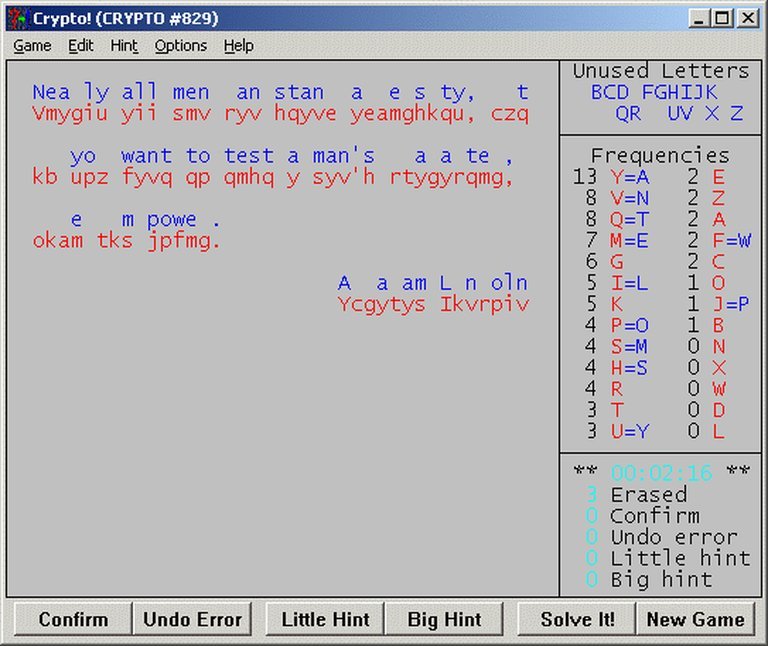
Description
Crypto! is a Windows-based puzzle game where players decrypt encrypted quotes or phrases by substituting letters, similar to traditional cryptogram puzzles found in print media. The game offers tools like letter frequency analysis, hints, and an undo function to assist in solving. Players can also create custom puzzles and print them for offline solving. With a library of 50 puzzles in the free version and over 16,000 quotes in the registered version, it provides a digital twist on classic cryptogram challenges alongside a tutorial and extensive help documentation.
Crypto! Reviews & Reception
verticalslicegames.com (100/100): The overall sentiment for Donkey Kong Bananza is overwhelmingly positive, with critics hailing it as an essential, must-have system seller for the Nintendo Switch 2.
imdb.com (60/100): A solid, mostly well-acted drama, although its slow pacing and Knapp’s one-note performance will put many viewers to sleep.
Crypto!: A Cryptogram Puzzle Game in the Digital Age
Introduction
In a world increasingly dominated by high-octane action games and sprawling open worlds, Crypto! (2019) stands as a quiet homage to a timeless puzzle tradition: the cryptogram. Developed by KMR Consulting, this Windows-based title digitizes the classic newspaper brainteaser, offering players a no-frills, focused experience centered on letter-substitution puzzles. While lacking the flash of modern indie darlings, Crypto! carves out a niche for purists seeking a meditative challenge. This review argues that Crypto! succeeds as a functional adaptation of cryptograms but falls short of innovating beyond its analog roots, delivering a retro experience that feels both comforting and conspicuously dated.
Development History & Context
KMR Consulting, a lesser-known studio specializing in pragmatic software solutions, ventured into gaming with Crypto! in 2019. The game emerged during a resurgence of interest in minimalist puzzle games, alongside titles like Sudoku Quest and Crossword Chronicles. However, unlike its contemporaries, Crypto! avoided modern gamification trends, opting instead for a stripped-down approach reminiscent of early 2000s casual games.
The technological constraints of the era—particularly the dominance of low-resolution displays and the rise of PC gaming among older demographics—shaped Crypto!’s design. Its fixed/flip-screen presentation and point-and-select interface catered to users accustomed to pre-mobile puzzle interfaces, prioritizing accessibility over flair. Released in a landscape dominated by Candy Crush Saga and The Witness, Crypto! felt like an artifact from a simpler time, appealing to cryptogram enthusiasts wary of overly complex systems.
Narrative & Thematic Deep Dive
As a puzzle game, Crypto! lacks a traditional narrative, but its library of over 16,000 quotes (in the registered version) inadvertently creates a thematic tapestry. The quotes span proverbs, literary excerpts, and pop-culture aphorisms, offering fragmented glimpses into human wisdom, humor, and hubris. While not curated to convey a coherent message, the selection occasionally resonates thematically—players might solve a puzzle only to uncover a poignant observation on perseverance or irony.
The absence of characters or dialogue confines the game’s “story” to the player’s solitary journey of decryption. Each solved puzzle becomes a micro-narrative of triumph, though the lack of contextual scaffolding leaves the experience feeling mechanically transactional rather than emotionally engaging.
Gameplay Mechanics & Systems
Crypto!’s core loop is elegantly simple:
1. Puzzle Generation: The game encrypts a quote using a substitution cipher, replacing letters with alternatives.
2. Solving Tools:
– Letter Frequency Analysis: Displays how often each character appears, a nod to cryptanalysis fundamentals.
– Hints: Reveals a single correct letter, dwindling the challenge for newcomers.
– Undo Function: Allows players to backtrack mistakes—a critical quality-of-life feature.
3. Customization: Players can create puzzles from personal phrases, adding replayability.
Strengths:
– The UI is utilitarian but effective, with clear letter grids and drag-and-drop functionality.
– The inclusion of a tutorial mitigates the learning curve for cryptogram novices.
Flaws:
– No progressive difficulty curve or scoring system, reducing long-term motivation.
– The lack of multiplayer or daily challenges limits engagement compared to modern puzzle apps.
World-Building, Art & Sound
Crypto!’s aesthetic is barebones, relying on a static screen with a muted color palette—likely to avoid distracting players during prolonged focus. Visual flourishes are nonexistent, leaning into the sterility of early Windows applications.
Sound design is similarly minimal: keystrokes produce soft clicks, and solved puzzles trigger a brief fanfare. While this austerity aligns with the game’s no-nonsense ethos, it misses an opportunity to immerse players through ambient music or thematic audio cues. The result is an experience that feels more like a productivity tool than a game.
Reception & Legacy
At launch, Crypto! flew under the radar, earning no professional reviews and minimal player feedback. Its commercial performance remains undocumented, but its niche appeal likely limited its reach. However, within cryptogram circles, it gained modest traction as a reliable digital alternative to paper puzzles.
The game’s legacy lies in its preservation of a classic puzzle format. While it didn’t inspire sequels or industry trends, Crypto! serves as a digital time capsule for a pre-mobile era of casual gaming. Its most significant contribution is the custom puzzle feature, which allowed educators and hobbyists to craft personalized challenges—a seldom-seen innovation in the genre.
Conclusion
Crypto! is a paradox: a meticulously faithful adaptation of cryptograms that feels both timeless and obsolete. Its strengths—simplicity, customization, and accessibility—are undermined by its refusal to evolve beyond its analog roots. For puzzle purists, it remains a satisfying digital toolkit, but its lack of audiovisual polish and modern gamification elements render it a relic in a genre increasingly defined by apps like Wordscapes and Monument Valley.
In video game history, Crypto! will likely be remembered as a modest footnote—a competent but unambitious tribute to a fading puzzle tradition. Its true value lies not in innovation but in its unwavering commitment to a singular vision: the quiet joy of cracking a code, one letter at a time.
Final Verdict: A functional love letter to cryptograms, best suited for nostalgia seekers and crossword veterans—but hardly essential in 2024.