
- Release Year: 2015
- Platforms: Linux, Macintosh, PlayStation 4, Windows, Xbox One
- Publisher: Question, LLC
- Developer: Question, LLC
- Genre: Action
- Perspective: 1st-person
- Game Mode: Single-player
- Gameplay: Hacking, Puzzle
- Setting: Fantasy, Futuristic, Sci-fi
- Average Score: 81/100
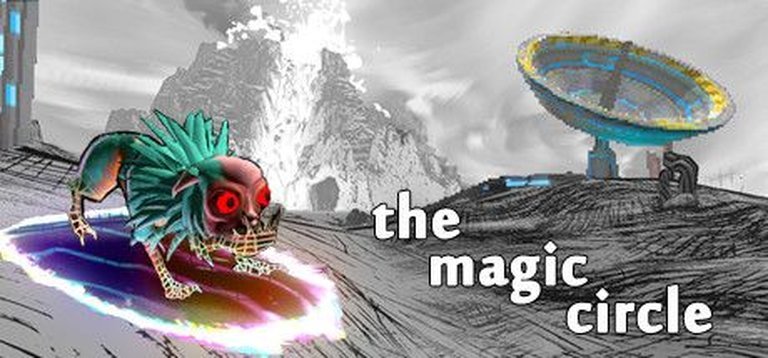
Description
In ‘The Magic Circle’, players take on the role of a QA tester exploring an unfinished fantasy game of the same name. The game serves as a meta-commentary on game development, with players overhearing developers’ arguments and discovering notes about the game’s creation. The goal is to gain power, overcome challenges, and ultimately become a development god, altering the game world at will. The game features a unique hacking mechanic, allowing players to edit and manipulate game elements to solve puzzles and explore a world with multiple solutions.
Gameplay Videos
Where to Buy The Magic Circle
PC
The Magic Circle Guides & Walkthroughs
The Magic Circle Reviews & Reception
opencritic.com (78/100): The Magic Circle is a marvelously creative, puzzling adventure that’s very mad at you.
metacritic.com (79/100): The Magic Circle is the best “broken” game you’ve ever played – and a rich satire of the industry to boot.
steambase.io (92/100): The Magic Circle has achieved a Steambase Player Score of 92 / 100.
en.wikipedia.org (80/100): The game has a score of 80 out of 100 on aggregate review website Metacritic.
ign.com (78/100): The Magic Circle is a marvelously creative, puzzling adventure that’s very mad at you.
The Magic Circle: A Meta-Masterpiece in Game Development Satire
Introduction
The Magic Circle isn’t just a game—it’s a hall of mirrors reflecting the chaos, ego, and creative turbulence of game development itself. Released in 2015 by indie studio Question, this first-person puzzle-adventure challenges players to “fix” a fictional game trapped in two decades of development hell, all while skewering industry tropes with razor-sharp wit. My thesis? The Magic Circle is a triumph of meta-commentary and systemic creativity, though its bitter critique of game culture occasionally overshadows its brilliance.
Development History & Context
Studio & Vision
Developed by Question, a trio including BioShock and Dishonored veterans Jordan Thomas and Stephen Alexander, The Magic Circle emerged from a desire to satirize the industry’s dysfunction. Thomas, disillusioned by AAA development cycles, described it as a “catharsis” for creators trapped in endless iteration. Funded via Kickstarter and released on PC and consoles (as the Gold Edition), the game mirrored its own narrative: a scrappy indie project about a scrappy indie project gone awry.
Technological Constraints
Built in Unity, the game’s minimalist aesthetic—blocky textures, monochrome landscapes—was both a stylistic choice and a necessity. The team leaned into the “unfinished” look to represent the fictional game’s incomplete state, with dynamic shifts between pixelated sci-fi segments and barren fantasy zones. Console versions later refined lighting and AI, but the core remained a scrappy ode to imperfection.
Gaming Landscape
In 2015, crowdfunding and early access were booming, alongside controversies over projects like Mighty No. 9 and Star Citizen. The Magic Circle arrived as a darkly comic response—a game about the perils of overpromising and creative indecision.
Narrative & Thematic Deep Dive
Plot & Characters
You play a nameless QA tester for The Magic Circle, a vaporware sequel to a ’90s text adventure. The game’s developers—egomaniacal auteur Ish Gilder (James Urbaniak), disillusioned pro gamer Maze Evelyn (Karen Dyer), and fan-fiction-obsessed intern Coda Soliz (Ashly Burch)—manifest as floating eyeballs, bickering over design choices. Enter The Old Pro (Stephen Russell), a rogue AI from the game’s scrapped sci-fi incarnation, who empowers you to hack the unfinished world.
Themes
– Creative Control: Ish’s god complex (“Starfather”) clashes with Maze’s cynicism and Coda’s fan-driven idealism, embodying conflicts between auteurship, commerce, and fandom.
– Player Agency: The game critiques designers who infantilize players, as you rebel by reprogramming enemies and environments.
– Development Dysfunction: Audio logs reveal toxic crunch, misplaced priorities (e.g., arguments over grass physics), and the tragedy of “forever games” trapped in iteration purgatory.
Dialogue & Tone
The writing oscillates between hilarious (Ish’s delusional rants about “narrative purity”) and poignant (Maze’s resentment of gamers who harassed her). Yet its satire sometimes veers into bitterness—a “Stop Having Fun” manifesto aimed at players and creators alike.
Gameplay Mechanics & Systems
Core Loop
The game’s genius lies in its pseudo-hacking mechanics:
1. Trap & Reprogram: Use energy to capture enemies, then edit their traits (movement, attacks, alliances).
2. Frankenstein Solutions: Combine abilities to solve puzzles—e.g., give a rock “float” and “railgun” to bridge gaps.
3. Build an Army: Command modified creatures to overwhelm obstacles.
Innovations & Flaws
– Strengths: The open-ended toolset encourages experimentation. One player might pacify foes with “group think,” while another creates fireproof flying wolves.
– Weaknesses: Late-game puzzles rely on repetitive object farming, and the lack of combat (outside minions) may frustrate action fans.
UI & Progression
The minimalist UI reinforces the “unfinished” aesthetic. A radial menu for editing creatures feels intuitive, though the map—a scribbled dev draft—can be disorienting.
World-Building, Art & Sound
Visual Design
The game’s two primary zones—a rusty spaceship and a grayed-out fantasy realm—are littered with half-built assets and developer notes. The deliberately ugly art (muddy textures, placeholder models) sells the “alpha” illusion, while dynamic shifts (e.g., zones “rendering” as you progress) dazzle.
Sound Design
– Voices: The cast delivers career-best performances, particularly Urbaniak’s unhinged Ish.
– Ambience: Glitchy soundscapes echo the broken world, while Steve Pardo’s score swells from melancholic piano to triumphant brass as you rebel.
Atmosphere
The bleak, absurd humor evokes The Stanley Parable, but with a darker edge. Overheard dev arguments (“Is ‘fun’ even a quantifiable metric?”) immerse you in the chaos.
Reception & Legacy
Critical Response
– Praise: Critics lauded its innovation (Destructoid: “A message worth hearing”) and metacommentary (IGN: “Marvelously creative”).
– Criticism: Some found the narrative heavy-handed (Rock Paper Shotgun: “Too determined to convey its message”).
– Sales: A modest ~16,500 units sold, attributed to minimal marketing.
Influence
Though not a commercial hit, The Magic Circle inspired indie devs to explore meta-narratives (There Is No Game) and systemic creativity (Baba Is You). Its IGF nomination for Excellence in Narrative cemented its cult status.
Conclusion
The Magic Circle is a paradox—a game about failure that succeeds spectacularly. Its biting satire of development culture may alienate some, but its inventive mechanics and fearless introspection make it essential for anyone who cares about games as art. A flawed masterpiece, yes, but a masterpiece nonetheless: a “magic circle” where players and creators collide, for better or worse.
Final Verdict: 8/10 – A brilliant, if uneven, ode to the chaos of creation.