
- Release Year: 2004
- Platforms: Macintosh, Windows
- Publisher: Elea Publishing
- Developer: Morgen Studios GmbH
- Genre: Adventure
- Perspective: 3rd-person
- Game Mode: Single-player
- Gameplay: Mini-games, Puzzle-solving
- Setting: Fantasy
- Average Score: 96/100
Description
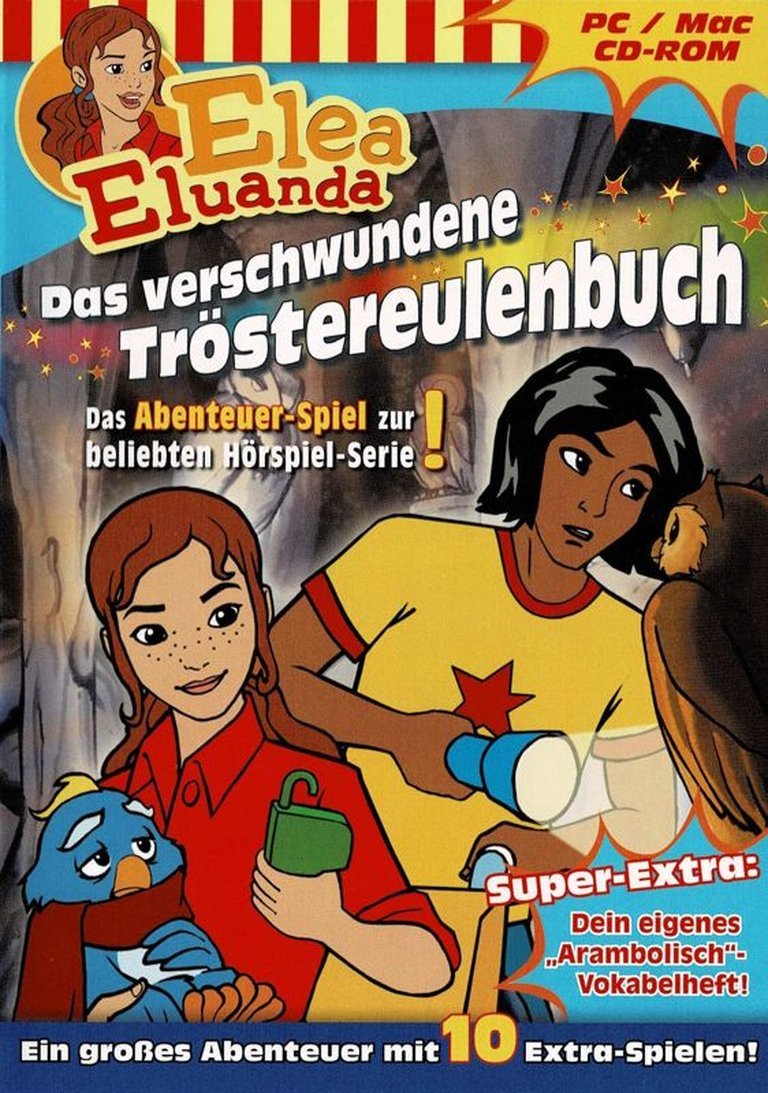
Elea Eluanda: Das verschwundene Tröstereulenbuch is a children’s fantasy adventure game where three friends—Elea, Ravi, and Ezekiel—embark on a magical quest to find a missing book containing a life-saving medicine recipe for Ezekiel. Players solve puzzles and mini-games across enchanting locations, guiding the trio through whimsical challenges to recover the cherished tome.
Elea Eluanda: Das verschwundene Tröstereulenbuch Reviews & Reception
der-hoerspiegel.de : Insgesamt ein tolles Spiel passend zur neuen Hörspielserie aus dem Hause Kiddinx. Viele einzelne Spiele in einem großen Spiel untergebracht bringen Abwechslung und Vergnügen.
Elea Eluanda: Das verschwundene Tröstereulenbuch: Review
Introduction
In an era dominated by blockbuster franchises, Elea Eluanda: Das verschwundene Tröstereulenbuch (2004) carved a quiet yet enduring niche as a whimsical, empathy-driven adventure for children. Born from the collaborative efforts of Morgen Studios and Kiddinx Entertainment, this point-and-click gem—based on the German audio drama Elea Eluanda—immersed young players in a magical quest centered on friendship and perseverance. While lacking the commercial stomp of contemporaries like Harry Potter games, Elea Eluanda remains a fascinating artifact of early 2000s European children’s media, blending educational mini-games with a heartfelt narrative. This review argues that the game’s focus on emotional intelligence, paired with its accessible design, secures its legacy as a compassionate outlier in children’s gaming.
Development History & Context
Studio Vision & Technological Constraints
Developed by Morgen Studios GmbH (known for children’s tie-ins like Benjamin Blümchen and Wendy horse adventures) and published by Elea Publishing, the game emerged during a transitional period for German family software. The early 2000s saw modest budgets for locally tailored titles, often prioritizing educational value over technical ambition. Elea Eluanda’s specs—requiring just a Pentium II 266 MHz CPU, 32 MB RAM, and a 16-bit graphics card—reflected its target audience: households with older hardware. The CD-ROM format ensured accessibility but limited visual complexity, leading the team to adopt a fixed/flip-screen 3rd-person perspective reminiscent of King’s Quest but simplified for younger players.
Creative Landscape
Narrative lead Tania Folaji (credited for Storyline & Script) and Dagmar Kolatschny (Script Editor) anchored the project in Kiddinx’s established lore, translating an episodic audio drama into an interactive adventure. This synergy between media was uncommon at the time, predating modern transmedia franchises. The game’s focus on non-violent problem-solving and emotional intelligence bucked industry trends favoring action-driven titles, positioning it closer to Putt-Putt or Pajama Sam in tone, albeit with a distinctly European flair.
Narrative & Thematic Deep Dive
Arambolian Fairytale Mechanics
The plot follows Elea, her human friend Ravi, and the ailing Ezechiel, a Tröstereule (comfort owl) from the fictional realm of Arambolien. When Ezechiel contracts an Arambolian “Eulenschnupfen” (owl cold), the trio must recover his stolen medical tome from Tante Lissy’s antiquariat. This MacGuffin hunt evolves into a journey through enchanted locales, where puzzles gate progress toward the elusive “Eulensaal” (Owl Hall).
Friendship as Gameplay
The narrative’s core theme—friendship as active labor—is mechanized through the Amigometer, a UI element tracking character moods. Players must balance tasks:
– Ezechiel needs cough drops and tissues.
– Ravi craves basketball matches.
– Tante Lissy requires help organizing books (avoid smashing her vase!).
Failures sour relationships, while successes unlock dialogue and aid. This system predates The Sims’ social dynamics but scales it to child-friendly simplicity, teaching emotional cause/effect.
Language-Worldbuilding
The game integrates Arambolisch, a constructed language, via an in-game Translator. Clicking objects reveals whimsical terms (“schwunkeldarz” = “very black”), supported by a physical vocabulary booklet included with the CD. Though superficial, this layer deepened immersion for its audience, echoing Harry Potter’s pseudo-Latin but tailored for linguistic playfulness.
Gameplay Mechanics & Systems
Mini-Game Anthology
The core loop interweaves exploration with 10 distinct mini-games, ranging from classics like Käsekästchen (tic-tac-toe) and 4-gewinnt (Connect Four) to original creations:
1. Capoplayoni: A cup-and-ball memory challenge.
2. Fliegende Post: A tile-matching postal delivery game.
3. Bandito: A reflex-based shooting gallery (sans violence).
4. Euloteespiel: A lotto-style number puzzle.
These games scaffold difficulty—early puzzles teach logic, while late-game mazes test spatial reasoning—but reviews noted occasional spikes in challenge (e.g., labyrinth navigation).
UI & Accessibility
The Universator, a diegetic control panel voiced by series narrator Lutz Mackensy, allows players to:
– Access inventory
– Adjust volume
– Replay cleared mini-games
– Request hints
Navigation uses point-and-select controls, avoiding complex inputs. While praised for clarity, the fixed camera angles occasionally obscured interactable objects, requiring trial-and-error clicks.
World-Building, Art & Sound
Visual Charm & Limitations
Artists Marieta Elenkova and Petja Popova crafted a storybook aesthetic, blending hand-drawn 2D backgrounds with simple animations. Key locations—Elea’s cluttered bedroom, Tante Lissy’s cozy shop—burst with pediatric detail: stuffed animals, doodled posters, and Ezechiel’s oversized ceramic residence. However, technical constraints resulted in low-resolution textures and limited animation frames, aging poorly against 3D contemporaries.
Audio Identity
Voice acting—led by Giuliana Jakobeit (Elea) and Gerrit Schmidt-Foß (Ezechiel)—elevated the experience, lending authenticity to Folaji’s dialogue. The soundtrack mixes light orchestration with ambient woodland sounds, reinforcing the fairy-tale mood. Standout tracks include the melancholic “Eulensaal” theme, using flute melodies to evoke mystery.
Reception & Legacy
Commercial & Critical Performance
Launching to little fanfare outside Germany, Elea Eluanda earned positive but niche reception (Amazon.de: 4.8/5 from 8 ratings). Parents praised its “wholesome” focus and educational value (“teaches logic and empathy,” per kugelmotte), while children adored Ezechiel’s humorous sneezes. However, professional reviews were scarce; MobyGames lists no critic scores, underscoring its obscurity.
Industry Impact
The game’s legacy is twofold:
1. Niche Cult Status: A beloved artifact among German millennials, often recalled for its Amigometer mechanic and Arambolian lore.
2. Kiddinx’s Educational Blueprint: The studio reused its mini-game framework in later titles like Benjamin Blümchen: Das große Zoofest, cementing a template for low-risk children’s adventures.
While not revolutionary, it demonstrated how licensed games could enrich source material rather than dilute it—a lesson franchises like LEGO Harry Potter later embraced.
Conclusion
Elea Eluanda: Das verschwundene Tröstereulenbuch is a time capsule of early 2000s European children’s design: technically modest yet brimming with sincerity. Its integration of emotional storytelling, linguistic play, and mini-game pedagogy offered a rare blend of education and enchantment, albeit hampered by budgetary limitations. While undeniably eclipsed by flashier titles, its focus on friendship as interactive labor remains a quietly radical statement. For historians, it exemplifies a pre-F2P era when kids’ games prized tenderness over tactics—a “Tröstereule” in a industry increasingly allergic to solace. Final Verdict: A minor classic, worth preserving for its compassionate vision of play.