
- Release Year: 1997
- Platforms: Windows
- Publisher: Project Two Interactive BV
- Developer: Aqua Pacific Ltd.
- Genre: Action
- Perspective: Behind view
- Game Mode: Single-player
- Gameplay: Aviation, Flight, Shooter, Vehicular
- Setting: World War I
- Average Score: 34/100
Description
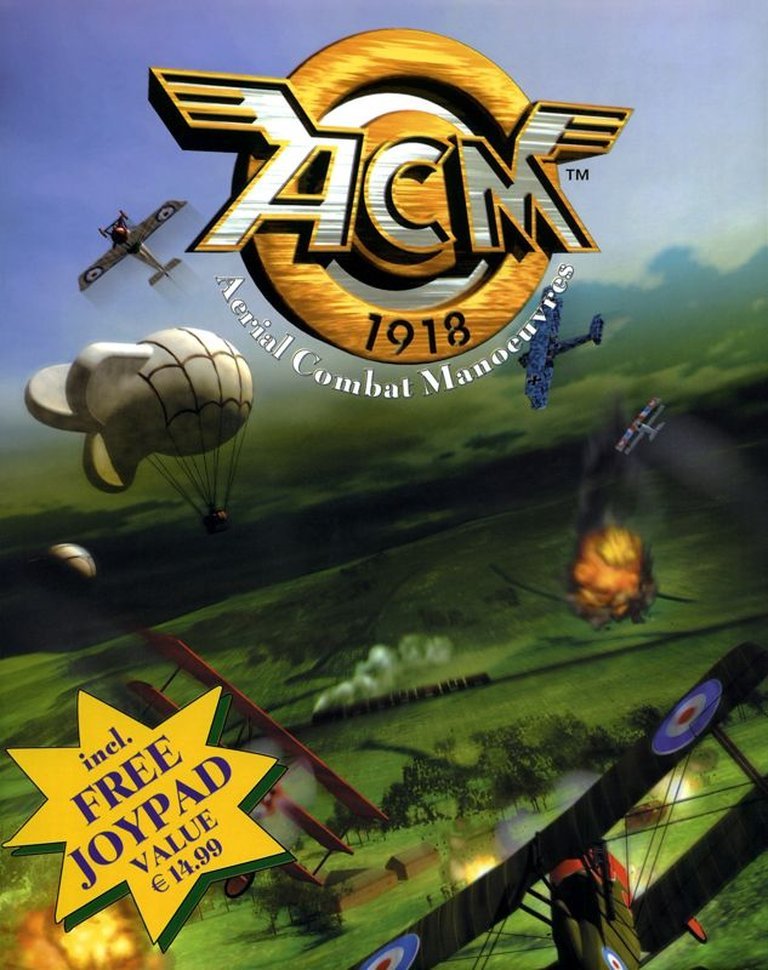
Set in the final year of World War I, ‘ACM 1918: Aerial Combat Manoeuvres’ is an arcade-style flight shooter where players choose from four cartoonish pilot characters to fly iconic biplanes like the Fokker DR1 Triplane and Albatross D-III. Engaging in 20 missions across a 3D third-person perspective, players perform bombing runs, aerial stunts, and target-based objectives to earn medals, with training missions introducing core mechanics like flying through hoops and precision bombing.
ACM 1918: Aerial Combat Manoeuvres Free Download
ACM 1918: Aerial Combat Manoeuvres Reviews & Reception
mobygames.com (34/100): A triumphant return to form for the series.
ACM 1918: Aerial Combat Manoeuvres Cheats & Codes
PlayStation Version
Hold R1 + Circle before entering a loading screen to activate the secret cheat input screen.
| Code | Effect |
|---|---|
| Down, Circle, Triangle, Triangle, Triangle, Circle, Triangle, Circle, Triangle, Circle + Triangle | Grants 999,999,000 credits |
| Up, Down, Left, Right, Up, Down, Left, Right, R1 | Enemy color for player aircraft |
| Start (x10), R1 | Enemy color for wingmen aircraft |
| Left, Right, Left, Right, Down, Up, Down, Up, Triangle, Triangle, Triangle | Selectable enemy color in 2 Player Mode |
| Up, Left, Down, Right | Activates secret mini-game |
| Triangle + Start | Skips Mission Overview |
| L1 or R1 (while paused) | Removes subtitles (Japanese version only) |
ACM 1918: Aerial Combat Manoeuvres: A Requiem for Ambitious Mediocrity
Introduction
Like a biplane sputtering through flak-filled skies, ACM 1918: Aerial Combat Manoeuvres arrived in 1997 with a blend of earnest ambition and technical limitations. Marketed as an “arcade-style flight sim shoot ’em up,” this Windows title—developed by the obscure Aqua Pacific Ltd. and published by Project Two Interactive—promised to immerse players in the daring exploits of World War I fighter pilots. Yet its legacy remains shrouded in the fog of critical neglect and commercial obscurity. While dismissed by contemporary reviewers as a shallow After Burner clone with cardboard-thin mechanics, ACM 1918 offers modern historians a fascinating case study in how budget-tier developers navigated the nascent 3D gaming landscape. This review argues that despite its flaws, ACM 1918 inadvertently preserves the awkward adolescence of flight simulators caught between arcade immediacy and simulation depth.
Development History & Context
A Studio in the Shadows
Operating from the UK, Aqua Pacific Ltd. left few fingerprints on gaming history outside this title. The development team, led by programmers Iain Nolan and Jon Howard, aimed to capitalize on two late-1990s trends: the renaissance of World War I media (spurred by films like Flyboys) and the public’s growing appetite for accessible 3D action games. However, Aqua Pacific lacked the resources of contemporaries like Dynamix (Red Baron) or Microsoft (Combat Flight Simulator).
Technological Turbulence
Released at the dawn of DirectX 5.0 and 3D accelerator adoption, ACM 1918 relied on software rendering, resulting in crude polygons and texture warping that even contemporary critics deemed “traurig” (pathetic). Project Two Interactive’s decision to bundle a budget gamepad—touted as a selling point in marketing—failed to mask the game’s mechanical simplicity. The studio’s ambition to deliver “over 20 missions” and 12 aircraft (including the Fokker Dr.I and SPAD S.XIII) strained against engine limitations, reducing its environments to featureless skies and blocky terrain.
Market Landscape
1997 was a watershed year for flight games: Gran Turismo redefined vehicular physics on consoles, while Falcon 4.0 catered to hardcore sim enthusiasts. ACM 1918 occupied an awkward middle ground—too arcadey for sim purists, too janky for casual players—and sank without trace amidst giants.
Narrative & Thematic Deep Dive
A Sketch of Heroism
ACM 1918 dispenses with narrative nuance. Players select one of four cartoonish pilots (nationalities implied but never explored) to undertake 20 missions across Belgian and French skies. Objectives include dogfighting, bombing runs, and reconnaissance—all framed as isolated vignettes without overarching context.
Themes of Futility
Beneath its colorful façade, the game unintentionally mirrors the desolation of trench warfare. Dialogueless and devoid of characters, its repetitive sorties evoke the existential grind of aerial combat: a circus of death with no ideological stakes. The sole “progression” comes via medals awarded for mission completion—a hollow replication of military honor that feels as meaningful as participation trophies.
Historical Irony
While boasting authentic aircraft models, ACM 1918 reduces the Great War’s aerial theater to a carnival shooting gallery. Missions lack historical context (no Battle of Verdun or Red Baron lore), reducing the conflict to a backdrop for target practice. The game’s PG-12 approach sanitizes war’s horrors, contrasting sharply with later titles like Verdun: 1914-1918.
Gameplay Mechanics & Systems
Control Simplicity as a Double-Edged Sword
ACM 1918’s most praised feature was its accessibility. Using just four buttons for flight (pitch, roll, throttle, brakes) and one for firing, it mirrored arcade cabinets rather than flight sticks. Dutch magazine Power Unlimited (2/10) noted: “No flight lessons, extra buttons, or special movements—just shoot until your MG overheats.”
A Loop of Repetition
The 20 missions—bookended by mandatory training sessions involving flying through hoops—fail to innovate. Objectives recycle ad nauseam: bomb X targets, defend Y convoy, photograph Z location. Enemy AI follows predictable flight paths, reducing dogfights to turkey shoots. With no damage modeling (planes explode after arbitrary hit counts) or fuel/ammo management, strategy evaporates.
Underbaked Systems
– UI & Feedback: A confusing HUD obscures critical data like altitude and target distance.
– Progression: Unlocking medals carries no tangible benefits.
– Difficulty Balancing: Sudden enemy spawns create artificial challenge.
German outlet PC Player (18/100) summarized: “After ten minutes, the game loses all appeal.”
World-Building, Art & Sound
Visuals: Ambition vs. Execution
ACM 1918’s 3D environments aspire to grandeur but deliver melancholy. The behind-view perspective showcases chunky, low-poly planes with rudimentary animations, while terrain resembles green-and-brown felt draped over wireframes. Weather effects are nonexistent; clouds are static sprites.
Sound Design: A Symphony of Disappointment
Reviewers universally panned the audio. The engine roar is a looped buzzsaw note, while gunfire sounds like popcorn kernels hitting tin. The soundtrack—a generic militaristic synth march—fails to evoke period atmosphere.
Saving Grace: Aircraft Models
The game’s sole artistic merit lies in its faithfully rendered biplanes. The Fokker Dr.I’s tri-wing silhouette and Albatros D.III’s distinctive tailfin suggest research effort squandered on an otherwise lazy presentation.
Reception & Legacy
Critical Carnage
ACM 1918 holds a dismal 34% average on MobyGames across four reviews:
– PC Player (Germany): “Sad graphics, sparse sound.”
– Power Unlimited: “For people with money and no taste.”
– GameStar: “Shallow novelty, wears thin fast.”
Commercial data is lost to history, but its MobyGames “collector interest” score (1.6/5) suggests minimal player impact.
Cult Reassessment
Decades later, ACM 1918 gained niche appreciation:
– Physical Media Nostalgia: eBay listings ($99 CIB) and sites like PCGamezUSA frame it as a relic of “when PC gaming was about collecting.”
– Historical Curiosity: Retro forums dissect its flawed ambition, comparing it to Aerial Combat ST (1994) as ancestor to War Thunder’s arcade mode.
– Modding Graveyard: Unlike Red Baron, no community patches exist to salvage its systems.
Industry Impact
Indirectly, ACM 1918 highlighted market saturation of budget flight titles, paving the way for mid-2000s innovators like Blazing Angels. It remains a cautionary tale about marrying complex history with minimalist design.
Conclusion
ACM 1918: Aerial Combat Manoeuvres is not a good game—but it is a revealing artifact of late-90s ambition colliding with technological growing pains. Its fumbling attempt to balance arcade thrills and historical reverence resulted in a product both naive and earnest, like a child’s crayon drawing of a dogfight. While unsalvageable as a playable experience today, its existence speaks to an era when developers could gamble on half-formed ideas without corporate oversight. For historians, it’s a vital dig site; for collectors, a curiosity; for players, a 45-minute diversion best enjoyed ironically with friends. Two stars—not for quality, but as a monument to trying something when everyone else played it safe.