
- Release Year: 2006
- Platforms: Macintosh, Windows
- Publisher: Electronic Literature Organization
- Genre: Compilation
- Perspective: Text-based
- Game Mode: Single-player
- Gameplay: Hypertext, Interactive fiction, Text-based
Description
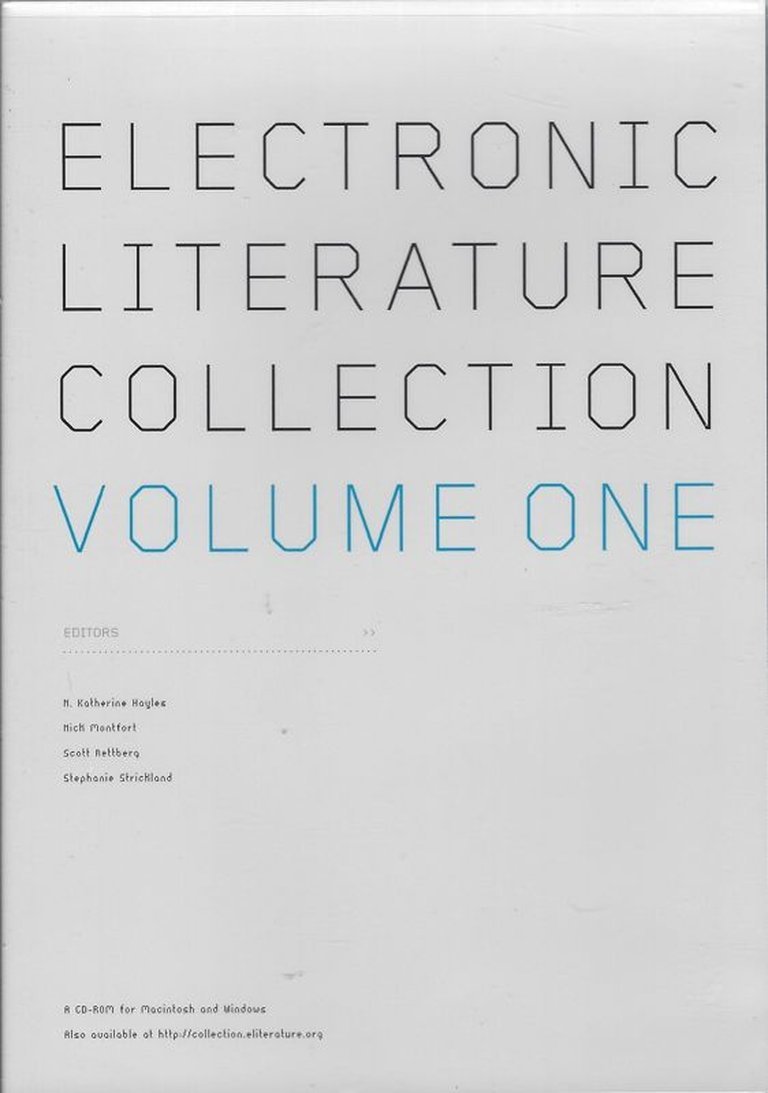
Electronic Literature Collection: Volume One is a curated anthology of indie interactive fiction, featuring a diverse range of text adventures, hypertext narratives, and experimental digital works. Published in October 2006 by the Electronic Literature Organization, the compilation includes notable pieces like Emily Short’s ‘Galatea’ and Judd Morrissey’s ‘The Jew’s Daughter,’ showcasing innovative approaches to storytelling through digital mediums. The collection highlights creative explorations of language, interactivity, and multimedia, offering a snapshot of early electronic literature’s evolution.
Electronic Literature Collection: Volume One: Review
Introduction
The digital realm has always been a wild frontier for storytelling, but few artifacts capture its early experimental spirit like Electronic Literature Collection: Volume One (ELC1). Released in October 2006 by the Electronic Literature Organization (ELO), this anthology isn’t merely a game—it’s a time capsule of digital literary innovation. At a time when hypertext fiction was evolving beyond CD-ROMs and the internet was reshaping narrative paradigms, ELC1 assembled 60 boundary-pushing works from 1994–2006 into a free, cross-platform archive. This review argues that ELC1 is not just a compilation but a foundational act of cultural preservation, cementing electronic literature’s legitimacy as both art form and academic discipline.
Development History & Context
The Visionary Studio: Electronic Literature Organization
Founded in 1999 to “promote the writing, publishing, and reading of literature in electronic media,” the ELO positioned ELC1 as a democratic counterpoint to the proprietary constraints of early hypertext platforms like Eastgate Systems’ Storyspace. Editors N. Katherine Hayles, Nick Montfort, Scott Rettberg, and Stephanie Strickland—academics and practitioners themselves—curated submissions through an open call, prioritizing works that leveraged digital affordances beyond mere digitized print.
Technological and Cultural Constraints
ELC1 emerged during a transitional era. Flash and Shockwave dominated web aesthetics, while Java applets promised interactivity but battled browser incompatibility. The collection’s hybrid release—as both a downloadable CD-ROM and web publication—reflected tensions between accessibility and preservation. Many works relied on now-obsolete plugins, a prescient acknowledgment of digital fragility. Culturally, electronic literature struggled for recognition against commercial gaming and print traditionalism, yet ELC1’s editors saw an opportunity to define a nascent canon amid the chaos.
The 2006 Landscape: A Digital Literary Renaissance
By 2006, platforms like Blogger and nascent social media democratized storytelling, while indie games like Facade (2005) blurred narrative and interactivity. ELC1 responded by showcasing forms ignored by mainstream gaming: generative poetry, parser-based interactive fiction (IF), and algorithmic “codework.” Its embrace of Creative Commons licensing underscored a commitment to open culture, contrasting with the walled gardens of corporate digital media.
Narrative & Thematic Deep Dive
Fractured Tales and Emergent Meanings
Unlike traditional games, ELC1’s works reject linearity in favor of reader-driven exploration. Consider Emily Short’s Galatea (2000), an IF masterpiece where players engage a sentient statue through conversational commands, unearthing tragic layers of myth and memory. Similarly, Judd Morrissey’s The Jew’s Daughter (2000) uses “stretchtext”—hover-triggered textual mutations—to fragment historical trauma into haunting, recombinant vignettes.
Thematically, memory, identity, and mediation dominate. In my body—a Wunderkammer, Shelley Jackson turns hyperlinks into corporeal excavations, mapping a woman’s life through interactive body parts. Donna Leishman’s Deviant: The Possession of Christian Shaw (2004) reimagines a 17th-century witch trial as a Lynchian point-and-click nightmare, where clicks distort visuals and audio to evoke psychological erosion.
Language as Plaything
Many works deconstruct linguistic stability. Brian Kim Stefans’ The Dreamlife of Letters (2000) animates alphabetized words into kinetic dances, while Jim Andrews’ Stir Fry Texts (1999) randomizes syntax to create surreal, Burroughs-esque cut-ups. Jean-Pierre Balpe ou les Lettres Dérangées (Patrick-Henri Burgaud, 2005) turns algorithmic text generation into a game, scrambling and reassembling letters to satirize authorship itself.
Gameplay Mechanics & Systems
Interface as Narrative Instrument
ELC1’s core “gameplay” lies in decoding eclectic interfaces. Dan Shiovitz’s Bad Machine (1999)—a TADS-powered IF—casts players as a malfunctioning AI parsing broken commands (“ERROR: LOVE NOT FOUND”). Talan Memmott’s Lexia to Perplexia (2000) weaponizes HTML and JavaScript into a glitchy labyrinth where cursor movements trigger cryptic neologisms (“I-terminal”) and destabilized identities.
Innovation and Frustration
While some systems enchant, others frustrate. Twelve Blue (Michael Joyce, 1996)—a hypertext web fiction—immerses users in aquatic ephemerality via threaded narratives and haptic hyperlinks. Yet its lack of clear progression can feel aimless. The collection’s technological heterogeneity is both strength and weakness: Flash-based works like Young-Hae Chang Heavy Industries’ Dakota (2002) remain crisp, while Shockwave-dependent pieces (e.g., Nio) now require emulation.
The Absence of Gamification
Notably, ELC1 avoids scoring systems or win conditions. Instead, “progress” is measured by interpretive revelation. Noah Wardrip-Fruin’s Regime Change (2003), splicing political speeches via Markov chains, rewards users who uncover satirical resonances between Bush and Hussein. This prioritization of literary experimentation over playability underscores its ethos: electronic literature is a form of critical play.
World-Building, Art & Sound
Digital Aesthetics: From Minimalism to Baroque
ELC1’s visual identity mirrors its thematic diversity. Maria Mencia’s Birds Singing Other Birds’ Songs (2001) pairs avian calligraphy with ambient field recordings, evoking Oulipian constraint as poetry. In contrast, Jason Nelson’s Dreamaphage (2003) bombards players with collaged graphics, cryptic poetry, and dissonant audio—a maximalist critique of information overload.
Soundscapes of the Unseen
Audio is often the unsung hero. Edward Falco’s Chemical Landscapes Digital Tales (2006) layers spoken word over photogrammic abstractions, while John Cayley’s windsound (1999) turns Mandarin translations into whispering, algorithmic winds. These pieces treat sound not as ornament but as structural architecture, guiding emotional cadence.
The Failures of Preservation
Some works suffer from digital decay. Reiner Strasser and M.D. Coverley’s ii—in the white darkness (2004), a Flash-based meditation on dementia, risks obsolescence as Flash fades from the web. Yet this fragility underscores ELC1’s archival urgency: it is a hedge against cultural amnesia.
Reception & Legacy
Critical Response and Academic Embrace
ELC1 wasn’t reviewed by mainstream gaming press—unsurprising given its avant-garde leanings—but became a cornerstone in digital humanities. Scholars praised its editorial rigor, with Future of the Book noting it “brought these texts back into the light” to inspire future experimentation. Criticisms centered on uneven quality and北美-centric authorship, issues addressed in later ELO collections.
Institutionalization and Influence
The anthology’s impact is profound. It legitimized electronic literature as a teachable genre, with universities adopting it for digital media courses. Its framework inspired ELC2 (2011) and ELC3 (2016), which expanded into multilingual and VR-driven works. Technically, it preserved endangered pieces like Patchwork Girl (Shelley Jackson), previously confined to proprietary Storyspace.
The Ripple Effect
ELC1’s DNA surfaces in indie games (80 Days, Kentucky Route Zero) and interactive documentaries. Its ethos—democratized creation, playful textuality—also fueled platforms like Twine, empowering marginalized voices. Yet its most enduring legacy is proof-of-concept: literature can thrive beyond the page.
Conclusion
Electronic Literature Collection: Volume One is a monument to digital storytelling’s wild adolescence. It captures a moment when artists exploited the web’s pliability to redefine narrative, challenging passive consumption with interactive complexity. While some pieces feel dated—trapped in amber by expired plugins—their collective power endures. As both archive and argument, ELC1 insists electronic literature isn’t a passing fad but a vital evolution of literary tradition. For historians, it’s indispensable; for creators, it’s a challenge: the future of narrative remains unwritten, awaiting new rebels with new lexicons.