
- Release Year: 2008
- Platforms: Windows
- Publisher: Electronic Arts, Inc.
- Genre: Compilation
- Game Mode: Single-player
- Average Score: 75/100
Description
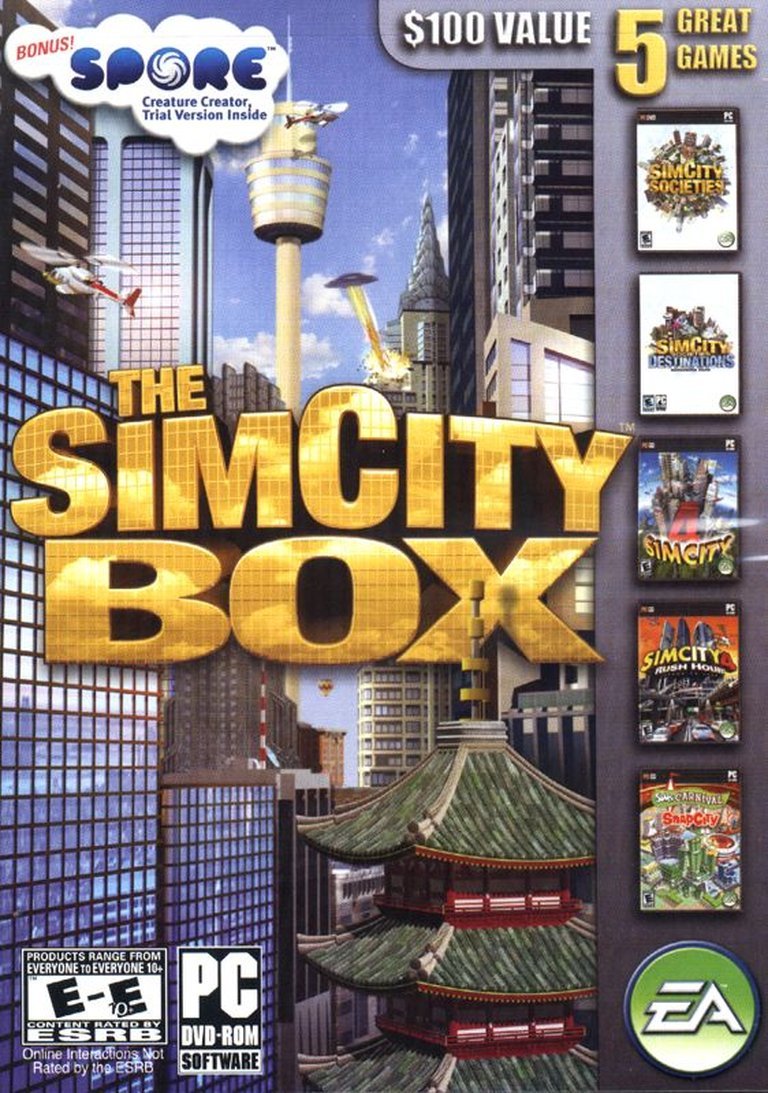
The SimCity Box is a compilation pack that offers a comprehensive introduction to the SimCity series. It includes five games: SimCity 4, SimCity 4: Rush Hour, SimCity Societies, SimCity Societies: Destinations, and The Sims: Carnival – SnapCity, along with a trial version of Spore Creature Creator. This collection is designed for fans of city-building and management simulation games, providing a broad range of experiences within the SimCity universe.
The SimCity Box Free Download
The SimCity Box Reviews & Reception
bullz-eye.com : The SimCity Box should be a cause for celebration, but it isn’t. Instead, for a number of gamers, it will be a gigantic pain in the ass that will lead to absolutely no enjoyment and hours of frustration.
gamespot.com (75/100): If you’re new to the SimCity franchise, this package is a solid introduction.
worthplaying.com : The SimCity Box is an attractive compilation of some of the most recent SimCity strategy games.
The SimCity Box Cheats & Codes
PC (SimCity 4)
During the game, hit Ctrl+Alt+Shift+X to bring up the Cheat Entry Box. Now enter one of the following and hit Enter.
| Code | Effect |
|---|---|
| weaknesspays | Adds 1,000 to your treasury. |
| you don’t deserve it | All Rewards |
| whererufrom [name] | Change City Name. Enter cityname where [name] is. |
| hellomynameis [name] | Change mayor’s name. Enter Mayor Name where [name] is. |
| fps | Displays Frame Rate |
| gol | Green Tinge on map |
| zoneria | Hides empty zone color. |
| sizeof [number] | Increase Magnification. (1-100) |
| recorder | Opens up the Animation Recorder Menu. |
| stopwatch | Pause/Resume 24-hour clock. |
| fightthepower | Removes power requirement for all buildings. |
| howdryiam | Removes water requirement for all buildings. |
| whattimeizit [time] | Set the Time of Day. Enter time where [time] is. |
| TerrainQuery [on/off] | Show coordinates when hovering over an item. |
| DollyLlama | Toggles your advisors between people/Llamas. |
| tastyzots | Toggles Zots. |
MAC (SimCity 4)
During the game push Control + X to get the Code Entry Box, then type in one of the following codes and press Enter.
| Code | Effect |
|---|---|
| weaknesspays | Adds $1000 to your treasury |
| you don’t deserve it | All Rewards |
| whererufrom [name] | Change city name, enter the new city name where [name] is. |
| hellomynameis [name] | Change mayor name, enter the new mayor name where [name] is. |
| fps | Displays frame rate. |
| whattimeizit [time] | Enter time of day, enter new time where [time] is. |
| gol | Green tinge on map. |
| zoneria | Hides empty zone color. |
| sizeof [number] | Increase magnification, 1-100 |
| stopwatch | Pause/resume 24 hour clock |
| terrainquery [on/off] | Show coordinates when hovering over an item. |
| dollyllama | Toggles your advisors between people/Llamas. |
| tastyzots | Toggles Zots. |
| fightthepower | You don’t need to have electricty anymore. |
| howdryiam | You don’t need to have water anymore. |
The SimCity Box: A Definitive Retrospective on Electronic Arts’ Ambitious Compilation
Introduction
The SimCity Box (2008) represents both a celebration and a missed opportunity for one of gaming’s most influential franchises. Bundling five entries from Maxis’ iconic city-building series—SimCity 4, Rush Hour, SimCity Societies, Destinations, and The Sims Carnival: SnapCity—this compilation aimed to offer a broad introduction to urban planning simulation. Yet, its eclectic mix of classics and divisive spin-offs highlights the franchise’s turbulent evolution under Electronic Arts (EA). This review dissects its historical context, gameplay innovations, and legacy, arguing that while the package delivers value for newcomers, its omissions and technical flaws undermine its potential as a definitive anthology.
Development History & Context
The Rise and Fall of Maxis
Developed by Will Wright and Jeff Braun in 1989, SimCity revolutionized gaming by marrying open-ended creativity with systemic depth. Maxis’ acquisition by EA in 1997 marked a turning point: while SimCity 3000 (1999) and SimCity 4 (2003) refined the formula, EA outsourced SimCity Societies (2007) to Tilted Mill Entertainment, diverging from Wright’s vision. Societies prioritized social engineering over infrastructure management, alienating purists.
A Compilation of Compromises
Released in 2008, The SimCity Box mirrored EA’s strategy of repackaging franchises for mass appeal. The inclusion of Societies and its Destinations expansion reflected EA’s push for experimental spin-offs, while SimCity 4 and Rush Hour catered to longtime fans. However, excluding earlier titles like SimCity 2000 and 3000—cornerstones of the franchise—rendered the collection incomplete. The addition of SnapCity, a Tetris-inspired puzzle game, felt incongruous, while the Spore Creature Creator trial served as mere marketing fodder.
Narrative & Thematic Deep Dive
Beyond Mayoral Tyranny
Unlike narrative-driven games, SimCity thrives on emergent storytelling. Players shape cities through zoning, disaster management, and policy decisions, echoing Wright’s fascination with systems theory and Jay Forrester’s Urban Dynamics. Societies, however, introduced overt themes: buildings reflected “social energies” like creativity or authority, transforming city-building into ideological sculpting. This shift polarized players—some appreciated its accessibility, while others lamented its shallowness.
The Illusion of Control
Beneath its cheerful veneer, SimCity critiques urban planning’s pitfalls. Tax hikes spark riots, pollution triggers epidemics, and corruption simmers—an unintentional commentary on neoliberal governance. Yet Societies sanitized these complexities, rewarding superficial aesthetics over systemic mastery.
Gameplay Mechanics & Systems
SimCity 4: The Pinnacle of Depth
SimCity 4 and Rush Hour remain the compilation’s crown jewels. The regional system allowed interconnected cities, while modular transit (subways, ferries) demanded meticulous planning. The Rush Hour expansion added traffic simulations and U-Drive-It missions, though critics noted its steep learning curve.
Societies: A Divisive Experiment
Societies replaced zoning with direct building placement, emphasizing “social values” over infrastructure. While streamlined, its AI struggled with pathfinding, and performance tanked as cities grew. The Destinations expansion doubled down on tourism but failed to address core issues.
SnapCity: A Misstep
This puzzle hybrid reduced city-building to block-matching, offering little replayability. Reviewers dismissed it as filler.
Technical Quirks
The Bullz-Eye review highlighted crippling patch issues for Societies, with crashes and hangs plaguing installations—a stark reminder of EA’s QA shortcomings.
World-Building, Art & Sound
Aesthetic Evolution
SimCity 4’s isometric 3D and orchestral soundtrack evoked grandeur, while Societies leaned into cartoonish vibrancy. Yet its cluttered UI and noisy animations strained immersion.
Sound Design
The series’ signature soundscapes—booming disasters, chirping birds—remained charming, though Societies’ whimsical score clashed with its predecessor’s gravitas.
Reception & Legacy
Mixed Reviews
Critics praised SimCity 4 but lambasted Societies’ shallowness, awarding the compilation a middling 75% (GameSpot). Players rated it 4/5 on MobyGames, though many lamented its missed potential.
Franchise Suicide
The 2013 SimCity reboot—a flawed always-online experiment—doomed Maxis and the franchise. Yet The SimCity Box inadvertently foreshadowed this decline, showcasing EA’s struggle to balance innovation with tradition.
Indie Resurrection
Paradoxically, SimCity’s decline birthed successors like Cities: Skylines (2015), which embraced the complexity EA had abandoned.
Conclusion
The SimCity Box is a flawed time capsule. While SimCity 4 and Rush Hour justify its price tag, Societies and SnapCity dilute its legacy. Its exclusion of seminal entries like SimCity 2000 and technical hiccups further diminish its value. Yet as a gateway to urban simulation’s golden age, it remains a poignant reminder of Maxis’ genius—and EA’s fumbles. For historians, it’s a cautionary tale; for players, a fragmented masterpiece.
Final Verdict: A worthwhile curio for newcomers, but veterans deserve a fuller anthology.
Legacy Score: 7/10—a half-built metropolis yearning for completion.