
- Release Year: 1983
- Platforms: Antstream, Windows, ZX Spectrum
- Publisher: Imagine Software Ltd., Pixel Games UK
- Developer: Imagine Software Ltd.
- Genre: Action
- Perspective: Fixed / flip-screen
- Game Mode: Single-player
- Gameplay: Arcade
- Setting: Dental care
- Average Score: 67/100
Description
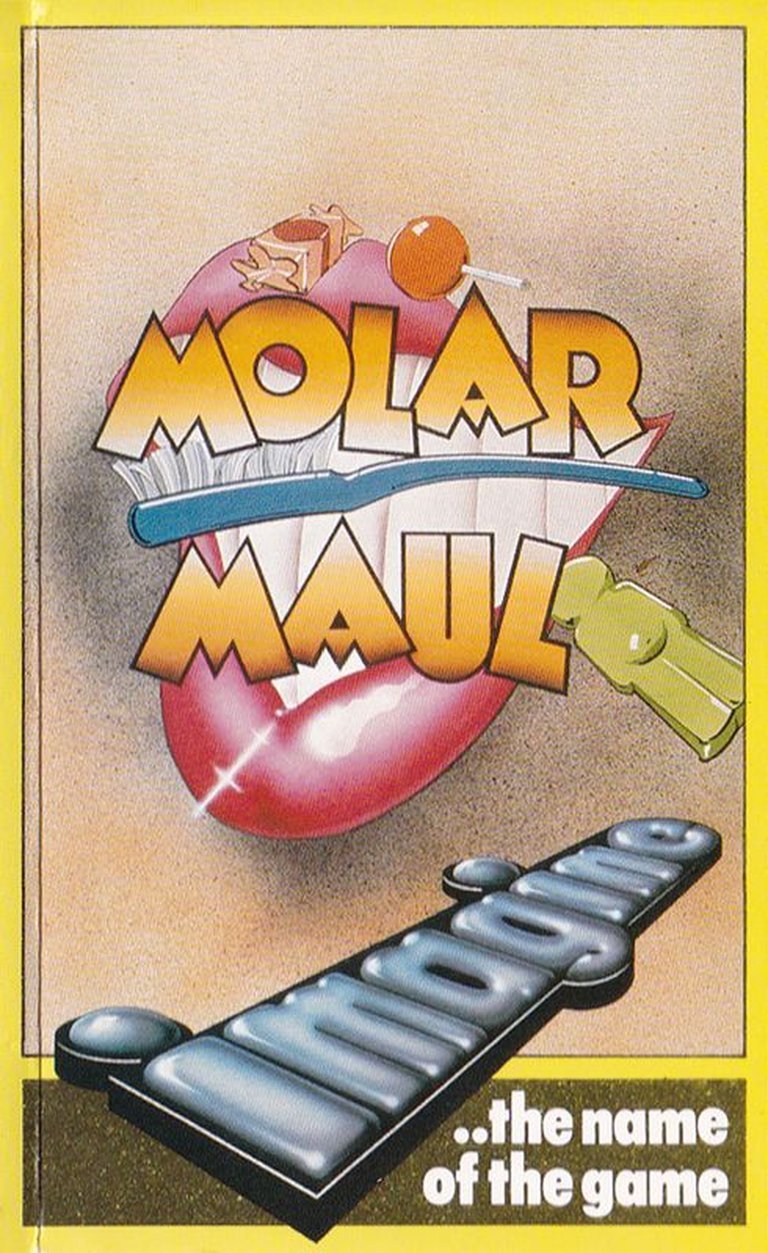
Molar Maul is a single-player arcade action game set inside an open mouth, where players combat tooth decay caused by Dentorium Kamikazium (DK) bacteria. Using a toothpaste-infused brush, players defend 32 teeth that progressively darken under attack, aiming to keep a decay score as low as possible while managing limited toothpaste supplies. Sweets trigger bacterial assaults, creating frantic gameplay where strategic brushing and swift responses determine success.
Gameplay Videos
Where to Buy Molar Maul
PC
Molar Maul Free Download
Molar Maul Reviews & Reception
mobygames.com (74/100): An excellent game with wonderful graphics
spectrumcomputing.co.uk (60/100): An excellent game with wonderful graphics
Molar Maul: Review
In the annals of video game history, few titles stand out as uniquely bizarre and culturally significant as Molar Maul. Released in 1983 for the ZX Spectrum, this action game tasked players with the peculiar mission of fighting tooth decay. Developed by John Gibson and published by Imagine Software, Molar Maul is a testament to the creativity and audacity of early game developers. This review delves into the game’s development history, narrative depth, gameplay mechanics, world-building, reception, and enduring legacy.
Development History & Context
The Studio and Creators’ Vision
Imagine Software, founded by David Lawson, was a pioneering force in the British video game industry during the early 1980s. The studio was known for its innovative and often experimental approach to game design. John Gibson, the creator of Molar Maul, joined Imagine Software after a job interview where he was challenged to write 16K of machine code in a month. Gibson, who had previously coded a game called Fly In A Bottle for the Sinclair ZX81, was tasked with creating a game that would stand out in the crowded market.
Gibson’s vision for Molar Maul was born out of a casual conversation with Lawson about a dental appointment. The idea of a game where players prevent teeth from decaying by constantly brushing them was both novel and timely, given the era’s fascination with novelty games. Gibson’s background in machine coding and his experience with the Sinclair ZX81 made him well-suited to tackle the technical challenges of developing a game for the ZX Spectrum.
Technological Constraints and Gaming Landscape
The ZX Spectrum, released in 1982, was a groundbreaking home computer that democratized gaming for a generation of British youths. Its 8-bit processor and limited graphical capabilities presented significant challenges for developers. Gibson had to work within these constraints, creating a game that was both visually appealing and mechanically sound. The lack of advanced graphics technology meant that developers had to rely on creativity and clever programming to make their games stand out.
The gaming landscape of the early 1980s was characterized by a surge in creativity and experimentation. Games like Pac-Man, Donkey Kong, and Space Invaders had captured the public’s imagination, but there was still room for innovation. Molar Maul fit into this landscape by offering a unique twist on the action genre, combining elements of strategy and arcade gameplay.
Narrative & Thematic Deep Dive
Plot and Characters
The plot of Molar Maul revolves around the battle against Dentorium Kamikazium (DK), a form of bacteria that attacks teeth. Scientists have discovered that DK appears to die but actually rejuvenates, making it indestructible. The player’s mission is to use a toothbrush and special toothpaste containing DKX 11 to clean teeth and kill the bacteria. The game’s narrative is simple but effective, providing a clear goal and a sense of urgency.
The characters in Molar Maul are minimalistic but memorable. The player controls a toothbrush, which is both the game’s protagonist and the player’s avatar. The DK bacteria are the antagonists, represented as small, menacing creatures that fly around the mouth, attacking teeth. The game’s visuals and sound design contribute to the overall atmosphere, making the player feel immersed in the battle against dental decay.
Dialogue and Themes
Molar Maul features minimal dialogue, but what little there is serves to enhance the game’s themes. The game’s instructions and in-game text emphasize the importance of dental hygiene, subtly educating players about the dangers of tooth decay. The theme of prevention is central to the game’s narrative, encouraging players to take proactive measures to maintain their dental health.
The game’s themes of hygiene and prevention are timeless, resonating with players of all ages. Molar Maul uses its unique premise to deliver a message about the importance of oral care, making it both entertaining and educational.
Gameplay Mechanics & Systems
Core Gameplay Loops
The core gameplay loop of Molar Maul involves maneuvering the toothbrush to the toothpaste tube, applying a squirt of Imagico toothpaste, and then using the toothbrush to clean the teeth under attack by DK bacteria. The game’s screen consists of an open mouth with 32 teeth, each of which changes color as it is attacked, moving from white to black if destroyed.
The player starts with three toothbrushes/lives and an unlimited supply of Imagico toothpaste. The game’s score, represented as a decay level, starts at 1,600 and decreases whenever a tooth is cleaned. The initial condition of the teeth is yellow, indicating that the player already has work to do from the start.
Combat and Character Progression
Combat in Molar Maul is straightforward but challenging. The player must navigate the toothbrush around the mouth, avoiding the DK bacteria while cleaning the teeth. The DKs are killed by contact with a loaded toothbrush, which also lightens non-black teeth. As the game progresses, sweets appear, introducing ever-larger numbers of DK, increasing the difficulty.
Character progression in Molar Maul is minimal, as the game does not feature traditional leveling or skill trees. Instead, the player’s progress is measured by the decay level, which decreases as more teeth are cleaned. The game’s challenge lies in maintaining a low decay level while managing the increasing number of DK bacteria.
User Interface
The user interface of Molar Maul is simple and intuitive. The top of the screen displays the current decay level, while the top right corner shows a green bar indicating the amount of toothpaste left in the tube. The center of the mouth features a red area where the DKs live, and below this area is the toothpaste tube. The UI is designed to be unobtrusive, allowing players to focus on the gameplay.
World-Building, Art & Sound
Setting and Atmosphere
The setting of Molar Maul is a stylized open mouth, complete with teeth, a toothpaste tube, and DK bacteria. The game’s visuals are limited by the technological constraints of the ZX Spectrum, but Gibson’s design is effective in creating a sense of immersion. The mouth is depicted in a way that is both realistic and surreal, enhancing the game’s unique atmosphere.
The atmosphere of Molar Maul is one of urgency and tension. The constant threat of DK bacteria attacking the teeth creates a sense of danger, while the need to maintain a low decay level adds a strategic element. The game’s visuals and sound design contribute to this atmosphere, making the player feel as though they are truly battling against dental decay.
Visual Direction
The visual direction of Molar Maul is characterized by its simplicity and effectiveness. The game’s graphics are limited by the ZX Spectrum’s capabilities, but Gibson’s design makes the most of what is available. The teeth, toothbrush, and DK bacteria are all clearly defined, making it easy for players to understand the game’s mechanics.
The color scheme of Molar Maul is also noteworthy. The teeth change color as they are attacked, moving from white to black if destroyed. This visual cue is an effective way of conveying the game’s progress and the player’s success or failure.
Sound Design
The sound design of Molar Maul is minimalistic but effective. The game features simple sound effects for actions such as applying toothpaste and cleaning teeth, as well as background music that enhances the game’s atmosphere. The sound effects are designed to be unobtrusive, allowing players to focus on the gameplay without being distracted.
Reception & Legacy
Critical and Commercial Reception
Molar Maul received mixed reviews upon its release. Critics praised the game’s unique premise and addictive gameplay, but some found the graphics and sound design lacking. Popular Computing Weekly gave the game a score of 90%, highlighting its addictive nature and fast-paced action. The Game Hoard, The gave it a score of 71%, noting its tactical depth and balance. Retro Gamer, however, was less enthusiastic, giving it a score of 60% and describing it as “more enjoyable than it deserved to be.”
Commercially, Molar Maul was a modest success. It was re-released on multiple platforms, including Antstream in 2020 and Windows in 2022. The game’s unique premise and addictive gameplay have ensured its enduring popularity among retro gaming enthusiasts.
Influence on Subsequent Games and the Industry
Molar Maul has had a lasting influence on the video game industry. Its unique premise and innovative gameplay mechanics have inspired countless developers to push the boundaries of what is possible in gaming. The game’s emphasis on prevention and education has also influenced the development of educational games, demonstrating the potential for games to deliver meaningful messages.
Molar Maul is often cited as an example of the creativity and innovation that characterized the early days of video game development. Its legacy serves as a reminder of the importance of taking risks and experimenting with new ideas, even in the face of technological constraints.
Conclusion
Molar Maul is a unique and enduring classic of the video game industry. Its innovative gameplay mechanics, engaging narrative, and effective world-building have ensured its place in the annals of gaming history. Despite its modest commercial success, the game’s influence can be seen in countless titles that have followed, demonstrating the power of creativity and innovation.
In conclusion, Molar Maul is a testament to the vision and talent of its creator, John Gibson, and the pioneering spirit of Imagine Software. Its unique premise, engaging gameplay, and enduring legacy make it a must-play for any retro gaming enthusiast. Molar Maul stands as a shining example of what is possible when developers push the boundaries of what is expected and embrace the spirit of experimentation.