
- Release Year: 2008
- Platforms: Windows
- Publisher: Digital Brandplay, LLC, Zero G Games, Inc
- Developer: Positech Computing Ltd.
- Genre: Simulation, Strategy, Tactics
- Game Mode: Single-player
- Gameplay: Cabinet Management, Elections, Policy Making, Political simulation, Turn-based strategy, Voter System
- Setting: American Politics
- Average Score: 60/100
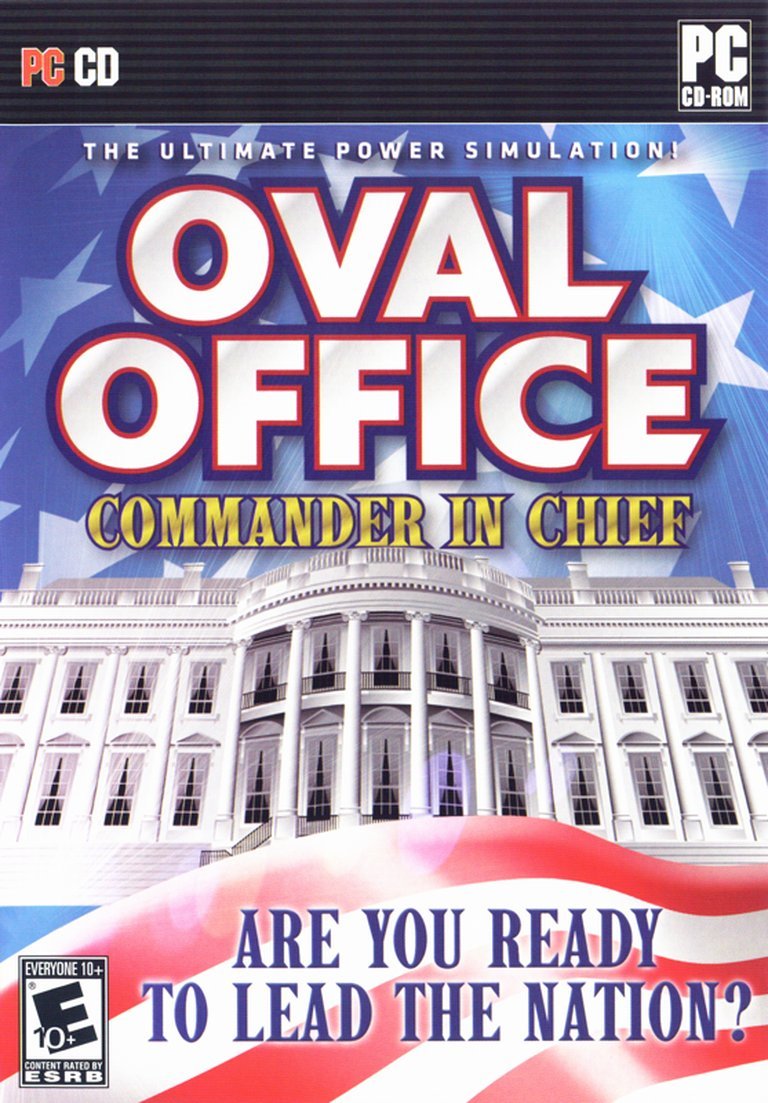
Description
Oval Office: Commander in Chief is a political simulation game where players step into the role of the U.S. President, managing policy decisions, appointing a cabinet, and balancing voter approval across diverse demographics. As a streamlined version of Democracy 2, the game focuses on American politics, requiring strategic use of political capital to enact policies that satisfy overlapping voter groups (e.g., environmentalists, smokers, or low-income citizens). Each three-month turn impacts your re-election chances, culminating in elections where maintaining over 50% voter support is critical to staying in power.
Oval Office: Commander in Chief Reviews & Reception
en.wikipedia.org (45/100): A pretty hollow attempt to cash in on the recent Presidential elections.
gamezebo.com : A comprehensive simulation of modern politics and matters of state, the game quickly wows with its detail and depth, even if the scope and difficulty will be hard for the average player to stomach.
myabandonware.com (80/100): Cloned and reskin of the Game Democracy
Oval Office: Commander in Chief: A Political Theatre of Compromise and Catastrophe
Introduction
In the annals of political simulation games, Oval Office: Commander in Chief (2008) occupies a curious niche—part earnest civic lesson, part bureaucratic masochism simulator. Developed by Positech Computing Ltd., this stripped-down iteration of the studio’s acclaimed Democracy 2 series zeroes in exclusively on the U.S. presidency, tasking players with navigating the labyrinthine demands of American governance. Released during a seismic election year (Obama vs. McCain), the game’s pitch was provocative: could it meaningfully simulate the Sisyphean balancing act of modern politics? As we dissect its systems, legacy, and limitations, one thesis emerges: Oval Office is a noble experiment in procedural storytelling, hamstrung by its own austerity and the era’s technological constraints—yet fascinating as a time capsule of pre-Trump political idealism.
Development History & Context
Studio Vision & Technological Constraints
Positech Computing, helmed by solo developer Cliff Harris, carved a reputation for niche simulations (Gratuitous Space Battles, Kudos 2) that prioritized systemic depth over polish. Oval Office emerged as a budget-friendly spin-off of 2007’s Democracy 2, itself a cult hit praised for modeling policy domino effects. Harris’ vision was pragmatic: recycle Democracy 2’s codebase to create a hyper-focused U.S.-centric experience, stripping out global politics to deepen domestic policy granularity.
Developed for Windows XP/Vista-era hardware, the game’s tech limitations were stark: Direct3D 7 rendering, 16MB VRAM minimum specs, and a UI built for 1024×768 resolutions. These constraints birthed a minimalist presentation—spreadsheet-like menus, static character portraits, and rudimentary pie charts—that prioritized functionality over flair. This was Harris’ ethos: simulations as “digital board games,” where abstracted systems trumped audiovisual spectacle.
Gaming Landscape of 2008
2008 was a watershed year for games (Grand Theft Auto IV, Braid), yet political sims remained a boutique genre. Oval Office launched alongside Civilization IV: Colonization and Spore, but its closest peer was Commander in Chief (Eversim, 2008), a broader geopolitical sim mired in inaccuracies (e.g., misrepresenting Finnish demographics). Against this backdrop, Oval Office’s U.S.-only focus was a calculated gamble—one that traded scope for intimacy.
Narrative & Thematic Deep Dive
Plot: The Eternal Campaign
Oval Office forgoes traditional narrative for emergent storytelling. As president, players face an indefinite election cycle divided into three-month turns. Your “story” is sculpted through policy decisions: deregulating Wall Street might boost GDP but spark homelessness; banning prayer in schools could energise secular voters while alienating the Religious Right.
Characters: Voter Archetypes as Protagonists
The game’s true cast is its electorate, segmented into 50+ demographic slices (e.g., “Poor Environmentalist Smokers,” “Wealthy Gun Owners”). Each group reacts dynamically to policies, their approval tethered to overlapping loyalties—a smoker might tolerate higher taxes if healthcare improves. Cabinet appointments add personality: an ineffective VP drains political capital, while a savvy Secretary of Education amplifies policy impacts.
Themes: The Cost of Power
At its core, Oval Office grapples with utilitarianism vs. ideology. Every decision consumes “political capital”—a regenerating resource tied to cabinet loyalty—forcing players to choose between bold reforms (e.g., gay marriage legalisation) and incremental tweaks. The game’s bleakest takeaway: even well-intentioned policies create losers. Subsidise green energy, and coal miners revolt; slash military spending, and hawks defect. This nihilistic undertone mirrors Harris’ view of politics as a “series of compromises where everyone hates you.”
Gameplay Mechanics & Systems
Core Loop: Policy Tetris
Each turn, players allocate political capital across seven policy domains: Economy, Welfare, Foreign Affairs, etc. Adjusting sliders—e.g., raising carbon taxes—triggers cascading effects visualized through meter fluctuations (e.g., “Air Quality ↑, Truckers’ Happiness ↓”). The genius lies in how variables intersect: legalising marijuana might boost tourism revenue but strain law enforcement.
Political Capital: The Oxygen of Governance
Scarce and slow-replenishing, political capital gatekeeps ambition. Early-game missteps (e.g., firing a disloyal cabinet member) can cripple later turns, echoing real-world political fatigue. This system excels in teaching opportunity cost—though critics argue it oversimplifies realpolitik (no backroom deals or filibusters here).
Elections: The Scoreboard
Victory hinges on maintaining >50% voter approval by Election Day. Polls update quarterly, reflecting policy impacts—but the lack of emergent events (scandals, natural disasters) renders elections predictable, a missed opportunity for drama.
UI/UX: Functional but Hostile
The interface overwhelms newcomers: nested menus, microscopic text, and a cluttered dashboard demand patience. Yet, for genre veterans, this density becomes a perverse virtue—every pixel conveys data.
World-Building, Art & Sound
Visuals: Austere to a Fault
Oval Office’s art direction is utilitarian. Static backgrounds depict a cartoonish Oval Office, while policy icons resemble clipart (e.g., a globe for Foreign Affairs). Character portraits—outsourced to Narcissistic Studios—offer fleeting personality but remain wooden versus contemporaries like The Political Machine.
Sound Design: A Whisper in the Void
Jesse Hopkins’ soundtrack loops muted piano melodies, evoking C-SPAN bleakness. Sound effects are spartan (a click for menu navigation), reinforcing the game’s “spreadsheet simulator” identity.
Reception & Legacy
Launch Reception: Niche Appeal, Critical Ambivalence
Oval Office launched to muted buzz. With no marketing budget, it relied on Democracy 2’s fanbase. Player reviews on MobyGames averaged 2.8/5 (based on one rating), while Gamezebo’s review (70/100) praised its depth but lamented its “overwhelming” complexity. The absence of major critic reviews underscored its obscurity.
Legacy: A Footnote in Political Sim History
The game’s influence is negligible compared to Democracy 2’s legacy or Paradox’s Tropico/Crusader Kings juggernauts. Yet it foreshadowed trends:
– Genre Refinement: Later titles like Reigns (2016) adopted Oval Office’s “sliders-as-narrative” approach but added whimsy.
– Educational Tool: Professors used it to teach policy trade-offs, presaging NationStates’ classroom adoption.
– Abandonware Cult: Its 34MB footprint (downloadable via MyAbandonware) endears it to retro sim enthusiasts.
Conclusion
Oval Office: Commander in Chief is a paradox: a game that excels in modelling political cause-and-effect yet fails to make that process fun. Its brilliance lies in systemic storytelling—every policy shift whispers a cautionary tale about governance—but its dry presentation and punitive learning curve alienate all but the most patient players. Historically, it stands as a relic of indie ambition, a proof-of-concept for Positech’s mantra: “Games can be about ideas, not just explosions.” For political sim diehards, it’s a fascinating artifact; for others, an admirable slog. In the pantheon of presidential games, it’s no Birth of the Federation—but as a mirror to democracy’s messy reality, it remains unnervingly prescient.
Final Verdict: A 3/5 star experiment—flawed, forgettable, yet philosophically vital. Play Democracy 4 for polish, but revisit Oval Office to witness indie simulation at its most unflinching.