
- Release Year: 2004
- Platforms: Macintosh, Windows
- Publisher: 1C Company, Auran Games Pty Ltd., PAN Vision AB, Paradox Entertainment AB, Snowball.ru, Strategy First, Inc., Virtual Programming Ltd.
- Developer: Paradox Entertainment AB
- Genre: Strategy, Tactics
- Perspective: Top-down
- Game Mode: LAN, Single-player
- Gameplay: Diplomacy, Dynasty management, Historical events, Marriage alliances, Pause-able, Real-time
- Setting: Historical events, Medieval Europe
- Average Score: 71/100
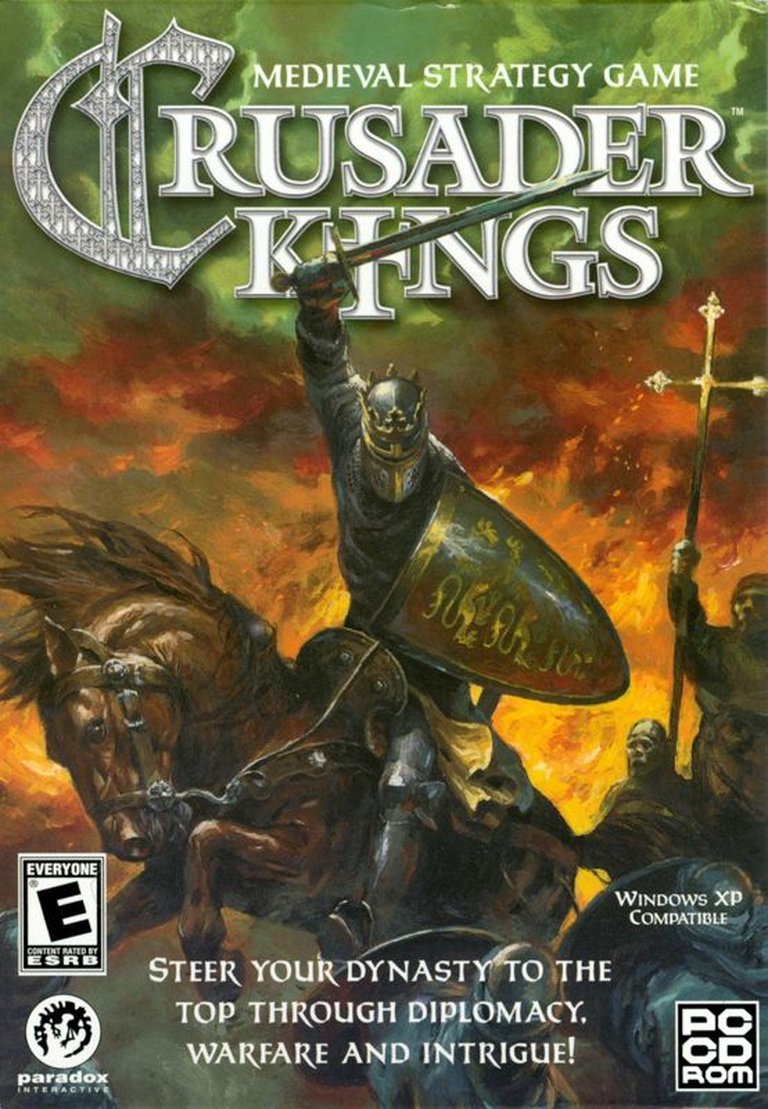
Description
Crusader Kings is a real-time strategy game set in medieval Europe from 1066 to 1419 A.D., where players take on the role of a feudal ruler managing diplomacy, warfare, and dynasty-building. The game emphasizes intricate political maneuvering, marriage alliances, and territorial expansion, with scenarios like the Battle of Hastings, the Third Crusade, and the Hundred Years War. Players must balance loyalty to the Pope, their liege, and their own ambitions while navigating a dynamic world of shifting alliances and betrayals.
Where to Buy Crusader Kings
Crusader Kings Free Download
Crusader Kings Patches & Updates
Crusader Kings Reviews & Reception
metacritic.com (73/100): The best game I have played in months. The game managed to create the most complex yet most simple to navigate gameplay mechanism I have ever experienced.
en.wikipedia.org (73/100): Plays like a series of Shakespearean plays with every king having a character arc and every count’s struggle up the ladder of power a fascinating narrative.
mobygames.com (68/100): A real-time (but pause-able) strategy game based on the Europa Universalis engine that focuses on the feudal kingdoms of medieval Europe in the time period of 1066 to 1419 A.D.
Crusader Kings Cheats & Codes
PC
Press F12 in the game to open the console window, type the code and press enter.
| Code | Effect |
|---|---|
| gold | +1000 gold |
| piety | +1000 piety |
| prestige | +1000 prestige |
| nowar | AI won’t declare war |
| byzantine | All diplomacy is success |
| difrules | God mode |
| die | Kill selected character |
| fullcontrol | Control all troops on map (need difrules code first) |
| norevolts | Population won’t revolt |
| nofog | Remove fog of war |
| showid | Show country ID |
| handsoff | Turns your dynasty over to AI control |
| charevent [number] | Activate indicated event |
Crusader Kings: A Pioneering Dynasty Simulator That Redefined Grand Strategy
Introduction: The Birth of a Genre-Defining Experience
In the annals of grand strategy gaming, few titles have left as indelible a mark as Crusader Kings. Released in 2004 by Paradox Development Studio, this game didn’t just iterate on existing formulas—it revolutionized them. At a time when strategy games were largely focused on nation-building and military conquest, Crusader Kings dared to shift the lens onto the personal, the familial, and the dynastic. It was a game that understood the Middle Ages not as a series of battles and borders, but as a tapestry of human relationships, political intrigue, and generational ambition.
This review aims to dissect Crusader Kings in its entirety, exploring its development, its groundbreaking mechanics, its reception, and its lasting legacy. We’ll examine how it stood apart from its contemporaries, how it laid the foundation for an entire franchise, and why, despite its flaws, it remains a touchstone for strategy gaming nearly two decades later.
Development History & Context: The Paradox Gambit
The Studio and the Vision
Paradox Development Studio, by 2004, had already established itself as a niche but respected name in strategy gaming. With titles like Europa Universalis and Hearts of Iron under its belt, the studio had carved out a reputation for deep, historically grounded simulations. However, Crusader Kings represented a bold departure. While it shared the Europa Universalis engine, it was not merely another iteration of that formula. Instead, it was an experiment in focusing on the micro rather than the macro.
The game’s lead designer, Joakim Bergqwist, and lead programmer, Johan Andersson, envisioned a title that would simulate the complexities of medieval feudalism through the lens of a single dynasty. The goal was to create a game where players wouldn’t just manage territories and armies, but would navigate the intricate web of marriages, inheritances, betrayals, and alliances that defined the era. This was a radical shift from the geopolitical focus of Europa Universalis, and it required a rethinking of how strategy games could engage players on a personal level.
Technological Constraints and Innovations
The Europa Engine, while robust, was not originally designed for the kind of character-driven simulation that Crusader Kings demanded. The team had to adapt the engine to handle the complexities of individual traits, relationships, and events. This required significant modifications to the underlying systems, particularly in how the game tracked and simulated the lives of hundreds of characters across generations.
One of the most significant innovations was the introduction of a pauseable real-time system. Unlike traditional turn-based strategy games, Crusader Kings allowed players to pause the game at any moment, issue orders, and then resume the flow of time. This mechanic was crucial for managing the game’s complexity, giving players the breathing room to make informed decisions without being overwhelmed by the sheer volume of information.
The Gaming Landscape of 2004
The early 2000s were a transitional period for strategy gaming. Real-time strategy (RTS) games like Warcraft III and Age of Mythology dominated the market, emphasizing fast-paced combat and resource management. Meanwhile, turn-based strategy games were often relegated to niche audiences, with titles like Civilization III and Medieval: Total War catering to fans of deeper, more deliberate gameplay.
Crusader Kings arrived in this landscape as an anomaly. It was neither a traditional RTS nor a turn-based game, but a hybrid that defied easy categorization. Its focus on dynasty management and long-term strategy set it apart from the action-oriented RTS titles of the time, while its real-time mechanics distinguished it from the turn-based grand strategy games that Paradox was known for. This made it a hard sell to casual gamers, but it also ensured that it would find a dedicated audience among those who craved something different.
The Road to Release
Development on Crusader Kings began in 2002, with the game officially announced in April of that year. The team faced numerous challenges, particularly in balancing the game’s complexity with accessibility. Early beta tests revealed that the game’s steep learning curve could be a significant barrier to entry, but the developers were committed to preserving the depth that made the game unique.
Initially, Crusader Kings was slated for publication by Strategy First in North America. However, in a move that would become a hallmark of Paradox’s business strategy, the studio decided to self-publish the game in June 2004. This decision was driven by a desire to maintain creative control and ensure that the game reached its audience in the form that the developers intended. The game was released in Europe on April 23, 2004, and in North America on September 28, 2004.
Narrative & Thematic Deep Dive: The Personal and the Political
The Premise: A Dynasty’s Journey Through History
Crusader Kings is set in medieval Europe, spanning from the aftermath of the Battle of Hastings in 1066 to the eve of the fall of Constantinople in 1453. Unlike many strategy games that focus on a single ruler or nation, Crusader Kings tasks players with guiding an entire dynasty through the centuries. The game begins with the player assuming the role of a medieval ruler—be it a count, duke, or king—and challenges them to ensure the survival and prosperity of their family line.
The game’s narrative is not scripted in the traditional sense. Instead, it emerges organically from the player’s decisions and the game’s systems. Each playthrough is a unique story, shaped by the marriages, wars, betrayals, and alliances that unfold over generations. This emergent storytelling is one of the game’s greatest strengths, making each campaign feel like a living, breathing historical drama.
Characters and Traits: The Building Blocks of Drama
At the heart of Crusader Kings are its characters, each defined by a set of traits that influence their abilities, relationships, and fate. These traits range from the mundane (e.g., “Strong,” “Intelligent”) to the dramatic (e.g., “Lustful,” “Paranoid,” “Cannibal”). Each trait has tangible effects on gameplay, shaping how characters interact with one another and how they perform in their roles.
For example, a ruler with the “Diplomat” trait will excel in negotiations and alliances, while a “Martial” ruler will be a formidable military leader. Traits can also lead to unexpected events, such as a “Lustful” ruler fathering a bastard child, which can complicate succession plans and create new political dynamics.
The game’s character system is deeply interconnected with its narrative themes. Characters age, marry, have children, and eventually die, passing their traits—and their legacies—on to the next generation. This creates a sense of continuity and consequence that is rare in strategy games, where the focus is often on abstract nations rather than individual people.
Dialogue and Events: The Game’s Storytelling Engine
Crusader Kings does not rely on traditional dialogue trees or cutscenes to tell its stories. Instead, it uses a system of events—both scripted and random—to create narrative moments. These events can range from major historical occurrences (e.g., the Crusades, the Black Death) to personal dramas (e.g., a spouse’s infidelity, a child’s illness).
Each event presents the player with choices, and these choices have consequences that ripple through the game. For example, deciding to execute a rebellious vassal might strengthen your rule in the short term, but it could also create lasting resentment among other vassals. Similarly, arranging a marriage for political gain might secure an alliance, but it could also lead to a loveless union that produces few heirs.
The game’s events are designed to reflect the unpredictability of medieval life. Disease, betrayal, and sudden death were constant threats, and Crusader Kings captures this uncertainty with a system that keeps players on their toes. This unpredictability is both a strength and a weakness: it makes the game feel alive, but it can also lead to frustration when a carefully laid plan is undone by a random event.
Themes: Power, Legacy, and the Human Condition
Crusader Kings is, at its core, a game about power—how it is acquired, how it is maintained, and how it is lost. But it is also a game about legacy. Unlike many strategy games where the goal is to conquer the world, Crusader Kings challenges players to think about the long-term survival of their dynasty. This shift in focus from territorial expansion to generational continuity is one of the game’s most innovative aspects.
The game explores themes of loyalty and betrayal, love and ambition, faith and heresy. It asks players to grapple with moral dilemmas, such as whether to assassinate a rival or to spare a traitorous vassal. These themes are not just window dressing; they are woven into the game’s mechanics, shaping how players interact with the world and how the world responds to them.
One of the most compelling themes in Crusader Kings is the tension between personal ambition and dynastic duty. Players must balance their own desires for power and prestige with the needs of their family and realm. A ruler who focuses too much on personal glory might neglect their heirs, leading to a weak succession. Conversely, a ruler who is too cautious might miss opportunities to expand their influence, leaving their dynasty vulnerable to more aggressive neighbors.
Gameplay Mechanics & Systems: The Engine of Dynasty
Core Gameplay Loop: Rule, Expand, Survive
The core gameplay loop of Crusader Kings revolves around managing a dynasty across generations. Players must navigate a complex web of relationships, alliances, and conflicts, all while ensuring that their family line survives and thrives. The game is divided into several key systems, each of which plays a crucial role in the player’s success.
- Dynasty Management: Players must manage their family’s reputation, wealth, and influence. This involves arranging marriages, educating heirs, and ensuring that the dynasty’s bloodline remains strong.
- Realm Governance: Players must oversee their territories, balancing the needs of their vassals with the demands of their liege (if they are not independent). This includes managing taxes, laws, and military obligations.
- Diplomacy and Intrigue: Players must navigate the complex political landscape of medieval Europe, forging alliances, declaring wars, and engaging in espionage.
- Warfare: Players must raise armies, fight battles, and siege castles to expand their territory or defend their realm.
The game’s real-time pauseable mechanics allow players to manage these systems at their own pace. This is crucial, as the game’s complexity can be overwhelming, especially for new players.
Combat and Warfare: A System of Abstraction
Combat in Crusader Kings is abstracted rather than tactical. Players do not directly control armies in battle; instead, they issue orders and let the game’s systems resolve the outcomes. This approach is in line with the game’s focus on grand strategy rather than tactical combat.
Armies are raised from the player’s territories, with each province contributing a certain number of troops based on its population and infrastructure. Players can also call upon their vassals to provide additional troops through the scutage system, which allows them to trade tax income for military support.
Battles are resolved based on a variety of factors, including army size, unit composition, morale, and the martial skill of the commanding character. Sieges are similarly abstracted, with the outcome determined by the size of the besieging force and the strength of the defenses.
While this system is functional, it lacks the depth and excitement of more tactical combat systems. Players who enjoy the tactical nuances of games like Total War may find Crusader Kings‘ combat system underwhelming. However, the abstraction is necessary to keep the focus on the game’s broader strategic and narrative elements.
Character Progression: The Rise and Fall of Rulers
Character progression in Crusader Kings is tied to the traits and skills of individual rulers. Each ruler has a set of attributes—Martial, Diplomacy, Intrigue, and Stewardship—that determine their effectiveness in different areas. These attributes can be improved through education, events, and the ruler’s actions.
Traits play a crucial role in character progression. Some traits are inherited, while others are acquired through events or age. For example, a ruler who frequently engages in intrigue might develop the “Deceitful” trait, which can help them in espionage but may also make them less trustworthy in the eyes of their vassals.
The game’s character progression system is deeply interconnected with its narrative themes. A ruler’s traits and skills shape their relationships, their decisions, and their legacy. A ruler who is skilled in diplomacy might forge powerful alliances, while a ruler who is martial might lead their armies to victory. However, these strengths can also become weaknesses if not managed carefully.
UI and Accessibility: A Steep Learning Curve
One of the most significant challenges in Crusader Kings is its user interface. The game’s UI is dense and complex, reflecting the depth of its systems. While this complexity is necessary to manage the game’s many mechanics, it can be overwhelming for new players.
The game lacks a proper tutorial, relying instead on a manual that is often insufficient for explaining the intricacies of its systems. This steep learning curve was a common criticism in contemporary reviews, with many reviewers noting that the game’s depth came at the cost of accessibility.
Despite these challenges, the UI is functional once players become familiar with it. The game’s pauseable real-time mechanics allow players to take their time making decisions, and the various menus and screens provide the information needed to manage a dynasty effectively.
Innovative Systems: What Set Crusader Kings Apart
Crusader Kings introduced several innovative systems that set it apart from other strategy games of the time. These systems were not just technical achievements; they were fundamental to the game’s identity and appeal.
-
Dynasty Simulation: The game’s focus on dynasty management was revolutionary. Unlike other strategy games that focused on nations or empires, Crusader Kings challenged players to think about the long-term survival of a family line. This shift in focus created a unique narrative experience, where the player’s success was measured not just in territory conquered, but in the legacy of their dynasty.
-
Character-Driven Gameplay: The game’s emphasis on individual characters and their traits was another innovation. Characters were not just abstract units; they were people with personalities, relationships, and ambitions. This made the game feel more personal and immersive, as players became invested in the lives of their rulers and their families.
-
Emergent Storytelling: The game’s event system created a dynamic narrative experience. Rather than following a scripted story, players experienced a series of events that emerged from their decisions and the game’s systems. This made each playthrough unique, as the game’s narrative unfolded in unexpected ways.
-
Real-Time Pauseable Mechanics: The game’s pauseable real-time system was a technical innovation that allowed players to manage the game’s complexity at their own pace. This was crucial for a game that required players to juggle multiple systems and make informed decisions.
These innovations were not without their flaws. The game’s complexity could be overwhelming, and its systems were not always perfectly balanced. However, they laid the foundation for a new kind of strategy game—one that focused on the personal and the dynastic rather than the geopolitical.
World-Building, Art & Sound: Crafting a Medieval Tapestry
Setting and Atmosphere: A Living Medieval World
Crusader Kings is set in a meticulously crafted medieval Europe, spanning from the British Isles to the Middle East. The game’s world is divided into hundreds of provinces, each with its own unique characteristics, cultures, and histories. This attention to detail creates a sense of immersion, as players navigate a world that feels alive and dynamic.
The game’s setting is not just a backdrop; it is an active participant in the gameplay. The political and religious landscape of medieval Europe shapes the player’s options and challenges. For example, the Catholic Church plays a central role in the game, with the Pope wielding significant influence over Christian rulers. Players must navigate this religious landscape carefully, balancing their secular ambitions with their spiritual obligations.
The game’s atmosphere is further enhanced by its historical accuracy. While Crusader Kings is not a strict historical simulation, it draws heavily from real-world events and figures. Players can encounter historical characters like William the Conqueror, Richard the Lionheart, and Saladin, and they can participate in major historical events like the Crusades and the Hundred Years’ War. This blend of history and gameplay creates a rich and engaging world that feels both familiar and fresh.
Visual Direction: Functional but Unremarkable
The visual design of Crusader Kings is functional but unremarkable. The game uses a top-down 2D perspective, with a map that is divided into provinces and territories. The art style is simple and utilitarian, focusing on clarity and functionality rather than aesthetic appeal.
Character portraits are one of the game’s visual highlights. Each character has a unique portrait that reflects their traits and status. For example, a ruler with the “Strong” trait might have a more muscular portrait, while a ruler with the “Intelligent” trait might have a more scholarly appearance. These portraits help to bring the game’s characters to life, giving players a visual representation of their rulers and their families.
The game’s UI is similarly functional. Menus and screens are designed to provide players with the information they need to manage their dynasty, but they are not particularly visually striking. This utilitarian approach is in line with the game’s focus on depth and complexity, but it does little to enhance the game’s atmosphere.
Sound Design: A Forgotten Element
The sound design of Crusader Kings is one of its weakest elements. The game features a sparse soundtrack composed by Inon Zur, which is atmospheric but repetitive. The sound effects are similarly unremarkable, with little to distinguish them from other strategy games of the time.
The lack of voice acting is particularly noticeable. While this was not uncommon for strategy games in 2004, the absence of voice acting makes the game’s characters feel less alive. This is a missed opportunity, as the game’s focus on character-driven storytelling would have benefited greatly from voice acting that brought its rulers and vassals to life.
Despite these shortcomings, the game’s sound design is not actively detrimental to the experience. The soundtrack is pleasant enough, and the sound effects are functional. However, they do little to enhance the game’s immersion or atmosphere.
Reception & Legacy: A Game Ahead of Its Time
Critical Reception: A Mixed but Respectful Response
Crusader Kings received mixed reviews upon its release, with critics praising its depth and innovation while criticizing its complexity and accessibility. The game’s Metacritic score of 73/100 reflects this divide, with some reviewers hailing it as a groundbreaking strategy game and others dismissing it as overly complex and niche.
Positive reviews highlighted the game’s innovative focus on dynasty management and character-driven gameplay. GameSpot gave the game an 8.2/10, praising its “rigorous attention to detail and epic scope” and noting that it was a game that would appeal to history enthusiasts. IGN similarly praised the game’s depth, awarding it a 7.6/10 and noting that it was a game that rewarded patience and strategic thinking.
However, many reviewers also criticized the game’s steep learning curve and lack of accessibility. Computer Gaming World gave the game a 70/100, noting that its “convoluted interface, some minor bugs, and lack of a detailed manual” made it a frustrating experience for newcomers. GameSpy was similarly critical, awarding the game a 60/100 and noting that its “inadequate documentation, a sad assortment of bugs and instability, and a weak A.I.” detracted from the experience.
Despite these criticisms, Crusader Kings was recognized for its innovation. It received several awards, including the Strategy Gaming Online Editor’s Choice award and the Game Vortex Top Pick award. These accolades underscored the game’s pioneering mechanics and its potential to redefine the grand strategy genre.
Commercial Performance: A Niche Success
Commercially, Crusader Kings was a modest success. It did not achieve the same level of mainstream recognition as titles like Warcraft III or Rome: Total War, but it found a dedicated audience among strategy gamers. The game’s niche appeal was both a strength and a weakness: it ensured that it would have a loyal fanbase, but it also limited its commercial potential.
The game’s commercial success was sufficient to justify the development of sequels, however. Crusader Kings II, released in 2012, built on the foundation of the original game, refining its mechanics and expanding its scope. Crusader Kings III, released in 2020, further evolved the franchise, introducing 3D visuals and deeper role-playing elements.
Legacy: The Birth of a Franchise
The legacy of Crusader Kings is undeniable. It pioneered a new approach to grand strategy gaming, one that focused on the personal and the dynastic rather than the geopolitical. This approach has influenced not just the Crusader Kings franchise, but the broader strategy genre as a whole.
The game’s emphasis on character-driven storytelling and emergent narratives has become a hallmark of Paradox’s subsequent titles. Games like Europa Universalis IV and Stellaris have incorporated elements of Crusader Kings‘ design philosophy, blending grand strategy with role-playing elements to create richer, more immersive experiences.
Crusader Kings also laid the foundation for a thriving modding community. The game’s text-based file structure made it relatively easy for modders to create custom content, and the Deus Vult expansion further enhanced this accessibility. Mods like the Deus Vult Improvement Pack and the Westeros: Total Conversion mod demonstrated the game’s potential for player-driven innovation, and they helped to extend the game’s lifespan long after its official support had ended.
Today, Crusader Kings is remembered as a cult classic—a game that was ahead of its time and that paved the way for a new generation of strategy games. While it may not have achieved the same level of mainstream success as some of its contemporaries, its influence is undeniable, and its legacy continues to shape the strategy genre.
Conclusion: A Landmark in Strategy Gaming
Crusader Kings is a game that defies easy categorization. It is neither a traditional grand strategy game nor a traditional role-playing game, but a hybrid that blends the best elements of both. Its focus on dynasty management and character-driven storytelling set it apart from its contemporaries, and its innovative mechanics laid the foundation for an entire franchise.
The game’s strengths are numerous. Its depth and complexity create a rich and immersive experience, where each playthrough feels like a unique historical drama. Its emphasis on emergent storytelling and character-driven gameplay makes it a game that rewards patience, strategic thinking, and a willingness to engage with its systems.
However, the game is not without its flaws. Its steep learning curve and lack of accessibility can be daunting for newcomers, and its visual and audio design are functional but unremarkable. These flaws are a reminder of the game’s origins as a niche title, one that was designed for a dedicated audience rather than a mainstream one.
Despite these flaws, Crusader Kings remains a landmark in strategy gaming. It is a game that challenged the conventions of the genre and paved the way for a new approach to grand strategy. Its influence can be seen in the Crusader Kings franchise and in the broader strategy genre, where its emphasis on character-driven storytelling and emergent narratives has become a hallmark of modern strategy games.
For those willing to invest the time and effort to master its systems, Crusader Kings offers a rewarding and immersive experience. It is a game that asks players to think not just about conquest and expansion, but about legacy and survival. It is a game that understands the Middle Ages not as a series of battles and borders, but as a tapestry of human relationships, political intrigue, and generational ambition.
In the annals of strategy gaming, Crusader Kings stands as a testament to the power of innovation and the potential of the genre. It is a game that dared to be different, and in doing so, it redefined what a strategy game could be.