
- Release Year: 2006
- Platforms: PlayStation 2, Wii, Windows
- Publisher: Metro3D Europe Ltd., Popcorn Arcade
- Developer: Data Design Interactive Ltd
- Genre: Driving, Racing
- Perspective: 1st-person
- Game Mode: Single-player
- Gameplay: Arcade, Open world driving
- Setting: City, Contemporary, London
- Average Score: 15/100
Description
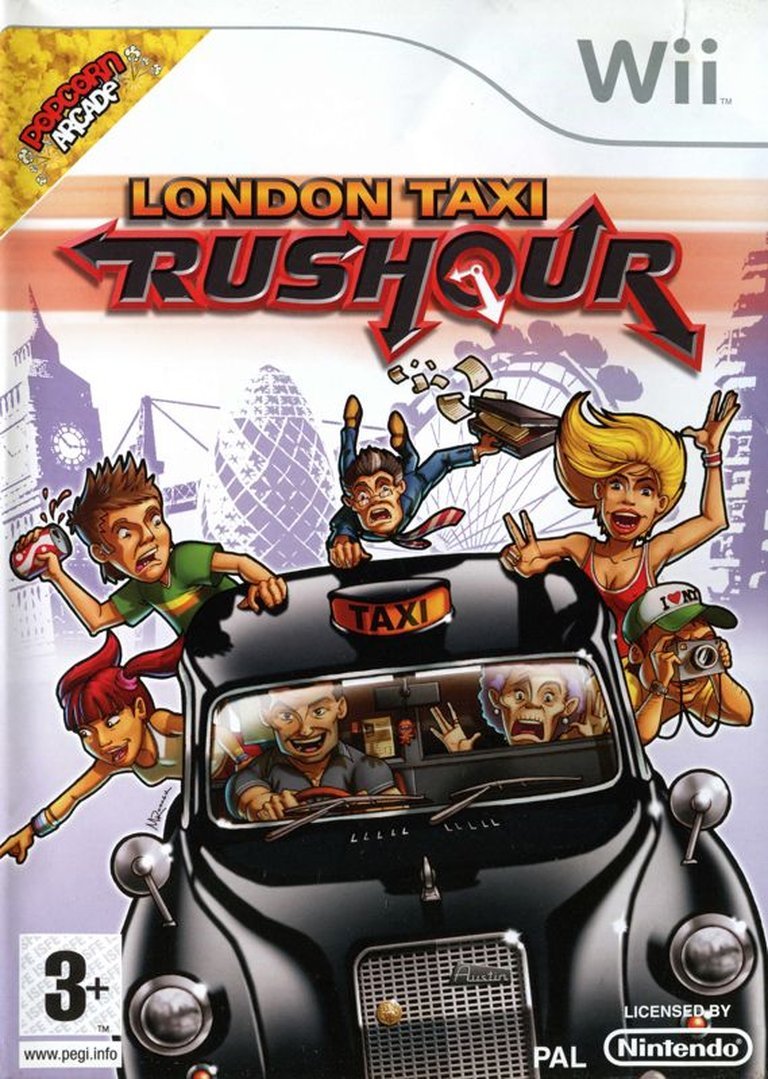
London Taxi: Rush Hour is an arcade-style racing game where players take on the role of a London taxi driver, navigating through a stylized version of the city to deliver passengers to their destinations within tight time limits. The game features iconic landmarks like the London Eye and Big Ben, and offers three modes: Time Games (earning money within a time limit), Money Games (hitting a financial target), and Perfect Day (chaining successful fares). Players start with a classic black taxi and can unlock additional vehicles, while power-ups help extend time limits or clean their cab. With chaotic traffic and no traffic laws, the gameplay emphasizes speed and reckless driving, drawing comparisons to Crazy Taxi.
Gameplay Videos
London Taxi: Rush Hour Free Download
London Taxi: Rush Hour Cracks & Fixes
London Taxi: Rush Hour Patches & Updates
London Taxi: Rush Hour Guides & Walkthroughs
London Taxi: Rush Hour Reviews & Reception
metacritic.com (20/100): It’s crap. It’s like Crazy Taxi’s-not-quite-ready-to-hang-with-the-grown-ups little brother, complete with bad hair and pimples.
en.wikipedia.org (15/100): The Wii version received ‘overwhelming dislike’ according to Metacritic.
ign.com (10/100): Sloppy controls and offensively poor graphics — N64 quality with a broken framerate — combine for an end racing product that just plain sucks.
mobygames.com (20/100): Average score: 1.0 out of 5
metacritic.com (10/100): Sloppy controls and offensively poor graphics — N64 quality with a broken framerate — combine for an end racing product that just plain sucks.
London Taxi: Rush Hour Cheats & Codes
Wii (Europe) (EN,FR,DE,IT)
Enter codes using Gecko.
| Code | Effect |
|---|---|
| 06F2E31C 00000014 2C1F0026 40820008 D1E50004 80A30004 4B150B28 00000000 0407EE50 48EAF4CC |
Car Always Clean |
| 06F2E2E4 0000001C 3D60E4B1 396B2581 7C0BD800 40820008 D1FE0004 C00286C4 4B134FD8 00000000 040632D0 48ECB014 |
Customers Always Happy |
| 0407F184 38000064 | Gold Bulldogs worth 100 |
| 0407F1EC EC01002A | Infinite Boost |
| 06F2E330 0000001C 3D605BFF 396B139E 81430000 7C0B5000 41820008 D0230004 4B1512BC 00000000 0407F600 48EAED30 |
Stop Fare Timer |
| 06F2E300 0000001C 2C070004 40820010 3D608039 C1CB10C0 FC0E0032 EC01002A 4B150DEC 00000000 0407F100 48EAF200 |
Taxi Fare x2 |
London Taxi: Rush Hour: A Deep Dive into a Forgotten Arcade Racer
Introduction: The Infamous Clone That Couldn’t
London Taxi: Rush Hour (2006) is a game that exists in the shadow of Crazy Taxi—a shadow so vast that it eclipses nearly every aspect of this budget title. Developed by Data Design Interactive (DDI) and published by Metro3D Europe, it arrived during a time when arcade-style racing games were still a staple of the gaming landscape. Yet, despite its ambitious premise—putting players in the driver’s seat of a London black cab to ferry passengers through a stylized version of the city—it failed spectacularly, earning a reputation as one of the worst racing games of its era.
This review will dissect London Taxi: Rush Hour in exhaustive detail, exploring its development history, gameplay mechanics, narrative (or lack thereof), and its lasting legacy as a cautionary tale in game design. Was it merely a victim of its own ambition, or was it doomed from the start by its developer’s limitations?
Development History & Context: The Rise and Fall of a Budget Title
The Studio Behind the Wheel
Data Design Interactive (DDI) was a UK-based developer known for producing budget titles, often leveraging licensed properties or mimicking successful franchises. Their portfolio included games like Kawasaki Jet Ski, Billy the Wizard: Rocket Broomstick Racing, and Anubis II—none of which are remembered fondly. DDI’s games were typically rushed, underfunded, and plagued by technical issues, and London Taxi: Rush Hour was no exception.
The game was first announced in November 2004, when DDI secured exclusive licensing rights to the FX4 black cab, a iconic London taxi. The initial vision was a mission-based driving game planned for PlayStation 2, Xbox, Windows, and PSP. However, the project faced immediate delays. By April 2005, DDI confirmed that console versions would launch in August, while the PC version would be a digital-only release on their online store.
These plans quickly unraveled. The Xbox and PSP versions were canceled, and the PlayStation 2 version didn’t materialize until June 2006, nearly a year behind schedule. The Wii port followed in 2008, published by Bold Games in North America, marking DDI’s attempt to capitalize on the Wii’s motion-controlled gaming craze.
Technological Constraints & the Gaming Landscape
London Taxi: Rush Hour was developed using Gods™ Technology, a middleware engine licensed from Green Solutions Ltd. Despite this, the game suffered from severe technical limitations:
– Graphics that looked a decade outdated, with blocky models and muddy textures.
– A framerate that often dipped below 15 FPS, making gameplay nearly unplayable.
– Physics and collision detection that were unpredictable and glitchy, despite the use of the Havok engine.
The game’s release coincided with a golden age of arcade racers, including Burnout Revenge (2005), Need for Speed: Most Wanted (2005), and Mario Kart DS (2005). In this competitive landscape, London Taxi: Rush Hour had no chance—it was outclassed in every technical and design aspect.
Narrative & Thematic Deep Dive: A Game Without a Story
The Premise (or Lack Thereof)
London Taxi: Rush Hour has no traditional narrative. There are no characters, no dialogue, and no overarching plot. The game’s “story” is simple:
– You are a London taxi driver.
– Pick up passengers.
– Drive them to their destinations as fast as possible.
This minimalist approach isn’t inherently bad—Crazy Taxi thrived on its simplicity. However, London Taxi fails to inject personality, humor, or charm into its premise. There are no quirky passengers, no memorable radio chatter, and no sense of progression beyond unlocking new cabs.
Themes: Chaos Over Realism
The game’s only thematic throughline is chaos. Unlike real-world London, where traffic laws and congestion charges reign supreme, London Taxi: Rush Hour presents a lawless, anarchic version of the city:
– No traffic lights, stop signs, or police.
– Pedestrians and other cars are obstacles to ram or avoid.
– Sidewalks, parks, and even the Underground are fair game for shortcuts.
This design choice is a direct lift from Crazy Taxi, but where Sega’s game embraced over-the-top arcade fun, London Taxi feels sloppy and uninspired. The absence of any consequences for reckless driving removes tension, making the experience feel hollow and repetitive.
Gameplay Mechanics & Systems: A Broken Arcade Experience
Core Gameplay Loop
The game offers three primary modes:
1. Time Games – Earn as much money as possible within a time limit.
2. Money Games – Reach a financial target before time runs out.
3. Perfect Day – Complete as many consecutive fares as possible without failing.
Each mode revolves around the same pick-up-and-deliver mechanic, with no meaningful variation. The Wii version attempted to innovate with motion controls, allowing players to steer by tilting the Wii Remote like a wheel. However, the implementation was clunky and unresponsive, making precision driving nearly impossible.
Controls & Physics: A Recipe for Frustration
- Steering is loose and imprecise, with cars often sliding uncontrollably or getting stuck on geometry.
- Collision detection is broken, leading to unpredictable bounces and instant failures for minor scrapes.
- The framerate stutters constantly, making split-second maneuvers a gamble rather than a skill test.
Power-Ups & Progression
The game includes power-ups scattered across the map:
– Cleaning boxes – Remove dirt from your cab (a purely cosmetic effect).
– Clocks – Extend the time limit for your current fare.
– Bulldogs – Award points used to unlock new vehicles.
However, these additions feel tacked on rather than integral to gameplay. Unlocking new cabs (including non-taxi vehicles like a double-decker bus) provides no meaningful advantage, as they handle identically to the default black cab.
UI & Presentation: A Mess of Missed Opportunities
- The HUD is barebones, displaying only time, money, and a mini-map.
- The mini-map is nearly useless, failing to clearly indicate pickup locations or optimal routes.
- No voice acting, no radio chatter, no dynamic music—just repetitive sound effects and a forgettable soundtrack.
World-Building, Art & Sound: A Stylized London That Feels Empty
The Setting: A Postcard Without Life
The game’s biggest selling point was its stylized recreation of London, featuring landmarks like:
– Big Ben
– The London Eye
– Trafalgar Square
– Hyde Park
However, the city feels sterile and lifeless:
– Buildings are low-poly and textureless.
– Traffic consists of a handful of repeating car models.
– Pedestrians are rare and behave unpredictably.
The Wii version attempted to leverage motion controls for immersion, but the graphical downgrades made it even less appealing than the PS2 original.
Sound Design: A Silent Ride
- The soundtrack is generic elevator music, lacking the punk-rock energy of Crazy Taxi.
- Engine sounds are repetitive and tinny.
- No voice acting or passenger interactions—just beeps and honks.
Reception & Legacy: A Game That Everyone Hated
Critical Reception: A Universal Panning
London Taxi: Rush Hour was universally reviled by critics:
– Metacritic (PS2): 20/100 (“Generally Unfavorable”)
– Metacritic (Wii): 15/100 (“Overwhelming Dislike”)
– IGN (Wii): 1/10 – “Sloppy controls and offensively poor graphics… Avoid this one at all costs.”
– GamesRadar (Wii): “It’s like Crazy Taxi’s-not-quite-ready-to-hang-with-the-grown-ups little brother, complete with bad hair and pimples.”
– PlayStation Official Magazine (UK): 2/10 – “Avoid unless you enjoy punishment.”
Players were equally brutal:
– “A budget copy of Crazy Taxi… Not worth it even for comedy value.” (Kyle_Katarn92, Metacritic)
– “Another crap game by Data Design Interactive… The graphics are awful, the controls , the gameplay is god awful.”** (Mariofan, Metacritic)
Legacy: The Poster Child for Bad Racing Games
London Taxi: Rush Hour has become a cautionary tale in game development:
– A prime example of how not to clone a successful game.
– Proof that licensing a real-world vehicle (the FX4 cab) doesn’t guarantee quality.
– A symbol of Data Design Interactive’s reputation for shovelware.
Its only cultural impact is as a meme—a game so bad that it’s almost fascinating in its incompetence.
Conclusion: A Rush Hour You’ll Want to Avoid
London Taxi: Rush Hour is not just a bad game—it’s a fundamentally broken one. From its unresponsive controls to its ugly visuals and nonexistent narrative, it fails at every level of design. It’s a shameless Crazy Taxi clone that misses the point entirely, offering none of the charm, speed, or fun that made Sega’s classic so beloved.
Final Verdict:
⭐ 1/10 – A catastrophic failure in game design.
Should You Play It?
– Only if you’re a masochist or a historian of bad games.
– Even then, proceed with caution—your sanity may not survive the experience.
London Taxi: Rush Hour is not just a forgotten game—it’s a game that deserves to stay forgotten. Its legacy is a warning to developers: if you’re going to clone a classic, at least make it fun.