
- Release Year: 2001
- Platforms: Macintosh, Windows
- Publisher: EMME Interactive SA
- Developer: Hyptique
- Genre: Adventure, Educational
- Perspective: 3rd-person
- Game Mode: Single-player
- Gameplay: Map-based navigation, Mini-games, Non-linear adventure
- Setting: Children’s literature, Fantasy
Description
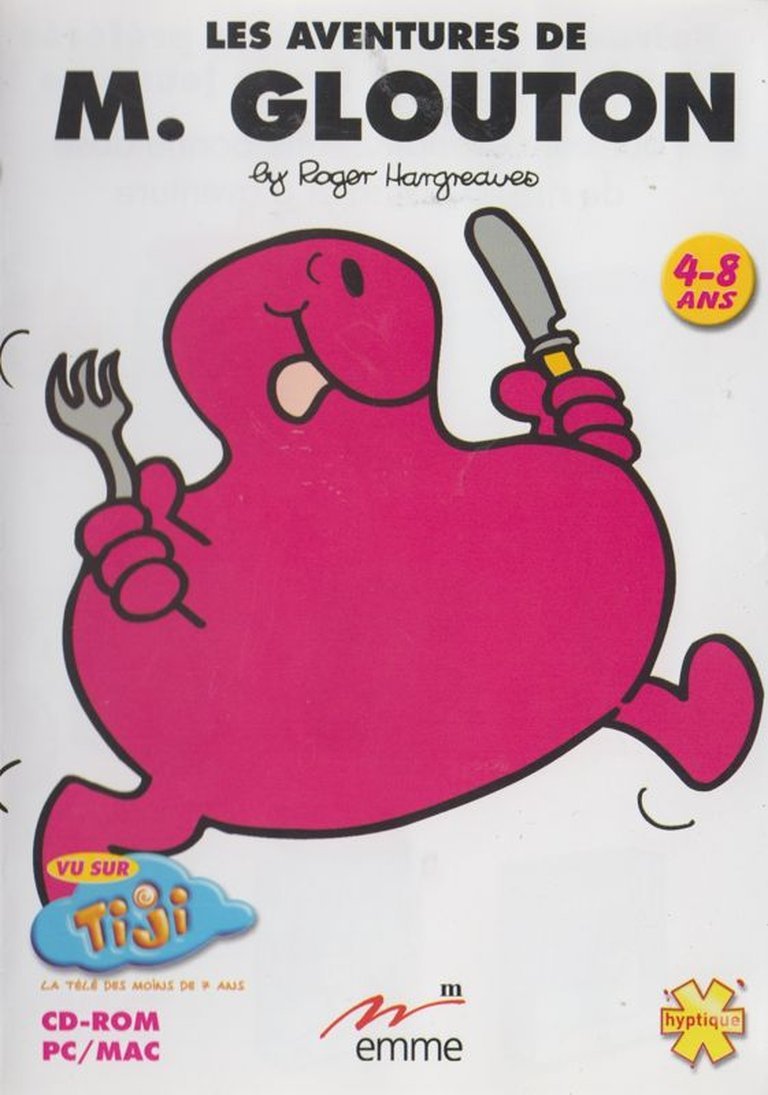
The Adventures of Mr. Greedy is an educational adventure game for children aged 4-8, based on the beloved Mr. Men and Little Miss series by Roger Hargreaves. Set in the whimsical village of Misterland, the game follows Mr. Greedy as he loses his appetite, prompting players to explore the world, interact with iconic characters like Mr. Happy and Little Miss Scatterbrain, and solve puzzles to restore order. With non-linear gameplay, mini-games, two difficulty levels, and a helpful mosquito guide, children navigate a colorful map to complete tasks such as baking a cake or finding lost friends, blending fun with light problem-solving.
Gameplay Videos
The Adventures of Mr. Greedy Mods
The Adventures of Mr. Greedy: A Whimsical Yet Flawed Foray into Early Edutainment
Introduction: A Nostalgic Glimpse into a Forgotten Era
The Adventures of Mr. Greedy (2001) is a relic of early 2000s edutainment—a genre that sought to blend education with entertainment, often with mixed results. Based on Roger Hargreaves’ beloved Mr. Men and Little Miss series, this game attempts to translate the charm of children’s literature into an interactive experience for ages 4–8. Yet, while it captures the whimsy of its source material, it also exemplifies the limitations of its era, offering a fascinating case study in the evolution of children’s gaming.
At its core, The Adventures of Mr. Greedy is a non-linear adventure where players navigate a vibrant village of anthropomorphic characters, solving problems like restoring Mr. Greedy’s lost appetite or coaxing Mr. Happy out of his sudden sadness. The game’s structure—filled with mini-games, a helpful mosquito guide, and two difficulty levels—reflects a sincere effort to engage young minds. However, its execution reveals the growing pains of a medium still learning how to balance fun and pedagogy.
This review will dissect the game’s development, narrative, mechanics, and legacy, arguing that while The Adventures of Mr. Greedy is far from a masterpiece, it remains a curious artifact of its time—a bridge between traditional storytelling and the burgeoning world of interactive media.
Development History & Context: A French Studio’s Ambitious Gamble
The Studio and the License
The Adventures of Mr. Greedy was developed by Hyptique, a French studio specializing in educational software, and published by EMME Interactive SA, a company known for adapting children’s properties into digital formats. The game was part of a trilogy of Mr. Men adaptations released in 2001, alongside The Adventures of Mr. Tickle and The Adventures of Little Miss Scatterbrain. These titles were collectively marketed as Mr. Happy and the Upside-Down World, a nod to the franchise’s emphasis on emotional and behavioral themes.
The project was overseen by Adam Hargreaves, son of original creator Roger Hargreaves, ensuring a degree of fidelity to the source material. The original concept and scenario were crafted by Sonia Cruchon, while the art direction was helmed by Michaël Douaud and Mikaël Cixous, who also handled animation and art. The game’s soundtrack, composed by Jean-Jacques Birgé and Bernard Vitet, aimed to complement the playful, lighthearted tone of the Mr. Men universe.
Technological Constraints and Design Choices
Released in 2001, The Adventures of Mr. Greedy was constrained by the technological limitations of its time. The game was built using Macromedia Director, a multimedia authoring tool popular for CD-ROM-based educational software. While this allowed for relatively smooth integration of animation, sound, and interactivity, it also resulted in a visually simplistic experience by modern standards.
The game’s third-person perspective and point-and-click navigation were standard for children’s adventure games of the era, but the lack of fluid movement or dynamic camera angles made exploration feel stiff. The map-based navigation system, while functional, lacked the immersive quality of later open-world games, instead relying on static screens connected by a top-down overview.
The Gaming Landscape of 2001
2001 was a pivotal year in gaming, marked by the launch of the GameCube and Xbox, the rise of 3D platformers like Super Mario Sunshine, and the revolution of open-world design in Grand Theft Auto III. In this context, The Adventures of Mr. Greedy was a niche product—targeted at preschoolers and toddlers, it competed not with blockbuster titles but with other edutainment software like Reader Rabbit and JumpStart.
The game’s educational focus—teaching problem-solving, basic logic, and emotional intelligence—aligned with the broader trends of early 2000s children’s media, which increasingly emphasized interactive learning. However, its linear mini-game structure and repetitive tasks reflected the limitations of early edutainment design, which often prioritized educational goals over pure entertainment value.
Narrative & Thematic Deep Dive: A Simple Story with Moral Lessons
Plot Overview
The game’s premise is straightforward: the idyllic village of Misterland is in disarray. Mr. Greedy has lost his appetite, Mr. Happy is inexplicably sad, and Little Miss Chatterbox has stopped talking. The player, cast as a silent protagonist, must visit various Mr. Men and Little Miss characters to diagnose and fix these problems.
The narrative unfolds through a series of self-contained vignettes, each tied to a specific character’s dilemma. For example:
– Agent Scatterbrain’s Game: Little Miss Scatterbrain attempts to bake a cake to restore Mr. Greedy’s appetite, requiring the player to select the correct ingredients.
– Private Bounce’s Game: Mr. Bounce must catch a parrot to help Little Miss Chatterbox regain her voice, testing the player’s timing and coordination.
– Sergeant Silly’s Game: Mr. Silly searches for Mr. Tickle to cheer up Mr. Happy, involving a simple fetch quest across the village.
The story culminates in the restoration of harmony, reinforcing the franchise’s recurring themes of friendship, cooperation, and emotional resilience.
Themes and Moral Lessons
The Adventures of Mr. Greedy is steeped in the moral simplicity of Hargreaves’ original books. Each character’s problem reflects a basic emotional or behavioral challenge:
– Mr. Greedy’s lost appetite serves as a metaphor for moderation and self-control.
– Mr. Happy’s sadness explores the idea that happiness is contagious and can be restored through kindness.
– Little Miss Chatterbox’s silence highlights the importance of communication and listening.
The game’s non-linear structure allows players to tackle these issues in any order, subtly reinforcing the idea that problems can be approached from multiple angles. However, the lack of narrative depth—characters are one-dimensional, and conflicts are resolved with minimal explanation—limits its emotional impact.
Dialogue and Character Interaction
The game features full voice acting, with characters like Mr. Greedy and Little Miss Scatterbrain brought to life by actors such as Alix Ewandé and Ken Norris. The dialogue is simple and repetitive, designed for young children, but it occasionally verges on the overly didactic, with characters explicitly stating moral lessons rather than allowing players to infer them.
The mosquito companion, Mojo, serves as a tutorial guide, offering hints when players are stuck. While helpful, Mojo’s presence underscores the game’s hand-holding approach, which may frustrate older or more experienced players.
Gameplay Mechanics & Systems: Mini-Games and Mixed Execution
Core Gameplay Loop
The Adventures of Mr. Greedy is structured around a hub-and-spoke design:
1. Navigation: Players use a map screen to travel between locations in Misterland.
2. Interaction: Clicking on characters or objects triggers dialogue or mini-games.
3. Problem-Solving: Each character’s dilemma is resolved through a dedicated mini-game.
4. Progression: Completing tasks unlocks new areas and characters, gradually restoring order to the village.
This loop is simple and accessible, but it also feels repetitive. The game’s lack of meaningful choices—players are funneled into predetermined solutions—limits replayability.
Mini-Games: Hit or Miss
The game’s three primary mini-games are its most interactive elements, but their quality varies:
1. Agent Scatterbrain’s Cake-Baking Challenge
– Mechanics: Players click on ingredients as Little Miss Scatterbrain calls them out.
– Analysis: This is essentially a memory and reaction test, with little room for creativity. The lack of consequences for failure (players can retry indefinitely) makes it feel perfunctory.
2. Private Bounce’s Parrot Catch
– Mechanics: Players time Mr. Bounce’s jumps to catch a flying parrot.
– Analysis: The most engaging mini-game, requiring precision and timing. However, the static background and limited animation make it feel dated.
3. Sergeant Silly’s Search for Mr. Tickle
– Mechanics: Players navigate a series of screens, clicking arrows to move Mr. Silly and interacting with objects to find clues.
– Analysis: This is the weakest segment, amounting to little more than a point-and-click scavenger hunt with no real challenge.
Difficulty Levels and Accessibility
The game offers two difficulty settings, but the differences are minimal:
– Easy Mode: Provides more hints and simplifies some tasks.
– Hard Mode: Reduces hints but does not fundamentally alter the gameplay.
The lack of a true challenge makes the game feel overly simplistic, even for its target audience. The absence of a scoring system or rewards further diminishes motivation to replay.
UI and Controls
The point-and-click interface is intuitive for young children, with large, colorful buttons and clear visual feedback. However, the lack of keyboard shortcuts or alternative control schemes reflects the era’s reliance on mouse-driven interaction.
The map system, while functional, is clunky. Players must exit and re-enter screens to navigate, which disrupts the flow of play. The absence of a fast-travel option makes backtracking tedious.
World-Building, Art & Sound: A Faithful but Limited Adaptation
Visual Design: Charming but Dated
The game’s art style faithfully recreates the round, colorful aesthetic of Hargreaves’ books. Characters are boldly outlined and brightly colored, with exaggerated expressions that convey their emotions clearly.
However, the technical limitations of Macromedia Director are evident:
– Static backgrounds with minimal animation.
– Limited character movement (most interactions are confined to simple gestures).
– Low-resolution assets that appear pixelated on modern displays.
The lack of environmental detail makes Misterland feel more like a series of dioramas than a living world. While this aligns with the storybook aesthetic, it also limits immersion.
Sound Design and Music
The soundtrack, composed by Jean-Jacques Birgé and Bernard Vitet, is whimsical and upbeat, with playful melodies that complement the game’s tone. However, the repetitive loops and limited variety make the music quickly forgettable.
The voice acting is competent but unremarkable. Characters like Mr. Greedy and Little Miss Scatterbrain are voiced with exaggerated, cartoonish deliveries, which suit the target audience but may grate on older players.
The sound effects—such as Mr. Bounce’s springs or Mr. Tickle’s giggles—are simple but effective, reinforcing the game’s lighthearted atmosphere.
Reception & Legacy: A Forgotten Footnote in Edutainment
Critical and Commercial Reception
The Adventures of Mr. Greedy received little critical attention upon release, reflecting its status as a niche educational title. There are no recorded Metacritic or GameRankings scores, and contemporary reviews are scarce.
Anecdotal evidence suggests the game was well-received by its target audience—parents and educators praised its accessibility and moral lessons, while children enjoyed the colorful characters and simple gameplay. However, it was overshadowed by more ambitious edutainment titles like JumpStart and The ClueFinders.
Commercially, the game was likely a modest success, given the popularity of the Mr. Men franchise. However, it failed to leave a lasting impression, fading into obscurity as the edutainment genre evolved.
Influence and Legacy
The Adventures of Mr. Greedy is not remembered as a groundbreaking title, but it offers insights into the evolution of children’s gaming:
1. Early Edutainment Design: The game exemplifies the trial-and-error approach of early 2000s educational software, where mini-games and linear progression were the norm.
2. Licensed Properties in Gaming: It reflects the trend of adapting children’s books and TV shows into interactive media, a practice that continues today with franchises like Paw Patrol and Peppa Pig.
3. The Shift to Digital Learning: The game’s focus on problem-solving and emotional intelligence foreshadowed the rise of “serious games” and social-emotional learning (SEL) tools in modern education.
While The Adventures of Mr. Greedy did not directly influence later games, it serves as a historical marker—a snapshot of a time when developers were still experimenting with how to make learning fun.
Conclusion: A Flawed but Fascinating Relic
The Adventures of Mr. Greedy is not a great game by any objective measure. Its repetitive gameplay, simplistic mechanics, and dated presentation make it a hard sell for modern audiences, even young children accustomed to the polished interactivity of tablets and smartphones.
Yet, it is not without merit. The game’s faithful adaptation of the Mr. Men universe, its gentle moral lessons, and its sincere attempt to engage young minds make it a fascinating artifact of early 2000s edutainment. It is a product of its time—a bridge between traditional storytelling and interactive media, created when developers were still learning how to balance education and entertainment.
Final Verdict: 5/10 – A Nostalgic Curiosity
The Adventures of Mr. Greedy is best appreciated as a historical footnote—a reminder of how far children’s gaming has come. While it may not be worth revisiting for gameplay, it offers valuable insights into the evolution of edutainment and the challenges of adapting beloved characters into interactive experiences.
For collectors of retro children’s games or fans of the Mr. Men franchise, it holds nostalgic value. For everyone else, it remains a quaint but forgettable experiment—a game that tried its best but was ultimately outpaced by time.
Post-Script: Where to Find It Today
Copies of The Adventures of Mr. Greedy can still be found on eBay and second-hand marketplaces, often for under $10. Emulation is possible via Windows XP compatibility mode or virtual machines, though the Macromedia Director runtime may require additional setup. For those interested in preserving gaming history, it’s a worthwhile curiosity—if nothing else, a testament to the whimsy and limitations of early 2000s children’s software.