
- Release Year: 2000
- Platforms: Windows
- Publisher: eGames, Inc.
- Genre: Compilation
Description
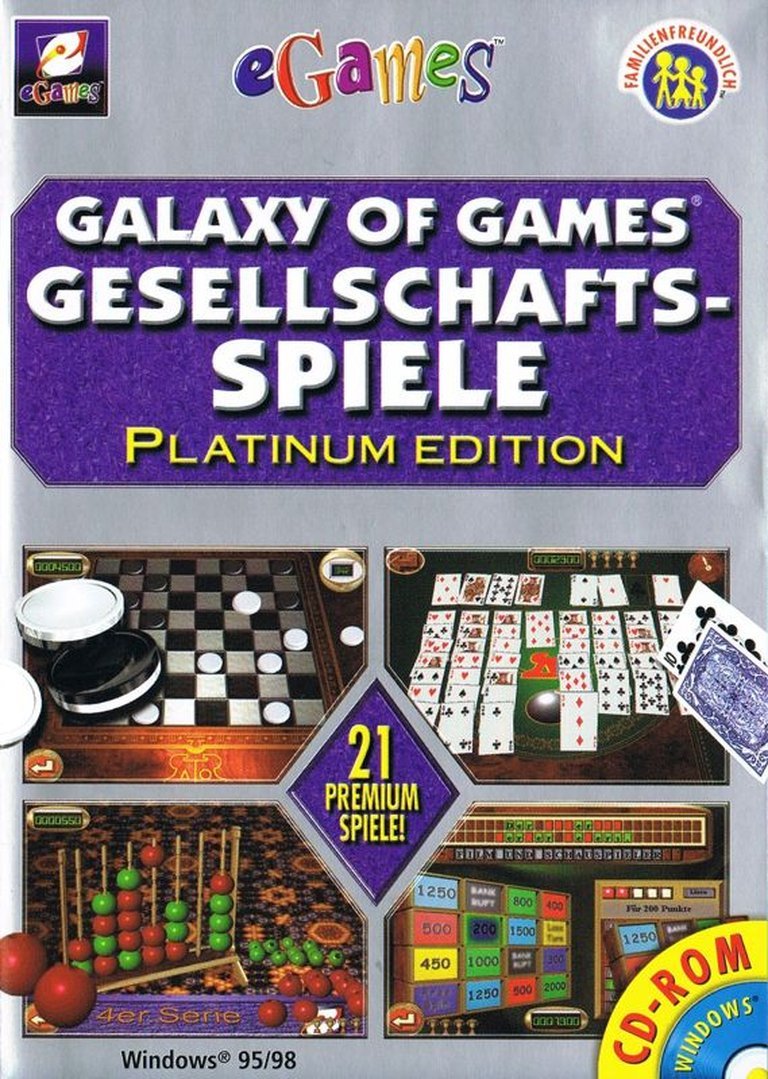
Galaxy of Games: Platinum Edition is a premium compilation of 21 classic family-friendly games released in 2000 for Windows. The collection features a diverse mix of board games like Reversi and Checkers, word games, puzzles, card games such as Solitaire and Win 21, MahJongg, mazes, and more. Each game is enhanced with detailed graphics and offers challenging gameplay suitable for players of all ages, providing hours of entertainment in a single CD-ROM package.
Galaxy of Games: Platinum Edition Free Download
Galaxy of Games: Platinum Edition Cheats & Codes
PC
Press ~ to bring up the console then put in one of these cheats
| Code | Effect |
|---|---|
| heretic | Invincibility |
| ninja | Invisible to enemies |
| phantom | Go through walls |
| bigelbow | Get all weapons |
| killallmonsters | Eliminate all enemies |
| updateinvfinal | Get Ammo |
| defaultweapons | Get default weapons |
| elbow | Get Weapons 1-5 |
| matrix [1-10] | Slow motion mode |
| gimme [Item] | Spawn item |
| Map # | Go to map # (use a map name below for #) |
| god | Invincibility |
| noclip | No clipping mode |
| notarget | Invisible to enemies |
| timescale .4 | Slow motion |
| givemoretutorial | .44 pistol |
| givesnipertutorial | Sniper rifle |
| weapontest | All weapons |
| spawn | Use code spawn with these items |
PC (SpellForce Platinum)
Open the console. Ctrl + ] (v1.05), Ctrl + + (v1.02), + (v1.0)
| Code | Effect |
|---|---|
| Application:SetBuildingFastBuildMode(x) | Build your buildings faster |
| Application:SetGodMode(x) | God mode, health decreases to 0 but you never die |
| Application:FastHeroCast(x) | Much faster hero casting |
| Application:SetBuildingTechTreeMode(x) | Now you have all buildings |
| Application:SetFigureTechTreeMode(x) | Now you have all units |
| Application:SetNoManaUsage(x) | Spells wont cost mana anymore |
| UnExplored:Enable (0) | Whole map is visible |
| Application:GiveMeGoods(y) | You get y units of each material |
PC (SpellForce: The Breath of Winter)
Ctrl + ] (v1.0)
| Code | Effect |
|---|---|
| Application:SetBuildingFastBuildMode (x) | Faster Building |
| Application:FastHeroCast (x) | Faster Hero Casting |
| Application:SetGodMode (x) | God Mode. Health will go down, but you wont die |
| Application:SetNoManaUsage (x) | Player’s spells wont cost any mana |
| UnExplored:Enable (x) | Whole Map is Visable |
| Application:GiveMeGoods (1000) | You get 1000 units of each material. You may change the amount to what you want |
| Application:SetBuildingTechTreeMode (x) | You have all buildings |
| Application:SetFigureTechTreeMode (x) | You have all units |
PC (SpellForce: Shadow of the Phoenix)
Ctrl + ] (v1.0)
| Code | Effect |
|---|---|
| Application:SetBuildingFastBuildMode (x) | Faster Building |
| Application:FastHeroCast (x) | Faster Hero Casting |
| Application:SetGodMode (x) | God Mode. Health will go down, but you wont die |
| Application:SetNoManaUsage (x) | Player’s spells wont cost any mana |
| UnExplored:Enable (x) | Whole Map is Visable |
| Application:GiveMeGoods (1000) | You get 1000 units of each material. You may change the amount to what you want |
| Application:SetBuildingTechTreeMode (x) | You have all buildings |
| Application:SetFigureTechTreeMode (x) | You have all units |
Galaxy of Games: Platinum Edition – A Forgotten Gem of the Early 2000s Compilation Era
Introduction: The Golden Age of Game Compilations
The year 2000 was a pivotal moment in gaming history. The PlayStation 2 had just launched, The Sims was redefining life simulation, and Deus Ex was pushing the boundaries of immersive storytelling. Amidst these titans, Galaxy of Games: Platinum Edition emerged as a quiet but significant artifact—a digital board game cabinet for the PC, offering a curated selection of classic and casual experiences. While it lacked the narrative depth of Final Fantasy IX or the adrenaline of Tony Hawk’s Pro Skater 2, it carved out a niche as a family-friendly, accessible, and surprisingly polished compilation. This review explores its development, design, cultural context, and enduring charm as a relic of the early 2000s gaming landscape.
Development History & Context: The Rise of eGames and the Compilation Boom
The Studio Behind the Stars
Galaxy of Games: Platinum Edition was developed by Sator Videogames and published by eGames, Inc., a company that specialized in budget-friendly, family-oriented software. eGames (originally RomTech, Inc.) was a prolific publisher in the late 1990s and early 2000s, known for its Galaxy of Games series—a line of compilations sold in retail chains like Best Buy, Target, and Kmart. These titles were designed to be impulse purchases: affordable, visually appealing, and packed with enough variety to justify their shelf space.
The Galaxy of Games series was part of a broader trend in the late 1990s and early 2000s, where publishers capitalized on the CD-ROM’s vast storage capacity to bundle multiple games into single, cost-effective packages. This era saw the rise of compilations like Microsoft Entertainment Pack, Hoyle’s Card Games, and The Learning Company’s educational suites. eGames’ approach was distinct in its focus on accessibility—games that required minimal setup, no complex controls, and appealed to all ages.
Technological Constraints and Design Philosophy
Released exclusively for Windows PC in 2000, Platinum Edition was constrained by the hardware of its time:
– DirectX 6.0 was a requirement, reflecting the shift from DOS-based gaming to Windows-native titles.
– QuickTime 3.0 was bundled for multimedia support, a common practice in an era before standardized video codecs.
– The CD-ROM format limited installation size, but eGames optimized the package to include 21 distinct games without excessive bloat.
The game’s custom browser interface was a standout feature, allowing players to navigate between titles seamlessly—a far cry from the clunky DOS executables of earlier compilations. This UI was a precursor to modern digital distribution platforms like Steam, where a unified launcher manages multiple experiences.
The Gaming Landscape in 2000
2000 was a year of transitional gaming:
– Consoles were dominated by the PlayStation 1, Nintendo 64, and the fledgling Dreamcast, while the PS2’s launch promised a new era.
– PC gaming was thriving with RPGs (Baldur’s Gate II), FPS titles (Deus Ex), and life sims (The Sims).
– Casual and family gaming was still largely physical—board games, card games, and puzzles—but digital alternatives were gaining traction.
Galaxy of Games: Platinum Edition positioned itself as a bridge between analog and digital play, offering virtual versions of games families already knew (checkers, solitaire, mahjong) while introducing novel digital twists (maze puzzles, memory challenges). It was not a groundbreaking title, but it was a smartly packaged one, leveraging nostalgia and convenience.
Narrative & Thematic Deep Dive: The Absence of Story as a Design Choice
A Compilation Without a Plot
Unlike narrative-driven games of 2000 (Final Fantasy IX, The Legend of Zelda: Majora’s Mask), Platinum Edition had no overarching story. Instead, its “narrative” was player-driven, emerging from the act of selection and competition. Each game within the compilation had its own implicit rules and objectives, but the broader experience was about choice and variety.
This absence of narrative was not a flaw but a deliberate design philosophy. The compilation’s strength lay in its modularity—players could dip in and out of experiences without commitment. In an era where games were becoming increasingly complex, Platinum Edition offered instant gratification.
Themes: Nostalgia, Accessibility, and Digital Preservation
Several themes underpin the compilation:
1. Nostalgia as a Selling Point
– Games like checkers, solitaire, and mahjong were digital homages to physical classics.
– The inclusion of Reversi (Othello) and Four-in-a-Row (Connect Four) tapped into collective memories of family game nights.
-
Accessibility for All Ages
- The E for Everyone rating was not just a formality—it was a core design principle.
- Simple controls (mouse-only), clear rules, and AI opponents with adjustable difficulty made it welcoming for children and non-gamers.
-
Digital Preservation of Analog Games
- Before mobile gaming democratized digital board games, Platinum Edition was a pioneer in virtualizing tabletop experiences.
- It predicted the rise of apps like Tabletop Simulator and Board Game Arena, albeit in a more limited form.
The Illusion of Progression
While individual games had scoring systems and high-score tables, there was no meta-progression (e.g., unlockables, achievements). This was a missed opportunity—modern compilations like The Jackbox Party Pack use progression to incentivize replayability. However, Platinum Edition relied on pure gameplay variety to retain interest, a testament to the strength of its core experiences.
Gameplay Mechanics & Systems: Deconstructing the Compilation
The Core Gameplay Loop
Platinum Edition’s structure was simple:
1. Launch the custom browser.
2. Select a game category (Board Games, Card Games, Word Games, etc.).
3. Choose a specific game.
4. Play against AI or locally with friends.
5. Return to the browser to try another game.
This loop was elegant in its simplicity, but its success hinged on the quality of the individual games.
Game Categories and Standout Titles
The compilation was divided into five broad categories, each offering distinct gameplay styles:
| Category | Key Games | Gameplay Style |
|---|---|---|
| Board Games | Checkers, Reversi, Four-in-a-Row, Dominoes | Turn-based strategy, spatial reasoning |
| Card Games | Solitaire, FreeCell, Win 21, Towers | Patience, probability, risk assessment |
| Word Games | Crosswords, Word Challenges | Vocabulary, pattern recognition |
| Visual Memory | Mah Jongg, Match It, Differences | Memory retention, visual acuity |
| Pastimes | Mazes, Cross Number Puzzles, Math Games | Logic, deduction, time pressure |
Standout Experiences:
– Mah Jongg: A faithful adaptation of the tile-matching classic, with multiple layouts and difficulty settings.
– Win 21: A blackjack variant with simple but addictive risk-reward mechanics.
– Mazes: Surprisingly tense due to time limits and labyrinthine designs.
– Differences: A “spot the difference” game that tested observational skills in a way few digital games did at the time.
AI and Multiplayer
- AI Opponents: Competent but not overly aggressive, making them suitable for casual play.
- Local Multiplayer: Supported 1-4 players, though the lack of online play (a rarity in 2000) limited its longevity.
- No Online Features: A product of its time—broadband internet was not yet ubiquitous.
UI/UX: Ahead of Its Time
The custom game browser was a standout feature:
– Intuitive navigation with large, clickable icons.
– Clear instructions for each game, reducing the need for external manuals.
– Visual consistency across all 21 games, ensuring a cohesive experience.
However, the lack of save functionality (beyond high scores) was a notable omission, reflecting the ephemeral nature of casual gaming in 2000.
Innovations and Flaws
Innovations:
✅ Unified launcher (a precursor to modern game libraries).
✅ Diverse gameplay in a single package.
✅ Family-friendly design without sacrificing depth.
Flaws:
❌ No progression system (no unlocks, achievements, or meta-rewards).
❌ Limited replayability beyond high scores.
❌ No online multiplayer (a missed opportunity even for 2000).
World-Building, Art & Sound: Crafting a Digital Game Cabinet
Visual Design: Aesthetic Consistency
Platinum Edition’s art direction was colorful, clean, and functional:
– 2D sprites and simple animations were used for most games, reflecting the technical limitations of early 2000s budget titles.
– Themed backgrounds (e.g., a wooden table for board games, a green felt for card games) reinforced the analog-to-digital transition.
– Bright, high-contrast colors ensured visibility on the CRT monitors of the era.
While not visually groundbreaking, the art style was cohesive and purposeful, avoiding the jarring transitions that plagued some compilations.
Sound Design: Minimalist but Effective
- Ambient sound effects (card shuffles, tile clicks, victory chimes) added tactile feedback.
- No voice acting or complex soundtracks—music was limited to looping midis, a common trait in budget titles.
- Sound served a functional role, reinforcing gameplay rather than immersing the player.
Atmosphere: The Comfort of Familiarity
The compilation’s greatest strength was its ability to evoke the comfort of physical games while leveraging digital conveniences:
– No lost pieces (a common frustration with board games).
– Instant setup (no shuffling, no board assembly).
– Adjustable difficulty (AI that adapted to the player).
This hybrid appeal made it a unique artifact—neither fully analog nor fully digital, but a bridge between the two.
Reception & Legacy: The Quiet Success of a Budget Title
Critical Reception: Overlooked but Appreciated
Galaxy of Games: Platinum Edition received little mainstream critical attention, a fate shared by most compilations of its era. However, it found a niche audience:
– Parents and educators praised its family-friendly nature.
– Casual gamers appreciated its pick-up-and-play design.
– Retail success was driven by its affordable price point and impulse-buy appeal.
While it never competed with Game of the Year contenders like Deus Ex or The Sims, it fulfilled its role as a gateway game—introducing non-gamers to digital entertainment.
Commercial Performance
- Sold primarily in big-box retailers (Best Buy, Target, Walmart).
- No exact sales figures are available, but its multiple re-releases (Silver Edition, Gold Edition) suggest strong performance.
- eBay listings (even in 2024) show sealed copies selling for $10–$20, indicating nostalgic collector interest.
Legacy: The Precursor to Modern Digital Board Games
Platinum Edition’s influence can be seen in:
1. Mobile Gaming – Apps like Solitaire, Mahjong, and Chess owe a debt to early digital adaptations.
2. Steam/GOG Compilations – Modern bundles (The Jackbox Party Pack, Tabletop Simulator) refine the compilation-as-platform model.
3. Casual Gaming’s Rise – Titles like Among Us and Fall Guys prove that simple, accessible games can achieve massive success.
While Platinum Edition is not remembered alongside 2000’s greats, it was a crucial stepping stone in the evolution of digital casual gaming.
Conclusion: A Time Capsule of Early 2000s Gaming
Galaxy of Games: Platinum Edition was not a masterpiece, but it was a masterfully crafted product—one that understood its audience and delivered exactly what it promised. In an era of increasingly complex games, it offered simplicity, variety, and accessibility, making it a hidden gem of the early 2000s.
Final Verdict: 7.5/10 – A Nostalgic Delight with Lasting Charm
✅ Pros:
– 21 well-implemented games with surprising depth.
– Family-friendly and accessible to all ages.
– Ahead-of-its-time UI that predicted modern game launchers.
– A digital preservation of classic analog games.
❌ Cons:
– No meta-progression (unlocks, achievements).
– Limited replayability beyond high scores.
– No online multiplayer (even for 2000, this was a missed opportunity).
Where It Stands in Gaming History
Platinum Edition is not a landmark title, but it is a culturally significant one—a snapshot of gaming’s transition from physical to digital, from niche to mainstream. It deserves recognition as:
– A pioneer in digital board game compilations.
– A testament to the power of accessibility in game design.
– A relic of the early 2000s retail gaming boom.
For collectors, nostalgia seekers, and historians, Galaxy of Games: Platinum Edition is a fascinating time capsule—one that reminds us that not every great game needs a story, a sequel, or a cinematic trailer. Sometimes, a well-crafted compilation is enough.
Final Score: ★★★★★★★☆☆☆ (7/10) – A Forgotten Classic of the Compilation Era