
- Release Year: 2004
- Platforms: Windows
- Publisher: 1C Company, CDV Software Entertainment AG, Empire Interactive Europe Ltd., Nival Interactive LLC, ZOO Corporation
- Developer: Brat Designs Ltd.
- Genre: Action
- Perspective: 1st-person
- Game Mode: Online PVP, Single-player
- Gameplay: Aviation, Flight, Shooter, Tank, Vehicular
- Setting: Futuristic, Sci-fi
- Average Score: 61/100
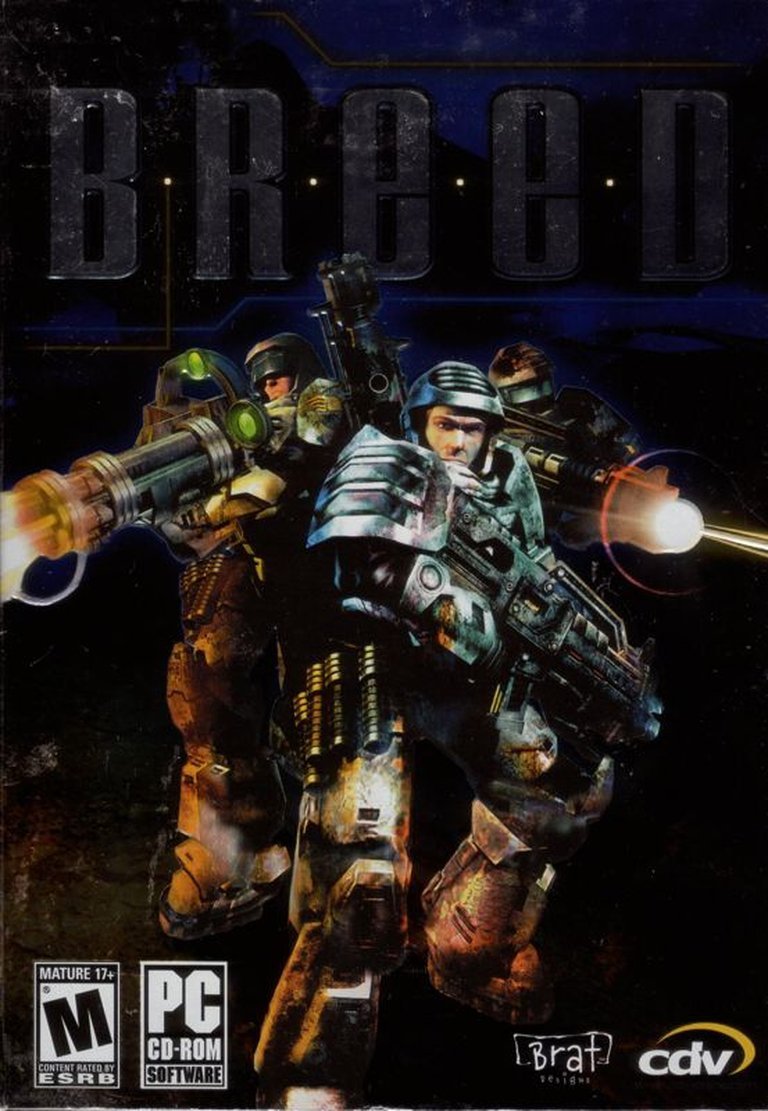
Description
Breed is a sci-fi first-person shooter set in the year 2610, where players command a squad of soldiers to reclaim Earth after a deceptive war with the robotic alien race known as the Breed. The game features 18 diverse missions across tropical islands, Antarctica, and outer space, offering a mix of on-foot combat and vehicular warfare with tanks, buggies, and fighter jets. With destructible environments and an arsenal of weapons like plasma guns and grenades, players must adapt to varied combat scenarios while uncovering the truth behind the Breed’s invasion.
Gameplay Videos
Where to Buy Breed
PC
Breed Cracks & Fixes
Breed Patches & Updates
Breed Guides & Walkthroughs
Breed Reviews & Reception
metacritic.com (51/100): It offers a very nice graphical engine, great voices and sound effects, and an incredibly addictive and intense story line.
ign.com (73/100): While the vehicle combat is pretty fun, it’s still brought back down a few times by design flaws and some odd AI behavior.
mobygames.com (60/100): Breed is set in the year 2610. After a long and costly war with the robotic alien race nick-named the Breed, your warship returns to Earth only to discover that the entire war only was a diversion.
Breed Cheats & Codes
PC
Edit the ‘difficulty.txt’ file in the ‘Scripts’ or ‘run/scripts’ folder to modify damage values.
| Code | Effect |
|---|---|
| Damage0 = 0.0 | Unlimited health (no damage taken except from falling or collisions) |
| Damage1 = 2 | Double damage dealt with any weapon |
| Damage1 = 3 | Triple damage dealt with any weapon |
| Damage1 = 10 | Ten times the damage dealt with any weapon |
| Damage1 = 100 | One hundred times the damage dealt with any weapon |
| Damage0 = -1.0 | Enemy attacks heal the player |
Breed: A Flawed but Fascinating Relic of Early 2000s Tactical Shooters
Introduction
In the annals of video game history, few titles embody the dichotomy of ambition and execution quite like Breed. Released in 2004 by Brat Designs and published by CDV Software, Breed was marketed as a “Halo-killer,” a squad-based tactical shooter that promised to revolutionize the genre with its blend of infantry combat, vehicular warfare, and a grand sci-fi narrative. Yet, despite its lofty aspirations, Breed emerged as a deeply flawed experience, plagued by technical issues, poor AI, and a lack of polish that left critics and players alike divided. This review delves into the game’s development history, narrative depth, gameplay mechanics, and lasting legacy, offering a comprehensive analysis of a title that remains a cautionary tale in game design.
Development History & Context
The Studio and Creators’ Vision
Brat Designs, a relatively obscure studio at the time, was founded by Ed Scio and Jason Gee, who served as the game’s directors and lead designers. Their vision for Breed was ambitious: a squad-based shooter that combined the tactical depth of Rainbow Six with the open-ended combat and vehicular variety of Halo. The game was built on the proprietary Mercury Engine, which was designed to handle large-scale battles, destructible environments, and seamless transitions between ground and space combat.
The development cycle for Breed was protracted, spanning nearly four years. This extended period was marked by shifting design goals, technological hurdles, and the ever-evolving landscape of the FPS genre. By the time Breed launched in early 2004, it faced stiff competition from established franchises like Halo, Far Cry, and Unreal Tournament 2004, all of which had set new benchmarks for graphics, gameplay, and storytelling.
Technological Constraints of the Era
The early 2000s were a transitional period for PC gaming. Hardware was rapidly advancing, but optimization remained a significant challenge. The Mercury Engine, while capable of rendering expansive environments and dynamic physics, struggled with performance issues. Long loading times, frequent crashes, and frame rate drops became hallmarks of Breed‘s technical shortcomings. These issues were exacerbated by the game’s ambitious scope, which included large-scale battles, destructible terrain, and simultaneous ground and space combat.
The Gaming Landscape at Launch
Breed entered a market dominated by titles that had already perfected the formula it sought to emulate. Halo: Combat Evolved had redefined console shooters with its tight controls and cinematic storytelling, while Far Cry and Unreal Tournament 2004 showcased the potential of PC hardware with their stunning visuals and innovative gameplay mechanics. Breed‘s delayed release meant it was judged against these polished experiences, and it often fell short in comparison.
The game’s troubled development was further complicated by a public falling-out between Brat Designs and CDV Software. The developers accused the publisher of releasing an outdated, bug-ridden build of the game, while CDV countered that the version they received was nearly unplayable, forcing them to bring in additional programmers to stabilize it. This dispute underscored the game’s rushed final months and contributed to its lackluster reception.
Narrative & Thematic Deep Dive
Plot Overview
Breed is set in the year 2610, following a prolonged war between humanity and an alien race known as the Breed. The game’s narrative unfolds across two distinct phases:
-
The Colony War (2602–2624): Humanity, having colonized the Besalius binary star system, faces sudden and devastating attacks from the Breed. The United Space Corps (USC) mobilizes a fleet to defend the colonies, culminating in a hard-fought victory. However, the war drains human resources, leaving only the USC Darwin—a massive warship—capable of returning to Earth.
-
The Invasion of Earth (2625): Upon their return, the crew of the Darwin discovers that the Colony War was a diversion. While humanity’s forces were engaged in Besalius, the Breed invaded and conquered Earth, enslaving the remaining population. The Darwin becomes the last bastion of human resistance, launching surgical strikes against the Breed while coordinating with a ragtag group of survivors led by the charismatic Carla Alvarez.
The story is a classic tale of deception, resilience, and desperation, drawing heavily from sci-fi tropes established by franchises like Starship Troopers and Aliens. However, its execution is uneven, with a narrative that often feels rushed or underdeveloped.
Characters and Dialogue
Breed‘s characters are largely anonymous, with the player controlling a squad of genetically engineered soldiers known as “Grunts.” The squad consists of three primary roles:
- Grunt: The default soldier, armed with an assault rifle and shotgun.
- Sniper: Equipped with a long-range rifle and silenced submachine gun.
- Heavy Gunner: Wields a devastating minigun for suppressive fire.
The squad is led by Sergeant Westwood, whose over-the-top dialogue and humorous asides provide occasional levity. However, the voice acting is widely criticized for its wooden delivery and lack of emotional depth. The game’s attempt to blend satire with serious storytelling often falls flat, leaving players with a disjointed tonal experience.
Themes
Breed explores several themes central to the sci-fi genre:
- The Cost of War: The game highlights the physical and psychological toll of prolonged conflict, particularly through the lens of the Grunts—soldiers bred for combat and treated as expendable assets.
- Deception and Strategy: The Breed’s diversionary tactics serve as a commentary on the nature of warfare, where victory often hinges on misdirection and exploitation of weaknesses.
- Human Resilience: Despite the overwhelming odds, the crew of the Darwin and the human resistance refuse to surrender, embodying the indomitable spirit of survival.
While these themes are compelling in theory, their execution is hampered by the game’s technical issues and underdeveloped narrative. The story’s potential is often overshadowed by repetitive mission structures and a lack of meaningful character development.
Gameplay Mechanics & Systems
Core Gameplay Loops
Breed is a squad-based first-person shooter that emphasizes tactical decision-making and coordinated combat. The game’s core gameplay loop revolves around completing mission objectives while managing a squad of soldiers, each with unique roles and abilities. Players can switch between squad members on the fly, allowing for dynamic approaches to combat scenarios.
The game features 18 missions set across diverse environments, including tropical islands, arctic wastelands, and outer space. Each mission typically involves a mix of infantry combat, vehicular segments, and occasional aerial dogfights. The variety in mission design is one of Breed‘s strengths, though it is often undermined by technical issues and poor AI.
Combat and Squad Mechanics
Combat in Breed is divided into three primary components:
-
Infantry Combat: Players engage in ground-based firefights, utilizing a range of weapons from assault rifles to plasma cannons. The game’s cover system is rudimentary, and enemy AI is often predictable, leading to repetitive encounters.
-
Vehicular Combat: One of Breed‘s standout features is its emphasis on vehicles, which include tanks, buggies, and fighter jets. Vehicular segments are generally more engaging than infantry combat, offering a sense of scale and destructibility that was impressive for its time.
-
Aerial Combat: The game includes several missions where players pilot spacecraft, engaging in dogfights and bombing runs. These segments are visually impressive but suffer from clunky controls and unclear objectives.
The squad mechanics allow players to issue commands such as regrouping, ceasing fire, or providing covering fire. However, the AI’s poor pathfinding and lack of tactical awareness often render these commands ineffective. Squad members frequently get stuck on terrain, fail to follow orders, or charge blindly into enemy fire, leading to frustration rather than strategic depth.
Character Progression and Customization
Breed lacks a traditional progression system. Players cannot customize their squad members’ abilities or upgrade their equipment. Instead, the game relies on its varied mission structures and vehicle segments to maintain player engagement. While this approach offers flexibility in how players tackle objectives, it also results in a lack of long-term progression or meaningful character development.
UI and Innovative Systems
The game’s user interface is functional but unremarkable. The heads-up display (HUD) provides essential information such as ammunition count, health, and mission objectives, but it lacks the polish of contemporary titles. One of Breed‘s more innovative features is its “gameplay kernel,” which allows for simultaneous action on the ground and in space. This system enables dynamic mission structures where players might engage in a dogfight in Earth’s orbit before descending to the planet’s surface to continue the battle.
Flawed Systems
Despite its innovations, Breed is riddled with flaws that detract from the overall experience:
- Poor AI: Both friendly and enemy AI suffer from glaring issues. Squad members often fail to follow orders or get stuck on terrain, while enemies exhibit predictable behavior and lack tactical awareness.
- Technical Instability: The game is plagued by long loading times, frequent crashes, and frame rate drops, particularly during intense combat sequences.
- Repetitive Mission Design: Many missions devolve into repetitive firefights or vehicle segments, with little variation in objectives or enemy encounters.
- Lack of Polish: The game’s visuals, while impressive in scale, lack the detail and refinement of its contemporaries. Textures are often muddy, and animations are stiff.
World-Building, Art & Sound
Setting and Atmosphere
Breed is set in a futuristic sci-fi universe where humanity is locked in a desperate struggle against the Breed. The game’s environments are diverse, ranging from lush tropical islands to frozen arctic landscapes and alien-infested installations. The sense of scale is one of the game’s strengths, with vast open areas that emphasize the isolation and desperation of the human resistance.
However, the game’s world-building is often undermined by its technical limitations. While the environments are expansive, they lack the detail and interactivity of more polished titles. Destructible terrain, a touted feature, is inconsistently implemented, with some objects indestructible despite the game’s marketing claims.
Visual Direction
Visually, Breed is a mixed bag. The Mercury Engine allows for impressive draw distances and large-scale battles, but the game’s textures and character models are often dated, even by 2004 standards. The art direction leans heavily into the sci-fi aesthetic, with sleek vehicles and futuristic weaponry, but the execution is uneven. The Breed, in particular, are visually unremarkable, resembling generic robotic aliens rather than the terrifying foes the narrative suggests.
Sound Design
The sound design in Breed is similarly inconsistent. The game features a soundtrack composed by Nathan McCree, known for his work on the Tomb Raider series. The music is atmospheric, blending orchestral and electronic elements to create a sense of tension and urgency. However, the voice acting is widely criticized for its wooden delivery and over-the-top dialogue. Sound effects, such as weapon fire and explosions, are serviceable but lack the impact of more polished titles.
Reception & Legacy
Critical and Commercial Reception
Breed received mixed reviews upon its release, with critics praising its ambitious scope and vehicular combat while lambasting its technical issues and poor AI. The game’s Metacritic score of 51/100 reflects this divided reception. Notable criticisms included:
- Technical Instability: Long loading times, frequent crashes, and frame rate drops were common complaints.
- Poor AI: Both friendly and enemy AI were criticized for their lack of intelligence and tactical awareness.
- Repetitive Gameplay: Many reviewers found the mission design repetitive, with little variation in objectives or enemy encounters.
- Lack of Polish: The game’s visuals and sound design were seen as dated and unrefined compared to contemporaries like Halo and Far Cry.
Despite these flaws, some critics praised Breed for its innovative squad mechanics and vehicular combat. IGN’s review, for example, noted that “the vehicle combat is pretty fun,” though it was “brought back down by design flaws and some odd AI behavior.”
Commercially, Breed was a disappointment. The game’s technical issues and lackluster reception likely contributed to its poor sales, and it failed to make a significant impact in the crowded FPS market of 2004.
Influence and Legacy
Breed‘s legacy is one of missed potential. While it introduced several innovative mechanics, such as squad-based tactics and simultaneous ground/space combat, these features were overshadowed by the game’s technical shortcomings. The title serves as a cautionary tale about the dangers of over-ambition and rushed development, particularly in an era where player expectations were rapidly evolving.
Despite its flaws, Breed has garnered a small but dedicated fanbase over the years. Some players appreciate its unique blend of gameplay elements and its ambitious narrative, even if the execution leaves much to be desired. The game’s limited edition, which included a Grunt figurine and other collectibles, has become a sought-after item among collectors.
In the broader context of the FPS genre, Breed is often remembered as a footnote—a game that could have been great but was ultimately undone by its own ambitions. Its influence on subsequent titles is minimal, though its emphasis on squad mechanics and vehicular combat can be seen in later games like Battlefield 2 and Star Wars: Republic Commando.
Conclusion
Breed is a game of contradictions: ambitious yet flawed, innovative yet unpolished, and compelling yet frustrating. Its narrative of human resilience against an overwhelming alien threat is undeniably engaging, but its execution is marred by technical issues, poor AI, and a lack of refinement. The game’s vehicular combat and squad mechanics offer glimpses of what could have been a groundbreaking experience, but these moments are too often overshadowed by repetitive mission design and instability.
In the pantheon of early 2000s shooters, Breed occupies a unique position—a relic of an era where ambition frequently outpaced technical capability. It is a game that deserves recognition for its innovations, even as it serves as a reminder of the importance of polish and stability in game design. For those willing to overlook its flaws, Breed offers a fascinating, if imperfect, glimpse into the evolution of the tactical shooter genre.
Final Verdict: Breed is a flawed but fascinating experiment in squad-based shooters. Its ambitious design and innovative mechanics are undermined by technical issues and poor execution, making it a game that is more interesting in theory than in practice. While it fails to live up to its potential as a “Halo-killer,” it remains a noteworthy, if cautionary, entry in the history of FPS games.
Score: 6/10 – A bold but deeply flawed effort that ultimately falls short of its lofty ambitions.