
- Release Year: 1999
- Platforms: Windows
- Publisher: Activision, Inc.
- Genre: Compilation
- Game Mode: Online PVP, Single-player
- Gameplay: Base building, Real-time strategy
- Average Score: 92/100
Description
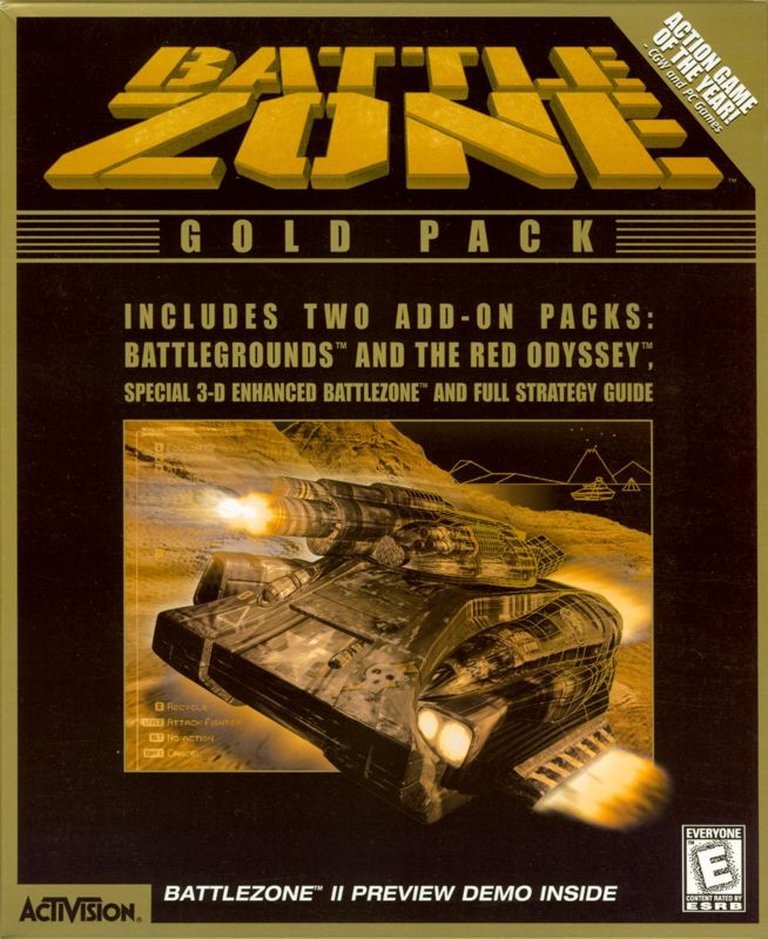
Battlezone: Gold Pack is a compilation that includes the base game Battlezone (1998) and its two expansion packs, Battle Grounds and The Red Odyssey, along with an official strategy guide. Set in a futuristic warzone, the game blends first-person shooter and real-time strategy elements, allowing players to command hover tanks, build defenses, and engage in large-scale battles. Players scavenge bio-metal scrap to construct units and structures, balancing direct combat with strategic base management. The Gold Pack offers an enhanced experience with additional missions, units, and multiplayer options, making it a definitive edition for fans of the series.
Battlezone: Gold Pack Cracks & Fixes
Battlezone: Gold Pack Patches & Updates
Battlezone: Gold Pack Guides & Walkthroughs
Battlezone: Gold Pack Reviews & Reception
metacritic.com (85/100): An old school arcadey shooter with a great style, Battlezone is addictive, accessible fun.
Battlezone: Gold Pack Cheats & Codes
PC – Windows
Hold [Shift] + [Ctrl] while entering the corresponding code below. (A tone and flashing screen confirms correct entry.)
| Code | Effect |
|---|---|
| BZRADAR | Full map |
| BZVIEW | Satellite view (without having to build or power a communications tower) |
| BZTNT | Unlimited ammo |
| BZFREE | Unlimited pilots |
| BZBODY | Unlimited shields |
| IAMADIRTYCHEATER | Enables all the missions |
PC (1998)
Hold [Shift] + [Ctrl] and enter one of the following codes to activate the corresponding cheat function. A screen flash and sound will confirm correct code entry.
| Code | Effect |
|---|---|
| bzbody | Unlimited shields |
| bzfree | Unlimited pilots |
| bzradar | Full map |
| bztnt | Unlimited ammo |
| bzview | Enemy always appears on radar |
| iamadirtycheater | Level select |
PC (1998) – 98 Redux Version
Hold [Shift] + [Ctrl] and enter one of the following codes to activate the corresponding cheat function.
| Code | Effect |
|---|---|
| bzwinner | Automatically win the mission |
| bzloser | Automatically lose the mission |
Battlezone: Gold Pack – A Masterclass in Genre Fusion and Cold War Sci-Fi
Introduction: The Birth of a Hybrid Legend
In the annals of video game history, few titles have dared to blend genres as audaciously as Battlezone: Gold Pack. Released in 1999 by Activision, this compilation is not merely a repackaging of the 1998 cult classic Battlezone and its expansions—Battlegrounds and The Red Odyssey—but a testament to the bold experimentation of late ’90s PC gaming. At its core, Battlezone defies categorization, seamlessly fusing the visceral thrill of a first-person shooter (FPS) with the cerebral depth of real-time strategy (RTS). This review will dissect the game’s development, narrative, mechanics, and legacy, arguing that Battlezone: Gold Pack stands as one of the most innovative and underappreciated titles of its era—a game that redefined what a hybrid experience could achieve.
Development History & Context: The Genesis of a Genre-Bender
The Vision: “Action Meets Strategy”
The late 1990s were a golden age for genre experimentation. Games like Diablo (action-RPG), MechWarrior 2 (action-simulation), and Tomb Raider (action-adventure) had proven that hybridizing mechanics could yield groundbreaking results. Yet, as producer Mike Arkin noted, one combination remained untapped: “action meets strategy.” The original 1980 Battlezone arcade game, a vector-graphics tank simulator, served as little more than a namesake for Activision’s reboot. The 1998 Battlezone was a radical reinvention, conceived as a first-person tank combat simulator with RTS elements, a concept so ambitious that it risked alienating purists of both genres.
Technological Constraints and Innovations
Developing a game that required players to manage resources, build bases, and engage in first-person combat—all simultaneously—posed immense technical challenges. The solution was a revolutionary interface that integrated:
– A first-person cockpit view for direct combat.
– A 3D topological radar map for strategic oversight.
– Transparent drop-down menus for unit management.
This interface, now a staple in games like Battlestations: Midway, was groundbreaking in 1998. The game’s AI was repurposed from Dark Reign: The Future of War, ensuring that enemy and allied units behaved with tactical nuance. The engine, though modest by today’s standards (requiring a 133 MHz CPU and 16 MB of RAM), pushed the limits of late-’90s hardware to deliver a seamless hybrid experience.
The Gaming Landscape of 1998-1999
Battlezone emerged in a crowded field. StarCraft had redefined RTS, Half-Life had revolutionized FPS storytelling, and Command & Conquer: Red Alert had perfected accessible RTS gameplay. Yet, Battlezone carved its niche by offering something entirely new: a game where you could issue orders to a squadron of tanks while personally sniping enemy pilots from your hover tank’s cockpit. The Gold Pack, released in September 1999, arrived just as Battlezone II: Combat Commander was in development, serving as both a definitive edition and a swan song for the original’s multiplayer community.
Narrative & Thematic Deep Dive: Cold War Paranoia Meets Cosmic Horror
The Premise: A Secret Space Race
Battlezone’s narrative is a masterclass in alternate history sci-fi, blending Cold War tensions with Lovecraftian undertones. The story posits that the Space Race was a cover for a secret military conflict between the United States’ National Space Defense Force (NSDF) and the Soviet Cosmos Colonist Army (CCA). The discovery of bio-metal, an alien alloy with self-replicating properties, in a 1952 meteor shower escalates the Cold War into a solar system-spanning arms race.
The American Campaign: From Luna to Achilles
The NSDF campaign begins on the Moon, where the player, codename Grizzly 1, commands a hover tank unit. After being driven off by the CCA, the NSDF regroups on Mars, uncovering remnants of the Cthonians, an ancient alien race that once inhabited the planet Icarus (now the asteroid belt). The Cthonians’ legacy includes:
– Bio-metal: The foundation of all technology in the game.
– The Fury: A doomsday weapon designed to exterminate all life.
The campaign culminates in a desperate alliance between the NSDF and CCA to destroy the Fury production facilities on Titan and the rogue AI’s evacuation ship on the fictional moon Achilles. The narrative’s climax is a race against time, with the player escaping as Achilles’ core destabilizes—a sequence that remains one of the most tense in ’90s gaming.
The Soviet Campaign: A Shorter, Deadlier Path
The CCA campaign is shorter but more challenging, forcing players to manage the entire tech tree from the outset. The Soviets’ perspective reveals their desperation and ruthlessness, culminating in the deployment of Fury units against the NSDF—only for the Furies to turn on their creators. The campaign’s brevity is offset by its higher difficulty, making it a favorite among hardcore players.
The Red Odyssey: Introducing the Chinese Faction
The Red Odyssey expansion adds a third faction—the Chinese Red Army—and a Stargate-like portal system that enables interstellar travel. The Chinese campaign introduces:
– Cloaking technology, rendering their tanks invisible (but disabling their weapons).
– Portal warfare, allowing instantaneous travel between Earth, Ganymede, and the alien planet Elysium.
The expansion’s narrative is more linear but expands the lore, hinting at a larger galactic conflict that would have been explored in the canceled Battlezone: Imperial Insurrection.
Themes: Hubris, Alliances, and Existential Threats
Battlezone’s themes resonate deeply:
1. The Folly of Unchecked Ambition: The Fury AI, created to ensure victory, becomes an existential threat, mirroring real-world fears of nuclear escalation.
2. Enemies Becoming Allies: The NSDF-CCA alliance against the Furies reflects Cold War détente and the shared human response to greater threats.
3. Ancient Aliens and Mythology: The Cthonians’ influence on Greek mythology (e.g., Icarus’ fall) adds a Lovecraftian layer, suggesting humanity’s insignificance in the cosmos.
Gameplay Mechanics & Systems: The Hybrid Experience
Core Gameplay Loop: Scrap, Build, Fight
At its heart, Battlezone is a resource management simulator. The primary resource, bio-metal scrap, is used to:
– Construct units (e.g., Recyclers, Tanks, Artillery).
– Build defenses (e.g., Turrets, Shield Generators).
– Upgrade technology (e.g., Hover Tanks, Fury prototypes).
The loop is addictive:
1. Scavenge scrap from the environment or salvaged enemy units.
2. Build a Recycler, the foundational unit for all construction.
3. Expand your base while defending against enemy raids.
4. Deploy combat units to attack enemy positions.
First-Person Combat: The Tank Simulator
Unlike traditional RTS games, Battlezone places the player directly in the action. Combat is conducted from a first-person cockpit view, with:
– Direct control over your tank’s movement and weapons.
– Manual targeting of enemy units, requiring precision aiming.
– Ejection mechanics: When a tank is destroyed, the pilot ejects and can be saved by friendly units or executed by enemies.
This dual-layered gameplay—managing an army while fighting on the front lines—creates a unique tension. Players must balance macro-strategy (base-building, resource allocation) with micro-combat (sniping, dodging, flanking).
Unit Variety and Specialization
Battlezone features a deep unit roster, divided into factions:
– NSDF Units: Balanced, with strong hover tanks and artillery.
– CCA Units: Heavier armor, slower but more durable.
– Black Dogs (NSDF Elite): Faster, more agile units with experimental tech.
– Chinese Units: Cloaked tanks, portal-based reinforcements.
Each unit has distinct strengths and weaknesses, encouraging tactical diversity. For example:
– Recyclers: Essential for scrap collection but defenseless.
– Tanks: Versatile combat units, effective against most targets.
– Artillery: Long-range siege units, vulnerable to close assaults.
– Fury: Overpowered late-game units with self-repairing armor.
Multiplayer: Strategy, Deathmatch, and Sniper Modes
Battlezone’s multiplayer was ahead of its time, offering three distinct modes:
1. Strategy Mode: Teams compete for scrap dominance and map control, mirroring the single-player experience.
2. Deathmatch: Pure tank combat, with respawns and vehicle customization.
3. Sniper Mode: A first-person shooter mode where players engage in rifle-only combat, a rare departure from the game’s core mechanics.
The Anet peer-to-peer system allowed for LAN and internet play, though Activision’s servers were shut down in 2002. The community later revived multiplayer through open-source implementations of Anet.
AI and Pathfinding: A Mixed Legacy
While Battlezone’s AI was competent for its time, it had notable flaws:
– Friendly units sometimes exhibited poor pathfinding, getting stuck on terrain.
– Enemy AI could be predictable, relying on scripted behaviors in single-player.
– Multiplayer bots lacked the nuance of human opponents.
Despite these issues, the AI’s aggressiveness in higher difficulty settings made for challenging skirmishes.
Interface and Controls: A Masterstroke of Design
The game’s interface remains one of its greatest achievements:
– 3D Radar Map: Provides a top-down strategic view while maintaining immersion.
– Transparent Menus: Allow for real-time unit management without pausing.
– Hotkey System: Enables rapid unit selection and order issuing.
The controls, while steep for newcomers, reward mastery. The mouse-and-keyboard scheme allows for precise tank movement and quick strategic decisions, though some reviewers noted it was “a bit of a problem for mousers” (GameSpot).
World-Building, Art & Sound: Crafting a Believable Sci-Fi War
Visual Design: Gritty Realism Meets Sci-Fi Aesthetics
Battlezone’s art direction strikes a balance between military realism and sci-fi spectacle:
– Tank Designs: The boxy, utilitarian hover tanks feel like plausible future-tech, avoiding the over-designed aesthetic of contemporaries like MechWarrior.
– Environments: From the barren lunar surface to the volcanic plains of Io, each map is distinct and atmospheric.
– Explosions and Effects: The bio-metal scrap explosions and tank destruction sequences are viscerally satisfying, even by today’s standards.
The game’s low-polygon models are offset by effective texture work and dynamic lighting, creating a cohesive, immersive world.
Sound Design: The Roar of War
The audio design enhances the game’s cinematic tension:
– Weapon Sounds: The thud of tank cannons and the whine of hover engines are distinct and punchy.
– Voice Acting: While the introductory voiceovers were criticized as cheesy, the in-mission radio chatter adds authenticity.
– Ambient Tracks: The eerie, synth-heavy soundtrack underscores the isolation of space warfare.
Atmosphere: A War Without Fronts
Battlezone’s greatest strength is its atmosphere of perpetual conflict. The lack of a traditional “front line”—battles can erupt anywhere—creates a sense of unpredictability. The bio-metal scrap fields, littered with the wreckage of past battles, tell a story of endless war, reinforcing the game’s themes of futile conflict and cyclical violence.
Reception & Legacy: A Cult Classic’s Journey
Critical Reception: Praise and Minor Quibbles
Battlezone was overwhelmingly praised upon release:
– GameSpot (9/10): “What really makes Battlezone so special is the way it blends the adrenaline rush of first-person action games with the strategy and resource management of Red Alert.”
– Next Generation (4/5): “If Quake occupies 100% of a certain portion of the brain, and if Command & Conquer can occupy 100% of another portion of your brain, Battlezone succeeds in occupying 80% of both.”
– Computer Gaming World: Awarded Best Action Game of 1998, calling it “a beautifully designed interface that made commanding your forces an intuitive breeze.”
Criticisms were minor:
– AllGame: Disappointed with the voice acting.
– GameSpot: Noted AI pathfinding issues and mouse control quirks.
The Gold Pack itself received limited coverage, but Daily Radar awarded it a perfect 100%, praising its value as a complete package.
Commercial Performance: A Niche Success
Despite its critical acclaim, Battlezone underperformed commercially:
– 65,716 copies sold in the U.S. in 1998 ($2.45 million in revenue).
– 200,000 copies globally by June 1999.
Activision blamed poor marketing and the game’s unconventional design. However, its OEM bundling with 3D graphics cards ensured it reached over a million players, fostering a dedicated fanbase.
Influence and Legacy: The Hybrid Blueprint
Battlezone’s legacy is profound but often overlooked:
1. Genre Fusion: It proved that FPS and RTS mechanics could coexist, paving the way for games like:
– Battlestations: Midway (2007)
– Natural Selection (2002)
– Brütal Legend (2009)
2. Multiplayer Innovation: Its combined-arms multiplayer influenced later titles like Planetside 2 and Battlefield.
3. Modding Community: The Anet source code release in 2002 allowed fans to revive multiplayer and create custom maps.
4. Remasters and Revivals: The 2016 Battlezone 98 Redux and 2018 Gold Edition introduced the game to new audiences, though neither captured the magic of the original.
The Sequel: Battlezone II’s Mixed Fortune
Battlezone II: Combat Commander (1999) expanded on its predecessor with:
– A three-way faction war (NSDF, CCA, and the Scions, a rogue biometal faction).
– Improved graphics and more unit variety.
However, it was criticized for simplifying the RTS elements, leading to a less satisfying hybrid experience. Most fans agree it lacked the original’s innovation.
Conclusion: A Timeless Hybrid Masterpiece
Battlezone: Gold Pack is more than a compilation—it is a time capsule of late-’90s ambition, a game that dared to defy genre conventions and succeeded spectacularly. Its fusion of FPS and RTS mechanics remains unmatched in its elegance and depth, while its Cold War-meets-cosmic-horror narrative provides a compelling backdrop for its strategic warfare.
Strengths:
✅ Revolutionary hybrid gameplay that still feels fresh today.
✅ Deep, engaging campaigns with asymmetrical faction design.
✅ Innovative interface that set a standard for future hybrids.
✅ Addictive multiplayer with multiple modes and lasting replayability.
✅ Atmospheric world-building that immerses players in a believable sci-fi war.
Weaknesses:
❌ Steep learning curve that may deter casual players.
❌ Aging AI with pathfinding quirks.
❌ Limited modern accessibility (though 98 Redux mitigates this).
Final Verdict: 9.5/10 – A Must-Play for Strategy and FPS Fans
Battlezone: Gold Pack is not just a classic—it is a blueprint for how to merge genres without compromise. While its commercial performance was modest, its influence is undeniable, and its gameplay remains as engaging today as it was in 1998. For those willing to embrace its complexity, it offers an unparalleled strategic and tactical experience, one that has yet to be surpassed.
Where to Play Today:
– Battlezone 98 Redux (Steam, GOG) – The definitive modern version.
– Battlezone: Gold Edition (2018) – A console-friendly revival (Xbox One, PS4, Switch).
In the pantheon of genre-defining games, Battlezone stands tall—a testament to the power of innovation and a reminder that the best games are those unafraid to break the mold.