
- Release Year: 2001
- Platforms: DOS, Windows
- Publisher: Interplay Entertainment Corp.
- Genre: Compilation
- Game Mode: Single-player
Description
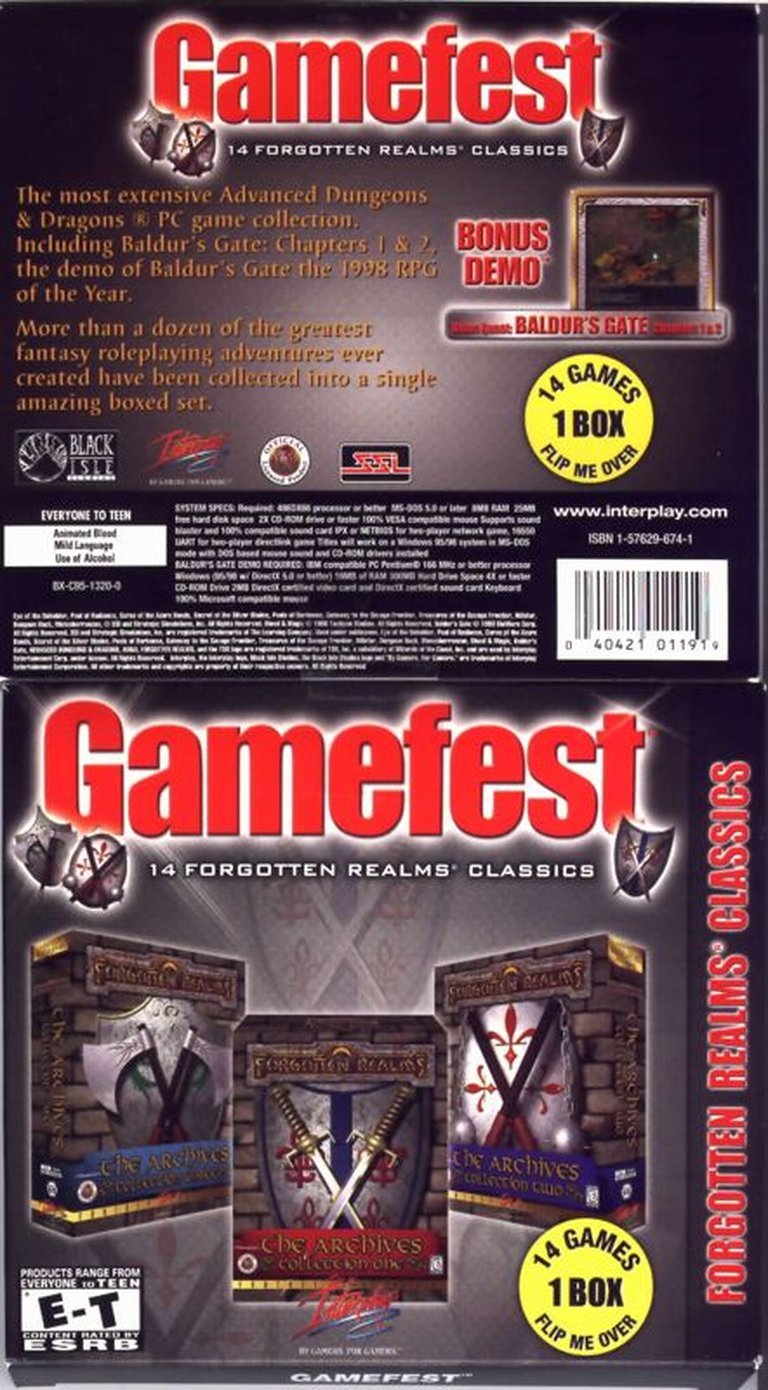
Gamefest: Forgotten Realms Classics is a comprehensive compilation of classic Advanced Dungeons & Dragons games set in the Forgotten Realms universe. Released in 2001 by Interplay Entertainment, this collection bundles three previously released archives into a single package, featuring iconic titles like the Eye of the Beholder trilogy, Pool of Radiance, Baldur’s Gate, and many others. The games span a variety of genres, including dungeon crawlers, RPGs, and strategy games, all set in the rich fantasy world of the Forgotten Realms.
Gamefest: Forgotten Realms Classics Cheats & Codes
Pool of Radiance
| Code | Effect |
|---|---|
| start.exe STING | The Gods intervene! |
Curse of the Azure Bonds
| Code | Effect |
|---|---|
| start.exe STING Wooden | The Gods intervene! |
Secrets of the Silver Blade
| Code | Effect |
|---|---|
| start.exe Hoop Gem | The Gods intervene! |
Pools of Darkness
| Code | Effect |
|---|---|
| game.exe 2 2 Helm | The Gods intervene! |
Gateway to the Savage Frontier
Press the Z button on your turn and ‘-‘ on the monsters
| Code | Effect |
|---|---|
| game.exe Super Wooden | The Gods intervene! |
Treasure of the Savage Frontier
| Code | Effect |
|---|---|
| game.exe 2 2 Helm | The Gods intervene! |
Champions of Krynn
| Code | Effect |
|---|---|
| start.exe Woof Helm | The Gods intervene! |
Death Knights of Krynn
| Code | Effect |
|---|---|
| start.exe anything Helm | The Gods intervene! |
Gamefest: Forgotten Realms Classics: A Definitive Retrospective
Introduction: The Ultimate Dungeon Master’s Toolkit
In the pantheon of Dungeons & Dragons video game compilations, Gamefest: Forgotten Realms Classics (2001) stands as a monumental artifact—a dual-CD jewel case that encapsulates the golden age of Advanced Dungeons & Dragons (AD&D) gaming on PC. Released by Interplay Entertainment, this compilation is not merely a collection of games but a compilation of compilations, bundling the three Forgotten Realms Archives sets into a single, budget-priced package. For fans of the Forgotten Realms, this release was nothing short of a treasure trove, offering a comprehensive journey through the evolution of AD&D gameplay, narrative depth, and world-building across nearly two decades of development.
At its core, Gamefest: Forgotten Realms Classics is a time capsule. It preserves the legacy of 14 distinct AD&D games, from the grid-based tactical combat of Pool of Radiance to the first-person dungeon crawling of Eye of the Beholder, the experimental Dungeon Hack, and the narrative-driven Baldur’s Gate demo. This review will dissect the compilation’s historical significance, gameplay diversity, narrative richness, and enduring influence, arguing that it remains one of the most essential collections for both retro gaming enthusiasts and scholars of RPG history.
Development History & Context: The Golden Age of AD&D on PC
The Interplay & SSI Legacy
The games included in Gamefest: Forgotten Realms Classics were developed by a constellation of studios under the auspices of Interplay and Strategic Simulations, Inc. (SSI), the latter of which was the primary licensee for AD&D video games throughout the 1980s and early 1990s. SSI’s Gold Box engine, debuted in Pool of Radiance (1988), became the backbone of early Forgotten Realms RPGs, offering a blend of tactical combat, party management, and deep lore. Meanwhile, Westwood Studios’ Eye of the Beholder series (1990–1993) pioneered first-person dungeon crawling with real-time combat, while DreamForge Intertainment’s Menzoberranzan (1994) and Blood & Magic (1996) experimented with narrative-driven gameplay and strategic spellcasting.
By the time Gamefest was released in 2001, the gaming landscape had shifted dramatically. The rise of 3D graphics, real-time combat systems, and open-world design—exemplified by Baldur’s Gate II: Shadows of Amn (2000)—had rendered many of these earlier titles obsolete in the eyes of mainstream audiences. Yet, Interplay’s decision to repackage these classics was not merely nostalgic; it was a deliberate act of preservation. The compilation arrived at a moment when digital distribution was in its infancy, and physical media remained the primary means of accessing older games. For collectors and newcomers alike, Gamefest offered a rare opportunity to experience the foundational works of the Forgotten Realms in a single, accessible format.
Technological Constraints & Innovations
The games in Gamefest span multiple technological eras, each reflecting the limitations and innovations of their time:
- Early Gold Box Titles (1988–1991): Pool of Radiance, Curse of the Azure Bonds, and Secret of the Silver Blades relied on DOS-based systems with EGA/VGA graphics, turn-based combat, and text-heavy interfaces. These games were revolutionary for their time, offering complex character creation and tactical depth, but their reliance on keyboard inputs and menu-driven navigation feels archaic by modern standards.
- First-Person Dungeon Crawlers (1990–1993): The Eye of the Beholder trilogy introduced real-time combat and 3D dungeon environments, albeit with rudimentary graphics by today’s standards. These games emphasized exploration and puzzle-solving, with Assault on Myth Drannor (1993) pushing the limits of the engine with larger dungeons and more intricate level design.
- Experimental & Hybrid Titles (1993–1996): Dungeon Hack (1993) was a roguelike dungeon crawler with procedurally generated levels, while Menzoberranzan (1994) blended adventure game mechanics with RPG elements. Blood & Magic (1996) stood out as a real-time strategy game with RPG elements, offering a unique take on spellcasting and resource management.
The compilation’s inclusion of a Baldur’s Gate demo (Chapters I & II) served as a bridge between the old and the new, showcasing the Infinity Engine’s capabilities and hinting at the future of CRPG design. However, the demo’s presence also underscored the technological gulf between the older titles and the emerging standards of the late 1990s.
The Gaming Landscape in 2001
By 2001, the CRPG genre was in a state of flux. Baldur’s Gate II and Icewind Dale had set new benchmarks for narrative depth and gameplay polish, while Neverwinter Nights (2002) was on the horizon, promising a revolution in modular storytelling. Meanwhile, action RPGs like Diablo II (2000) and Dark Alliance (2001) were attracting a broader audience with their accessible combat and multiplayer focus.
In this context, Gamefest: Forgotten Realms Classics was a niche product, targeted at hardcore fans and collectors rather than mainstream gamers. Its release coincided with the decline of DOS gaming and the rise of Windows XP, which posed compatibility challenges for older titles. Interplay’s decision to include code wheels for Hillsfar, Curse of the Azure Bonds, and Pool of Radiance was a nod to authenticity, but the lack of printed manuals reflected the cost-cutting measures of budget compilations.
Narrative & Thematic Deep Dive: The Tapestry of Faerûn
The Forgotten Realms as a Living World
The Forgotten Realms, created by Ed Greenwood in the 1960s and officially published by TSR in 1987, is one of the most richly detailed fantasy settings in gaming history. The games in Gamefest collectively explore the breadth of Faerûn, from the war-torn streets of Phlan (Pool of Radiance) to the treacherous Underdark (Menzoberranzan), the political intrigues of Waterdeep (Gateway to the Savage Frontier), and the demonic invasions of the Moonsea (Pools of Darkness).
Each game contributes to the setting’s lore in meaningful ways:
- Pool of Radiance (1988): The inaugural Gold Box title introduces players to the city of Phlan, a once-great port now overrun by evil forces. The game’s narrative is straightforward—a band of adventurers must reclaim the city—but its world-building is foundational, establishing the tone and scope of the Forgotten Realms.
- Curse of the Azure Bonds (1989): A direct sequel to Pool of Radiance, this game expands the stakes, introducing the eponymous cursed tattoos that bind the party to a greater conspiracy. The narrative is more personal, with characters grappling with their own fates while uncovering a plot involving the Red Wizards of Thay.
- Eye of the Beholder Trilogy (1990–1993): These games shift the focus to dungeon crawling, with Assault on Myth Drannor (1993) offering a climactic battle against the forces of darkness in the ruins of the elven city. The trilogy’s strength lies in its atmospheric storytelling, with environmental details and NPC interactions hinting at deeper lore.
- Menzoberranzan (1994): A narrative-driven adventure set in the drow city of the same name, this game explores the cutthroat politics of the Underdark. Players take on the role of a surface-dwelling adventurer caught in the machinations of House Baenre, offering a rare glimpse into drow society.
- Blood & Magic (1996): A real-time strategy game with RPG elements, Blood & Magic focuses on the magical wars of the Forgotten Realms, with players commanding armies of spellcasters and monsters. Its narrative is episodic, but its world-building is expansive, drawing on the setting’s rich history of arcane conflicts.
Themes of Heroism, Corruption, and Redemption
The games in Gamefest explore a range of themes that resonate with the broader Dungeons & Dragons ethos:
- Heroism and Sacrifice: Many of the games, particularly the Gold Box titles, revolve around the classic D&D trope of a band of adventurers rising to meet a great threat. Whether reclaiming a city (Pool of Radiance), breaking a curse (Curse of the Azure Bonds), or thwarting a demonic invasion (Pools of Darkness), the protagonists are cast as heroes in the traditional sense.
- Corruption and Power: The Forgotten Realms is a world where power often corrupts, and several games explore this theme. Menzoberranzan delves into the ruthless politics of the drow, while Blood & Magic examines the consequences of unchecked magical ambition.
- Redemption and Identity: Games like Secret of the Silver Blades and Treasures of the Savage Frontier feature characters grappling with their pasts and seeking redemption. The narrative arcs often involve uncovering hidden truths and making moral choices that shape the protagonist’s identity.
Dialogue and Character Depth
The dialogue in these games varies widely in quality, reflecting the technological and design constraints of their eras:
- Gold Box Titles: The early Gold Box games rely heavily on text-based interactions, with dialogue often limited to exposition and quest prompts. However, games like Curse of the Azure Bonds and Pools of Darkness feature more nuanced NPC interactions, with characters offering insights into the world’s politics and history.
- Eye of the Beholder Trilogy: These games prioritize environmental storytelling over dialogue, with NPCs often serving as quest givers or vendors. The lack of voice acting and limited text space means that character depth is conveyed through actions rather than words.
- Menzoberranzan and Blood & Magic: These later titles feature more elaborate dialogue systems, with Menzoberranzan in particular offering branching conversations and moral choices. Blood & Magic’s episodic structure allows for more character-driven storytelling, with each mission featuring unique NPCs and objectives.
Gameplay Mechanics & Systems: A Spectrum of RPG Design
Core Gameplay Loops
The Gamefest compilation offers a remarkable diversity of gameplay mechanics, reflecting the evolution of CRPG design from the late 1980s to the mid-1990s:
-
Gold Box Engine (Turn-Based Tactical Combat):
- Combat: The Gold Box games (Pool of Radiance, Curse of the Azure Bonds, Secret of the Silver Blades, Pools of Darkness, Gateway to the Savage Frontier, Treasures of the Savage Frontier) feature a grid-based combat system where players issue commands to their party members in turn-based rounds. The system is deeply tactical, with positioning, spell selection, and weapon choice playing crucial roles.
- Character Progression: Characters advance through experience points (XP) earned from combat and quests, with level-ups unlocking new spells, abilities, and hit points. The AD&D ruleset is faithfully implemented, with attributes like Strength, Dexterity, and Intelligence directly impacting gameplay.
- Exploration: The Gold Box games blend overworld exploration with dungeon crawling, with players navigating towns, wilderness areas, and dungeons. The interface is menu-driven, with players selecting actions from text-based prompts.
-
First-Person Dungeon Crawling (Eye of the Beholder Trilogy):
- Combat: The Eye of the Beholder games feature real-time combat with a first-person perspective. Players control a party of adventurers, issuing commands via a simple interface (e.g., attack, cast spell, use item). The combat is less tactical than the Gold Box games but more immediate and visceral.
- Character Progression: Similar to the Gold Box games, characters gain XP and level up, but the focus is more on equipment and item management. The lack of a robust skill system means that progression is largely linear.
- Exploration: The dungeons in Eye of the Beholder are labyrinthine, with puzzles, traps, and hidden secrets. The first-person perspective immerses players in the environment, but the lack of an automap (in the first game) can make navigation frustrating.
-
Hybrid & Experimental Systems:
- Dungeon Hack (1993): A roguelike dungeon crawler with procedurally generated levels, Dungeon Hack emphasizes randomness and replayability. Players create a single character and delve into a dungeon filled with traps, monsters, and treasure. The gameplay is fast-paced and unpredictable, with permadeath adding tension.
- Menzoberranzan (1994): A narrative-driven adventure game with RPG elements, Menzoberranzan features a point-and-click interface and a focus on dialogue and puzzle-solving. Combat is turn-based but less prominent than in other titles.
- Blood & Magic (1996): A real-time strategy game with RPG elements, Blood & Magic tasks players with commanding armies of spellcasters and monsters. The gameplay revolves around resource management, spellcasting, and tactical positioning, with a unique “magic pool” system that limits spell use.
Combat Systems: From Turn-Based to Real-Time
The combat systems in Gamefest reflect the broader trends in CRPG design:
- Turn-Based Combat (Gold Box Games): The Gold Box engine’s combat is methodical and strategic, with players selecting actions for each character in a turn-based sequence. The system rewards careful planning, with spellcasters needing to manage their spell slots and warriors positioning themselves for optimal attacks.
- Real-Time Combat (Eye of the Beholder): The shift to real-time combat in Eye of the Beholder offers a more dynamic experience, but the lack of tactical depth can make battles feel repetitive. The first-person perspective adds immersion but limits strategic oversight.
- Hybrid Systems (Blood & Magic): Blood & Magic’s real-time strategy combat is a departure from traditional CRPG mechanics, offering a blend of resource management and tactical decision-making. The game’s focus on spellcasting and unit control makes it a unique entry in the compilation.
Character Progression & Customization
Character progression in Gamefest adheres closely to the AD&D ruleset, with each game offering varying degrees of customization:
- Gold Box Games: Players create a party of adventurers, choosing from classic D&D classes (Fighter, Mage, Cleric, Thief) and races (Human, Elf, Dwarf, Halfling). The progression system is robust, with characters gaining new spells, abilities, and equipment as they level up.
- Eye of the Beholder: Character creation is similar to the Gold Box games, but the lack of a skill system means that progression is more linear. The focus is on equipment and item management, with players scouring dungeons for powerful gear.
- Dungeon Hack: The game’s roguelike nature means that character progression is tied to random loot drops and level-ups. The lack of a persistent party means that each playthrough offers a fresh experience.
- Menzoberranzan: The game’s narrative focus means that character progression is less emphasized, with players advancing through dialogue choices and puzzle-solving rather than combat.
- Blood & Magic: The game’s RTS mechanics mean that character progression is tied to unit upgrades and spell research. Players must balance resource management with tactical decision-making.
UI & Accessibility
The user interfaces in Gamefest vary widely in quality and accessibility:
- Gold Box Games: The UI is functional but dated, with text-based menus and keyboard-driven controls. Modern players may struggle with the lack of mouse support and the reliance on hotkeys.
- Eye of the Beholder: The first-person perspective and simple interface make the game more accessible, but the lack of an automap (in the first game) can be frustrating.
- Dungeon Hack & Menzoberranzan: These games feature more modern UIs, with mouse support and intuitive menus. However, the lack of contemporary quality-of-life features (e.g., auto-save, tooltips) can make them feel clunky.
- Blood & Magic: The game’s RTS UI is relatively polished, with clear unit controls and spellcasting mechanics. However, the lack of a tutorial means that newcomers may struggle with the game’s complexity.
Innovative & Flawed Systems
Several games in Gamefest introduce innovative mechanics that set them apart:
- Dungeon Hack’s Procedural Generation: The game’s randomly generated dungeons offer near-infinite replayability, a rarity in early CRPG design. The permadeath system adds tension, but the lack of a save feature can be punishing.
- Menzoberranzan’s Narrative Focus: The game’s emphasis on dialogue and puzzle-solving makes it a standout in the compilation. However, the lack of combat depth may disappoint fans of traditional RPGs.
- Blood & Magic’s Spellcasting System: The game’s “magic pool” system, which limits spell use based on available resources, is a unique take on RTS mechanics. However, the game’s episodic structure and lack of a cohesive campaign can make it feel disjointed.
World-Building, Art & Sound: The Aesthetics of Faerûn
Setting & Atmosphere
The Forgotten Realms is a setting of unparalleled depth, and the games in Gamefest capture its essence in different ways:
- Gold Box Games: These titles excel in world-building, with detailed descriptions of towns, dungeons, and wilderness areas. The text-based interfaces and static images limit immersion, but the sheer volume of lore compensates for the lack of visual polish.
- Eye of the Beholder Trilogy: The first-person dungeon crawling offers a more immersive experience, with detailed environments and atmospheric lighting. The lack of an overworld means that the setting feels more confined, but the dungeons themselves are richly realized.
- Menzoberranzan: The game’s depiction of the Underdark is one of its strongest assets, with detailed descriptions of drow society and the treacherous politics of House Baenre. The art style is dark and moody, reflecting the setting’s oppressive atmosphere.
- Blood & Magic: The game’s episodic structure allows for a broader exploration of the Forgotten Realms, with missions set in diverse locations. The art style is more polished than earlier titles, with detailed unit models and spell effects.
Visual Direction: From EGA to VGA
The visual evolution of the games in Gamefest reflects the technological advancements of their eras:
- Early Gold Box Titles (EGA/VGA): Games like Pool of Radiance and Curse of the Azure Bonds feature simple sprite-based graphics, with limited color palettes and static backgrounds. The visuals are functional but lack the polish of later titles.
- Eye of the Beholder Trilogy (VGA): The shift to VGA graphics in Eye of the Beholder offers more detailed environments and character sprites. The first-person perspective and flickering torchlight create a sense of immersion, but the lack of texture variety can make dungeons feel repetitive.
- Menzoberranzan & Blood & Magic (SVGA): These later titles feature more advanced graphics, with detailed character models and environmental effects. Blood & Magic in particular stands out for its polished visuals, with spell effects and unit animations that hold up surprisingly well.
Sound Design & Music
The sound design in Gamefest is a mixed bag, reflecting the limitations of early PC audio:
- Gold Box Games: The sound effects are minimal, with simple beeps and bloops accompanying combat and exploration. The lack of music means that the atmosphere relies heavily on text and imagination.
- Eye of the Beholder Trilogy: The games feature more robust sound design, with ambient noises (e.g., dripping water, monster growls) adding to the immersion. The music is sparse but effective, with eerie dungeon themes enhancing the atmosphere.
- Menzoberranzan & Blood & Magic: These titles feature more advanced audio, with voice acting (in Menzoberranzan) and dynamic music (in Blood & Magic). The sound design is more polished, with detailed environmental effects and combat noises.
Reception & Legacy: A Compilation’s Enduring Influence
Critical & Commercial Reception
Gamefest: Forgotten Realms Classics was released in 2001 to a niche audience of retro gaming enthusiasts and D&D fans. Critical reception was limited, with the compilation receiving little mainstream attention. However, among its target audience, the release was warmly received for its comprehensive collection of classic AD&D titles.
- MobyGames: The compilation holds a user score of 4.0/5, with players praising its value and historical significance.
- Retro Replay: The site’s review highlights the compilation’s diversity and faithful preservation of the original games, noting that it offers “a living timeline of AD&D gameplay that still holds up, provided you’re patient with its vintage pacing.”
- Community Feedback: Fans of the Forgotten Realms appreciated the inclusion of rare titles like Menzoberranzan and Blood & Magic, which had become difficult to find by the early 2000s.
Influence on Subsequent Games
While Gamefest itself did not directly influence later games, the titles it contains had a profound impact on the CRPG genre:
- Gold Box Engine: The tactical combat and party management systems of the Gold Box games influenced later titles like Baldur’s Gate and Neverwinter Nights.
- Eye of the Beholder Trilogy: The first-person dungeon crawling mechanics inspired later games like The Elder Scrolls and Legend of Grimrock.
- Dungeon Hack: The roguelike elements of Dungeon Hack foreshadowed the rise of procedural generation in modern RPGs like Diablo and Path of Exile.
- Blood & Magic: The game’s blend of RTS and RPG mechanics was ahead of its time, influencing later hybrid titles like Spellforce and Warcraft III.
Evolution of the Forgotten Realms in Gaming
The Forgotten Realms has remained a cornerstone of D&D gaming, with later titles like Neverwinter Nights (2002), Baldur’s Gate 3 (2023), and Idle Champions of the Forgotten Realms (2017) continuing to explore the setting. Gamefest serves as a historical touchstone, preserving the early days of Forgotten Realms gaming and offering a glimpse into the evolution of the setting.
Conclusion: A Monument to AD&D’s Golden Age
Gamefest: Forgotten Realms Classics is more than a mere compilation; it is a monument to the golden age of AD&D gaming. By bundling 14 distinct titles into a single package, Interplay offered players a comprehensive journey through the evolution of CRPG design, from the turn-based tactical combat of the Gold Box games to the first-person dungeon crawling of Eye of the Beholder and the experimental mechanics of Dungeon Hack and Blood & Magic.
For modern players, Gamefest is a challenging but rewarding experience. The games’ archaic interfaces and dated mechanics require patience and perseverance, but the depth of lore, the richness of the setting, and the sheer variety of gameplay make it a must-play for fans of retro RPGs. For historians and scholars, the compilation is an invaluable resource, offering a snapshot of the technological and design innovations that shaped the CRPG genre.
In the end, Gamefest: Forgotten Realms Classics is a testament to the enduring appeal of the Forgotten Realms and the creativity of the developers who brought it to life. It is a compilation that deserves to be celebrated not just for its historical significance but for its role in preserving the legacy of AD&D gaming for future generations.
Final Verdict: 9/10 – A Masterclass in Retro RPG Design