
- Release Year: 2007
- Platforms: PlayStation 2, Windows
- Publisher: Oxygen Interactive Software Ltd.
- Developer: Broadsword Interactive Limited
- Genre: Action
- Perspective: Behind view
- Game Mode: Hotseat, Single-player
- Gameplay: Stealth
- Setting: Fantasy
- Average Score: 20/100
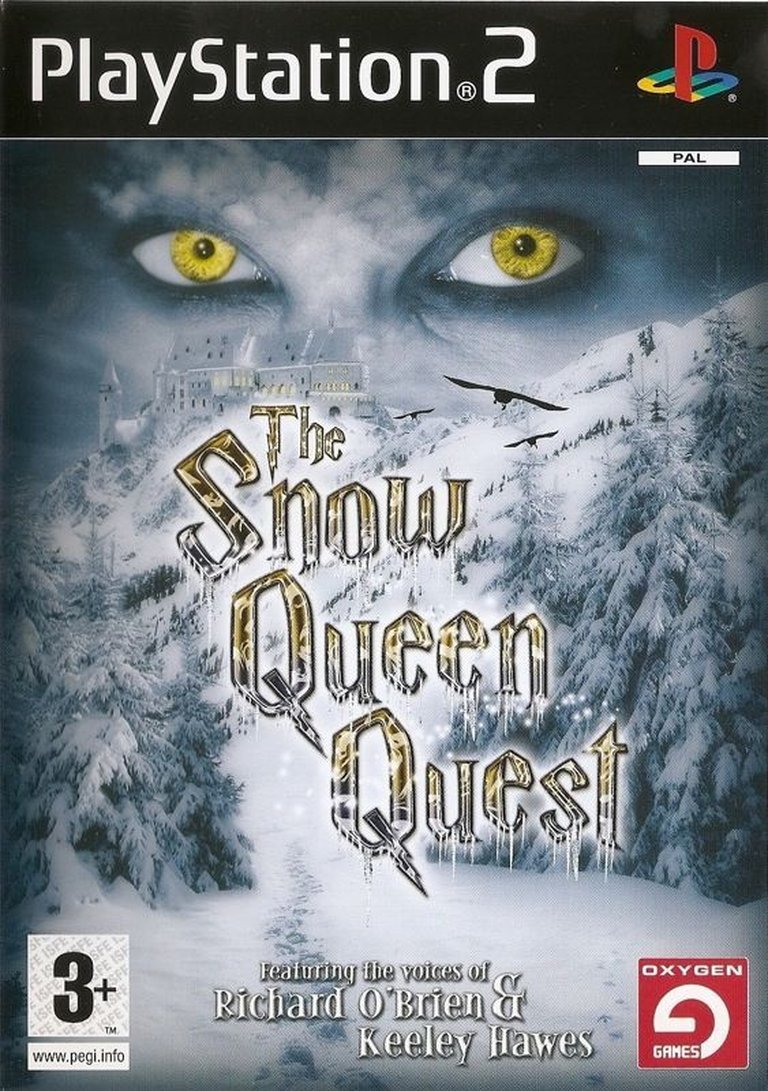
Description
The Snow Queen Quest is a 3D stealth adventure game inspired by Hans Christian Andersen’s fairy tale. Set in a frozen fantasy world, players must break the Snow Queen’s ancient winter spell by sneaking past her minions—such as frogs and guards—while collecting keys, extra lives, and other items hidden in boxes. The goal is to destroy her magical mirror, the source of her power, but getting caught by her underlings awakens the queen and costs the player a life.
Gameplay Videos
The Snow Queen Quest Free Download
PlayStation 2
The Snow Queen Quest Cracks & Fixes
The Snow Queen Quest Reviews & Reception
reddit.com : The Snow Queen Quest is a sad excuse of a videogame and almost makes Home Alone (PS2) feel like a fun game.
gamepressure.com (20/100): An ill-fated town lies cloaked in the shroud of winter, under the icy spell of the evil Snow Queen.
The Snow Queen Quest Cheats & Codes
PC
Extract files from the downloaded archive into the game directory, replacing originals. Then press the following keys during gameplay:
| Code | Effect |
|---|---|
| F1 | Invincibility (works only at certain periods) |
| F2 | Adds 25 Extra Life Energy + Adds 5 Bags of Gold + Adds 5 Collection of each Keys |
PC (Alternative Source)
Modify the ‘data\setup.lua’ file by adding or uncommenting the line ‘EnableCheats()’. Then use the following keys during gameplay:
| Code | Effect |
|---|---|
| F1 | Invincibility |
| F2 | Gives 25 lives, gold, and keys |
The Snow Queen Quest: A Frozen Fiasco or Forgotten Gem?
Introduction: The Icy Allure of a Forgotten Fairy Tale
The Snow Queen Quest (2007) is a game that exists in the shadowy limbo of video game history—a title so obscure that even its most vocal critics struggle to find an audience. Developed by Broadsword Interactive Limited and published by Oxygen Interactive, this 3D stealth-adventure game attempts to adapt Hans Christian Andersen’s The Snow Queen into an interactive experience. On paper, the premise is enticing: a hero must infiltrate the Snow Queen’s fortress, evade her minions, and shatter her magical mirror to lift an eternal winter. In execution, however, the game stumbles into a chasm of clunky mechanics, baffling design choices, and a presentation that feels trapped between eras.
This review seeks to dissect The Snow Queen Quest with surgical precision, examining its development, narrative ambitions, gameplay systems, and the cultural void it occupies. Was it a noble failure, a rushed cash-in, or something stranger—a game so flawed it circles back to fascination? By analyzing its strengths (few as they may be) and its many, many weaknesses, we can better understand why it vanished into the frostbitten annals of gaming history.
Development History & Context: A Studio’s Struggle in the PS2’s Twilight
The Studio Behind the Frost: Broadsword Interactive’s Legacy
Broadsword Interactive Limited was a British developer with a modest portfolio, primarily known for licensed and budget titles. Their work included Robin Hood’s Quest (2006) and Quest for Aladdin’s Treasure (2007), both part of a loose series of fairy-tale adaptations aimed at younger audiences. The Snow Queen Quest was another entry in this lineage, but its development was fraught with challenges.
A prototype from May 25, 2006 (released by Hidden Palace in 2024) reveals a game in flux. The executable was compiled in PSP resolution by default, suggesting potential multi-platform ambitions, and the build shared assets with Robin Hood’s Quest, hinting at resource constraints. The final PS2 and PC versions launched in February 2007, a time when the PlayStation 2 was nearing the end of its lifecycle, and the industry was shifting toward the PlayStation 3 and Xbox 360. The Snow Queen Quest arrived as an anachronism—a game built for an audience that had already moved on.
Technological Constraints and the PS2’s Limits
The PlayStation 2, while capable, was pushing its boundaries by 2007. The Snow Queen Quest’s visuals are a testament to this: character models resemble upscaled PS1 assets, environments lack verticality, and animations are stiff. The game’s stealth mechanics, which require precision, are undermined by the hardware’s limitations. Hit detection is inconsistent, AI behavior is erratic, and the camera—fixed in a behind-the-shoulder perspective—often obscures critical information.
The PC version fared slightly better, but neither iteration could escape the sense of being trapped in the past. The game’s engine, likely repurposed from earlier Broadsword titles, was ill-suited for the stealth genre’s demands. This technical debt would prove fatal.
The Gaming Landscape of 2007: A Crowded Winter
2007 was a banner year for gaming, with titles like BioShock, Mass Effect, Call of Duty 4, and Super Mario Galaxy redefining their genres. Even in the stealth space, Assassin’s Creed was on the horizon, promising a revolution in open-world infiltration. The Snow Queen Quest, by contrast, was a budget title aimed at children, competing for shelf space against giants.
Its closest contemporaries were other licensed or fairy-tale adaptations, such as Harry Potter and the Sorcerer’s Stone (2001) or The Lord of the Rings: The Fellowship of the Ring (2002). But where those games benefited from strong source material and polished execution, The Snow Queen Quest had neither. It was a game destined to be overlooked, a footnote in a year of masterpieces.
Narrative & Thematic Deep Dive: A Fairy Tale Frozen in Time
Plot Summary: A Hero’s Quest to Melt the Winter
The game’s story is a loose adaptation of Andersen’s The Snow Queen, stripped of its emotional depth and moral complexity. The Snow Queen has cursed the land with eternal winter, and the player assumes the role of an unnamed hero tasked with sneaking into her castle and destroying her magical mirror—the source of her power. The premise is simple, almost mythic, but the execution is perfunctory.
The narrative unfolds through a narrator whose voice acting is, according to Reddit user [deleted], “surprisingly good” compared to the rest of the cast. The hero’s lines, however, are delivered with all the enthusiasm of a hostage reading a ransom note. The infamous “GOT-TA-FIND-DA-KEY” line, repeated ad nauseam when interacting with locked doors, has achieved meme status among the few who remember the game.
Themes: Power, Patience, and the Illusion of Stealth
At its core, The Snow Queen Quest is about patience and perseverance. The Snow Queen’s slumber is a metaphor for the player’s need to remain unseen, to move carefully, and to avoid confrontation. The game’s central mechanic—stealth—is thus thematically appropriate, but the implementation is disastrous.
The Snow Queen herself is a passive antagonist for most of the game, only awakening when the player is caught. This creates a tense, if frustrating, dynamic: every mistake brings the player closer to failure, reinforcing the idea that haste leads to ruin. Unfortunately, the game’s controls and AI are so uncooperative that this theme becomes less about strategy and more about enduring arbitrary punishment.
Characters: The Hollow Heroes of a Forgotten Tale
The hero is a cipher, a silent (or, when speaking, painfully awkward) vessel for the player. The Snow Queen, despite her central role, is barely present until the game’s ludicrous finale, where she awakens to scream like a banshee as her mirror shatters. The supporting cast—frogs, guards, and other minions—are mere obstacles, devoid of personality or purpose.
The narrator is the game’s sole attempt at charm, but even this is undercut by the disjointed presentation. The voice acting is uneven, the dialogue is repetitive, and the story lacks the emotional weight of Andersen’s original. What could have been a poignant tale of bravery and sacrifice instead feels like a half-hearted retelling, frozen in mediocrity.
Gameplay Mechanics & Systems: A Stealth Game That Forgot How to Sneak
Core Gameplay Loop: Sneak, Fail, Repeat
The Snow Queen Quest bills itself as a stealth-adventure, but its mechanics are so poorly implemented that the experience resembles a dark comedy. The player must navigate linear levels filled with guards and frogs, avoiding detection while collecting keys and items. The controls are sluggish, the hitboxes are inconsistent, and the AI is both hyper-aware and easily confused.
The stealth system revolves around two primary tools:
1. Whistling: A loud, attention-grabbing noise meant to lure enemies away. In practice, it functions like a nuclear alarm, alerting every NPC in the level and filling the “Snow Queen’s Awareness Meter.” Overuse results in instant failure.
2. Sleeping Powder: A theoretically useful item that should incapacitate enemies. In reality, it requires pixel-perfect aiming, rapid button-mashing, and a specific distance to work—conditions rarely met in the heat of pursuit.
The result is a game where stealth feels less like strategy and more like a cruel joke. Players are punished for mistakes they didn’t know they were making, and success often hinges on exploiting AI quirks rather than skill.
Level Design: The Flat, Forgettable Fortress
The game’s levels are a masterclass in anti-design. As noted by the Reddit reviewer, they resemble “a Christmas attraction”—flat, rectangular, and devoid of verticality. Keys and locked doors are placed on opposite sides of the map, forcing tedious backtracking. There are no alternative paths, no environmental interactions, and no meaningful exploration.
The castle’s interior is a maze of identical corridors, and the outdoor sections are little more than empty fields. The lack of visual variety makes navigation a chore, and the absence of checkpoints means that a single mistake can erase minutes of progress.
Combat and Progression: The Illusion of Depth
There is no traditional combat in The Snow Queen Quest. The player’s only “weapons” are the whistling and sleeping powder mechanics, neither of which function reliably. Progression is tied to collecting items (keys, pouches, extra lives) hidden in boxes scattered throughout the levels. These boxes are often guarded, creating a frustrating loop:
1. Spot a box.
2. Attempt to lure the guard away.
3. Fail.
4. Repeat until the guard’s pathfinding glitches in your favor.
The game’s difficulty is artificial, stemming not from clever design but from clunky controls and unpredictable AI. There is no sense of mastery, only endurance.
Multiplayer: A Half-Baked Co-Op Mode
The game supports local co-op, allowing a second player to join as a companion. In theory, this could have added a layer of strategy, with one player distracting enemies while the other sneaks past. In practice, the second player is more of a hindrance, as the game’s mechanics were clearly designed for solo play. The co-op mode feels tacked on, a last-minute addition to justify the “multiplayer” label on the box.
World-Building, Art & Sound: A Kingdom of Ice and Indifference
Visual Design: PS1 Aesthetics in a PS2 Era
The Snow Queen Quest’s art direction is its most damning flaw. Character models are blocky and stiff, with animations that lack fluidity. The Snow Queen herself looks “like she’s made of stone rather than ice,” as the Reddit reviewer aptly put it. Environments are bland, with repetitive textures and a complete absence of detail.
The game’s color palette is dominated by blues and whites, which, while thematically appropriate, contribute to the visual monotony. There is no sense of scale or grandeur—no towering ice spires, no intricate castle architecture. The world feels small, static, and utterly forgettable.
Sound Design: A Symphony of Silence and Suffering
The game’s audio is a study in imbalance. The narrator’s voice work is passable, but the hero’s lines are muffled, as if recorded in a different room. The soundtrack is generic fantasy fare, neither memorable nor offensive, but it is often drowned out by the game’s sound effects—or, worse, by silence.
The most egregious issue is the lack of audio feedback. When the player is detected, there is no clear indication of why or how. The Snow Queen’s “awareness meter” fills without warning, and the player is left to guess what triggered the alarm. This lack of clarity turns stealth into a guessing game, further frustrating an already flawed experience.
Atmosphere: A Castle Without a Soul
The Snow Queen’s fortress should be a place of dread and wonder, a labyrinth of ice and magic. Instead, it feels like an empty set, a series of connected rooms with no life or history. There are no environmental storytelling elements, no hints of the queen’s backstory, and no sense of the world beyond the player’s immediate path.
The game’s failure to create a compelling atmosphere is its greatest missed opportunity. A strong aesthetic could have elevated the experience, making the player feel like they were truly infiltrating a fairy-tale kingdom. Instead, The Snow Queen Quest offers only the illusion of a world, one as hollow as its gameplay.
Reception & Legacy: The Game That Time Forgot
Critical Reception: A Resounding Silence
The Snow Queen Quest received no professional reviews upon release. Metacritic lists no critic scores, and MobyGames has no recorded reviews. The game was, for all intents and purposes, ignored by the press—a fate worse than outright condemnation.
Player reception, as seen in the Reddit post, is uniformly negative. The game is described as “a sad excuse of a videogame,” “clunky,” and “not fun.” The few who remember it do so with a mix of bewilderment and dark humor, treating it as a curiosity rather than a legitimate experience.
Commercial Performance: A Budget Title’s Budget Fate
Sales figures for The Snow Queen Quest are unavailable, but its obscurity suggests it was a commercial non-entity. The game’s lack of marketing, combined with its release in the PS2’s twilight, ensured it would be overshadowed by bigger titles. It was likely sold in bargain bins shortly after launch, if it was sold at all.
Legacy: The Meme That Could Have Been
In the years since its release, The Snow Queen Quest has achieved a minor cult status—not as a hidden gem, but as a punchline. Its awkward voice acting, broken mechanics, and absurd ending have made it a target for mockery, particularly in communities like r/patientgamers, where it is held up as an example of how not to design a game.
Its influence on the industry is nil. No subsequent games have cited it as an inspiration, and its developer, Broadsword Interactive, has faded into obscurity. If it is remembered at all, it is as a cautionary tale—a game that tried to adapt a beloved fairy tale and failed at every turn.
Conclusion: A Frozen Relic of a Bygone Era
The Snow Queen Quest is not a good game. It is not a bad game in the so-bad-it’s-good sense. It is, instead, a profoundly mediocre game, one that fails at nearly every level of design, execution, and presentation. Its stealth mechanics are broken, its narrative is forgettable, its visuals are outdated, and its world is devoid of charm.
And yet, there is something fascinating about it. In its failures, The Snow Queen Quest reveals the pitfalls of adapting literature to interactive media without care or vision. It is a game that exists in the uncanny valley of design—close enough to competence to be frustrating, but far enough to be intriguing. It is a relic of an era when budget titles could still find shelf space, even if they didn’t deserve it.
Final Verdict: 2/10 – A Frozen Mistake
The Snow Queen Quest is not worth playing, except as a curiosity for those who enjoy dissecting failures. It is a game that time has forgotten, and for good reason. But in its forgettability, it serves as a reminder of how far game design has come—and how easily even the simplest concepts can go wrong.
For historians, it is a footnote. For masochists, it is a challenge. For everyone else, it is a warning: not all fairy tales are meant to be played.