
- Release Year: 1996
- Platforms: Windows
- Publisher: Dinamic Multimedia, S.A.
- Developer: Dinamic Multimedia, S.A.
- Genre: Compilation
- Game Mode: Single-player
- Average Score: 65/100
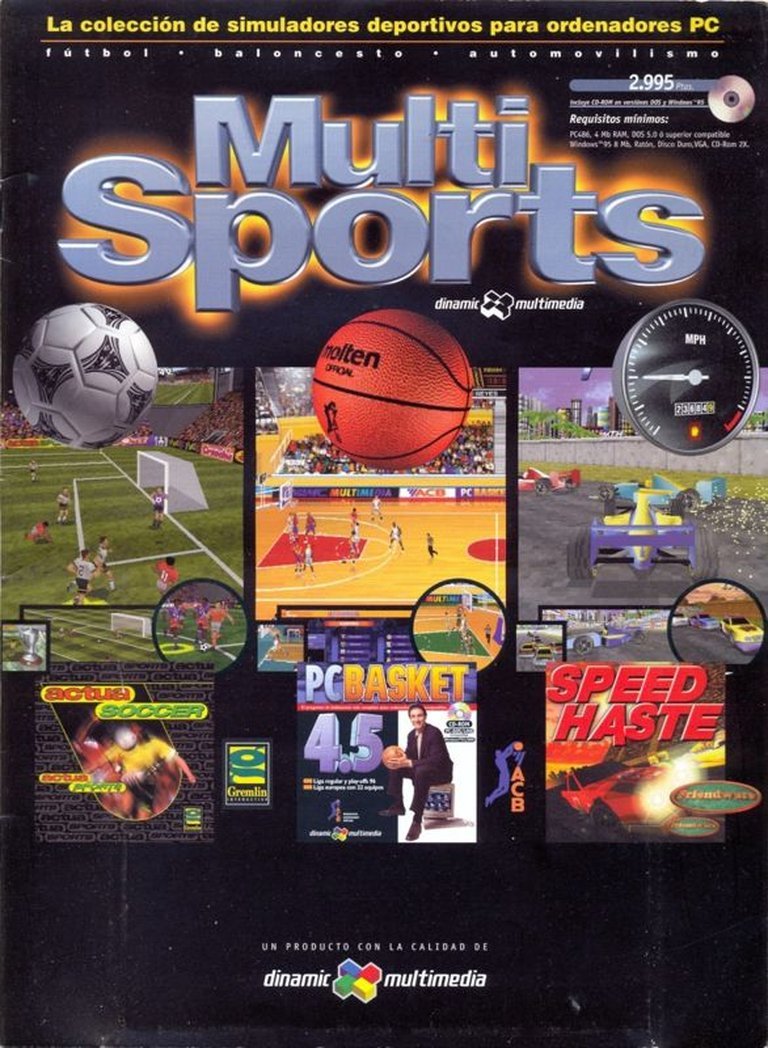
Description
Multi Sports is a compilation game released in December 1996 for Windows, bundling three distinct sports simulations: Actua Soccer, Speed Haste, and an updated version of PC Basket 4.5 (dubbed the ‘Super Epi’ edition). The game offers players the chance to compete in soccer, basketball, and motorsport, each with updated rosters and features tailored to the 1996/97 season. Developed and published by Dinamic Multimedia, S.A., it provides an affordable way to enjoy multiple sports genres in one package, blending realistic gameplay with accessible mechanics.
Multi Sports Reviews & Reception
mobygames.com (75/100): A bundle composed of the following games: Actua Soccer, Speed Haste, PC Basket 4.5.
vgtimes.com (55/100): A compilation of games with average ratings across all criteria.
Multi Sports: A Comprehensive Retrospective
Introduction
In the mid-1990s, the video game industry was undergoing a seismic shift. The transition from 2D to 3D graphics, the rise of CD-ROM technology, and the increasing sophistication of gameplay mechanics were redefining what players expected from their interactive experiences. Amidst this evolution, Multi Sports emerged as a fascinating artifact—a compilation that captured the spirit of its era while offering a snapshot of the sports gaming landscape in 1996. Released by Dinamic Multimedia, S.A., Multi Sports was more than just a collection of games; it was a testament to the growing demand for diverse, high-quality sports simulations on the PC platform.
This review will delve deeply into Multi Sports, examining its development context, gameplay mechanics, and the individual titles that comprised the compilation. We will explore how it fit into the broader narrative of sports gaming in the late 20th century, its reception, and its lasting impact on the genre. By analyzing its strengths and weaknesses, we can better understand its place in video game history and why it remains a notable, if underappreciated, entry in the sports gaming canon.
Development History & Context
The Studio: Dinamic Multimedia, S.A.
Dinamic Multimedia, S.A. was a Spanish video game developer and publisher that played a significant role in the European gaming scene during the 1980s and 1990s. Founded in 1984, the company initially focused on creating and localizing games for home computers like the ZX Spectrum, Amstrad CPC, and MSX. By the mid-1990s, Dinamic had expanded its operations to include PC gaming, capitalizing on the growing popularity of CD-ROM technology and the increasing power of personal computers.
Dinamic was known for its ambitious projects, often pushing the boundaries of what was possible on contemporary hardware. The company’s portfolio included a mix of original titles and licensed properties, with a particular emphasis on sports and racing games. Multi Sports was part of this tradition, reflecting Dinamic’s commitment to delivering diverse, high-quality gaming experiences to a broad audience.
The Vision Behind Multi Sports
The late 1990s saw a surge in the popularity of sports video games, driven in part by advancements in 3D graphics and the increasing realism of gameplay mechanics. Titles like FIFA International Soccer (1993) and NBA Jam (1993) had demonstrated the commercial viability of sports games, and publishers were eager to capitalize on this trend. Multi Sports was conceived as a way to offer players a variety of sports experiences in a single package, providing value and diversity at a time when individual sports games were becoming more specialized and expensive.
The compilation included three distinct sports simulations:
1. Actua Soccer: A 3D football (soccer) game that emphasized realistic gameplay and detailed player animations.
2. Speed Haste: A high-speed racing game that showcased the potential of 3D graphics in the racing genre.
3. PC Basket 4.5: An updated version of Dinamic’s popular basketball simulation, featuring enhanced graphics and updated rosters for the 1996/97 season.
By bundling these titles together, Dinamic aimed to appeal to a wide range of sports fans, offering something for enthusiasts of football, racing, and basketball. The inclusion of PC Basket 4.5 as an exclusive “Super Epi” edition—named after the legendary Spanish basketball player Juan Antonio San Epifanio “Epi”—added a layer of prestige and local appeal, particularly for Spanish audiences.
Technological Constraints and Innovations
The mid-1990s were a period of rapid technological advancement in the gaming industry. The shift from 2D to 3D graphics was well underway, and developers were experimenting with new ways to create immersive, realistic experiences. However, this transition was not without its challenges. Hardware limitations, particularly in terms of processing power and memory, meant that developers had to make careful compromises to achieve their vision.
Multi Sports was developed for the Windows platform, taking advantage of the increasing power of personal computers. The use of CD-ROM technology allowed for larger, more detailed game assets, including higher-resolution graphics, digitized audio, and more complex gameplay mechanics. However, the games in the compilation were still constrained by the hardware of the time, particularly in terms of polygon counts and texture resolution.
One of the key innovations in Multi Sports was its use of 3D graphics in both Actua Soccer and Speed Haste. While 3D sports games were not entirely new—titles like Virtua Striker (1994) had already demonstrated the potential of 3D football—Actua Soccer aimed to bring a more realistic, simulation-style experience to the PC. Similarly, Speed Haste sought to compete with established racing games like Virtua Racing (1992) and Ridge Racer (1993), offering a high-speed, arcade-style racing experience with detailed 3D environments.
The Gaming Landscape in 1996
The release of Multi Sports in December 1996 coincided with a period of significant change in the gaming industry. The fifth generation of video game consoles, including the Sony PlayStation, Sega Saturn, and Nintendo 64, was in full swing, and these systems were pushing the boundaries of what was possible in terms of graphics and gameplay. However, the PC remained a vital platform for sports games, particularly in Europe, where football (soccer) simulations were immensely popular.
1996 was a landmark year for sports gaming, with several influential titles making their debut. FIFA 97 and International Superstar Soccer (ISS) continued to dominate the football genre, while NBA Live 97 and NBA Jam were leading the charge in basketball. Racing games like Gran Turismo (1997) were on the horizon, promising even greater realism and depth. Against this backdrop, Multi Sports offered a compelling alternative, providing a diverse range of sports experiences in a single package.
The compilation format was not entirely new—titles like Wii Sports (2006) would later popularize the concept of bundling multiple sports games together—but Multi Sports was one of the earlier examples of this approach on the PC. By offering three distinct games in one package, Dinamic was able to provide players with a variety of experiences at a competitive price point, making it an attractive option for sports fans looking to expand their gaming library.
Narrative & Thematic Deep Dive
The Absence of Narrative in Sports Games
Sports video games, by their very nature, are inherently different from narrative-driven genres like role-playing games (RPGs) or adventure games. While some sports games incorporate story elements—such as career modes or player-driven narratives—the primary focus is almost always on the gameplay itself. Multi Sports is no exception, as none of the included titles feature a traditional narrative structure. Instead, the “story” is emergent, arising from the player’s interactions with the game mechanics and the outcomes of matches, races, or games.
This lack of a predefined narrative is not a weakness but rather a reflection of the genre’s strengths. Sports games are about competition, skill, and mastery, and their appeal lies in the player’s ability to improve, strategize, and ultimately triumph over opponents. The absence of a scripted story allows players to create their own narratives, whether it’s leading a underdog football team to victory, mastering the nuances of a high-speed race, or executing the perfect play in a basketball game.
Thematic Elements: Competition and Mastery
While Multi Sports may not have a traditional narrative, it is rich in thematic content. The overarching theme of the compilation is competition—the drive to improve, to outperform opponents, and to achieve mastery over the game’s mechanics. This theme is reflected in each of the included titles, albeit in different ways.
-
Actua Soccer: The theme of competition is central to Actua Soccer, which emphasizes realistic gameplay and strategic depth. Players must manage their team’s tactics, adapt to their opponents’ strategies, and execute precise passes and shots to score goals. The game’s focus on realism and simulation-style gameplay reinforces the idea that success comes from skill, strategy, and adaptability.
-
Speed Haste: In Speed Haste, the theme of competition is more immediate and visceral. The game’s high-speed racing mechanics emphasize quick reflexes, precise timing, and the ability to navigate complex tracks at breakneck speeds. The arcade-style gameplay encourages players to push their limits, taking risks to achieve the fastest lap times and outmaneuver their opponents.
-
PC Basket 4.5: Basketball is a sport that combines individual skill with teamwork, and PC Basket 4.5 reflects this duality. The game’s updated rosters and enhanced graphics allow players to take on the role of their favorite teams and players, competing in a virtual recreation of the 1996/97 basketball season. The inclusion of the “Super Epi” edition, featuring the legendary Juan Antonio San Epifanio, adds a layer of historical and cultural significance, particularly for Spanish players.
The Role of Realism and Simulation
One of the key thematic elements in Multi Sports is the tension between realism and arcade-style gameplay. Actua Soccer and PC Basket 4.5 lean more toward the simulation end of the spectrum, offering detailed, realistic recreations of their respective sports. In contrast, Speed Haste embraces a more arcade-like approach, prioritizing fast-paced action and accessibility over strict realism.
This balance between realism and arcade-style gameplay is a recurring theme in sports gaming. Simulation-style games appeal to players who want a more authentic, strategic experience, while arcade-style games attract those who prefer quick, action-packed gameplay. Multi Sports successfully caters to both audiences, offering a diverse range of experiences that appeal to different types of players.
Cultural and Historical Context
The inclusion of PC Basket 4.5 as the “Super Epi” edition adds a layer of cultural and historical context to Multi Sports. Juan Antonio San Epifanio, known simply as “Epi,” was one of the most iconic basketball players in Spanish history. His inclusion in the game not only adds a sense of authenticity but also serves as a tribute to his legacy. For Spanish players, this edition would have held particular significance, as it allowed them to relive the glory days of Spanish basketball and compete with one of the sport’s legends.
This cultural context is an important thematic element in Multi Sports, as it highlights the role of sports games in preserving and celebrating sporting history. By including updated rosters and historical figures, PC Basket 4.5 allows players to engage with the sport on a deeper level, connecting with the past while enjoying the present.
Gameplay Mechanics & Systems
Core Gameplay Loops
Each of the three games in Multi Sports features distinct gameplay mechanics and systems, reflecting the unique challenges and appeal of their respective sports. However, they all share a common focus on competition, skill, and mastery.
-
Actua Soccer:
- Gameplay Loop: The core gameplay loop in Actua Soccer revolves around managing a football team, executing strategic plays, and scoring goals. Players must control their team’s movements, pass the ball effectively, and take shots on goal while defending against their opponents’ attacks.
- Controls and Mechanics: The game features a control scheme that allows for precise player movement and ball handling. Players can perform a variety of actions, including passing, shooting, dribbling, and tackling. The game’s physics engine simulates the behavior of the ball and players, adding a layer of realism to the gameplay.
- Strategic Depth: Actua Soccer includes a range of tactical options, allowing players to adjust their team’s formation, playing style, and defensive strategies. This strategic depth adds a layer of complexity to the gameplay, requiring players to think critically about their approach to each match.
-
Speed Haste:
- Gameplay Loop: The core gameplay loop in Speed Haste is centered around high-speed racing, with players competing to achieve the fastest lap times and outmaneuver their opponents. The game features a variety of tracks, each with its own unique challenges and obstacles.
- Controls and Mechanics: The game’s controls are designed to be intuitive and responsive, allowing players to accelerate, brake, and steer with precision. The physics engine simulates the behavior of the cars, including factors like speed, traction, and collision dynamics.
- Arcade-Style Gameplay: Unlike simulation-style racing games, Speed Haste embraces an arcade-like approach, prioritizing fast-paced action and accessibility. The game features power-ups and special abilities that add an extra layer of excitement to the races, encouraging players to take risks and push their limits.
-
PC Basket 4.5:
- Gameplay Loop: The core gameplay loop in PC Basket 4.5 revolves around managing a basketball team, executing plays, and scoring points. Players must control their team’s movements, pass the ball effectively, and take shots while defending against their opponents’ attacks.
- Controls and Mechanics: The game features a control scheme that allows for precise player movement and ball handling. Players can perform a variety of actions, including passing, shooting, dribbling, and blocking. The game’s physics engine simulates the behavior of the ball and players, adding a layer of realism to the gameplay.
- Updated Rosters and Features: PC Basket 4.5 includes updated rosters for the 1996/97 season, as well as enhanced graphics and gameplay mechanics. The inclusion of the “Super Epi” edition adds a layer of historical and cultural significance, particularly for Spanish players.
Innovative and Flawed Systems
While Multi Sports offers a diverse range of gameplay experiences, it is not without its flaws. Each of the included titles has its own strengths and weaknesses, reflecting the challenges of developing sports games in the mid-1990s.
-
Actua Soccer:
- Strengths: The game’s emphasis on realism and strategic depth is one of its greatest strengths. The detailed player animations, realistic physics, and tactical options make it a compelling experience for fans of simulation-style football games.
- Weaknesses: The game’s graphics, while impressive for the time, have not aged well. The 3D models and textures are relatively simple by modern standards, and the game’s performance can be inconsistent on lower-end hardware.
-
Speed Haste:
- Strengths: The game’s arcade-style gameplay and high-speed racing mechanics make it an exciting and accessible experience. The inclusion of power-ups and special abilities adds an extra layer of fun and unpredictability to the races.
- Weaknesses: The game’s physics engine can be somewhat unforgiving, with collisions and track obstacles sometimes leading to frustrating outcomes. Additionally, the game’s tracks, while varied, can feel repetitive after extended play.
-
PC Basket 4.5:
- Strengths: The game’s updated rosters and enhanced graphics make it a compelling experience for basketball fans. The inclusion of the “Super Epi” edition adds a layer of historical and cultural significance, particularly for Spanish players.
- Weaknesses: The game’s controls can be somewhat clunky, particularly when it comes to executing precise passes and shots. Additionally, the game’s AI can be inconsistent, with opponents sometimes exhibiting unrealistic behavior.
User Interface and Accessibility
The user interface (UI) in Multi Sports is functional but somewhat dated by modern standards. Each of the included titles features its own UI, reflecting the unique needs of their respective sports. However, the overall design is consistent with the aesthetic of mid-1990s PC games, with a focus on practicality over polish.
-
Actua Soccer: The game’s UI is designed to be intuitive and easy to navigate, with clear menus and options for adjusting tactics and formations. However, the interface can feel somewhat cluttered, particularly during matches, where players must quickly access a variety of controls and options.
-
Speed Haste: The game’s UI is more streamlined, reflecting its arcade-style gameplay. The menus are simple and easy to navigate, with a focus on quick access to races and settings. However, the interface lacks some of the depth and customization options found in more simulation-style racing games.
-
PC Basket 4.5: The game’s UI is functional but somewhat basic, with a focus on providing players with the information they need to manage their team and execute plays. The interface includes options for adjusting tactics and formations, but it can feel somewhat dated compared to more modern basketball games.
World-Building, Art & Sound
Setting and Atmosphere
The world-building in Multi Sports is primarily focused on creating immersive, realistic environments for each of the included sports. While the games do not feature the same level of narrative depth as RPGs or adventure games, they excel in creating a sense of place and atmosphere that enhances the gameplay experience.
-
Actua Soccer: The game’s environments are designed to replicate real-world football stadiums, complete with detailed crowds, realistic lighting, and dynamic weather effects. The atmosphere is electric, with the roar of the crowd and the tension of the match creating a sense of immersion that draws players into the game.
-
Speed Haste: The game’s tracks are designed to be visually striking, with a variety of environments ranging from urban streets to futuristic circuits. The high-speed racing mechanics and the inclusion of power-ups and special abilities create a sense of excitement and unpredictability that keeps players engaged.
-
PC Basket 4.5: The game’s environments are designed to replicate real-world basketball courts, complete with detailed crowds, realistic lighting, and dynamic camera angles. The atmosphere is intense, with the sound of the crowd and the tension of the game creating a sense of immersion that draws players into the action.
Visual Direction
The visual direction in Multi Sports reflects the technological constraints and artistic ambitions of the mid-1990s. While the games may not have the same level of graphical fidelity as modern titles, they are impressive for their time, showcasing the potential of 3D graphics and CD-ROM technology.
-
Actua Soccer: The game’s visuals are focused on realism, with detailed player models, realistic animations, and dynamic lighting effects. The use of 3D graphics allows for a more immersive experience, with players able to see the action from a variety of camera angles.
-
Speed Haste: The game’s visuals are more stylized, reflecting its arcade-style gameplay. The tracks are designed to be visually striking, with bright colors, detailed textures, and dynamic lighting effects. The use of 3D graphics allows for a more immersive racing experience, with players able to see the action from a variety of camera angles.
-
PC Basket 4.5: The game’s visuals are focused on realism, with detailed player models, realistic animations, and dynamic lighting effects. The use of 3D graphics allows for a more immersive experience, with players able to see the action from a variety of camera angles.
Sound Design
The sound design in Multi Sports plays a crucial role in creating an immersive, engaging experience. Each of the included titles features a unique soundtrack and sound effects that enhance the gameplay and atmosphere.
-
Actua Soccer: The game’s sound design is focused on realism, with detailed crowd noises, realistic player grunts, and dynamic commentary. The soundtrack is energetic and exciting, with a mix of original compositions and licensed tracks that enhance the atmosphere of the matches.
-
Speed Haste: The game’s sound design is more arcade-like, with a focus on high-energy music and sound effects. The soundtrack is fast-paced and exciting, with a mix of original compositions and licensed tracks that enhance the excitement of the races.
-
PC Basket 4.5: The game’s sound design is focused on realism, with detailed crowd noises, realistic player grunts, and dynamic commentary. The soundtrack is energetic and exciting, with a mix of original compositions and licensed tracks that enhance the atmosphere of the games.
Reception & Legacy
Critical and Commercial Reception
Multi Sports was released to a mixed but generally positive reception. The compilation was praised for its diversity and value, offering three distinct sports experiences in a single package. However, the individual games received varying levels of acclaim, reflecting their unique strengths and weaknesses.
-
Actua Soccer: The game was praised for its realism and strategic depth, with critics highlighting its detailed player animations and tactical options. However, some reviewers noted that the game’s graphics were somewhat dated, particularly when compared to more modern football simulations.
-
Speed Haste: The game was praised for its arcade-style gameplay and high-speed racing mechanics, with critics highlighting its exciting races and power-ups. However, some reviewers noted that the game’s physics engine could be somewhat unforgiving, leading to frustrating outcomes.
-
PC Basket 4.5: The game was praised for its updated rosters and enhanced graphics, with critics highlighting its historical and cultural significance. However, some reviewers noted that the game’s controls could be somewhat clunky, particularly when it came to executing precise passes and shots.
Commercially, Multi Sports performed well, particularly in Europe, where football and basketball simulations were immensely popular. The compilation’s competitive price point and diverse range of experiences made it an attractive option for sports fans looking to expand their gaming library.
Evolution of Reputation
Over time, Multi Sports has come to be seen as a fascinating artifact of its era—a snapshot of the sports gaming landscape in the mid-1990s. While the individual games may not have the same level of polish or depth as more modern titles, they are impressive for their time, showcasing the potential of 3D graphics and CD-ROM technology.
The compilation’s legacy is particularly significant in the context of the sports gaming genre. Multi Sports was one of the earlier examples of the compilation format, demonstrating the appeal of bundling multiple sports experiences together. This approach would later be popularized by titles like Wii Sports (2006), which offered a diverse range of sports experiences in a single package.
Influence on Subsequent Games
The influence of Multi Sports can be seen in a variety of subsequent sports games, particularly in the realm of compilation titles. The success of Multi Sports demonstrated the commercial viability of bundling multiple sports experiences together, paving the way for future titles like Wii Sports, Nintendo Switch Sports, and Mario Sports Superstars.
Additionally, the individual games in Multi Sports have had their own influence on the sports gaming genre. Actua Soccer helped to establish the simulation-style football game as a viable subgenre, while Speed Haste contributed to the evolution of arcade-style racing games. PC Basket 4.5, with its updated rosters and historical significance, highlighted the importance of authenticity and cultural context in sports games.
Conclusion
Multi Sports is a fascinating and underappreciated entry in the sports gaming canon. Released at a time of rapid technological advancement and genre evolution, the compilation offers a diverse range of experiences that showcase the potential of 3D graphics and CD-ROM technology. While the individual games may not have the same level of polish or depth as more modern titles, they are impressive for their time, reflecting the ambitions and constraints of mid-1990s game development.
The compilation’s greatest strength lies in its diversity. By bundling three distinct sports experiences together, Multi Sports offers something for every type of sports fan, whether they prefer the strategic depth of football, the high-speed excitement of racing, or the teamwork and skill of basketball. The inclusion of the “Super Epi” edition of PC Basket 4.5 adds a layer of historical and cultural significance, particularly for Spanish players, highlighting the role of sports games in preserving and celebrating sporting history.
However, Multi Sports is not without its flaws. The games’ graphics and controls have not aged well, and the compilation’s UI and performance can feel somewhat dated by modern standards. Additionally, the individual games vary in quality, with some offering more depth and polish than others.
Despite these shortcomings, Multi Sports remains a notable and important entry in the sports gaming genre. Its influence can be seen in subsequent compilation titles, and its diverse range of experiences continues to offer value and enjoyment to players. For fans of sports games and retro gaming enthusiasts, Multi Sports is a compelling and rewarding experience—a snapshot of a pivotal era in gaming history.
Final Verdict: Multi Sports is a solid and ambitious compilation that offers a diverse range of sports experiences. While it may not have the same level of polish or depth as more modern titles, it is an impressive and enjoyable snapshot of mid-1990s sports gaming. For fans of retro sports games, it is well worth experiencing.
Score: 7.5/10