
- Release Year: 1999
- Platforms: Windows
- Publisher: Hasbro Interactive, Inc.
- Genre: Compilation
- Game Mode: Online PVP, Single-player
- Average Score: 85/100
Description
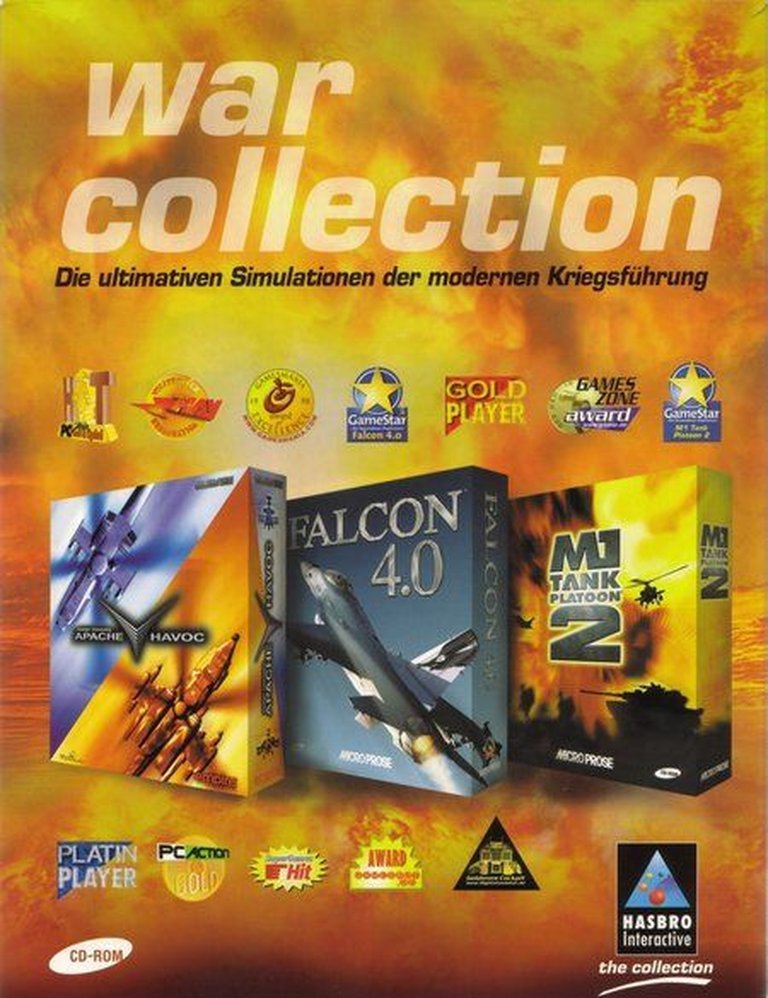
The ‘Modern Warfare Collection’ is a compilation of three military simulation games released in 1999, including ‘Enemy Engaged: Apache/Havoc’, ‘Falcon 4.0’, and ‘M1 Tank Platoon II’. Each game focuses on different aspects of modern warfare, offering players the chance to pilot advanced aircraft, command tanks, and engage in tactical combat. The collection is designed for fans of realistic military simulations, providing immersive experiences across various combat scenarios.
Modern Warfare Collection Reviews & Reception
mobygames.com (85/100): A compilation of celebrated military simulations, offering deep tactical gameplay and authentic experiences.
retro-replay.com : Ultimate Wargame Collection Volume 3: Modern Warfare delivers a rich tactical experience by bundling four distinct titles that span the spectrum from turn-based wargaming to detailed flight and helicopter simulations.
Modern Warfare Collection Cheats & Codes
PC
Collect the indicated number of intel pieces (enemy laptop computers) hidden throughout the game to unlock the corresponding cheat option.
| Code | Effect |
|---|---|
| COD Noir | Turns graphics black and white. |
| Photo-Negative | Inverts the colors. |
| Super Contrast | Increases the contrast. |
| Ragtime Warfare | Silent Movie mode; graphics are black and white, dust and scratches fill the screen, game plays at two times the speed, and the music becomes piano music. |
| Cluster Bombs | Frag grenades are more powerful. |
| A Bad Year | Enemies explode into tires when shot. |
| Slow-Mo Ability | Slow motion game play. |
| Infinite Ammo | Infinite ammunition. |
| Zakhaev’s Sons | Unknown effect (requires 30 intel pieces). |
| Explosive Lemons | Unknown effect (requires 30 intel pieces). |
| Melon Head | Unknown effect (requires 30 intel pieces). |
Modern Warfare Collection: A Retrospective on a Forgotten Gem
Introduction
The Modern Warfare Collection (1999) is a curious artifact in the annals of gaming history—a compilation of three distinct military simulations bundled under a title that would later become synonymous with one of the most influential first-person shooter franchises of all time. Released by Hasbro Interactive, this collection arrived at a pivotal moment in gaming, bridging the gap between the niche appeal of hardcore military simulations and the burgeoning mainstream interest in modern combat experiences. While it lacks the cultural impact of its namesake, the Call of Duty: Modern Warfare series, this compilation offers a fascinating snapshot of late-1990s gaming trends, technological constraints, and the evolving tastes of PC gamers.
This review will dissect the Modern Warfare Collection in exhaustive detail, exploring its development context, gameplay mechanics, narrative (or lack thereof), and its place in the broader landscape of military-themed games. We will also examine how its legacy has been overshadowed—and occasionally conflated—with the Call of Duty series, despite the two being entirely unrelated products.
Development History & Context
The Studio and the Era
The Modern Warfare Collection was published by Hasbro Interactive, a subsidiary of the toy and board game giant Hasbro, which had acquired several prominent game developers in the late 1990s, including MicroProse and Atari. Hasbro Interactive’s strategy revolved around repackaging and bundling existing titles to capitalize on the growing PC gaming market. The late 1990s were a transitional period for military simulations, with developers experimenting with 3D graphics, real-time strategy elements, and more accessible gameplay mechanics.
The collection includes three games:
1. Enemy Engaged: Apache/Havoc (1998) – A helicopter combat simulator.
2. Falcon 4.0 (1998) – A flight simulator focused on the F-16 Fighting Falcon.
3. M1 Tank Platoon II (1998) – A tank combat simulator.
Each of these titles was developed by different studios:
– Enemy Engaged was created by Razorworks, a British developer known for its work on flight and combat simulators.
– Falcon 4.0 was developed by MicroProse, a legendary studio with a storied history in military simulations, including the original Falcon series.
– M1 Tank Platoon II was produced by Parsoft Interactive, a studio specializing in armored warfare simulations.
Technological Constraints
The late 1990s were a time of rapid technological advancement in PC gaming. The Modern Warfare Collection reflects the limitations and innovations of the era:
– Graphics: The games relied on early 3D acceleration, with Falcon 4.0 and Enemy Engaged utilizing Direct3D and OpenGL rendering. Textures were low-resolution by modern standards, and polygon counts were limited, but the simulations prioritized functional realism over visual fidelity.
– Hardware Requirements: These games demanded robust hardware for their time. Falcon 4.0, in particular, was notorious for its steep system requirements, often requiring high-end CPUs and dedicated 3D accelerators like the 3dfx Voodoo series.
– Input Devices: The collection supported a variety of input devices, including joysticks, flight sticks, and specialized controllers like CH Products’ flight yokes and throttle quadrants. Keyboard and mouse support was included but often considered suboptimal for the precision required in these simulations.
The Gaming Landscape
In 1999, the gaming market was dominated by several key trends:
1. The Rise of 3D Acceleration: Games like Quake III Arena and Unreal Tournament showcased the potential of 3D graphics, pushing developers to adopt hardware-accelerated rendering.
2. The Decline of Pure Simulations: While hardcore simulations like Falcon 4.0 maintained a dedicated fanbase, the market was shifting toward more accessible titles. Games like MechWarrior 3 and Jane’s Combat Simulations series attempted to balance realism with broader appeal.
3. The Emergence of Tactical Shooters: Titles like Rainbow Six and Ghost Recon began to blend military realism with first-person shooter mechanics, foreshadowing the success of Call of Duty 4: Modern Warfare in 2007.
The Modern Warfare Collection was positioned as a premium bundle for enthusiasts, offering a curated selection of high-quality simulations at a time when standalone titles were becoming increasingly expensive to develop and market.
Narrative & Thematic Deep Dive
The Absence of Traditional Narrative
Unlike the Call of Duty: Modern Warfare series, which is renowned for its cinematic storytelling and memorable characters, the Modern Warfare Collection is devoid of traditional narrative structures. These are military simulations, not story-driven experiences. The “narrative” in these games is derived from:
– Mission Briefings: Text-based or voice-over briefings that outline objectives, enemy forces, and tactical considerations.
– Historical Context: Some missions in Falcon 4.0 and M1 Tank Platoon II are loosely based on real-world conflicts, such as the Gulf War or hypothetical Cold War scenarios.
– Procedural Storytelling: The player’s actions and outcomes create emergent narratives. For example, surviving a brutal dogfight in Falcon 4.0 or leading a tank platoon to victory in M1 Tank Platoon II can feel like a personal triumph, even without a scripted plot.
Themes of Realism and Authenticity
The overarching theme of the Modern Warfare Collection is authenticity. Each game strives to replicate the complexities of modern military hardware and tactics:
– Falcon 4.0: Focuses on the operational realities of flying an F-16, including radar management, weapons systems, and air-to-air combat dynamics. The game’s campaign mode simulates a large-scale conflict, with dynamic mission generation based on the player’s performance.
– Enemy Engaged: Apache/Havoc: Emphasizes the unique challenges of helicopter combat, such as nap-of-the-earth flying, coordinating with ground forces, and managing limited ammunition.
– M1 Tank Platoon II: Simulates the command and control aspects of armored warfare, requiring players to manage multiple tanks, coordinate with infantry, and navigate terrain obstacles.
Characters and Dialogue
Given the simulation-focused nature of these games, character development is minimal. The most “character” the player interacts with is their own avatar—a pilot, helicopter gunner, or tank commander—whose personality is defined by the player’s actions. Dialogue is limited to radio chatter, mission updates, and occasional banter between AI-controlled squad members. The tone is uniformly professional and militaristic, reinforcing the games’ commitment to realism.
Gameplay Mechanics & Systems
Core Gameplay Loops
Each game in the collection offers a distinct gameplay experience, united by a shared emphasis on realism and tactical depth.
-
Falcon 4.0
- Flight Model: Renowned for its accurate flight dynamics, Falcon 4.0 requires players to master throttle control, aerodynamics, and energy management. The F-16’s fly-by-wire system is faithfully replicated, making the aircraft responsive but demanding.
- Combat Systems: Players must manage radar locks, missile employment zones (MEZ), and countermeasures. The game’s AI is aggressive, with enemy pilots employing realistic tactics like “boom and zoom” attacks and defensive maneuvers.
- Campaign Mode: The dynamic campaign system generates missions based on the player’s performance, creating a sense of a living, evolving conflict. Success in one mission can lead to easier objectives in the next, while failures can result in escalating enemy threats.
-
Enemy Engaged: Apache/Havoc
- Helicopter Physics: The Apache’s flight model is designed to reflect the challenges of rotary-wing aircraft, including torque effects, ground effect, and the limitations of forward speed. Players must learn to hover, strafe, and perform rapid ascents/descents.
- Weapons Systems: The game features a detailed simulation of the Apache’s armament, including Hellfire missiles, Hydra rockets, and the 30mm chain gun. Ammunition management is critical, as running out of missiles mid-mission can be catastrophic.
- Multi-Crew Coordination: Players can switch between pilot and gunner roles, adding a layer of complexity to combat engagements. Effective coordination is essential for surviving against enemy armor and infantry.
-
M1 Tank Platoon II
- Platoon Command: Unlike many tank simulators that focus on a single vehicle, M1 Tank Platoon II allows players to command an entire platoon of M1 Abrams tanks. This introduces strategic elements, such as flanking maneuvers and combined arms tactics.
- Terrain and Mobility: The game emphasizes the importance of terrain in armored warfare. Players must navigate mud, hills, and urban environments, each of which affects the tanks’ speed, visibility, and vulnerability.
- Damage Modeling: The simulation includes detailed damage systems, where hits to specific components (e.g., tracks, turret, engine) can disable or destroy a tank. Players must prioritize targets and manage their own vehicle’s integrity.
Innovative and Flawed Systems
-
Innovations:
- Dynamic Campaigns: Falcon 4.0’s dynamic campaign was groundbreaking for its time, offering a level of replayability and unpredictability rare in military simulations.
- Multi-Crew Mechanics: Enemy Engaged’s ability to switch between pilot and gunner roles was a novel feature that added depth to helicopter combat.
- Platoon-Level Command: M1 Tank Platoon II’s focus on commanding multiple tanks was ahead of its time, foreshadowing later titles like Steel Beasts.
-
Flaws:
- Steep Learning Curves: All three games are notoriously difficult for newcomers. The lack of comprehensive tutorials and the complexity of the controls can be overwhelming.
- Technical Issues: Falcon 4.0, in particular, was plagued by bugs at launch, including AI pathfinding issues and mission scripting errors. Patches were released, but some problems persisted.
- Hardware Limitations: The games’ performance was heavily dependent on the player’s hardware. Without a high-end system, frame rates could suffer, making precise control difficult.
UI and Accessibility
The user interfaces in these games are functional but dated. Menus are text-heavy, and critical information is often buried in submenus. The lack of modern quality-of-life features, such as tooltips or contextual help, can make the games feel arcane to contemporary players. That said, the UI’s utilitarian design reflects the games’ military themes, prioritizing efficiency over aesthetics.
World-Building, Art & Sound
Setting and Atmosphere
The Modern Warfare Collection is set in a variety of modern and near-future conflict zones, ranging from the deserts of the Middle East to the forests of Eastern Europe. The games’ environments are designed to be functional rather than immersive, with a focus on tactical realism over atmospheric storytelling. That said, the attention to detail in the vehicle models, weapon systems, and terrain types contributes to a sense of authenticity.
- Falcon 4.0: The game’s environments are vast and open, reflecting the operational range of the F-16. Missions take place over diverse landscapes, from mountainous regions to coastal areas, each with its own challenges for navigation and combat.
- Enemy Engaged: The Apache’s missions are often set in densely populated or rugged terrain, where the helicopter’s maneuverability is put to the test. Urban environments, in particular, are claustrophobic and dangerous, with enemy forces hiding in buildings and alleys.
- M1 Tank Platoon II: The tank battles unfold across a mix of open plains and urban battlefields. The game’s terrain system affects mobility and line-of-sight, forcing players to think strategically about positioning.
Visual Direction
The visuals in the Modern Warfare Collection are a product of their time, with low-polygon models, basic textures, and limited lighting effects. However, the games’ art direction is focused on clarity and functionality:
– Vehicle Models: The F-16, Apache, and M1 Abrams are rendered with a high degree of accuracy, reflecting their real-world counterparts. While the models lack the detail of modern simulations, they are instantly recognizable.
– Terrain and Environments: The landscapes are blocky and repetitive by today’s standards, but they serve their purpose in providing a tactical playground. The use of color and texture helps players distinguish between different types of terrain, such as forests, deserts, and urban areas.
– HUD and Instrumentation: The games’ heads-up displays (HUDs) and cockpit instruments are designed to be informative and realistic. Falcon 4.0’s cockpit, in particular, is a maze of gauges, switches, and displays, all of which are functional and interactive.
Sound Design
Sound plays a crucial role in immersing the player in the Modern Warfare Collection’s military simulations:
– Engine and Weapon Sounds: The roar of the F-16’s afterburner, the thump of the Apache’s rotors, and the rumble of the M1’s turbine engine are all faithfully reproduced. Weapon sounds, from the crack of a Hellfire missile to the boom of a tank’s main gun, are punchy and satisfying.
– Radio Chatter: The games feature extensive voice acting for radio communications, with AI-controlled squad members providing updates, warnings, and tactical advice. The dialogue is professional and militaristic, reinforcing the games’ realistic tone.
– Ambient Noise: Environmental sounds, such as wind, distant explosions, and the hum of enemy vehicles, contribute to the games’ atmospheric tension. The sound design is functional but effective, enhancing the player’s situational awareness.
Reception & Legacy
Critical and Commercial Reception
The Modern Warfare Collection received limited critical attention upon release, with most reviews focusing on the individual games rather than the bundle itself. GameStar (Germany) awarded the collection an 85%, praising the inclusion of Falcon 4.0 and M1 Tank Platoon II but criticizing the absence of printed manuals, which were essential for mastering the games’ complex mechanics.
Commercially, the collection was a niche product, appealing primarily to hardcore simulation enthusiasts. It did not achieve the mainstream success of later Call of Duty titles but found a dedicated audience among fans of military simulations.
Evolution of the Genre
The Modern Warfare Collection represents a transitional period in military gaming. By the early 2000s, the genre had begun to shift away from hardcore simulations toward more accessible, action-oriented experiences. Titles like Call of Duty 4: Modern Warfare (2007) and Battlefield 2 (2005) demonstrated that military-themed games could achieve mass-market appeal without sacrificing realism entirely.
The legacy of the Modern Warfare Collection lies in its influence on later simulation titles. Games like DCS World and Arma 3 owe a debt to the technical ambition and attention to detail exhibited by Falcon 4.0 and its contemporaries. However, the collection’s lack of narrative depth and accessibility limited its broader impact.
The Call of Duty Connection
The Modern Warfare Collection’s name has led to confusion with the Call of Duty: Modern Warfare series, which debuted nearly a decade later. While both share a focus on modern military conflict, they are fundamentally different products:
– The Modern Warfare Collection is a bundle of hardcore military simulations, emphasizing realism, complexity, and tactical depth.
– The Call of Duty: Modern Warfare series is a cinematic first-person shooter franchise, prioritizing narrative, accessibility, and fast-paced action.
The naming overlap is coincidental but has contributed to the Modern Warfare Collection’s obscurity. Today, the collection is largely forgotten, overshadowed by the cultural juggernaut of Call of Duty.
Conclusion: A Niche Masterpiece Overshadowed by Time
The Modern Warfare Collection is a fascinating relic of late-1990s gaming—a product of its time, both in terms of its technological achievements and its limitations. For enthusiasts of military simulations, it remains a compelling package, offering three distinct and deeply realistic experiences. The games’ emphasis on authenticity, tactical depth, and dynamic gameplay loops makes them stand out in an era increasingly dominated by action-oriented shooters.
However, the collection’s steep learning curves, technical quirks, and lack of narrative appeal limit its accessibility. It is a product designed for a specific audience—one that values realism over spectacle and complexity over simplicity. In this regard, the Modern Warfare Collection succeeds admirably, even if it has been largely eclipsed by the more mainstream Call of Duty series.
Final Verdict
For Hardcore Simulation Fans: 9/10
The Modern Warfare Collection is a must-have for fans of military simulations. Its inclusion of Falcon 4.0, Enemy Engaged, and M1 Tank Platoon II offers a diverse and challenging set of experiences that remain impressive even by modern standards.
For Casual Gamers: 4/10
The collection’s complexity and lack of accessibility make it a poor choice for casual players. Those seeking a more approachable military experience would be better served by later Call of Duty titles or games like Arma 3.
Historical Significance: 8/10
As a snapshot of late-1990s military gaming, the Modern Warfare Collection is a valuable artifact. It represents a transitional period in the genre, bridging the gap between hardcore simulations and the more accessible shooters that would dominate the 2000s.
In the grand tapestry of gaming history, the Modern Warfare Collection may not be a household name, but it is a testament to the ambition and craftsmanship of its era. For those willing to invest the time and effort, it remains a rewarding—and occasionally punishing—experience.