
- Release Year: 1985
- Platforms: Amstrad CPC, Windows, ZX Spectrum
- Publisher: Gremlin Graphics Software Limited, Pixel Games UK
- Developer: Gremlin Graphics Software Limited
- Genre: Action
- Perspective: Side view
- Game Mode: Single-player
- Gameplay: Puzzle elements
- Setting: Department store
- Average Score: 84/100
Description
Grumpy Gumphrey: Supersleuth is a puzzle-action game set in a surreal department store, where players take on the role of Gilbert Gumphrey, a veteran store detective tasked with completing a variety of odd jobs—from rescuing children and putting out fires to fetching tea for his boss. The game features 39 screens of forced-perspective 3D puzzles, each with unique challenges and objects to collect, such as umbrellas, keys, and skateboards. Players must navigate the store while avoiding obstinate shoppers and solving tasks under time pressure, with failure risking the sack. Originally released in 1985 for the ZX Spectrum and Amstrad CPC, the game blends humor, quirky gameplay, and a Monty Python-esque charm.
Gameplay Videos
Where to Buy Grumpy Gumphrey: Supersleuth
PC
Grumpy Gumphrey: Supersleuth Free Download
Grumpy Gumphrey: Supersleuth Guides & Walkthroughs
Grumpy Gumphrey: Supersleuth Reviews & Reception
everygamegoing.com (90/100): An original, fun game which Spectrum owners should add to their collections immediately.
mobygames.com (76/100): Grumpy Gumphrey Supersleuth is made up of 39 screens of puzzles.
spectrumcomputing.co.uk (86/100): An original, fun game which Spectrum owners should add to their collections immediately.
Grumpy Gumphrey: Supersleuth: A Retrospective Masterpiece of 8-Bit Ingenuity
Introduction: The Unlikely Hero of 1985
In the annals of video game history, few protagonists are as endearingly unconventional as Gilbert “Grumpy” Gumphrey, the ageing, short-sighted, overweight store detective who stumbled into the limelight in 1985. Grumpy Gumphrey: Supersleuth, developed by Shaun Hollingworth and published by Gremlin Graphics, is a game that defies expectations—not just in its protagonist, but in its ambitious blend of action, adventure, and puzzle-solving mechanics. Released during the golden age of the ZX Spectrum, this title stands as a testament to the creativity and technical prowess of its era, offering a unique narrative and gameplay experience that continues to intrigue retro enthusiasts and historians alike.
At its core, Grumpy Gumphrey: Supersleuth is a game about survival—specifically, the survival of one man’s employment in the face of absurdity. The premise is deceptively simple: keep your job by completing a series of increasingly bizarre tasks assigned by your boss and the eccentric shoppers of Mole Bros, a sprawling department store. Yet, beneath this whimsical surface lies a game of remarkable depth, one that challenges players with its intricate puzzles, time-sensitive objectives, and a world teeming with obstacles both human and environmental.
This review aims to dissect Grumpy Gumphrey: Supersleuth in exhaustive detail, exploring its development history, narrative brilliance, gameplay mechanics, and lasting legacy. Through this analysis, we will argue that Grumpy Gumphrey is not merely a relic of its time but a pioneering title that pushed the boundaries of what an 8-bit game could achieve in terms of storytelling, world-building, and player engagement.
Development History & Context: The Birth of a Geriatric Hero
The Studio and the Vision
Gremlin Graphics, based in Sheffield, UK, was a powerhouse of the British gaming industry in the 1980s. Known for hits like Wanted: Monty Mole (1984), the studio had a knack for creating games that were both technically impressive and rich in personality. Grumpy Gumphrey: Supersleuth was no exception. Developed by Shaun Hollingworth, with graphics by Marco Duroe, the game was a labor of love that sought to blend the action-adventure genre with a strong narrative focus—a rarity in the era of high-score chasers and arcade ports.
Hollingworth’s vision was clear: to create a game that was as much about character and atmosphere as it was about gameplay. The choice of protagonist—a grumpy, ageing store detective—was deliberate. In an industry dominated by young, athletic heroes, Grumpy Gumphrey was a breath of fresh air. He was flawed, relatable, and, most importantly, funny. The game’s humor, rooted in British surrealism, was a nod to the absurdist comedy of Monty Python, a comparison that would later be echoed in reviews.
Technological Constraints and Innovations
The ZX Spectrum, with its 48KB of RAM and color clash limitations, was not the most forgiving platform for ambitious game design. Yet, Grumpy Gumphrey managed to push the hardware to its limits. The game’s use of forced-perspective 3D was particularly noteworthy. Each of the 39 screens in Mole Bros was rendered in a way that created a sense of depth, with characters and objects moving in front of and behind one another. This was achieved through careful masking and sprite prioritization, a technique that required meticulous programming.
The game also featured an automated movement system when entering new rooms, which helped to mask the Spectrum’s limited processing power. This innovation allowed for smoother transitions between screens, maintaining the illusion of a continuous environment despite the hardware’s constraints.
The Gaming Landscape of 1985
1985 was a pivotal year for the ZX Spectrum. The platform was at the height of its popularity, with a library of games that ranged from simple arcade clones to more complex adventure titles. Grumpy Gumphrey arrived at a time when players were beginning to demand more from their games—more story, more depth, and more personality.
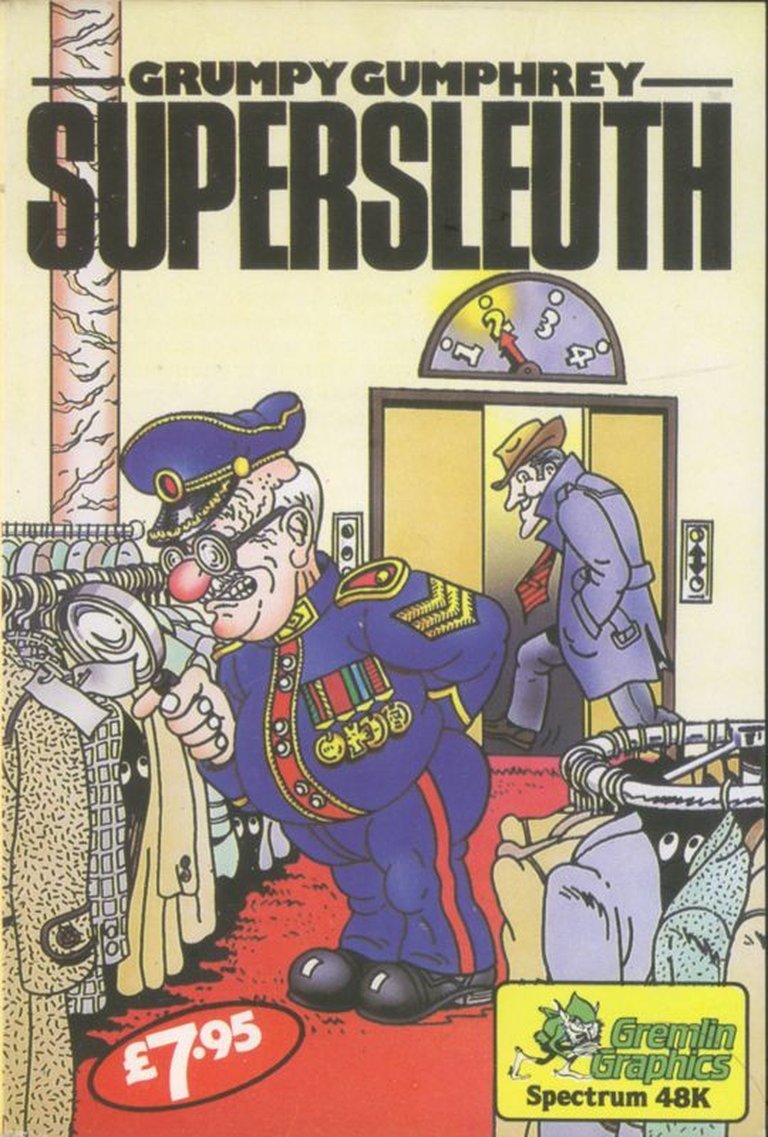
The game’s release was met with considerable anticipation, thanks in part to Gremlin Graphics’ strong reputation. Advertisements in magazines like Crash and Sinclair User touted the game’s originality, promising a experience that was both challenging and humorous. The game’s box art, featuring a caricature of Grumpy in his detective attire, further emphasized its unique tone.
Narrative & Thematic Deep Dive: The Absurdity of Everyday Life
Plot Overview: A Day in the Life of a Store Detective
Grumpy Gumphrey: Supersleuth is, at its heart, a game about the mundane made extraordinary. The player takes on the role of Gilbert Gumphrey, a veteran store detective whose job is anything but glamorous. Over the course of a single day (from 9:00 AM to 5:30 PM), Grumpy must complete a series of tasks assigned by his boss, “Sir,” and the various shoppers who frequent Mole Bros.
These tasks range from the relatively ordinary—such as making tea or tidying the storeroom—to the utterly surreal, like shooting ducks that have invaded the store or capturing a loose gorilla. The game’s narrative is delivered through a text-based message system at the bottom of the screen, which provides Grumpy with his objectives and occasional updates on his progress.
Character Analysis: Grumpy Gumphrey and the Cast of Mole Bros
Grumpy Gumphrey is a character of remarkable depth for his time. Unlike the silent protagonists of many 8-bit games, Grumpy has a distinct personality—one that is grumpy, sarcastic, and endlessly put-upon. His dialogue, though limited by the technical constraints of the Spectrum, is infused with a dry wit that resonates with players. The game’s manual and in-game text paint a picture of a man who is overworked, underappreciated, and perpetually on the verge of being sacked.
The supporting cast of Mole Bros is equally memorable. The shoppers, who serve as both obstacles and sources of tasks, are a motley crew of eccentric individuals. There’s the “harmless hippy,” who wanders the store without causing trouble, and the more aggressive shoppers, who will push Grumpy around if he gets in their way. The boss, “Sir,” is a tyrannical figure who rules the store with an iron fist, doling out warning letters at the slightest provocation.
Themes: Work, Absurdity, and the Struggle for Survival
Grumpy Gumphrey: Supersleuth is a game that explores themes of work, absurdity, and the struggle for survival in a bureaucratic world. Grumpy’s job is a metaphor for the modern workplace—filled with arbitrary tasks, unreasonable demands, and the ever-present threat of termination. The game’s surreal elements—ducks in the store, a loose gorilla—serve to highlight the absurdity of Grumpy’s situation, turning the mundane into the ridiculous.
The game also touches on themes of ageing and obsolescence. Grumpy is not a young, spry hero; he is an ageing man struggling to keep up with the demands of his job. His physical limitations are reflected in the gameplay, where he must rely on tools like a skateboard to navigate the store quickly. This theme of ageing was noted by contemporary reviewers, with Crash magazine calling Grumpy the “first geriatric hero to star in a computer game.”
Dialogue and Humor: The British Surrealist Touch
The humor in Grumpy Gumphrey is distinctly British, drawing on the absurdist traditions of Monty Python and The Goon Show. The game’s tasks are often ridiculous, and the dialogue is filled with dry, sarcastic wit. For example, one of Grumpy’s early tasks is to steal a handgun from under his boss’s chair—a task that is both darkly humorous and indicative of the game’s surreal tone.
The game’s manual, written in a tongue-in-cheek style, further enhances this humor. It describes Grumpy as a “veteran store detective” whose tasks range from the “complex to the mundane,” including “putting out fires, rescuing children, killing ducks, and getting the boss his afternoon cup of tea.” This blend of the ordinary and the absurd is what makes Grumpy Gumphrey such a memorable experience.
Gameplay Mechanics & Systems: A Masterclass in 8-Bit Design
Core Gameplay Loop: The Race Against the Clock
The core gameplay loop of Grumpy Gumphrey: Supersleuth revolves around completing tasks within a strict time limit. Each task is assigned by either the boss or a shopper, and Grumpy must navigate the store to find the necessary objects and complete the objective before time runs out. Failure to do so results in a warning letter, and four warning letters lead to game over.
This time-sensitive gameplay creates a sense of urgency that is rare in 8-bit adventure games. Players must constantly balance speed with precision, as rushing through the store can lead to collisions with shoppers, which further depletes Grumpy’s time.
Combat and Interaction: The Tools of the Trade
While Grumpy Gumphrey is not a combat-heavy game, it does feature elements of interaction that require dexterity and timing. For example, the task of shooting ducks requires Grumpy to steal a handgun from his boss’s office—a feat that demands precise movement and quick reflexes. Similarly, capturing the gorilla requires the use of a cage, which must be placed strategically to trap the animal.
The game’s inventory system is another standout feature. Grumpy can carry multiple objects, cycling through them with the ‘S’ key. This system allows for a level of strategic depth that was uncommon in 8-bit games, as players must decide which objects to carry and when to use them.
Puzzle Design: The Art of the Absurd
The puzzles in Grumpy Gumphrey are a masterclass in 8-bit design. Each task requires players to think creatively, often combining objects in unexpected ways. For example, one puzzle involves using a skateboard to navigate the store quickly, while another requires the use of a fire bucket to extinguish a blaze.
The game’s puzzles are also notable for their integration with the narrative. Unlike many adventure games of the era, which featured abstract puzzles disconnected from the story, Grumpy Gumphrey’s challenges are directly tied to Grumpy’s job. This integration creates a cohesive experience where gameplay and narrative reinforce one another.
UI and Controls: Navigating Mole Bros
The user interface of Grumpy Gumphrey is a model of efficiency, given the limitations of the ZX Spectrum. The game’s HUD is minimal, with a text-based message system at the bottom of the screen and a small inventory display in the corner. The controls are similarly streamlined, with keyboard inputs for movement and interaction.
One of the game’s most innovative features is its use of forced-perspective 3D. Each screen in Mole Bros is rendered in a way that creates a sense of depth, with characters and objects moving in front of and behind one another. This technique, while technically challenging, adds a layer of immersion that was rare in 8-bit games.
Innovative Systems: The Skateboard and the Lift
Two of the game’s most innovative systems are the skateboard and the lift. The skateboard allows Grumpy to move quickly through the store, a necessity given the game’s time-sensitive tasks. The lift, meanwhile, serves as both a transportation system and a storage space for objects, allowing players to stash items for later use.
These systems are not just mechanical gimmicks; they are integral to the game’s narrative and gameplay. The skateboard, for example, is a reflection of Grumpy’s ageing body—he cannot run fast enough on his own, so he must rely on tools to keep up with the demands of his job.
World-Building, Art & Sound: The Department Store as a Character
Setting and Atmosphere: Mole Bros, a World of Its Own
Mole Bros, the department store where Grumpy Gumphrey takes place, is one of the most vividly realized settings in 8-bit gaming. The store is divided into 39 screens, each representing a different department or area, from the ground floor to the boiler room. The attention to detail is remarkable, with each screen featuring unique merchandise, decor, and obstacles.
The store’s layout is designed to be both intuitive and challenging. Players must navigate escalators, lifts, and narrow corridors, all while avoiding the shoppers who mill about the store. The sense of place is further enhanced by the game’s use of forced-perspective 3D, which creates a sense of depth and scale.
Visual Direction: The Spectrum’s Color Clash, Mastered
The visual design of Grumpy Gumphrey is a triumph of 8-bit artistry. Marco Duroe’s graphics are bright, colorful, and filled with personality. The game’s use of color is particularly impressive, given the ZX Spectrum’s notorious color clash issues. Duroe managed to minimize these issues through careful sprite design and masking, creating a world that is both vibrant and cohesive.
The character designs are equally noteworthy. Grumpy himself is a caricature of a grumpy old man, with a hunched posture and a perpetual scowl. The shoppers, meanwhile, are a diverse cast of eccentrics, each with their own unique animations and behaviors.
Sound Design: The Symphony of the Spectrum
The sound design of Grumpy Gumphrey is minimal but effective. The game features a simple soundtrack, with a jaunty tune that plays during the title screen and a series of sound effects that accompany Grumpy’s actions. The sound of Grumpy’s footsteps, the clatter of objects being picked up, and the occasional shout of a shopper all contribute to the game’s immersive atmosphere.
While the Spectrum’s sound capabilities were limited, Grumpy Gumphrey makes the most of them. The game’s audio is not just functional; it is an integral part of the experience, enhancing the game’s humor and sense of place.
Reception & Legacy: The Enduring Appeal of a Geriatric Hero
Critical Reception: Praise for Originality and Polish
Grumpy Gumphrey: Supersleuth was met with widespread acclaim upon its release. Critics praised the game’s originality, humor, and technical polish. Sinclair User awarded the game a perfect 5/5, calling it a “novel plot” and highlighting its “bright and cheerful” graphics. Crash magazine gave the game an 86% rating, praising its “smooth and flicker-free” animation and calling Grumpy the “first geriatric hero to star in a computer game.”
Other reviews were similarly positive. Computer Gamer awarded the game a 90% rating, calling it “an original, fun game which Spectrum owners should add to their collections immediately.” Amtix! praised the game’s 3D effects and colorful presentation, while Computer and Video Games noted its similarity to Pyjamarama, another beloved adventure game of the era.
Commercial Success and Compilations
The game’s critical success translated into commercial success, with Grumpy Gumphrey becoming one of Gremlin Graphics’ best-selling titles. The game was later included in several compilations, including Kidsplay: The Back Pack Compilation (1987) and Take 4 Games (1987), further cementing its place in the Spectrum’s library.
Legacy and Influence: A Pioneer of Narrative-Driven Adventure
Grumpy Gumphrey: Supersleuth is often cited as a pioneer of narrative-driven adventure games. Its blend of action, puzzle-solving, and storytelling was influential, paving the way for later titles like The Secret of Monkey Island and Day of the Tentacle. The game’s use of humor and surrealism also had a lasting impact, inspiring a generation of developers to experiment with tone and narrative in their games.
The game’s legacy is further evidenced by its continued popularity among retro gamers. In 2022, Grumpy Gumphrey was re-released on Steam, introducing a new generation of players to its unique charm. The game’s enduring appeal is a testament to its timeless design and the universal themes it explores.
Conclusion: A Timeless Classic of 8-Bit Gaming
Grumpy Gumphrey: Supersleuth is more than just a relic of the 8-bit era; it is a masterpiece of game design that continues to resonate with players today. Its blend of humor, narrative depth, and innovative gameplay mechanics set it apart from its contemporaries, making it a standout title in the ZX Spectrum’s library.
The game’s protagonist, Grumpy Gumphrey, remains one of the most memorable characters in gaming history—a grumpy, ageing hero who defied the conventions of his time. His struggles to keep his job, complete absurd tasks, and navigate the chaotic world of Mole Bros are as relatable today as they were in 1985.
In the pantheon of retro gaming, Grumpy Gumphrey: Supersleuth deserves a place of honor. It is a game that pushed the boundaries of what was possible on the ZX Spectrum, both technically and narratively. Its legacy as a pioneer of narrative-driven adventure games is secure, and its enduring appeal is a testament to the timelessness of its design.
For those who have yet to experience the joys of Grumpy Gumphrey, the game’s recent re-release on Steam offers the perfect opportunity to step into the shoes of gaming’s first geriatric hero. And for those who remember it fondly, it remains a reminder of a time when games were not just about high scores and flashy graphics, but about character, humor, and the sheer joy of play.
Final Verdict: 9/10 – A timeless classic that remains as fresh and engaging today as it was in 1985.