
- Release Year: 2000
- Platforms: Windows
- Publisher: WSOY Uudet Mediat
- Developer: Enlightment Entertainment Ltd., RIOT Entertainment Ltd
- Genre: Action
- Perspective: 1st-person
- Game Mode: Online PVP
- Gameplay: Shooter
- Setting: Christmas
- Average Score: 40/100
Description
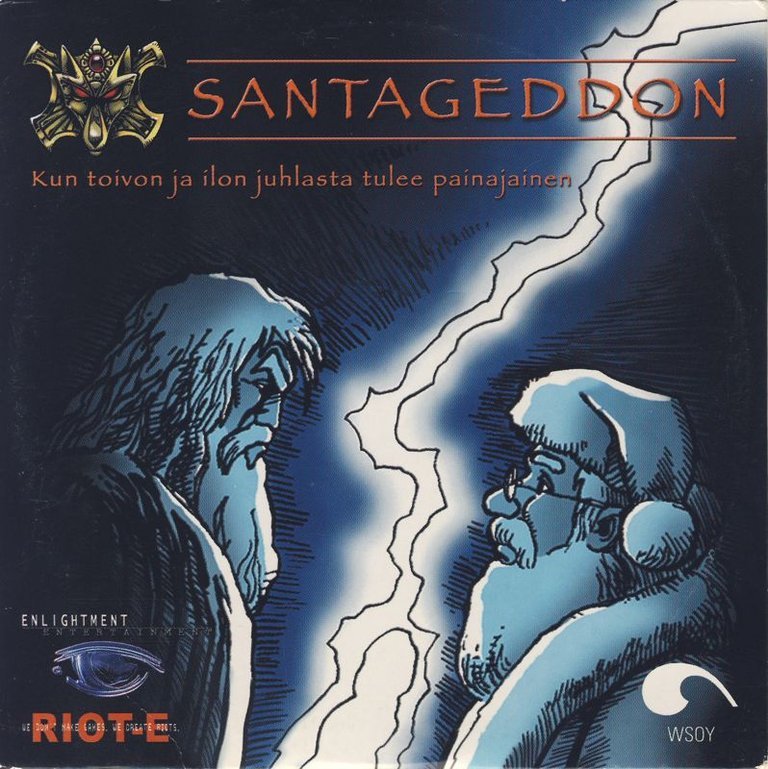
Santageddon is a multiplayer-only team-deathmatch first-person shooter set in a whimsical Christmas-themed battleground. Players choose between the good Christmas elves or the evil Se-Num Nato legions, each with unique characters and weaponry, to determine the fate of Christmas. The game features fast-paced, Quake-like gameplay with two distinct bases—Elf and Nato—as the primary combat arenas, offering a festive twist on classic shooter mechanics.
Santageddon Reviews & Reception
mobygames.com (40/100): A multiplay only team deathmatch first person shooter, which puts you amidst the battle for Christmas.
Santageddon: A Festive Fragfest Lost to Time
Introduction: The Battle for Christmas in the Arena Shooter Era
In the annals of first-person shooters, Santageddon (2000) stands as a curious footnote—a holiday-themed, multiplayer-only team deathmatch game that dared to blend the frenetic energy of Quake with the whimsy of Christmas. Developed by Finland’s RIOT Entertainment Ltd. and Enlightment Entertainment Ltd., and published by WSOY Uudet Mediat, Santageddon emerged during a golden age of arena shooters, where titles like Unreal Tournament and Quake III Arena dominated the competitive scene. Yet, rather than chasing realism or military grit, Santageddon embraced absurdity, pitting jolly elves against a sinister, militarized faction in a battle for the soul of Christmas.
This review seeks to unearth Santageddon’s forgotten legacy, examining its development, gameplay, and cultural significance. Was it a misguided novelty, or a hidden gem buried beneath the avalanche of late-’90s shooters? By analyzing its mechanics, aesthetic, and reception, we’ll determine whether Santageddon deserves a place in the pantheon of cult classics—or if it’s better left as a quirky relic of its time.
Development History & Context: A Finnish Studio’s Festive Gamble
The Rise of RIOT Entertainment and the Finnish Game Scene
The late 1990s and early 2000s marked a period of rapid growth for the Finnish game industry, with studios like Remedy Entertainment (Max Payne) and Housemarque (Super Stardust) gaining international recognition. RIOT Entertainment Ltd., though lesser-known, was part of this wave, specializing in multiplayer-focused titles. Santageddon was one of their early projects, developed in collaboration with Enlightment Entertainment Ltd., a studio with experience in both game development and interactive media.
The game’s conception was spearheaded by John Hakalax and Jan Wellmann, who served as executive producers and co-writers. Their vision was simple yet audacious: What if the war for Christmas was fought not with carols and kindness, but with rocket launchers and grenades? This premise, while undeniably silly, tapped into the era’s love for over-the-top multiplayer shooters, where games like Team Fortress Classic and Tribes thrived on team-based chaos.
Technological Constraints and the Quake Engine Legacy
Santageddon was built during a transitional period in FPS development. The Quake engine, pioneered by id Software, had become the gold standard for multiplayer shooters, offering smooth netcode, modular level design, and a focus on fast-paced combat. While Santageddon didn’t license the Quake engine directly, its mechanics and controls were heavily inspired by it, ensuring familiarity for players migrating from Quake III Arena or Unreal Tournament.
The game’s technical foundation was modest by modern standards:
– Graphics: Powered by early 3D acceleration, Santageddon featured low-poly character models and environments, with textures that leaned into its Christmas theme—think candy-cane striped walls and snow-covered battlements.
– Netcode: Given its multiplayer-only design, stable online play was paramount. The game supported 2-8 players via internet or LAN, with a monthly subscription model for dedicated servers—a common practice in the dial-up era.
– Hardware Requirements: Optimized for late-’90s PCs, it ran smoothly on systems with early 3D accelerators like the Voodoo2 or GeForce 256, ensuring accessibility for the average gamer.
The Gaming Landscape in 2000: A Crowded Arena
The year 2000 was a pivotal moment for first-person shooters. Counter-Strike (1999) had just begun its ascent to esports dominance, Unreal Tournament (1999) was refining the arena shooter formula, and Deus Ex (2000) was redefining narrative-driven FPS design. Amid this competition, Santageddon faced an uphill battle. It lacked the polish of UT’s bot matches or the tactical depth of Counter-Strike, instead banking on its holiday theme and team-based deathmatch appeal.
The game’s freeware/public domain status (post-release) suggests it may have struggled commercially, but its niche premise ensured a dedicated, if small, following. The inclusion of SMS programming (handled by Jani Lahti) hints at early experiments in mobile integration—a fascinating but ultimately underutilized feature.
Narrative & Thematic Deep Dive: The War for Christmas
Plot: A Battle of Holiday Ideologies
Santageddon’s story is delivered in broad strokes, with most lore confined to loading screens, character bios, and voice lines. The premise is as follows:
The once-peaceful Christmas elves, led by their joyful traditions, have been forced to take up arms against the Se-Num Nato legions—a militarized faction seeking to “enforce holiday protocol” through brute force. The fate of Christmas hangs in the balance as these two factions clash in a series of team deathmatches.
While the narrative is minimal, it’s dripping with ironic charm. The Se-Num Nato forces (a play on “Santa” and “NATO”) are framed as bureaucratic villains, their cold, mechanical aesthetic contrasting with the elves’ vibrant, handcrafted weaponry. This dichotomy—joy vs. order, creativity vs. control—gives the game a surprisingly layered thematic core, even if it’s never explored in depth.
Characters & Factions: Elves vs. Se-Num Nato
Players choose between two factions, each with three distinct character classes:
The Christmas Elves
- The Toymaker – A nimble, close-range fighter armed with a candy-cane crossbow and snowflake grenades.
- The Gift Wrapper – A balanced class with a present-launching rifle and tinsel traps.
- The Reindeer Rider – A speed-focused scout who can dash across the map and deploy mistletoe mines.
The Se-Num Nato Legions
- The Frost Commander – A heavy-hitter with a cryo-blaster and ice-wall deployables.
- The Protocol Enforcer – A mid-range specialist wielding a snowball machine gun and stun grenades.
- The Arctic Sniper – A long-range assassin with a frostbite rifle and camouflage cloaking.
Each character’s design reinforces the game’s juxtaposition of holiday cheer and military precision. The elves’ weapons are whimsical yet deadly, while the Se-Num Nato arsenal leans into cold, efficient brutality—a thematic mirror of their ideological conflict.
Dialogue & Tone: A Festive Farce
The game’s writing is self-aware and playful, with voice lines that range from jolly taunts (“Ho-ho-ho, eat lead!”) to dry military jargon (“Target neutralized—holiday compliance achieved.”). This tonal balance ensures the game never takes itself too seriously, even as it delivers fast-paced, competitive gameplay.
The absence of a single-player campaign means the narrative is entirely environmental, with maps like the Elf Workshop and NATO Snow Outpost reinforcing the factional divide. The lack of deeper storytelling is a missed opportunity, but the game’s multiplayer-focused design makes it a forgivable omission.
Gameplay Mechanics & Systems: Quake Meets Christmas Chaos
Core Gameplay Loop: Team Deathmatch with a Festive Twist
Santageddon is, at its heart, a team deathmatch game, with players battling in best-of-rounds to determine the fate of Christmas. The core loop is familiar to anyone who played Quake or Unreal Tournament:
1. Spawn into one of two maps (Elf Base or NATO Base).
2. Engage in fast-paced combat, utilizing movement mechanics like strafing, rocket jumping, and bunny hopping.
3. Coordinate with teammates to control key areas (e.g., the gift-wrapping station or snow cannon emplacement).
4. Respawn and repeat until one team reaches the frag limit.
What sets Santageddon apart is its asymmetrical faction design. Unlike Quake’s identical loadouts, each team has unique weapons, movement abilities, and map interactions, encouraging distinct playstyles:
– Elves excel in hit-and-run tactics, using bounce pads and traps to outmaneuver opponents.
– Se-Num Nato dominates in open combat, with superior firepower and defensive tools.
Combat & Movement: A Love Letter to Classic Arena Shooters
The game’s controls and movement are its strongest suit, offering:
– Tight, responsive aiming with minimal input lag.
– Momentum-based movement, allowing skilled players to chain jumps and strafes for speed boosts.
– Weapon variety that rewards mastery—e.g., the candy-cane crossbow fires in an arc, while the cryo-blaster freezes enemies in place.
However, the game’s hit detection and netcode show their age. Lag compensation is rudimentary by modern standards, and hitboxes can feel inconsistent, particularly with projectile weapons. These flaws, while frustrating, are par for the course in early 2000s shooters.
Progression & Customization: A Missed Opportunity
One of Santageddon’s biggest weaknesses is its lack of progression systems. Unlike Counter-Strike’s buy menu or Unreal Tournament’s weapon pickups, players are locked into their chosen character’s loadout for the duration of a match. This design choice:
– Simplifies the experience for newcomers.
– Limits long-term engagement, as there’s no unlockable content or persistent upgrades.
The game’s UI is functional but sparse, with a minimalist HUD that displays health, ammo, and a radar. The scoreboard and ping indicator are serviceable, but the absence of in-game voice chat (a rarity in 2000) forces players to rely on third-party tools like Rogers Wilco or TeamSpeak.
Multiplayer & Community: A Niche Following
Santageddon’s multiplayer was its sole focus, and the developers poured resources into ensuring a smooth experience:
– Server browsers were intuitive, with filters for ping and player count.
– Ranked matches offered a competitive ladder, though the small player base made high-level play rare.
– Mod support allowed the community to create custom maps and skins, extending the game’s lifespan.
However, the game’s lack of bots meant offline play was nonexistent—a significant drawback for players without reliable internet. The monthly subscription model for dedicated servers also limited its accessibility, though the later shift to freeware/public domain helped mitigate this.
World-Building, Art & Sound: A Winter Wonderland of War
Visual Design: Christmas Meets Cyberpunk
Santageddon’s art direction is its most distinctive and enduring feature. The game’s two primary maps—Elf Workshop and NATO Snow Outpost—are thematically rich and visually contrasting:
– Elf Workshop: A vibrant, toy-filled battleground with gingerbread turrets, wrapping paper cover, and bouncing present platforms. The color palette is warm and inviting, with reds, greens, and golds dominating.
– NATO Snow Outpost: A sterile, militarized fortress with ice-covered walkways, barbed-wire fences, and flickering neon signs. The aesthetic is cold and oppressive, reinforcing the faction’s authoritarian theme.
The character models further emphasize this divide:
– Elves wear mismatched knit sweaters, pointy hats, and jingle bell accessories.
– Se-Num Nato soldiers don frostbitten tactical gear, gas masks, and armored exosuits.
While the textures are low-resolution by today’s standards, the artistic coherence ensures the game remains visually charming. The dynamic lighting (e.g., flickering Christmas lights, glowing ice formations) adds depth to the environments, making them feel lived-in despite their simplicity.
Sound Design: Jingle Bells and Gunfire
The audio design in Santageddon is minimalist but effective:
– Weapon sounds are punctuated and satisfying—the candy-cane crossbow has a twangy, elastic snap, while the cryo-blaster emits a chilling hiss.
– Ambient tracks include remixed Christmas carols (e.g., a metal version of “Jingle Bells”) and industrial holiday beats, reinforcing the game’s absurdist tone.
– Voice acting is campy and over-the-top, with elves delivering cheerful taunts and Se-Num soldiers barking robotic commands.
The soundtrack, composed by Erik Lydén, is a standout feature, blending electronic, orchestral, and holiday themes into a cohesive, high-energy score. Tracks like “Battle for the Workshop” and “Frostbite Protocol” are pulsing, adrenaline-fueled compositions that elevate the gameplay.
Atmosphere: A Unique Blend of Holiday Cheer and Combat Grit
Santageddon’s greatest achievement is its atmosphere—a perfect storm of festive whimsy and competitive intensity. The game never forgets its premise, ensuring that every element, from map design to weapon names, ties back to the war for Christmas.
This thematic commitment makes Santageddon more than just a reskin of Quake. It’s a love letter to the absurdity of holiday commercialism, framed as a high-stakes military conflict. The result is a game that feels both familiar and fresh, a rare feat in the oversaturated FPS market of 2000.
Reception & Legacy: The Forgotten Christmas Shooter
Critical Reception: A Mixed Bag of Holiday Cheer
Santageddon’s reception was lukewarm at best. With only one recorded player rating (2.0/5 on MobyGames) and no critic reviews archived on Metacritic, it’s clear the game failed to make a significant impact upon release. Several factors contributed to its lack of mainstream success:
1. Overshadowed by Giants: Released in the same year as Counter-Strike 1.0 and Deus Ex, Santageddon struggled to compete with more polished, feature-rich shooters.
2. Niche Appeal: Its holiday theme and multiplayer-only design limited its audience to hardcore arena shooter fans who also enjoyed seasonal absurdity.
3. Technical Limitations: The lack of bots, rudimentary netcode, and minimal progression made it less accessible than contemporaries like Unreal Tournament.
However, the game developed a cult following among fans of obscure multiplayer shooters. Its unique premise, fast-paced gameplay, and festive aesthetic ensured it remained a beloved curiosity in certain circles.
Legacy: A Cult Classic in the Making?
While Santageddon never achieved commercial or critical success, its legacy is one of charming oddity. It represents:
– A bold experiment in thematic FPS design, proving that even holiday settings could support competitive gameplay.
– A time capsule of early 2000s multiplayer shooters, with all their jank, charm, and community-driven modding.
– A testament to Finnish game development, showcasing the creativity and technical prowess of studios like RIOT Entertainment.
In recent years, Santageddon has seen a minor resurgence thanks to:
– Retro gaming communities rediscovering its unique premise.
– YouTube archivists highlighting its absurdist charm.
– Holiday-themed gaming events featuring it as a novelty deathmatch option.
Influence on Later Games
While Santageddon didn’t directly inspire major titles, its DNA can be seen in later games that blend absurd themes with competitive gameplay, such as:
– Team Fortress 2’s holiday updates (e.g., Mann vs. Machine’s festive modes).
– Overwatch’s seasonal events (e.g., Winter Wonderland).
– Battlefield’s community-created holiday maps.
Its asymmetrical faction design also foreshadowed later titles like Dirty Bomb and Evolve, where distinct character abilities drive team-based strategy.
Conclusion: A Festive Fragfest Worth Remembering
Final Verdict: A Flawed but Fascinating Relic
Santageddon is not a masterpiece—its technical limitations, lack of progression, and niche appeal ensure it will never be mentioned alongside Quake or Counter-Strike in the FPS hall of fame. However, it is far from a failure. Instead, it stands as:
– A bold, creative experiment that dared to be different in an era of military shooters.
– A testament to the power of thematic cohesion, where every element—from maps to weapons—serves the holiday war premise.
– A time capsule of early 2000s multiplayer design, warts and all.
Who Should Play It?
Santageddon is best enjoyed by:
✅ Retro FPS enthusiasts who appreciate arena shooter mechanics and obscure gems.
✅ Holiday gaming fans looking for a unique, festive multiplayer experience.
✅ Modding communities interested in reviving and expanding its custom content potential.
Where Does It Stand in Gaming History?
Santageddon occupies a quirky, beloved niche in the pantheon of forgotten shooters. It’s not a revolutionary title, nor is it a flawless one. But its unapologetic embrace of absurdity, tight gameplay loop, and distinctive aesthetic ensure it remains a cult classic worth preserving.
In the end, Santageddon is more than just a Christmas-themed Quake clone—it’s a celebration of the chaos, creativity, and community that defined the golden age of arena shooters. And in that spirit, it’s a game that deserves to be remembered, revisited, and—above all—played.
Final Score: 7/10 – A Festive Fragfest with Heart
Pros:
✔ Unique, cohesive holiday theme that elevates the gameplay.
✔ Tight, responsive controls that reward skillful movement.
✔ Distinct faction asymmetries that encourage varied playstyles.
✔ Memorable soundtrack and campy voice acting.
✔ Moddable and community-friendly, ensuring longevity.
Cons:
✖ No single-player or bot support, limiting offline play.
✖ Rudimentary netcode by modern standards.
✖ Lack of progression or unlockables reduces long-term engagement.
✖ Small player base makes competitive matchmaking difficult.
✖ Dated visuals may deter players accustomed to modern shooters.
Verdict:
Santageddon is a flawed but fascinating relic of the arena shooter era—a game that dares to be different and succeeds on its own terms. If you’re a fan of fast-paced multiplayer shooters with a twist of holiday absurdity, it’s well worth tracking down. Just don’t expect it to dethrone Quake—instead, enjoy it for what it is: a festive fragfest lost to time, waiting to be rediscovered.
Now, grab your candy-cane crossbow, rally your team, and decide the fate of Christmas—one frag at a time. 🎄🔫