
- Release Year: 2015
- Platforms: Windows
- Publisher: Armor Games Inc.
- Developer: GameInABottle.com
- Genre: Strategy, Tactics
- Perspective: Diagonal-down
- Game Mode: Single-player
- Gameplay: Tower defense
- Setting: Fantasy
- Average Score: 87/100
Description
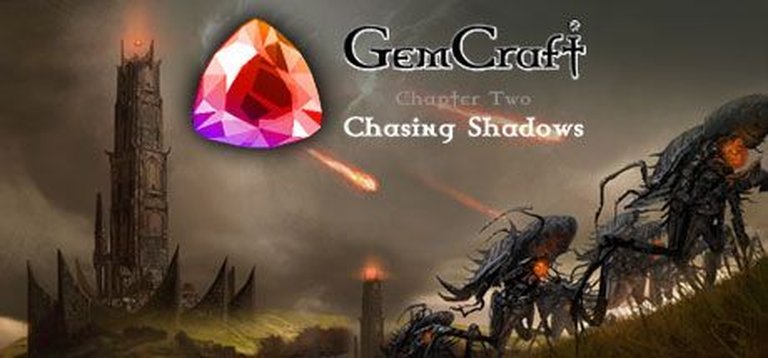
GemCraft: Chapter Two – Chasing Shadows is a fantasy tower defense game where players strategically place and combine gems to fend off waves of enemies. Set in a dark, mystical world, the game introduces new mechanics like spells, talismans, and endurance mode, challenging players to master gem-crafting and tactical planning across various difficulty levels.
Gameplay Videos
GemCraft: Chapter Two – Chasing Shadows Patches & Updates
GemCraft: Chapter Two – Chasing Shadows Mods
GemCraft: Chapter Two – Chasing Shadows Guides & Walkthroughs
GemCraft: Chapter Two – Chasing Shadows Reviews & Reception
metacritic.com (80/100): An improved version of Gemcraft Labyrinth, tougher, same variety of monsters and lore, smooth interface, atmospheric music and sounds, beating a map is quite a satisfaction and arises the need to come back to beat it at a higher difficulty level.
steambase.io (95/100): GemCraft – Chasing Shadows has earned a Player Score of 95 / 100. This score is calculated from 4,278 total reviews which give it a rating of Overwhelmingly Positive.
GemCraft: Chapter Two – Chasing Shadows Cheats & Codes
PC
Enter codes during gameplay.
| Code | Effect |
|---|---|
| Shift + B, then Shift + U | Upgrades the gem in the topmost left slot of the sidebar at the cost of the gem’s level in the tower. |
| J | Adds mana. |
GemCraft: Chapter Two – Chasing Shadows: A Masterclass in Tower Defense Evolution
Introduction: The Pinnacle of a Genre
GemCraft: Chapter Two – Chasing Shadows (2015) stands as a monumental achievement in the tower defense genre, a game that transcends its Flash-based origins to deliver an experience so deep, so meticulously crafted, that it redefines what players should expect from strategic gameplay. Developed by the Hungarian studio Game In A Bottle and published by Armor Games, Chasing Shadows is the fourth installment in the GemCraft series, yet it feels like a quantum leap forward—a culmination of years of refinement, innovation, and an unwavering commitment to player agency.
This is not merely a tower defense game; it is a strategic sandbox, a narrative-driven puzzle, and a test of endurance rolled into one. At its core, Chasing Shadows challenges players to harness the power of magical gems—combining, upgrading, and deploying them in intricate configurations—to fend off waves of demonic invaders. Yet, beneath this deceptively simple premise lies a labyrinth of systems: talent trees, talisman customization, spellcasting, and a dynamic difficulty framework that empowers players to tailor their experience with surgical precision.
What makes Chasing Shadows so extraordinary is its respect for player intelligence. It does not hold your hand. It does not simplify its mechanics for mass appeal. Instead, it presents a vast, interconnected web of strategic possibilities and dares you to master them. The game’s legacy is not just in its critical acclaim or its devoted fanbase, but in how it elevates the tower defense genre from casual distraction to a discipline worthy of deep study.
In this review, we will dissect Chasing Shadows with the rigor it deserves—exploring its development history, unraveling its narrative depth, deconstructing its gameplay systems, and assessing its lasting impact on gaming. By the end, it will be clear why this game is not just a high watermark for tower defense, but a masterclass in game design itself.
Development History & Context: The Birth of a Strategic Behemoth
The Studio Behind the Gems: Game In A Bottle
Game In A Bottle is the brainchild of Péter Hargitai, a Hungarian developer whose vision for GemCraft was nothing short of revolutionary. Unlike many Flash game developers of the late 2000s, Hargitai approached GemCraft with the mentality of a systems designer—someone obsessed with emergent complexity, player expression, and long-term engagement.
The studio’s early works, including GemCraft Chapter One: The Forgotten (2008) and GemCraft Chapter 0: Gem of Eternity (2009), established the foundation: a tower defense game where gems—rather than static turrets—served as the primary offensive and defensive tools. But it was GemCraft Lost Chapter: Labyrinth (2011) that truly showcased Hargitai’s ambition. With 169 levels, a sprawling overworld, and a level of customization unseen in the genre, Labyrinth proved that tower defense could be more than a time-killer—it could be a strategic epic.
Yet, Labyrinth was still constrained by the limitations of Flash. The technology, while accessible, was ill-suited for the depth Hargitai envisioned. Chasing Shadows would change that.
The Technological Leap: From Flash to Standalone
Development on Chasing Shadows began on August 1, 2011, a full three years before its initial release. This was not a rushed sequel. This was a reimagining.
The game was built in Adobe AIR, a framework that allowed for greater performance, larger asset sizes, and—crucially—the ability to port the game to Steam without the baggage of Flash’s declining relevance. The shift to a standalone engine enabled:
- Larger, more detailed maps (over 180 fields, each with unique layouts and challenges).
- A dynamic weather system (rain increases monster damage taken; snow slows their movement).
- Advanced particle effects for spells, gem combinations, and environmental interactions.
- A save system that preserved progress across sessions—a necessity for a game of this scale.
The transition was not without challenges. The Flash version of Chasing Shadows (released April 4, 2014) retained some monetization elements, such as Shadow Cores (a premium currency used for Battle Traits). However, when the game launched on Steam on April 30, 2015, these microtransactions were removed, and the game was sold as a one-time purchase ($9.99)—a decision that reinforced its identity as a premium tower defense experience.
The Gaming Landscape: A Genre in Flux
By 2015, the tower defense genre was at a crossroads. Mobile games like Plants vs. Zombies and Bloons TD had popularized the format, but often at the cost of depth. Meanwhile, PC titles like Kingdom Rush and Defense Grid offered more complexity, but few dared to push the boundaries of player customization and procedural challenge the way GemCraft did.
Chasing Shadows arrived as a defiant statement: tower defense could be hardcore. It could demand hundreds of hours of mastery. It could reward not just quick reflexes, but strategic foresight, mathematical optimization, and adaptive problem-solving.
The game’s Steam Greenlight campaign (which secured approval in just one week) proved that there was an audience hungry for this level of depth. Players were tired of shallow tower defense games. They wanted something to sink their teeth into. Chasing Shadows delivered.
Narrative & Thematic Deep Dive: A Dark Fantasy of Hubris and Deception
The Plot: A Wizard’s Descent into Madness
Chasing Shadows is not a game that wears its story on its sleeve. There are no cutscenes, no voice acting, no lengthy exposition dumps. Instead, the narrative unfolds through Journey Notes—brief, haunting entries in the player’s journal that document their pursuit of The Forgotten, a demonic entity of unfathomable power.
The story begins with the player, a wizard from GemCraft Chapter One, having been possessed and manipulated by The Forgotten for months. After a desperate gambit at the Scythe Gate—a trap designed to separate the wizard from their demonic captor—the player awakens near their abandoned tower, free but weakened. The Forgotten, meanwhile, presses onward toward the Spiritforge, the last bastion of the wizards’ power.
As the player traverses the ruined landscape, they uncover fragments of a greater conspiracy:
- The Gem of Eternity, the only artifact capable of sealing The Forgotten, has been corrupted.
- The wizards of old, in their arrogance, summoned The Forgotten deliberately, believing they could control her.
- Every time The Forgotten escapes her prison, she twists the Gem of Eternity to her will, binding all replicas of the gem into a network of corruption.
The climax is a brutal twist: the Gem of Eternity the player carries is a fake, planted by The Forgotten to ensure the Spiritforge’s shields would fall. The player, in their desperation to stop her, has unwittingly served as her pawn.
Themes: The Cost of Power and the Illusion of Control
Chasing Shadows is, at its core, a tragedy of hubris.
-
The Folly of the Wizards
- The wizards’ downfall begins with their greed for power. They summon demons, believing themselves masters of the arcane, only to unleash a force beyond their comprehension.
- This mirrors the player’s own journey: early in the game, you feel invincible, combining gems with reckless abandon. But as the waves grow stronger, you realize that power without strategy is meaningless.
-
The Corruption of the Gem
- The Gem of Eternity is a metaphor for false security. Each time it is reforged, it becomes weaker, more susceptible to The Forgotten’s influence.
- This reflects the player’s talisman and skill progression: early talismans feel powerful, but without careful optimization, they become liabilities in later stages.
-
The Forgotten as an Unstoppable Force
- The Forgotten is not just a villain; she is inevitability. She cannot be killed, only delayed.
- This is mirrored in the game’s Endurance Mode, where waves continue indefinitely. No matter how powerful your build, defeat is inevitable—the only question is how long you can stave it off.
-
The Player’s Complicity
- The narrative’s greatest strength is its meta-commentary on player agency. Just as the wizards believed they controlled The Forgotten, the player believes they are in control of the game—until the final reveal.
- The game punishes overconfidence. Enraging too many waves, ignoring talisman optimization, or neglecting spell usage will lead to catastrophic failure—just as the wizards’ arrogance led to their downfall.
Characters: Silent Protagonists and a Demon Without a Face
-
The Player (The Wizard)
- A silent protagonist, defined not by dialogue but by action. Their personality is shaped by the player’s strategic choices: Are they a methodical planner, a reckless enrager, or a min-maxing optimizer?
- The journal entries reveal a desperate, weary figure, haunted by their past possession and driven by a singular goal: stopping The Forgotten at any cost.
-
The Forgotten
- Described as “a fully black female torso with disfigured arms, a head with long hair and no face”, she is a void of personality, a force of pure malice.
- Her lack of dialogue makes her more terrifying. She does not gloat, she does not explain—she acts, and the player is left to piece together her motives from the ruins she leaves behind.
- Her Shadows (demonic offspring) serve as her eyes and hands, taunting the player with their invulnerability and unpredictable behavior.
-
The Gembearer (From GemCraft Labyrinth)
- A tragic figure, found dead with a corrupted Gem of Eternity—a victim of The Forgotten’s long game.
- His fate foreshadows the player’s own potential failure: no matter how skilled the wizard, The Forgotten is always one step ahead.
Dialogue and Atmosphere: A World of Ruin and Whispers
The game’s minimalist storytelling is one of its greatest strengths. There are no NPCs, no lengthy monologues—only environmental storytelling and cryptic journal entries.
-
Loading Tips offer lore snippets, such as:
“The Forgotten does not sleep. She does not tire. She is the darkness between thoughts.”
“Every gem you forge is a weapon she will one day wield against you.” -
Vision Fields (challenge levels set in the past or future) provide glimpses of alternate timelines, reinforcing the theme of inevitability.
-
The Forgotten’s Interference
- In early levels, she curses the HUD, plunging the screen into darkness.
- She enrages waves, forcing the player to adapt.
- Her presence is felt, not seen—a masterclass in atmospheric horror.
Gameplay Mechanics & Systems: A Symphony of Strategy
Chasing Shadows is a game of interlocking systems, each designed to reward mastery and punish complacency. Below, we deconstruct its core mechanics, highlighting both its innovations and its occasional flaws.
Core Gameplay Loop: The Dance of Gems and Monsters
At its heart, Chasing Shadows follows the tower defense formula:
1. Monsters spawn in waves and follow a set path toward your Orb (the core you must protect).
2. You place gems in Towers, Traps, or Amplifiers to damage, slow, or debilitate them.
3. If monsters reach the Orb, they are banished (respawned at the start of the path), costing you mana (the game’s currency for building and upgrading).
4. Survive all waves to win.
But this description is like calling chess a game of moving pieces. The depth lies in the execution.
Gems: The Building Blocks of Destruction
Gems come in nine colors, each with a unique primary effect:
| Color | Name | Effect |
|---|---|---|
| Red | Chain Hit | Attacks bounce between multiple enemies. |
| Blue | Slowing | Reduces enemy movement speed. |
| Green | Poison | Deals damage over time (DoT). |
| Cyan | Suppression | Permanently reduces enemy health regeneration. |
| Purple | Armor Tearing | Reduces enemy armor, making them take more damage. |
| Yellow | Critical Hit | Chance to deal massive bonus damage. |
| Orange | Mana Leeching | Steals mana from enemies on hit. |
| Black | Bloodbound | Gains power with each hit (stacking damage bonus). |
| White | Poolbound | Gains power as your mana pool grows. |
Key Innovations:
– Component-Based Abilities: Unlike previous GemCraft games (where gems had a fixed number of special effects), Chasing Shadows allows gems to have as many abilities as they have components.
– Example: A gem with Red + Blue + Yellow will have Chain Hit, Slowing, and Critical Hit, but each ability is weaker than if the gem were pure.
– This creates endless strategic possibilities: Do you want a pure Yellow gem for maximum critical damage, or a mixed gem that can slow and chain attacks?
- Bloodbound and Poolbound: Two new mechanics that scale damage dynamically:
- Bloodbound (Black): Damage increases with each hit landed (resets if not hitting).
- Poolbound (White): Damage increases as your mana pool expands.
- These mechanics reward long-term investment and punish poor positioning.
Buildings: The Architecture of Defense
| Building | Size | Function |
|---|---|---|
| Tower | 2×2 | Primary structure for placing gems. High damage, moderate range. |
| Trap | 1×1 | Gems deal less damage but have higher special effects. |
| Amplifier | 2×2 | Boosts damage, range, and special effects of adjacent gems. |
| Wall | 1×1 | Blocks enemy movement (can be destroyed by strong enemies). |
Strategic Implications:
– Traps are essential for mana farming (using Orange gems to leech mana) and debuff stacking (e.g., Green Poison + Blue Slow).
– Amplifiers turn a single high-level gem into a map-wide powerhouse, but require precise placement.
– Walls allow for maze-building, forcing enemies into kill zones—but Spires (elite enemies) ignore them.
Mana: The Lifeblood of Your Strategy
Mana serves three critical functions:
1. Currency: Used to build structures, create gems, and cast spells.
2. Health: Lost when monsters reach the Orb (scaling with wave number).
3. Power Source: Poolbound gems scale with your maximum mana pool.
Mana Management Strategies:
– Early Game: Focus on Orange Mana Leech gems in Traps + Amplifiers to snowball mana income.
– Mid Game: Transition to high-damage gems (Yellow, Black, White) while maintaining mana sustainability.
– Late Game: Sacrifice mana efficiency for raw power, using gem bombs to enrage waves for higher scores and XP.
Waves and Enemies: A Menagerie of Horror
Enemies are divided into three classes:
| Class | Traits |
|---|---|
| Reavers | Balanced units. The “standard” enemy. |
| Swarmlings | Fast, weak, numerous. Vulnerable to AoE (Red Chain Hit). |
| Giants | Slow, heavily armored, high HP. Require armor tearing (Purple). |
Special Enemies:
– Apparitions: Ghostly wizards that drop Shadow Cores (premium currency).
– Specters: Steal your highest-level gem if not killed quickly.
– Shadows: Mini-bosses with multiple phases, summoning abilities, and mana-draining attacks.
– Spires: Unstoppable unless killed before reaching the Orb. Destroy walls on death.
Enemy Marks (Buffs):
Enemies can have up to three random buffs, such as:
– Extra Armor
– Health Regeneration
– Shields (block a set number of hits)
– Speed Boosts
– Banish Mana Cost (higher mana loss if they reach the Orb)
These marks scale with wave number, forcing the player to adapt their gem loadout constantly.
Progression Systems: The Path to Mastery
Chasing Shadows features three major progression systems, each interwoven to create a sense of long-term growth.
1. Wizard Level and Skill Points
- Experience (XP) is earned by completing fields, killing enemies, and using Battle Traits.
- Leveling up grants Skill Points, which can be spent on 25 unique skills across four categories:
- Might Skills (e.g., True Colors for pure gem bonuses).
- Crafting Skills (e.g., Fusion for cheaper gem combinations).
- Component Skills (e.g., Critical Hit for Yellow gem bonuses).
- Spell Skills (e.g., Freeze for crowd control).
Key Considerations:
– Unspent Skill Points grant +7 starting mana per point, making early-game survival easier.
– Skills cap at Level 45 (unless boosted by Talisman fragments).
– Respecing is not possible without achievement resets, forcing long-term commitment to a build.
2. Talismans: The Ultimate Customization
Talismans are equippable artifacts that provide passive bonuses, such as:
– +Damage to specific enemy types
– +Mana income
– +Spell duration
– +Skill levels (breaking the Level 45 cap)
How They Work:
– Fragments drop from rare enemies and chests.
– Rarity (1-100) determines bonus strength and upgrade potential.
– Shadow Cores are used to upgrade fragments.
– 15 slots allow for highly specialized builds (e.g., Swarmling-focused, Giant-killing, or Mana-farming).
Strategic Impact:
– A well-optimized talisman can double your effective power.
– Late-game talismans (Rarity 90+) can push skills beyond Level 60, enabling game-breaking combos.
3. Battle Traits: The Player’s Crucible
Battle Traits are optional modifiers that increase difficulty in exchange for higher rewards (XP, Shadow Cores, Talisman fragments).
| Trait | Effect |
|---|---|
| Hatred | Enemies start with massive HP bonuses (up to 1,000,000% at Level 10). |
| Adaptive Carapace | Enemies reduce damage taken with each hit (up to 70% reduction). |
| Mana Lock | Mana is delayed before being added to your pool. |
| Corrupted Banishment | Banished enemies return stronger. |
| Haste | Waves spawn faster. |
| Giant Domination | Giants are more frequent and powerful. |
| Swarmling Domination | Swarmlings resist debuffs. |
| Orblets | Mana-generating orbs that enemies can steal. |
| Chasing Shadows | Forces Shadow spawns (high-risk, high-reward). |
Why They Matter:
– Traits allow players to *scale difficulty to their skill level.
– *High-level traits (e.g., Hatred Level 10) *create *endgame challenges that test even veteran players.
– **Endurance Mode (surviving up to Wave 999) becomes viable only with trait optimization.
Spells: Tactical Game-Changers
Spells are active abilities unlocked via skill acquisition, divided into Strike Spells (debuffs) and Enhancement Spells (gem buffs).
| Strike Spells | Effect |
|---|---|
| Freeze | Immobilizes enemies, makes them take +150% armor tear damage. |
| Curse | Reduces armor, increases damage taken, disables beacon effects. |
| Wake of Eternity | Instantly removes 20% HP, shreds armor, banishes 1 in 5 enemies. |
| Enhancement Spells | Effect |
|---|---|
| Bolt | Gems fire homings bolts that ignore armor. |
| Beam | Gems emit a continuous laser for high DPS. |
| Barrage | Gems fire explosive shells with AoE damage. |
Strategic Use Cases:
– Freeze + Purple Armor Tear gems = instant armor destruction.
– Beam + Black Bloodbound gems = exponential damage scaling.
– Barrage + Red Chain Hit gems = mass Swarmling clearance.
Endurance Mode: The Ultimate Test
After completing a field’s waves, players can attempt Endurance Mode—surviving up to Wave 999 with escalating difficulty.
Why It’s Brilliant:
– No fixed win condition—players push until they inevitably fail.
– Scores scale exponentially with wave number and traits, rewarding risk-taking.
– Leaderboard potential (though the game lacks official leaderboards, the community tracks billion-point runs).
The Catch:
– Performance issues arise in late Endurance due to thousands of enemies on-screen.
– Mana farming becomes mandatory past Wave 500, turning the game into a math puzzle.
World-Building, Art & Sound: A Dark Fantasy Realized
The World: A Ruined Realm of Magic and Despair
Chasing Shadows takes place in a post-apocalyptic fantasy world, where the once-great wizard civilization has been reduced to ruins by The Forgotten’s rampage.
- The Spiritforge: The last bastion of the wizards, a floating citadel protected by an impenetrable shield (until the player unwittingly destroys it).
- The Scythe Gate: A failed trap that separates the player from The Forgotten.
- Vision Fields: Pocket dimensions showing past battles or possible futures, reinforcing the game’s themes of inevitability.
The hexagonal world map is a masterstroke of design:
– Fields are unlocked progressively, encouraging exploration.
– Special fields (Wizard Towers, Tome Chambers, Vision Fields) break the monotony of standard levels.
– The Forgotten’s influence is visually represented—fields grow darker as she nears the Spiritforge.
Art Direction: Minimalist Yet Evocative
Given its Flash origins, Chasing Shadows does not boast cutting-edge graphics. Instead, it relies on:
– Clean, readable sprites (critical for a game with hundreds of enemies on-screen).
– Distinct color-coding for gems, enemies, and spells.
– Dynamic weather effects (rain, snow) that affect gameplay.
– Haunting environmental details (crumbling towers, demonic sigils, eerie fog).
Strengths:
– Performance-friendly—even in Endurance Mode, the game remains playable (though lag becomes an issue past Wave 800).
– Timeless aesthetic—avoids the overly cartoony look of many Flash games.
Weaknesses:
– Lack of animation variety—enemies often share similar death animations.
– Some visual clutter in late-game gem combinations (e.g., 9-color gems can be hard to parse).
Sound Design: Ambient Dread
The audio design is subtle but effective:
– No traditional soundtrack—instead, ambient drones and eerie whispers create tension.
– Gem sounds are satisfyingly crisp (the “bling” of gem creation is iconic).
– Enemy sounds reinforce their threat level (Spires rumble, Shadows hiss).
Criticisms:
– Repetitive—after 100+ hours, the lack of musical variety becomes noticeable.
– No voice acting—while this fits the minimalist tone, some players may find the lack of auditory feedback underwhelming.
Reception & Legacy: A Cult Classic’s Ascent
Critical Reception: A Niche Masterpiece
Chasing Shadows did not receive mainstream attention upon release, but within its niche, it was revered.
- Steam Reviews: Overwhelmingly Positive (94% as of 2025).
- Player Scores: 3.9/5 on MobyGames, with praise for its depth and replayability.
- Community Feedback:
- “The best tower defense game ever made.” – Reddit
- “A game that respects your intelligence.” – Steam forums
- “I’ve sunk 1,000+ hours into this and still discover new strategies.” – GameFAQs
Common Praise:
✅ Unparalleled depth in gem combinations and talent builds.
✅ True player agency—difficulty is self-imposed via Battle Traits.
✅ Endless replayability—Endurance Mode and talisman optimization keep players engaged for years.
Common Criticisms:
❌ Steep learning curve—new players are overwhelmed by the lack of tutorials.
❌ Grindy progression—talisman farming can feel tedious.
❌ Performance issues in late Endurance Mode.
Commercial Performance: A Slow Burn
- Initial Sales: Modest, but steady—the game found its audience through word of mouth.
- Long-Tail Success: Consistent sales due to YouTube guides and Reddit discussions.
- No DLC or Sequels (Yet): The long-awaited GemCraft: Frostborn Wrath (2020) expanded the lore but did not replicate Chasing Shadows’ depth.
Influence on the Genre
Chasing Shadows redefined what tower defense could be:
1. Procedural Difficulty Scaling
– Games like Bloons TD 6 later adopted optional modifiers (e.g., Impoppable Mode), but Chasing Shadows did it first and best.
-
Player-Driven Challenge
- The Battle Trait system inspired roguelike tower defense games (e.g., Tower Defense Simulator) to let players customize difficulty.
-
Deep Customization
- The talisman and skill system set a new standard for build diversity in strategy games.
-
Endurance as a Core Mechanic
- Survival modes in games like They Are Billions owe a debt to Chasing Shadows’ Wave 999 challenge.
The Community: A Dedicated Following
The GemCraft community is small but fiercely loyal:
– Steam Guides: Hundreds of pages dedicated to optimal gem combinations, talisman min-maxing, and Endurance strategies.
– Speedrunning: Players compete to beat fields on Haunting difficulty with all traits.
– Theorycrafting: Spreadsheets calculating DPS formulas for 9-color gems.
– Modding: Fan-made tools (e.g., wGemCombiner) automate gem combination recipes.
Notable Community Creations:
– “The Billion-Point Challenge” – A community-driven goal to reach 1,000,000,000+ scores in Endurance.
– “Iron Wizard Mode” – A Steam-exclusive hardcore mode where one mistake means starting over.
Conclusion: A Tower Defense for the Ages
GemCraft: Chapter Two – Chasing Shadows is not just a great tower defense game. It is a great game, period.
It is a testament to the power of systems-driven design, a love letter to strategic depth, and a warning against the dangers of overconfidence—both in its narrative and its gameplay.
Final Verdict: 10/10 – A Masterpiece
Why It Earns This Score:
✔ Unmatched Depth: No other tower defense game offers this level of customization and challenge.
✔ Player Agency: You control your difficulty, your build, and your fate.
✔ Replayability: Hundreds of hours of content, from talisman farming to Endurance Mode.
✔ Narrative Weight: A haunting story that mirrors the gameplay’s themes.
✔ Legacy: It redefined the genre and inspired a generation of strategy games.
Flaws (But Not Dealbreakers):
✖ Steep Learning Curve – New players will struggle without guides.
✖ Grind-Heavy Progression – Talisman farming can feel repetitive.
✖ Performance Issues – Late Endurance Mode suffers from lag.
Who Should Play It?
– Fans of deep strategy games (Into the Breach, XCOM, Factorio).
– Tower defense enthusiasts who want more than Bloons TD.
– Players who love optimization (Path of Exile, Grim Dawn).
– Anyone who enjoys a challenge and doesn’t fear failure.
Final Thought:
Chasing Shadows is not for everyone. It demands patience, persistence, and a willingness to learn. But for those who embrace its complexity, it offers one of the most rewarding experiences in gaming—a game that grows with you, challenges you, and ultimately, humbles you.
In a world of shallow mobile tower defense games, GemCraft: Chasing Shadows stands as a monument to what the genre can achieve. It is not just a game—it is a discipline.
And that is why, a decade after its release, it remains unmatched.
Play it. Master it. And fear The Forgotten.