
- Release Year: 1989
- Platforms: Linux, Macintosh, Windows
- Publisher: Unknown
- Developer: Stuart Cheshire
- Genre: Action, Strategy, Tactics
- Perspective: Top-down
- Game Mode: LAN, Single-player
- Gameplay: Base capture, Boat and bridge construction, Mine laying, Pillbox deployment, Resource collection, Road building, Tank combat, Wall building
- Setting: Military, Tactical
- Average Score: 72/100
Description
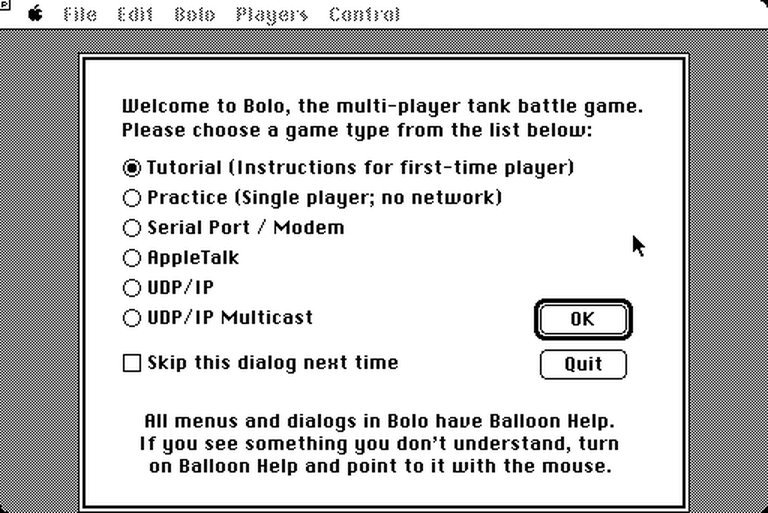
Bolo is a pioneering top-down tank combat game released in 1989 for the Macintosh, emphasizing real-time multiplayer strategy and teamwork. Players control tanks in a dynamic battlefield, collecting resources via a ‘Little Green Man’ (LGM) to build roads, walls, bridges, and defensive structures like pillboxes while competing to capture and defend refueling bases. Originally an experiment in early computer networking, Bolo supports up to 16 players over LAN, blending arcade-style action with tactical depth, and became a landmark in collaborative online gaming.
Where to Buy Bolo
PC
Bolo Free Download
Bolo Cracks & Fixes
Bolo Reviews & Reception
mobygames.com (72/100): An early networking experiment between BBC microcomputers, Bolo is a top-down tank deathmatch game with a highly simplified physics model.
reddit.com : It was simple by today’s standards but way up there in terms of fun I’ve had playing a video game.
classicreload.com : The 1993 version of Bolo, reimagined by Mr. Rm and inspired by the original 1982 game by Elvyn Software, is a compelling mix of arcade and strategy elements.
retro365.blog : Bolo became one of the first commercial games to tie into a novel and while Lane tried to get sci-fi writer Keith Laumer to write the scenario description, he declined and Lane and his then-wife wrote it.
Bolo: A Pioneering Multiplayer Masterpiece
Introduction
In the annals of video game history, few titles have left as indelible a mark on the evolution of multiplayer gaming as Bolo. Released in 1989 for the Macintosh, Bolo was not just a game—it was a revolution. A top-down tank battle simulator that seamlessly blended arcade action with real-time strategy, Bolo introduced players to a world where communication, teamwork, and tactical ingenuity were as crucial as quick reflexes. Developed by Stuart Cheshire as an early experiment in networked gaming, Bolo allowed up to 16 players to engage in frenetic, strategic battles across diverse terrains, capturing bases, deploying pillboxes, and outmaneuvering opponents in a way that was unprecedented for its time.
This review will delve deep into Bolo‘s development history, its innovative gameplay mechanics, its thematic and narrative underpinnings, and its lasting legacy. We will explore how Bolo transcended the limitations of its era to become a cornerstone of multiplayer gaming, influencing titles like StarCraft and setting the stage for the modern real-time strategy genre. Through an exhaustive analysis of its design, reception, and cultural impact, we will argue that Bolo was not merely a product of its time but a visionary work that redefined what networked gaming could achieve.
Development History & Context
The Genesis of a Networking Experiment
Bolo was born out of Stuart Cheshire’s fascination with computer networking and multiplayer gaming. In 1987, while a student at the University of Cambridge, Cheshire began experimenting with networking on the BBC Micro, a popular educational computer in the UK. His goal was ambitious: to create a real-time multiplayer game that could run on a local area network (LAN) without the need for a centralized server. This was a radical idea in an era where most multiplayer games were either turn-based or limited to two players sharing a single machine.
Cheshire’s early experiments involved stringing 50 meters of serial cable between dorm rooms to connect BBC Micro computers, a makeshift solution that laid the groundwork for Bolo‘s networking model. The name “Bolo” itself was inspired by Cheshire’s wife, Pavani Diwanji, who suggested the Hindi word for “communication.” This choice was deliberate, reflecting the game’s dual focus on machine-to-machine networking and human-to-human interaction. As Cheshire noted in the game’s FAQ, Bolo was “about computers communicating on the network, and more importantly about humans communicating with each other, as they argue, negotiate, form alliances, agree strategies, etc.”
Transition to the Macintosh
While the BBC Micro version of Bolo was prototyped in 1987, it was never commercially released due to the platform’s limitations and the complexity of its networking requirements. Cheshire shifted his focus to the Apple Macintosh, which offered a more robust environment for networking through AppleTalk, a proprietary suite of protocols developed by Apple. The Macintosh version, first released in 1989, became the definitive incarnation of Bolo, leveraging AppleTalk to support up to 16 players in real-time battles.
The Macintosh’s graphical capabilities and user-friendly interface made Bolo more accessible, and its networking features allowed the game to thrive in educational and corporate settings. Cheshire continued to refine Bolo throughout the early 1990s, with the final official version (0.99.7) released in 1995. The game’s shareware distribution model—where players could try it for free before purchasing a license—helped it gain a dedicated following, particularly in university computer labs and offices where LAN gaming was becoming increasingly popular.
Technological Constraints and Innovations
Bolo‘s development was shaped by the technological constraints of the late 1980s and early 1990s. The Macintosh’s limited processing power and memory required Cheshire to optimize the game’s physics and networking models. The game’s “simplified physics model” was a necessity rather than a design choice, allowing for smooth gameplay even on lower-end machines like the Mac Plus.
One of Bolo‘s most innovative features was its distributed networking architecture. Unlike modern games that rely on a client-server model, Bolo used a peer-to-peer approach where each player’s machine contributed to the game’s state. A single packet circulated among all players in a round-robin fashion, with each machine adding its input before passing the packet to the next. This design minimized network traffic and eliminated the need for a dedicated host, making Bolo remarkably resilient to player dropouts. However, it also introduced latency issues, particularly as the game expanded to internet play in later versions.
The Gaming Landscape of the Late 1980s
Bolo emerged at a time when multiplayer gaming was still in its infancy. Most games were single-player experiences, and those that did support multiplayer were typically limited to two players on the same machine. Networked gaming was rare, and when it did exist, it was often confined to text-based MUDs (Multi-User Dungeons) or simple turn-based strategy games.
In this context, Bolo was a revelation. It offered real-time, graphical multiplayer action that was both accessible and deeply strategic. The game’s emphasis on teamwork and communication set it apart from the arcade-style shooters of the era, which were often solitary or competitive experiences. Bolo was one of the first games to demonstrate the potential of networked gaming as a social activity, paving the way for future titles like Doom, Quake, and StarCraft.
Narrative & Thematic Deep Dive
The Absence of a Traditional Narrative
Bolo is not a game driven by a traditional narrative. There are no cutscenes, no characters with backstories, and no overarching plot. Instead, the game’s “story” emerges from the interactions between players as they compete and cooperate in real-time battles. This lack of a predefined narrative is not a weakness but a strength, as it allows players to create their own stories through their actions and strategies.
The game’s setting is a generic battlefield, populated by tanks, pillboxes, and refueling bases. The terrain varies from map to map, featuring forests, swamps, rivers, and open plains, but there is no overarching lore or context for these battles. The focus is purely on the gameplay, with the narrative emerging from the dynamics of competition and cooperation.
Themes of Communication and Cooperation
At its core, Bolo is a game about communication. The name itself, derived from the Hindi word for “speak,” underscores this theme. The game’s design encourages players to form alliances, negotiate strategies, and coordinate their actions in real-time. This emphasis on communication is reflected in the game’s mechanics, which allow players to send messages to each other, form teams, and even share control of a single tank (with one player driving and the other manning the turret).
The theme of cooperation is equally central to Bolo. While the game can be played as a free-for-all deathmatch, its true depth is revealed in team-based matches where players must work together to capture bases, deploy pillboxes, and defend their territory. The game’s resource management system—where players must harvest lumber to build roads, walls, and bridges—further emphasizes the importance of teamwork, as no single player can hope to control an entire map alone.
The Role of the Little Green Man (LGM)
One of Bolo‘s most iconic elements is the Little Green Man (LGM), a small engineer unit that can be deployed from the player’s tank to perform various tasks. The LGM is a vulnerable but essential part of the game, responsible for harvesting lumber, building structures, and planting mines. The LGM’s presence adds a layer of strategy to Bolo, as players must decide when to risk sending their engineer into dangerous territory and when to keep them safe inside the tank.
The LGM also serves as a thematic counterpoint to the game’s focus on destruction. While the tanks are instruments of war, the LGM is a builder, creating roads and bridges that facilitate movement and defense. This duality—between destruction and construction, between warfare and engineering—adds depth to Bolo‘s otherwise straightforward premise.
The Influence of Keith Laumer’s Bolo Series
Despite Stuart Cheshire’s insistence that his game’s name was inspired by the Hindi word for “communication,” it is impossible to ignore the influence of Keith Laumer’s Bolo series of science fiction novels. Laumer’s Bolo stories, which began in the 1960s, feature self-aware, heavily armored tanks that serve as both weapons of war and symbols of human ingenuity. While Cheshire’s Bolo is not directly based on Laumer’s work, the thematic overlap is striking.
Laumer’s Bolo tanks are characterized by their independence and strategic acumen, much like the player-controlled tanks in Cheshire’s game. Both versions of Bolo explore the idea of tanks as more than just machines of war—they are tools of strategy, requiring careful planning and adaptability. The presence of automated pillboxes in Bolo, which can be captured and redeployed, further echoes the themes of Laumer’s novels, where technology and tactics intertwine.
Gameplay Mechanics & Systems
Core Gameplay Loop
Bolo‘s gameplay revolves around a simple but deeply strategic core loop: move, shoot, build, and capture. Players control a tank from a top-down perspective, navigating a battlefield filled with terrain obstacles, enemy tanks, and strategic objectives. The primary goals are to capture refueling bases, which provide ammunition and repairs, and to deploy pillboxes, which serve as automated turrets that can be used for defense or offense.
The game’s real-time nature means that players must constantly adapt to changing circumstances. Unlike turn-based strategy games, where players have time to plan their moves, Bolo requires quick thinking and rapid decision-making. This makes the game both exhilarating and challenging, as players must balance offense and defense while managing their resources.
Combat and Physics
Bolo‘s combat system is deceptively simple. Tanks can fire shells in the direction they are facing, with a trajectory that accounts for gravity and range. The game’s “simplified physics model” means that shells follow a predictable arc, allowing skilled players to lead their shots and hit moving targets. Mines can also be deployed, either by the tank itself or by the LGM, adding an element of area denial to the gameplay.
The game’s terrain plays a crucial role in combat. Forests provide cover but slow movement, swamps impede tanks but can be traversed with bridges, and rivers require boats or bridges to cross. Explosions from shells and mines create craters, which can block movement or even flood adjacent areas, dynamically altering the battlefield. This environmental interaction adds a layer of strategy to Bolo, as players must adapt to the changing landscape.
Resource Management and Building
Resource management is a key aspect of Bolo‘s gameplay. Players must harvest lumber from forests using their LGM, which can then be used to build roads, walls, bridges, and boats. Roads allow tanks to move faster, walls provide cover and block enemy movement, and bridges enable crossing of rivers and swamps. Boats, while fragile, allow tanks to traverse water, opening up new strategic possibilities.
The LGM is central to this system, but it is also vulnerable. If the LGM is killed while outside the tank, a replacement must be parachuted in, leaving the player temporarily unable to build or harvest resources. This risk-reward dynamic forces players to carefully consider when and where to deploy their engineer, adding tension to the gameplay.
Pillboxes and Base Capture
Pillboxes are one of Bolo‘s most unique features. These automated turrets can be captured by shooting them until they are destroyed, at which point they can be picked up by the LGM and redeployed elsewhere on the map. Pillboxes are powerful defensive tools, as they can fire rapidly and do not require player input to operate. However, they are also vulnerable to enemy fire, and their placement must be carefully considered to maximize their effectiveness.
Capturing and defending refueling bases is another critical aspect of Bolo. Bases provide ammunition and repairs, but they have limited resources that must be managed carefully. Neutral bases can be captured by simply driving over them, while enemy bases must be shot until their defenses are depleted. Controlling bases is essential for long-term survival, as they provide the resources needed to sustain a prolonged battle.
Multiplayer Dynamics
Bolo‘s multiplayer mode is where the game truly shines. Supporting up to 16 players, Bolo allows for large-scale battles that can last for hours. Players can form teams, negotiate alliances, and coordinate strategies in real-time, making each match a unique social experience. The game’s lack of a traditional narrative is compensated for by the emergent stories that arise from these interactions, as players form rivalries, forge friendships, and engage in epic battles.
The game’s networking model, which uses a distributed peer-to-peer architecture, was revolutionary for its time. Unlike modern games that rely on a central server, Bolo allowed players to join and leave matches without disrupting the game. This made it ideal for LAN parties and office gaming sessions, where players could drop in and out as needed.
Single-Player and AI Opponents
While Bolo is primarily a multiplayer game, it also includes a single-player mode where players can practice against AI-controlled opponents, known as “brains.” These AI tanks simulate basic tactical behaviors, providing a challenging but fair opponent for solo players. The single-player mode is a useful tool for learning the game’s mechanics, but it lacks the depth and unpredictability of human opponents.
World-Building, Art & Sound
The Battlefield as a Dynamic Environment
Bolo‘s world is a procedurally generated battlefield, with each map offering a unique layout of terrain, bases, and pillboxes. The game’s top-down perspective gives players a clear view of the action, while the varied terrain types—forests, swamps, rivers, and open plains—add visual and strategic diversity. The battlefield is not static; explosions create craters that can block movement or flood adjacent areas, dynamically altering the landscape and forcing players to adapt their strategies.
The game’s art style is functional rather than flashy, with simple, clear graphics that prioritize gameplay over aesthetics. Tanks, pillboxes, and terrain features are easily distinguishable, ensuring that players can focus on the action without being distracted by unnecessary visual clutter. The game’s minimalist approach to art design is a testament to its focus on gameplay, but it also reflects the technological limitations of the era.
Sound Design and Atmosphere
Bolo‘s sound design is similarly understated but effective. The game features a range of sound effects, from the rumble of tank engines to the explosion of shells and mines. These sounds are not just decorative; they provide crucial feedback to players, alerting them to nearby actions and helping them track the movement of enemy tanks. The game’s lack of music is notable, as it allows players to focus on the sounds of battle, further immersing them in the action.
The game’s atmosphere is one of tension and excitement, as players navigate the battlefield, engage in combat, and strive to outmaneuver their opponents. The real-time nature of the gameplay, combined with the game’s strategic depth, creates a sense of urgency that keeps players engaged from start to finish.
Reception & Legacy
Critical and Commercial Reception
Bolo was released at a time when multiplayer gaming was still in its infancy, and its innovative approach to networked gameplay earned it praise from critics and players alike. The game’s blend of arcade action and real-time strategy was particularly noteworthy, as it offered a depth of gameplay that was rare in the late 1980s. Reviews from the era, such as those in the AUSOM user group newsletter, highlighted Bolo‘s addictive nature, strategic depth, and smooth performance on the Macintosh.
Commercially, Bolo was a modest success, thanks in part to its shareware distribution model. The game’s popularity was particularly strong in educational and corporate settings, where its networking capabilities made it a favorite for LAN parties and office gaming sessions. While it never achieved the mainstream success of later multiplayer games like Doom or Quake, Bolo developed a dedicated following that has endured for decades.
Influence on Subsequent Games
Bolo‘s influence on the gaming industry cannot be overstated. As one of the first real-time multiplayer strategy games, it laid the groundwork for future titles in the genre, including StarCraft, Command & Conquer, and Warcraft. The game’s emphasis on teamwork, resource management, and dynamic battlefield interactions set a new standard for multiplayer gaming, influencing everything from first-person shooters to massive multiplayer online games (MMOs).
The game’s distributed networking model was also groundbreaking, demonstrating that real-time multiplayer gaming could be achieved without a centralized server. This approach influenced later games like Age of Empires and Diablo, which used similar peer-to-peer architectures to support multiplayer gameplay.
The Evolution of Bolo: Ports and Clones
Bolo‘s legacy extends beyond its original Macintosh release. The game has been ported to numerous platforms, including Windows, Linux, and even the iPod. The most notable of these ports is WinBolo, developed by John Morrison in the late 1990s. WinBolo faithfully recreates the original game’s mechanics while adding modern features like internet matchmaking, customizable skins, and improved AI. The game’s open-source release under the GNU GPL v2 has further extended its lifespan, allowing the community to continue developing and refining the game.
Other ports, such as LinBolo for Linux and nuBolo for macOS, have kept the game alive on modern platforms, ensuring that new generations of players can experience its unique blend of strategy and action. The game’s enduring popularity is a testament to its timeless design, which continues to resonate with players decades after its initial release.
Community and Cultural Impact
Bolo‘s community has played a crucial role in its longevity. From the early days of LAN parties in university computer labs to the modern era of online matchmaking, Bolo players have formed tight-knit groups that share strategies, create custom maps, and organize tournaments. The game’s emphasis on communication and cooperation has fostered a sense of camaraderie among its players, many of whom have been active in the community for decades.
The game’s cultural impact is perhaps best illustrated by the stories of its players. Many recall Bolo as a defining part of their gaming experiences, whether it was staying after school to play in the Mac lab or competing in late-night LAN battles with friends. The game’s ability to bring people together, both in-person and online, has cemented its place in gaming history as more than just a game—it is a social phenomenon.
Conclusion
Bolo is a game that defies easy categorization. It is at once a real-time strategy game, an arcade shooter, and a social experiment in communication and cooperation. Its innovative networking model, strategic depth, and emphasis on teamwork set it apart from the games of its era, and its influence can be seen in countless titles that followed. From its humble beginnings as a student project on the BBC Micro to its enduring popularity on modern platforms, Bolo has proven to be a timeless classic that continues to captivate players decades after its release.
In the pantheon of video game history, Bolo occupies a unique and revered position. It was not the first multiplayer game, nor was it the most visually impressive or commercially successful. But what it lacked in polish, it more than made up for in innovation and depth. Bolo was a game that understood the potential of networked gaming long before the industry at large, and its legacy is a testament to the power of communication, cooperation, and strategic thinking in gaming.
For those who experienced it in its heyday, Bolo remains a cherished memory—a game that brought people together in ways that few others could. For new players discovering it today, it is a reminder of the timeless appeal of well-designed gameplay and the enduring power of human connection. In a world where multiplayer gaming is often dominated by competitive shooters and battle royales, Bolo stands as a beacon of what gaming can be: a collaborative, strategic, and deeply social experience.
Final Verdict: A Pioneering Masterpiece
Bolo is more than just a game; it is a milestone in the evolution of multiplayer gaming. Its innovative networking model, strategic depth, and emphasis on communication and cooperation set it apart from its contemporaries and laid the groundwork for future titles in the real-time strategy genre. While its graphics and sound may be primitive by modern standards, its gameplay remains as engaging and rewarding as ever. For its historical significance, its enduring appeal, and its influence on the gaming industry, Bolo deserves a place in the hall of fame of video game history.
Rating: 9.5/10 – A timeless classic that redefined multiplayer gaming.