
- Release Year: 2000
- Platforms: Macintosh, Windows
- Publisher: KIDDINX Studio GmbH
- Developer: bvm Gesellschaft für Konzeption und Gestaltung digitaler Medien mbH
- Genre: Action, Adventure
- Perspective: 1st-person, 3rd-person (Other)
- Game Mode: Single-player
- Gameplay: Mini-games
- Setting: Fantasy
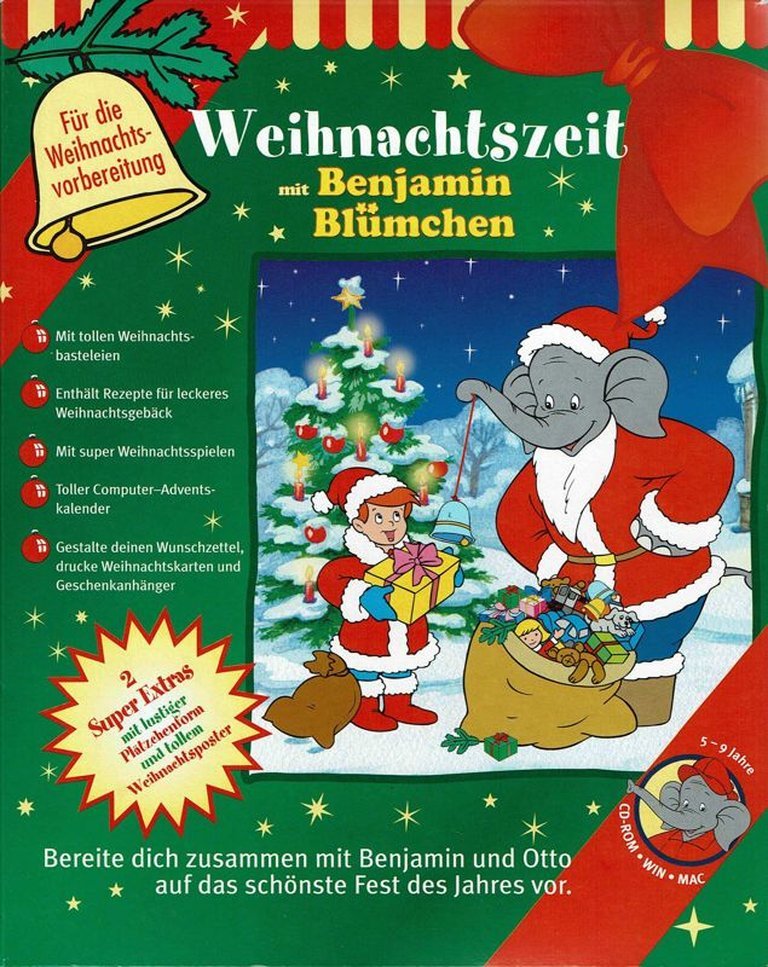
Description
Weihnachtszeit mit Benjamin Blümchen is a festive mini-game collection centered around the beloved elephant character, Benjamin Blümchen, set during the Christmas season. Players can engage in holiday-themed activities such as crafting ornaments and toys, assisting Santa in delivering presents, sledding down snowy hills, creating a Christmas wish list, and opening doors on an advent calendar. Designed for children, the game combines lighthearted adventure and action elements with a fantasy setting, offering a mix of 2D scrolling and fixed-screen perspectives.
Gameplay Videos
Weihnachtszeit mit Benjamin Blümchen: A Festive Foray into Early 2000s Edutainment
Introduction: The Elephant in the Christmas Room
In the year 2000, as the world stood on the precipice of a new millennium, German children were gifted a digital Christmas miracle: Weihnachtszeit mit Benjamin Blümchen. This charming, often overlooked title represents a fascinating microcosm of early 2000s edutainment gaming, blending seasonal cheer with the enduring appeal of one of Germany’s most beloved children’s characters. While it may not have reshaped the gaming landscape, this CD-ROM adventure offers a time capsule of how developers approached holiday-themed interactive experiences for young audiences at the turn of the century.
Development History & Context: The Making of a Holiday Classic
The Studio Behind the Magic
Weihnachtszeit mit Benjamin Blümchen emerged from the collaborative efforts of bvm Gesellschaft für Konzeption und Gestaltung digitaler Medien mbH (development) and KIDDINX Studio GmbH (publishing). Both companies were deeply embedded in the German children’s media ecosystem, with KIDDINX holding the rights to the Benjamin Blümchen franchise—a cultural institution since its radio debut in 1977.
Technological Constraints and Design Philosophy
Released for Windows and Macintosh, the game was built for the technical realities of 2000:
– Minimum Requirements: A Pentium processor, 32MB RAM, and Windows 95 or Mac OS 7.1
– Media Format: CD-ROM distribution, reflecting the era’s physical media dominance
– Visual Style: 2D scrolling and fixed/flip-screen perspectives, eschewing the 3D revolution for accessibility
The developers prioritized simplicity and engagement over graphical fidelity, recognizing their target audience of young children. The game’s structure as a mini-game collection rather than a linear narrative experience aligned with contemporary trends in educational software, where bite-sized activities were favored for maintaining attention spans.
The Gaming Landscape of 2000
This title arrived during a transitional period in gaming:
– The edutainment boom of the 90s was waning, but still influential
– Point-and-click adventures were giving way to more interactive formats
– Licensed children’s games were proliferating, though often criticized for shallow gameplay
Within this context, Weihnachtszeit stood out by leveraging Benjamin Blümchen’s established brand recognition while offering genuine seasonal activities rather than mere marketing.
Narrative & Thematic Deep Dive: The Spirit of Christmas, Elephant-Style
Plot Structure and Character Integration
The game eschews traditional storytelling in favor of an activity-based framework centered around Christmas preparations. Benjamin Blümchen, the eponymous talking elephant and zoo resident, serves as both host and participant in the festivities.
Key narrative elements include:
1. The Advent Calendar: A meta-structure framing the experience, with daily activities unlocking
2. Santa’s Workshop: Players assist in toy creation and gift distribution
3. Winter Wonderland: Sledding and ornament crafting activities
4. Wish List Creation: A personalization feature allowing children to articulate their desires
Thematic Analysis
The game’s themes revolve around:
– The Joy of Giving: Emphasized through gift-making and distribution mechanics
– Creativity and Craftsmanship: Toy and ornament creation activities
– Tradition and Ritual: The advent calendar and wish list features
– Community: Benjamin’s role as a helper figure reinforces social values
Notably absent are any conflict-driven narratives common in other children’s games of the era. Instead, the experience focuses on participatory joy and the magical anticipation of the holiday season.
Gameplay Mechanics & Systems: A Festival of Mini-Games
Core Gameplay Loops
The title’s structure revolves around five primary activity types:
-
Ornament Crafting
- Simple drag-and-drop mechanics
- Color and pattern selection
- Immediate visual feedback
-
Toy Manufacturing
- Assembly-line style gameplay
- Basic physics interactions
- Reward system for completed toys
-
Present Delivery
- Simple navigation challenges
- Memory-based gift matching
- Time pressure elements
-
Sledding
- Basic physics simulation
- Obstacle avoidance
- Speed-based scoring
-
Wish List Creation
- Text and image selection
- Personalization features
- Printable output option
UI and Accessibility
The interface demonstrates thoughtful design for its audience:
– Large, colorful buttons with clear icons
– Voice narration (presumably in German) guiding players
– Minimal text to accommodate pre-readers
– Instant feedback for all actions
Innovative Elements
For its time, the game incorporated several noteworthy features:
– The Advent Calendar: A rare example of time-gated content in children’s software
– Personalization: The wish list feature created tangible outputs
– Seasonal Authenticity: Activities directly mirrored real Christmas traditions
However, the lack of progression systems or skill development represents both a strength (accessibility) and weakness (limited replayability).
World-Building, Art & Sound: Crafting a Digital Christmas
Visual Design
The game’s aesthetic perfectly captures the whimsical charm of the Benjamin Blümchen universe:
– Bright, saturated colors evoking holiday cheer
– Hand-drawn 2D sprites with exaggerated, friendly proportions
– Fixed camera angles that maintain focus on activities
– Consistent character designs matching the established franchise style
The Christmas setting is realized through:
– Snow-covered landscapes
– Twinkling lights and decorations
– A cozy workshop environment
– Festive character outfits
Sound Design and Music
While specific audio details are scarce, we can infer:
– Jolly background music likely featuring traditional Christmas melodies
– Voice acting by established Benjamin Blümchen cast members
– Sound effects emphasizing the tactile nature of crafting activities
– Ambient sounds like crackling fires or jingling bells
The audio design would have played a crucial role in maintaining immersion for young players who might not yet be proficient readers.
Reception & Legacy: The Quiet Impact of a Holiday Game
Contemporary Reception
- Commercial Performance: Likely modest but steady, given the franchise’s popularity
- Critical Response: No recorded professional reviews, suggesting it was considered too niche for major coverage
- Audience Reception: Probably well-received by its target demographic of young German children
Evolution of Reputation
Over time, the game has:
– Faded from mainstream consciousness but remains a nostalgic touchstone
– Gained appreciation among retro gaming collectors
– Been recognized for its authentic representation of German Christmas traditions
Industry Influence
While not groundbreaking, the title contributed to several trends:
1. Licensed Character Games: Demonstrated the viability of beloved IP in educational contexts
2. Seasonal Software: Proved there was market demand for holiday-themed interactive experiences
3. Activity-Based Learning: Reinforced the effectiveness of mini-game collections for young audiences
Conclusion: A Stocking Stuffer of Gaming History
Weihnachtszeit mit Benjamin Blümchen occupies a unique position in gaming history as a culturally specific, seasonally focused edutainment title that successfully translated the magic of Christmas into interactive form. While it may lack the technical sophistication or narrative depth of more celebrated titles, its importance lies in:
- Cultural Preservation: Capturing German Christmas traditions for digital posterity
- Franchise Expansion: Extending Benjamin Blümchen’s reach into interactive media
- Design Philosophy: Exemplifying child-centered game design principles
- Historical Context: Serving as a time capsule of early 2000s edutainment
Final Verdict: 7/10 – A charming, if modest, holiday experience that fulfills its educational and entertainment goals with genuine seasonal spirit. While not essential playing for most gamers, it represents an important artifact of children’s software development and deserves recognition for its authentic, joyful approach to Christmas-themed interactivity.
For historians of children’s media, retro gaming enthusiasts, or anyone interested in the intersection of holiday traditions and digital play, Weihnachtszeit mit Benjamin Blümchen offers a delightful glimpse into how a beloved cultural icon helped make Christmas magical for a generation of young German gamers.