
- Release Year: 2022
- Platforms: Macintosh, Nintendo Switch, Windows
- Publisher: GIFT TEN INDUSTRY K.K.
- Developer: GIFT TEN INDUSTRY K.K.
- Genre: Puzzle
- Perspective: 1st-person
- Game Mode: Single-player
- Gameplay: Detective, Mystery
- Setting: Fantasy
- Average Score: 93/100
Description
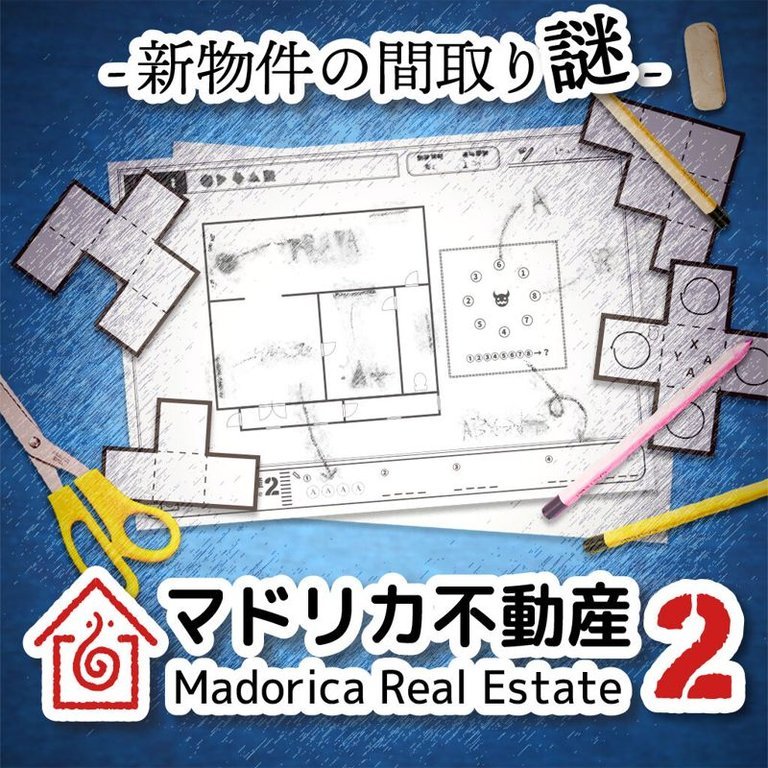
Madorica Real Estate 2: The Mystery Of The New Property is a puzzle-adventure game where players take on the role of a real estate agent solving mysteries by exploring properties and noting clues on floor plans. Set in a whimsical fantasy world, the game blends detective work with first-person exploration, challenging players to unravel puzzles and uncover secrets hidden within each property. With its unique note-taking mechanics and charming visuals, the game offers a fresh twist on the detective genre.
Gameplay Videos
Where to Buy Madorica Real Estate 2: The Mystery Of The New Property
PC
Madorica Real Estate 2: The Mystery Of The New Property Patches & Updates
Madorica Real Estate 2: The Mystery Of The New Property Guides & Walkthroughs
Madorica Real Estate 2: The Mystery Of The New Property Reviews & Reception
ladiesgamers.com : A unique puzzle game that combines challenging puzzles, paper floor plans, QR codes, and silly ghosts.
opencritic.com : There isn’t any other puzzle game on Switch quite like it.
store.steampowered.com (93/100): A positive reception with 93% of the 43 user reviews for this game being positive.
Madorica Real Estate 2: The Mystery Of The New Property: A Masterclass in Hybrid Puzzle Design
Introduction: The Ghostbusting Real Estate Agent Returns
In an era where video games increasingly blur the lines between digital and physical play, Madorica Real Estate 2: The Mystery Of The New Property stands as a bold, innovative experiment—a game that demands players to engage with both screen and paper, logic and creativity, solitude and collaboration. Developed by the enigmatic GIFT TEN INDUSTRY K.K. and puzzle designers TUMBLEWEEDJP, this sequel to the 2018 cult hit Madorica Real Estate refines and expands upon its predecessor’s unique formula: a first-person puzzle adventure where players must print, fold, cut, and annotate real-world floor plans to solve in-game mysteries and exorcise mischievous ghosts from haunted properties.
At its core, Madorica Real Estate 2 is a love letter to analog puzzle-solving, evoking the tactile joy of board games, escape rooms, and classic detective novels. Yet, it is also a distinctly modern experience, leveraging QR codes, digital interfaces, and even optional co-op play to create something that feels both nostalgic and fresh. With 20 meticulously crafted stages, each introducing new mechanics—from sound-based puzzles to color-coded ciphers—the game challenges players to think outside the box, quite literally.
But is this hybrid approach a gimmick, or does it elevate the puzzle genre to new heights? Through an exhaustive analysis of its development, narrative, gameplay, and legacy, this review will argue that Madorica Real Estate 2 is not just a novel experiment, but a landmark title in puzzle game design, one that redefines how we interact with games and each other.
Development History & Context: The Birth of a Hybrid Puzzle Phenomenon
The Studio Behind the Mystery: GIFT TEN INDUSTRY K.K.
GIFT TEN INDUSTRY K.K. is a Japanese indie studio with a penchant for unconventional game design. Founded by Takashi Hamada, the studio’s philosophy revolves around merging digital and physical play, a concept Hamada has described as “augmented reality gaming without the AR glasses.” Their debut title, Madorica Real Estate (2018), was a modest success, praised for its creativity but limited by its scope. The sequel, Madorica Real Estate 2, was developed in collaboration with TUMBLEWEEDJP, a team specializing in real-life escape room experiences, which explains the game’s intricate, multi-layered puzzles.
The Vision: A Game That Demands Physical Interaction
Hamada’s inspiration for the Madorica series stems from a childhood love of Sherlock Holmes: Consulting Detective, a tabletop game where players solve mysteries using physical casebooks. He sought to recreate that tactile experience in a digital format, but with a twist: instead of passive reading, players would actively manipulate paper floor plans to progress. This vision was realized through:
– Printable Floor Plans: Each of the game’s 20 stages requires players to print a unique floor plan from the official website (or use a pre-packaged physical copy).
– Analog Tools: Scissors, pencils, and even rulers become essential tools, as puzzles often require cutting, folding, or drawing on the plans.
– QR Code Integration: Stuck on a puzzle? Scan a QR code to access hint videos, blending digital convenience with analog challenge.
Technological Constraints and Design Choices
The game’s development was shaped by several key constraints:
1. Nintendo Switch as the Primary Platform: The Switch’s portability and local co-op capabilities made it the ideal platform for a game meant to be played in groups. However, this also meant designing around the Switch’s limited processing power, resulting in simple, stylized visuals.
2. The Printer Problem: Recognizing that not all players have easy access to a printer, the developers included an option to play without printed plans (though this severely limits the experience). The physical edition, sold in Japan, includes pre-printed plans and even a cassette tape of the soundtrack, emphasizing the game’s analog roots.
3. Time Limits and Accessibility: To cater to both casual and hardcore puzzle solvers, the game allows players to toggle time limits on or off—a rare feature in puzzle games that prioritizes accessibility without sacrificing challenge.
The Gaming Landscape in 2022: A Niche Within a Niche
Madorica Real Estate 2 launched on November 9, 2022, for the Nintendo Switch, followed by PC and Mac releases in early 2023. At the time, the puzzle genre was dominated by:
– Escape Room Simulators (The Room series, House of Da Vinci)
– Narrative-Driven Puzzles (The Witness, Return of the Obra Dinn)
– Co-op Puzzle Games (It Takes Two, Keep Talking and Nobody Explodes)
What set Madorica apart was its hybrid design. While games like Keep Talking and Nobody Explodes require verbal communication between players, Madorica demands physical collaboration—passing scissors, folding paper, and pointing at clues. This made it a standout title in a crowded market, though its niche appeal meant it flew under the radar for many mainstream gamers.
Narrative & Thematic Deep Dive: Ghosts, Real Estate, and the Joy of Problem-Solving
Plot Overview: A Haunted House Flipper’s Journey
Players assume the role of the newly appointed manager of Madorica Real Estate, a company specializing in exorcising ghosts from properties to make them rentable. The premise is delightfully absurd: in a town overrun by spectral squatters, your job is to visit haunted houses, solve their mysteries, and evict the ghosts using magic spells. The narrative is minimal but charming, with each ghost possessing a unique personality and backstory tied to the property they haunt.
Themes: The Intersection of the Mundane and the Mystical
- The Banality of the Supernatural: The game’s greatest strength is its tone. Despite the ghostly premise, Madorica Real Estate 2 is not a horror game. The ghosts are cute, cartoonish, and often comedic, more akin to Casper than The Ring. This subversion of expectations makes the game accessible to all ages and reinforces its core theme: that the supernatural can be mundane, even playful.
- The Joy of Discovery: The game celebrates the thrill of solving puzzles, whether alone or with friends. The act of printing a floor plan, scrawling notes, and physically manipulating paper mirrors the joy of childhood detective games.
- Collaboration and Community: The game’s co-op mode (where players can pass the Switch back and forth or work together on a single screen) emphasizes shared problem-solving, a rare and underappreciated mechanic in modern gaming.
Characters and Dialogue: Whimsy Over Depth
The game’s characters are archetypal but endearing:
– The Player Character: A silent protagonist, serving as the audience’s avatar.
– The Ghosts: Each ghost is tied to its property’s theme. For example, the ghost in the “Painted Gallery” is an artist who refuses to leave until their masterpiece is completed. Their designs are expressive and humorous, with exaggerated animations that make them feel more like mischievous roommates than malevolent spirits.
– Madorica Real Estate Staff: Brief, lighthearted interactions with your colleagues provide context but little depth. The writing is functional, prioritizing clarity over wit.
The Hidden Narrative: The Meta-Puzzle of the Secret Level
One of the game’s most intriguing aspects is its secret level, unlocked only after completing all 20 main stages and deciphering clues hidden in the credits. This meta-puzzle encourages players to:
– Re-examine earlier stages for missed details.
– Use the floor plans in unconventional ways (e.g., overlaying them, cutting them into specific shapes).
– Collaborate online to piece together the solution.
The existence of this hidden level speaks to the developers’ commitment to rewarding curiosity, a hallmark of great puzzle design.
Gameplay Mechanics & Systems: The Art of Analog-Digital Fusion
Core Gameplay Loop: Print, Solve, Exorcise
The gameplay follows a four-step structure:
1. Print the Floor Plan: Each stage begins with downloading and printing a floor plan from the official website. The plans are meticulously designed, with symbols, grids, and annotations that serve as clues.
2. Explore the Property: In first-person view, players navigate the haunted house, examining walls, floors, and ceilings for hints. The game’s UI is minimal, with no hand-holding—players must actively observe and deduce.
3. Solve the Puzzle: Using the floor plan, players must:
– Decode symbols (e.g., matching shapes to buttons).
– Fold or cut the paper to reveal hidden patterns.
– Use external tools (e.g., colored pencils to trace paths, scissors to create new shapes).
4. Exorcise the Ghost: Once the puzzle is solved, players input a spell (a sequence of button presses) to banish the ghost and unlock the next stage.
Puzzle Design: A Masterclass in Variety
The game’s 20 stages are divided into four difficulty tiers, each introducing new mechanics:
1. Beginner Stages (1-3):
– First Condominium: A tutorial level where players learn to match symbols to button inputs.
– Folded Villa: Introduces paper folding to align clues.
– Painted Gallery: Requires color-based puzzles, where players must use colored pencils to trace paths.
2. Intermediate Stages (4-10):
– Sound-Based Puzzles: Players must listen for auditory cues (e.g., matching tones to symbols).
– Perspective Puzzles: Certain clues only appear when the floor plan is viewed from a specific angle.
3. Advanced Stages (11-17):
– Multi-Layered Floor Plans: Players must overlay or cut plans to reveal hidden information.
– Time-Pressured Challenges: Some stages impose strict time limits, adding tension.
4. Expert Stages (18-20 + Secret Level):
– Meta-Puzzles: Require knowledge from previous stages (e.g., combining symbols from multiple floor plans).
– Physical Manipulation: The secret level demands creative use of scissors and tape, blurring the line between game and craft project.
Innovation and Flaws: What Works and What Doesn’t
Strengths:
– Tactile Engagement: The use of physical floor plans makes puzzles memorable and satisfying. There’s a unique joy in folding a piece of paper and seeing the solution click into place.
– Co-Op Play: The game shines when played with friends or family, fostering collaboration and discussion. It’s a rare modern game that encourages off-screen interaction.
– Hint System: The QR code hints are brilliantly implemented, providing just enough guidance without spoiling the solution.
Weaknesses:
– Printer Dependency: The game’s biggest flaw is its reliance on printed materials. Players without a printer are forced to use digital workarounds, which diminish the experience.
– PC Port Issues: The Steam version suffers from poor controller support and cursor bugs, suggesting it was designed primarily for the Switch.
– Repetitive Structure: While the puzzles are creative, the core loop (explore, decode, exorcise) can feel repetitive after 10+ hours.
UI and Accessibility: A Mixed Bag
The game’s UI is minimalist to a fault:
– Pros:
– No clutter; players focus entirely on the puzzle.
– The first-person perspective immerses players in the haunted house.
– Cons:
– No in-game floor plan viewer, forcing players to alt-tab or use a second device.
– Controller mapping is confusing on PC, with no rebinding options.
World-Building, Art & Sound: The Aesthetics of the Haunted
Visual Design: Simple but Effective
The game’s art style is deliberately basic, prioritizing clarity over detail:
– Haunted Houses: Each property has a distinct theme (e.g., a sushi restaurant, an art gallery, a mansion) but is rendered in low-poly 3D, with flat textures and minimal lighting.
– Ghosts: The spectral inhabitants are cartoonish and expressive, with exaggerated animations that make them feel more like playful tricksters than horror villains.
– Floor Plans: The star of the show. Each plan is a work of art, filled with symbols, grids, and hidden clues. The physicality of the paper adds a layer of immersion that digital-only games lack.
Sound Design: Atmospheric and Functional
The soundtrack, composed by Masuko Tsukasan (known for the Megami Tensei series), is a jazz-lounge fusion that perfectly complements the game’s whimsical tone. Key features:
– Ambient Tracks: Each property has a unique theme, from haunting melodies to upbeat jazz, reinforcing the game’s lighthearted approach to the supernatural.
– Auditory Puzzles: Some stages require players to listen for cues, such as matching tones to symbols or identifying patterns in sound.
Atmosphere: Cozy Horror
Madorica Real Estate 2 occupies a unique niche—cozy horror. The game’s tone is:
– Playful: Ghosts are more annoying than scary, and the puzzles are designed to be fun, not frightening.
– Nostalgic: The act of printing and folding paper evokes childhood memories of board games and puzzle books.
– Collaborative: The game encourages social play, making it ideal for game nights or family gatherings.
Reception & Legacy: A Cult Classic in the Making
Critical Reception: Praise from the Puzzle Community
While Madorica Real Estate 2 flew under the radar for mainstream critics, it received glowing reviews from puzzle enthusiasts and indie game fans:
– LadiesGamers (9/10): “There isn’t any other puzzle game on Switch quite like it. The combination of challenging puzzles, the use of paper floor plans, QR codes, and silly ghosts is unique.”
– Steam User Reviews (93% Positive): Players praised the game’s creativity, co-op potential, and satisfying puzzles, though some criticized the PC port’s technical issues.
– Indie Tsushin: “A genuine sense that we were ‘moving’ through this house and interacting with objects, much like we would in a real-life escape room game.”
Commercial Performance: A Niche Hit
The game’s commercial success was modest but notable:
– Nintendo Switch: Sold well in Japan, where physical puzzle games have a dedicated fanbase.
– Steam: Gained a cult following, with players sharing solutions and custom floor plans online.
– Bundles: The game’s inclusion in GIFT TEN INDUSTRY’s complete pack helped boost visibility.
Influence and Legacy: Inspiring a New Wave of Hybrid Games
Madorica Real Estate 2’s greatest legacy may be its impact on puzzle game design:
1. Proof of Concept: It demonstrated that hybrid analog-digital puzzles can work in a commercial game, paving the way for future experiments.
2. Community Engagement: The game’s secret level and QR hints inspired other indie developers to incorporate meta-puzzles and real-world interaction into their games.
3. Co-Op Innovation: Its collaborative puzzle-solving mechanics have influenced titles like Puzzle Bobble VR and The Past Within.
The Future of the Series
With the release of MR. ELEVATOR (a spiritual successor with similar puzzle mechanics), it’s clear that GIFT TEN INDUSTRY is committed to expanding the hybrid puzzle genre. Fans are already clamoring for:
– A level editor to create and share custom puzzles.
– Better PC support, including controller compatibility.
– More physical editions, complete with floor plans and soundtracks.
Conclusion: A Landmark in Puzzle Game Design
Madorica Real Estate 2: The Mystery Of The New Property is not just a game—it’s an experience, a celebration of analog creativity in a digital world. By demanding that players print, fold, cut, and collaborate, it transcends the limitations of traditional video games, offering something tangible, social, and deeply satisfying.
Final Verdict: 9/10 – A Masterpiece of Hybrid Puzzle Design
While its printer dependency and PC port issues hold it back from perfection, Madorica Real Estate 2 is a must-play for puzzle enthusiasts, co-op gamers, and anyone who misses the tactile joy of board games. It’s a rare gem—a game that challenges, delights, and brings people together in ways few modern titles can.
Where It Stands in History:
– One of the best puzzle games of the 2020s.
– A pioneer in hybrid analog-digital gameplay.
– A cult classic with the potential to inspire a new genre.
If you’ve ever loved escape rooms, detective stories, or the simple pleasure of solving a riddle with friends, Madorica Real Estate 2 is not to be missed. Just make sure you have a printer—and a pair of scissors—ready.