
- Release Year: 1996
- Platforms: CD-i, Windows
- Publisher: Infogrames Europe SA, Mirage Media S. C., Novitas GmbH
- Developer: Infogrames Europe SA
- Genre: Action
- Perspective: 1st-person
- Game Mode: Single-player
- Gameplay: Rail shooter
- Setting: Futuristic, Sci-fi
- Average Score: 61/100
Description
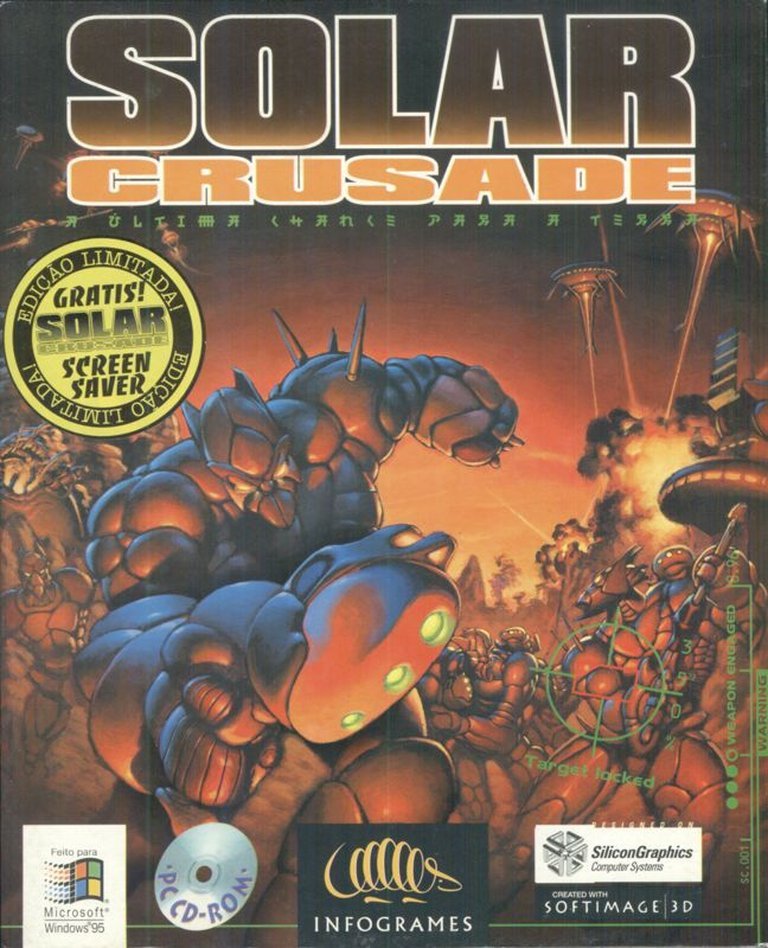
Solar Crusade is a sci-fi rail shooter game set in a futuristic universe where the player assumes the role of a fighter for the Orbital Defense Force (ODF). After believing they had defeated their enemies, the Kesh-Rhan, the ODF discovers their mistake and must engage in a series of intense battles across five chapters. The game features fast-paced action, anime-inspired visuals, and occasional branching paths that may lead to secret levels. Players must shoot down enemies while collecting ammunition and energy boosts to survive.
Solar Crusade Free Download
Solar Crusade Reviews & Reception
en.wikipedia.org (82/100): A rail shooter video game designed and published by Infogrames Multimedia.
mobygames.com (41/100): Average score: 41% (based on 5 ratings).
retro-replay.com : Solar Crusade delivers a classic rail-shooter experience, placing you firmly in the cockpit of an Orbital Defense Force (ODF) fighter craft.
Solar Crusade: A Forgotten Relic of the FMV Rail Shooter Era
Introduction: The Last Gasps of a Dying Genre
In the mid-1990s, the gaming landscape was a battleground of experimentation. As developers grappled with the transition from 2D sprites to 3D polygons, a peculiar hybrid emerged: the full-motion video (FMV) rail shooter. Solar Crusade, released in 1996 by Infogrames Multimedia, stands as both a relic of this fleeting era and a curious footnote in gaming history. It was the last official game released for the Philips CD-i, a console already on life support, and a sequel to Chaos Control, a title so obscure it barely registered in the collective memory of gamers. Yet, Solar Crusade is more than just a historical oddity—it’s a fascinating case study in ambition, limitation, and the perils of chasing trends.
This review will dissect Solar Crusade with surgical precision, exploring its development, narrative, gameplay, and legacy. We’ll examine why it failed to resonate with critics and players alike, and why, despite its flaws, it remains a compelling artifact of a time when games dared to be weird, flawed, and unapologetically experimental.
Development History & Context: The Infogrames Experiment
The Studio and the Vision
Infogrames Multimedia, under the leadership of Bruno Bonnell, was a French powerhouse in the mid-90s, known for its eclectic portfolio of games ranging from Alone in the Dark to V-Rally. Solar Crusade was developed by Studio A, a division within Infogrames, and helmed by producer Olivier Masclef and designer Franck Drevon. The team was no stranger to ambitious projects, but Solar Crusade was a departure from their usual fare—a foray into the niche world of FMV rail shooters, a genre popularized by Rebel Assault (1993) and Star Wars: Rebel Assault II (1995).
The game was built using Softimage 3D and modeled on Silicon Graphics workstations, cutting-edge tools for the time. The goal was to create a “cartoon-movie based science-fiction rail shooter,” blending the aesthetic of anime with the interactivity of a shooter. The team aimed to capitalize on the success of Rebel Assault while carving out a unique identity with its vibrant, cel-shaded visuals and branching pathways.
Technological Constraints and the CD-i’s Swan Song
Solar Crusade was initially released for Windows 95 in 1996, but its most notable release came in 1999 for the Philips CD-i, a console that had already been discontinued. This makes Solar Crusade the last official game ever released for the CD-i, a dubious honor that underscores its place in gaming history. The CD-i version was a port of the Windows release, but given the console’s limited hardware, it struggled to match the PC’s performance.
The game’s reliance on pre-rendered FMV backgrounds was both a strength and a weakness. On one hand, it allowed for lush, detailed environments that would have been impossible with real-time 3D on mid-90s hardware. On the other, it locked the game into a rigid, linear structure, with limited interactivity. The Smacker Video middleware, used for compression, helped keep file sizes manageable, but the trade-off was noticeable compression artifacts and occasional stuttering.
The Gaming Landscape of 1996
By 1996, the FMV craze was already waning. Games like Night Trap and Sewer Shark had tarnished the genre’s reputation, and the rise of 3D accelerators (thanks to Quake and Tomb Raider) made pre-rendered backgrounds feel outdated. Solar Crusade arrived at a time when gamers were clamoring for true 3D freedom, not rail-bound corridors. The market was shifting toward immersive, player-driven experiences, and Solar Crusade’s rigid design felt like a step backward.
Narrative & Thematic Deep Dive: A Story of False Victories
Plot Overview
Solar Crusade picks up where Chaos Control left off. The Orbital Defense Force (ODF) believes it has defeated the Kesh-Rhan, a malevolent alien empire, only to discover that the victory was a ruse. The Kesh-Rhan return with a vengeance, launching a surprise attack that decimates the ODF’s forward outposts. You play as an unnamed fighter pilot, thrust into the chaos as the last line of defense against the alien onslaught.
The story unfolds across five chapters, each punctuated by brief FMV cutscenes that blend animated sequences with voiceovers. The narrative is straightforward: shoot everything, survive, and uncover the Kesh-Rhan’s true plans. Along the way, you’ll encounter betrayals, hidden superweapons, and secret levels that hint at a larger conspiracy within the ODF.
Characters and Dialogue
The characters in Solar Crusade are archetypal at best. Your pilot is a silent protagonist, a blank slate for the player. The supporting cast—admirals, engineers, and fellow pilots—are voiced with varying degrees of enthusiasm, but the German localization (for the European release) is particularly rough. Critics at the time lambasted the poor synchronization between dialogue and lip movements, a common issue in FMV games of the era.
The dialogue itself is functional, serving primarily to advance the plot rather than develop characters. Lines like “The Kesh-Rhan are back, and they’re stronger than ever!” set the stakes, but there’s little in the way of depth or nuance. The game’s anime/manga aesthetic suggests a lighter, more humorous tone, but the execution leans toward generic sci-fi tropes rather than anything truly memorable.
Themes: Deception and the Illusion of Control
At its core, Solar Crusade is a story about deception. The ODF’s initial victory over the Kesh-Rhan is revealed to be a Pyrrhic triumph, a false sense of security that leaves them vulnerable to a devastating counterattack. This theme extends to the gameplay itself, where the player’s illusion of control is constantly undermined by the game’s rail-shooter mechanics. You can choose branching paths, but you’re always on rails, always moving forward at the game’s pace.
The Kesh-Rhan, as antagonists, embody relentless, overwhelming force. They are not just enemies to be defeated but a symbol of inevitability, a reminder that victory in war is often temporary. The game’s secret levels and hidden pathways reinforce this idea, suggesting that the true nature of the conflict is always just out of reach.
Gameplay Mechanics & Systems: Rails, Bullets, and Branching Paths
Core Gameplay Loop
Solar Crusade is, at its heart, a rail shooter. You sit in the cockpit of an ODF fighter, moving automatically through pre-rendered environments while blasting waves of enemies. The controls are simple:
– Mouse aim and fire (left-click for lasers, right-click for missiles).
– Collect power-ups (ammunition, energy pills, shields).
– Dodge enemy fire by moving the cursor to the edges of the screen.
The game’s five chapters are divided into distinct missions, each culminating in a boss fight against a massive Kesh-Rhan warship or weapon. The difficulty ramps up steadily, with later levels introducing swarms of drones, guided missiles, and environmental hazards that force you to prioritize targets carefully.
Branching Paths and Secret Levels
One of Solar Crusade’s few innovations is its branching pathways. At certain points in a level, you can choose to veer left or right, leading to alternate routes and, occasionally, secret levels. These detours are more than just cosmetic—they often contain hidden power-ups, extra ammunition, or tougher enemy formations that reward exploration.
The secret levels are the game’s best-kept feature, offering unique challenges and visual set pieces. For example, one hidden stage takes you through a neon-lit asteroid field, while another pits you against a Kesh-Rhan dreadnought in a high-speed chase. These moments break up the monotony of the main campaign and give the game a much-needed sense of replayability.
Combat and Progression
Combat in Solar Crusade is fast-paced but shallow. Your primary weapon is a laser cannon with unlimited ammo, but it’s weak against armored enemies. Missiles (limited by your ammo count) are essential for taking down larger foes, but overusing them leaves you vulnerable in prolonged firefights. The game encourages resource management, forcing you to balance aggression with conservation.
Enemy variety is adequate but uninspired. You’ll face:
– Basic fighters (easy to dispatch but come in swarms).
– Shielded drones (require multiple hits to destroy).
– Capital ships (slow-moving but heavily armored).
– Bosses (multi-phase battles with weak points to exploit).
The AI is predictable, with enemies following set patterns. This makes the game easy to master but also repetitive over time. The lack of upgrades or persistent progression means that each level feels like a self-contained challenge rather than part of a larger arc.
UI and Controls
The user interface is minimalist, with a health bar, ammo counter, and radar displayed at the edges of the screen. The radar is particularly useful, highlighting incoming enemies and projectiles. However, the lack of a pause feature (a common oversight in FMV games) can be frustrating, especially during intense sequences.
Controls are responsive but limited. The mouse-based aiming is precise, but the lack of analog movement (you can’t freely navigate the environment) reinforces the game’s rail-shooter constraints. The CD-i version suffers from input lag, a common issue with the console’s controller.
Innovations and Flaws
Solar Crusade’s greatest innovation is its branching paths, a feature that was rare in rail shooters of the time. However, the game is held back by:
– Repetitive gameplay (the core loop doesn’t evolve much).
– Lack of depth (no upgrades, no character progression).
– Technical limitations (FMV compression, input lag on CD-i).
– Poor enemy variety (most foes are just reskinned versions of the same models).
The game’s two-player mode (exclusive to the Windows version) is a standout feature, allowing for cooperative play where one player controls the ship’s movement and the other handles weapons. This mode was praised by PC Joker as the game’s saving grace, offering a level of interactivity missing from the single-player campaign.
World-Building, Art & Sound: A Cartoonish Cosmic Crusade
Setting and Atmosphere
Solar Crusade takes place in a vibrant, anime-inspired sci-fi universe. The ODF’s ships are sleek and futuristic, while the Kesh-Rhan’s designs are angular and menacing, evoking a mix of Macross and Star Wars. The game’s environments are pre-rendered FMV backdrops, ranging from asteroid fields to alien space stations, each bathed in neon hues and lens flares.
The atmosphere is cinematic but shallow. The game tries to evoke the feel of a Saturday morning cartoon, with over-the-top explosions and dramatic camera angles. However, the lack of interactivity (you can’t explore or interact with the environment) makes the world feel hollow, like a painted backdrop rather than a living universe.
Visual Direction: Anime Meets FMV
The game’s anime/manga aesthetic is its most distinctive feature. Characters and ships are designed with exaggerated proportions, bright colors, and bold outlines. The FMV sequences are rendered in a cel-shaded style, giving them a hand-drawn look that was rare in 1996.
However, the technical limitations of FMV are evident. The compression artifacts (a result of the Smacker Video codec) lead to pixelation and blurring, especially in fast-moving sequences. The seams between FMV backgrounds and sprite-based enemies are occasionally jarring, breaking the immersion.
Sound Design: A Mixed Bag
The soundtrack, composed by Max le Producteur (with additional music by Clin d’Œil), is a synth-heavy, electronic score that fits the game’s sci-fi theme. The music is pulsing and energetic, with tracks that ramp up during combat and mellow out during cutscenes. However, the repetitive loops can become grating over time, and the sound effects (laser blasts, explosions) are generic and lack impact.
The voice acting is a weak point. The German localization (for the European release) is particularly poor, with mis-synchronized dialogue and wooden deliveries. The English voice acting fares slightly better but still lacks the polish of contemporary titles like Wing Commander IV.
Reception & Legacy: A Game That Time Forgot
Critical Reception: A Resounding Thud
Solar Crusade was panned by critics upon release. The Windows version received an average score of 41%, with reviewers citing:
– Repetitive gameplay (PC Games Germany: “a stupid game with mediocre graphics”).
– Poor story and voice acting (PC Action Germany: “trübes Full-Motion-Video-Actiongeballere ohne Hirn und Handlung”).
– Technical flaws (PC Player Germany: “Whoever can’t even master the simple technology of removing enemies from the film shouldn’t touch the genre”).
The CD-i version fared slightly better, with The CD-i Collective giving it a 70%, praising its improvements over the original Chaos Control and calling it “a nice addition to any CD-i player’s library.” However, even this review acknowledged the game’s flaws, noting that it was “still flawed, but the challenge was raised.”
Commercial Performance: A Niche Within a Niche
Solar Crusade was not a commercial success. The Windows version was overshadowed by bigger titles like Quake and Tomb Raider, while the CD-i version arrived too late to save the dying console. The game was later bundled in compilation packs like Gold Games 2 (1997) and Infogrames Pack (1997), but it never found a wide audience.
Legacy: The Last of the FMV Rail Shooters
Solar Crusade’s legacy is one of obscurity. It’s remembered primarily as:
– The last official CD-i game (a footnote in console history).
– A relic of the FMV era (a genre that faded as 3D gaming took over).
– A curiosity for retro collectors (rare but not particularly sought-after).
The game’s branching paths and co-op mode were ahead of their time, but its rigid design and technical limitations ensured it would be forgotten. It’s a cautionary tale about the dangers of chasing trends without innovation.
Conclusion: A Flawed but Fascinating Relic
Solar Crusade is not a great game, but it is an interesting one. It’s a product of its time—a transitionary title caught between the FMV craze of the early 90s and the 3D revolution of the late 90s. Its anime-inspired visuals, branching paths, and co-op mode show glimpses of creativity, but its repetitive gameplay, shallow story, and technical flaws hold it back.
For retro enthusiasts, Solar Crusade is worth a look as a historical curiosity. For modern gamers, it’s a reminder of how far the medium has come. It’s not a masterpiece, but it’s a time capsule—a snapshot of an era when games were weird, experimental, and unapologetically flawed.
Final Verdict: 5.5/10 – A Nostalgic Oddity, But Not a Classic.
Solar Crusade is best enjoyed as a museum piece, a game to be studied rather than played for hours. It’s a relic of a bygone era, and while it doesn’t stand the test of time, it’s a fascinating glimpse into the evolution of gaming.
Would you like to see more deep dives into obscure retro games? Let us know in the comments! 🚀