
- Release Year: 2007
- Platforms: Windows
- Publisher: Suicidal Entertainment
- Developer: Suicidal Entertainment
- Genre: Action, Comedy, Shooter
- Perspective: Third-person
- Game Mode: Single-player
- Gameplay: Ballistics, Point System, Turn-based combat
- Setting: Comedy, Religious
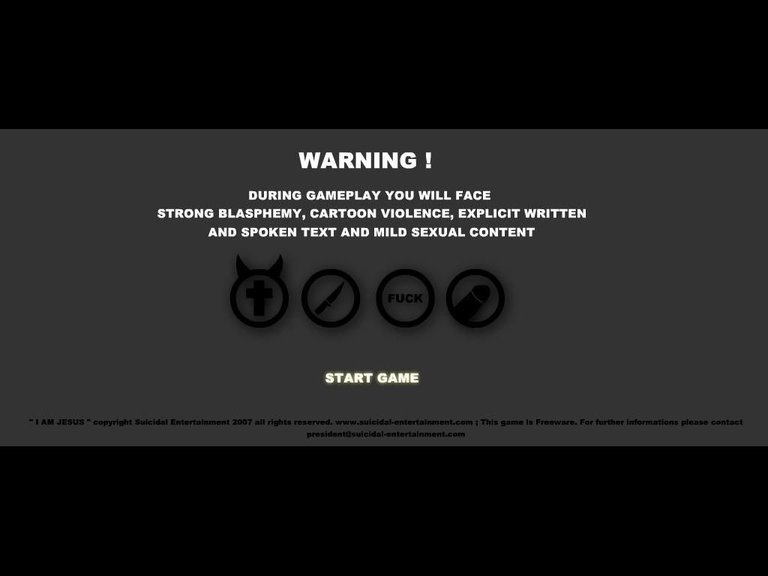
- Adult Content: Yes
Description
I am Jesus is a satirical ballistics game where players control Jesus Christ as he seeks revenge on his disciples by hurling spears at them, earning ‘God’s Love’ points to heal or gain advantages. The game features a giant stone penis as a central obstacle, blocking projectiles between Jesus and his enemies. It includes a story mode where players must defeat the twelve disciples and their Roman guards, a survival mode with endless enemies, and a ‘confess your sins’ mode for downloading new scenarios. Developed by Suicidal Entertainment, the game blends dark humor with simple shooter mechanics, offering a comedic twist on biblical themes.
Where to Buy I am Jesus
PC
I am Jesus Guides & Walkthroughs
I am Jesus Reviews & Reception
steamcommunity.com : This was a surprisingly tasteful game about the Gospels
christianitytoday.com : I don’t want to naysay anyone who’s trying to spread the gospel, but people can tell the difference in quality in a thing that is good and a thing that is bad. And this does not scream quality.
I Am Jesus: A Comprehensive Review of a Controversial and Unconventional Game
Introduction: A Game That Defies Expectations
Few games in the history of interactive entertainment have sparked as much curiosity, controversy, and confusion as I Am Jesus. Released in 2007 by the obscure studio Suicidal Entertainment, this title is a bizarre, satirical, and intentionally provocative take on religious themes, blending absurd humor with a gameplay loop reminiscent of classic artillery games like Scorched Earth. At its core, I Am Jesus is a ballistics game where players control Jesus Christ as he seeks revenge on his disciples by hurling spears at them, all while separated by a giant stone penis that blocks projectiles. The game’s premise is so outrageous that it begs the question: Is this a legitimate attempt at religious commentary, or is it merely a shock-value experiment designed to provoke reactions?
This review will dissect I Am Jesus in exhaustive detail, exploring its development history, narrative absurdity, gameplay mechanics, and the cultural context that surrounds it. We will also examine its reception—or lack thereof—and its place in the broader landscape of video game history. By the end, we will determine whether I Am Jesus is a forgotten gem of satirical design, a crass and meaningless joke, or something far more complex.
Development History & Context: The Birth of a Bizarre Vision
The Studio Behind the Madness: Suicidal Entertainment
I Am Jesus was developed and published by Suicidal Entertainment, a studio with virtually no other notable releases. The game’s credits list only five people, with Reinhard Schmid handling nearly every aspect of development, from programming and graphics to sound design and voice acting. This one-man-army approach suggests that I Am Jesus was a passion project—or perhaps a solo act of creative rebellion—rather than a commercial endeavor.
The studio’s name, “Suicidal Entertainment,” hints at a provocative, anti-establishment ethos. Given the game’s content, it’s clear that the developers were not aiming for mainstream appeal. Instead, I Am Jesus appears to be a deliberate attempt to push boundaries, challenge taboos, and perhaps even critique organized religion through absurdity.
The Gaming Landscape of 2007
2007 was a pivotal year in gaming, marked by the rise of immersive, narrative-driven experiences like BioShock and Mass Effect, as well as the continued dominance of multiplayer shooters like Call of Duty 4: Modern Warfare. Amidst this landscape, I Am Jesus stood out—not for its technical prowess or innovative design, but for its sheer audacity.
The game’s release as freeware/public domain software further underscores its niche appeal. It was not designed to compete with AAA titles but rather to exist as a curiosity, a digital artifact that would either be celebrated for its boldness or dismissed as offensive trash.
Technological Constraints and Design Choices
Given its 2007 release date, I Am Jesus is a technically simple game. The graphics are rudimentary, the physics engine is basic, and the gameplay mechanics are derived from older artillery games. The decision to use a giant stone penis as a central obstacle is not just a joke but also a functional gameplay element, forcing players to adjust their aim and strategy.
The game’s minimalist approach to design—both visually and mechanically—suggests that the developers prioritized concept over execution. This is not a game that aims to impress with its polish; instead, it relies on its premise to carry the experience.
Narrative & Thematic Deep Dive: Absurdity as Commentary
The Plot: Revenge of the Messiah
The narrative of I Am Jesus is as straightforward as it is absurd. Players take on the role of Jesus Christ, who, for reasons never explained, has decided to seek vengeance on his twelve disciples. The method of revenge? Throwing spears at them. The reward for this violence? “God’s Love,” a currency that can be spent on healing and other upgrades.
The game offers two primary modes:
1. Story Mode: Players must kill all twelve disciples, along with their Roman bodyguards.
2. Survival Mode: An endless wave of enemies must be defeated.
Additionally, the game includes a “confess your sins” mode, which allows players to download new scenarios from the internet—a feature that hints at a potential for user-generated content, though it’s unclear how widely this was utilized.
Themes: Satire, Blasphemy, or Something Else?
At first glance, I Am Jesus appears to be a blatant act of blasphemy, a game designed solely to offend. However, a deeper reading suggests that the game may be engaging in satire, using absurdity to critique religious dogma, the commercialization of faith, or even the video game industry’s tendency to glorify violence.
The giant stone penis, for example, is not just a crude joke but also a symbol of the game’s defiance of conventional morality. It forces players to confront the absurdity of the scenario, making it impossible to take the game seriously as a religious experience. Instead, I Am Jesus becomes a commentary on the ways in which religion and violence are often intertwined, both in history and in popular culture.
Characters and Dialogue: Minimalism as a Statement
The game’s characters are barely developed. Jesus is a silent protagonist, his disciples are faceless targets, and God is reduced to a voice that rewards violence with “God’s Love.” The lack of meaningful dialogue or character development reinforces the game’s satirical tone. There is no attempt to humanize Jesus or his disciples; instead, they are reduced to caricatures, stripped of their spiritual significance and repurposed as elements in a violent farce.
Gameplay Mechanics & Systems: A Simple Yet Provocative Design
Core Gameplay Loop: Artillery Combat with a Twist
I Am Jesus is, at its core, an artillery game. Players control Jesus, adjusting the angle and power of their spear throws to hit their targets. The giant stone penis in the center of the screen acts as an obstacle, blocking direct shots and forcing players to aim carefully.
The gameplay is divided into two main modes:
1. Story Mode: A structured campaign where players must eliminate all twelve disciples and their Roman guards.
2. Survival Mode: An endless mode where players face wave after wave of enemies, testing their endurance and aim.
Combat and Progression: “God’s Love” as Currency
The game’s progression system is simple. Killing enemies earns the player “God’s Love,” which can be spent on healing or other upgrades. This mechanic is darkly humorous, as it frames divine favor as a reward for violence—a clear inversion of traditional Christian teachings.
The lack of deeper mechanics or character progression reinforces the game’s minimalist design. There are no skill trees, no complex combat systems, and no meaningful choices. The gameplay is intentionally repetitive, emphasizing the absurdity of the premise over any sense of depth or challenge.
UI and Controls: Functional but Unremarkable
The game’s user interface is basic, with a health bar, a “God’s Love” counter, and a simple aiming reticle. Controls are limited to mouse inputs for aiming and firing, making the game accessible but not particularly engaging from a mechanical standpoint.
World-Building, Art & Sound: A Deliberately Crude Aesthetic
Visual Design: Minimalism and Provocation
I Am Jesus features a deliberately crude visual style. The environments are sparse, the character models are simplistic, and the animations are rudimentary. The giant stone penis, however, is rendered in detail, ensuring that it remains the most memorable visual element of the game.
The art direction serves the game’s satirical purposes. By stripping away any sense of realism or reverence, the developers ensure that players cannot mistake I Am Jesus for a serious religious experience. Instead, the game’s visuals reinforce its status as a provocative joke, a digital middle finger to conventional expectations.
Sound Design: Atmospheric or Nonexistent?
The game’s sound design is equally minimalist. The soundtrack consists of licensed tracks, including “Survival of the Fittest” and “Ancient Battle” by Ron Sorbo, which provide a generic, epic backdrop to the absurd on-screen action. The voice acting is limited to Reinhard Schmid’s portrayal of God, which is delivered in a deadpan, almost bored tone—further emphasizing the game’s satirical intent.
Reception & Legacy: A Game That Few Played but Many Remembered
Critical and Commercial Reception: A Niche Curiosity
I Am Jesus received virtually no critical attention upon release. It was not reviewed by major gaming outlets, and it failed to gain traction in the broader gaming community. However, it has since developed a cult following among those who appreciate its audacity and absurdity.
The game’s MobyGames page lists only one player rating—a zero out of five—suggesting that those who encountered it either did not understand its intent or were offended by its content. Yet, the game’s very existence ensures that it will not be forgotten. It stands as a testament to the power of video games as a medium for provocation and satire.
Influence on Subsequent Games: A Blueprint for Absurdity
While I Am Jesus did not spawn a genre of religious satire games, it does serve as a precursor to other provocative titles that use absurdity to challenge societal norms. Games like The Binding of Isaac and South Park: The Stick of Truth share I Am Jesus’ willingness to tackle taboo subjects with humor and irreverence.
In this sense, I Am Jesus can be seen as an early example of a game that prioritizes concept and commentary over commercial appeal. It may not have inspired direct imitators, but it certainly paved the way for other developers to explore controversial themes without fear of backlash.
Conclusion: A Game That Defies Categorization
I Am Jesus is a game that resists easy classification. It is simultaneously a crude joke, a satirical commentary, and a provocative experiment in game design. Its lack of polish and depth ensures that it will never be considered a classic, but its sheer audacity guarantees that it will remain a topic of discussion among those who appreciate video games as a medium for challenging conventions.
Final Verdict: A Bold but Flawed Experiment
I Am Jesus is not a good game in the traditional sense. Its mechanics are simplistic, its visuals are crude, and its narrative is nonsensical. However, it is a fascinating artifact—a game that uses absurdity to provoke thought and discussion. For those who appreciate satire and are not easily offended, I Am Jesus is a curious and memorable experience. For everyone else, it is likely to be dismissed as a tasteless joke.
In the grand tapestry of video game history, I Am Jesus occupies a unique and uncomfortable niche. It is not a masterpiece, but it is not without merit. It is a game that forces players to confront their own expectations and prejudices, and in doing so, it achieves something that few games dare to attempt: it makes us think, even if only to ask, “Why does this exist?”
For that reason alone, I Am Jesus deserves to be remembered—not as a great game, but as a bold and unapologetic experiment in the power of video games to challenge, provoke, and offend.