
- Release Year: 1999
- Platforms: Windows
- Publisher: Brightstar Entertainment Ltd., PBH Systems Ltd.
- Developer: Jinxter, Kuju Entertainment Ltd.
- Genre: Action
- Perspective: 3rd-person
- Game Mode: Single-player
- Gameplay: Shooter, Vehicular
- Setting: Modern
- Average Score: 40/100
Description
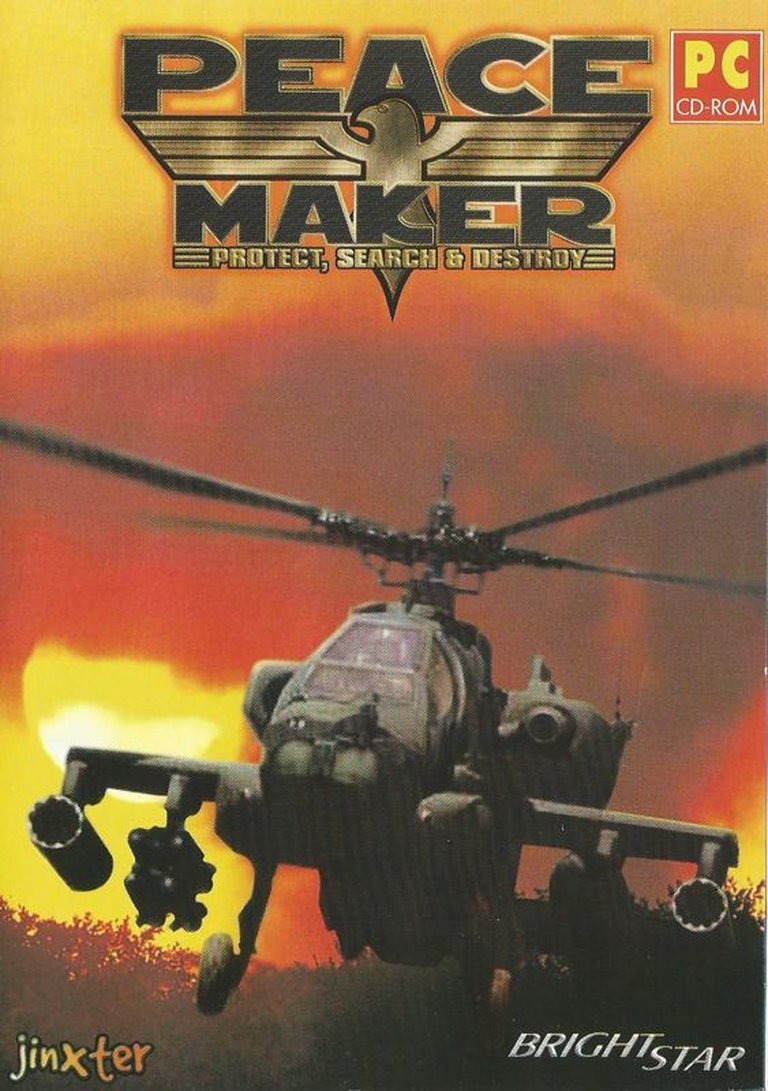
Peacemaker: Protect, Search & Destroy is a 3D helicopter shooter released in 1999, where players take on the role of a UN task force pilot engaged in various combat missions across United Nations territories. The game features 21 action-packed missions, including base defense, escort operations, and offensive strikes, with a training mode to master helicopter controls. Players can pilot multiple helicopters and futuristic hybrid aircraft, each equipped with weapons like miniguns and missiles, while toggling between nose and chase camera views for dynamic gameplay.
Peacemaker: Protect, Search & Destroy Reviews & Reception
oldpcgaming.net : It’s all done before it begins, and at the end of the day you might be wondering when the fun’s gonna start.
retro-replay.com : Peacemaker offers endless aerial warfare thrills for veteran flyers and aspiring rookies alike.
Peacemaker: Protect, Search & Destroy: A Comprehensive Retrospective
Introduction
In the late 1990s, the gaming landscape was a battleground of innovation and experimentation. Amidst this era, Peacemaker: Protect, Search & Destroy emerged as a unique, albeit flawed, entry in the vehicular combat genre. Developed by Jinxter and published by Brightstar Entertainment Ltd. and PBH Systems Ltd., this 1999 title promised an adrenaline-fueled experience as a UN task force pilot, engaging in high-stakes helicopter combat across 21 missions. However, despite its ambitious premise, Peacemaker struggled to leave a lasting mark. This review delves deep into the game’s development, mechanics, narrative, and legacy, offering a nuanced perspective on its place in gaming history.
Development History & Context
The Studio and Vision
Peacemaker: Protect, Search & Destroy was developed by Jinxter, a studio that operated under the umbrella of Kuju Entertainment Ltd., a British developer known for its work on simulation and action titles. The game was directed by Adonis Stevenson, who also served as the lead artist, alongside lead designer Colin Chung and lead programmer Tim Dinsdale. The team’s vision was to create a fast-paced, arcade-style helicopter shooter that emphasized action over realism, catering to fans of titles like Team Apache and Team Alligator, which shared the same Icarus engine.
The Icarus engine, developed by Simis (a UK-based studio), was a versatile tool that powered several helicopter combat games of the era, including M.I.A.: Missing in Action and Tank Racer. This engine allowed for 3D rendering and dynamic camera angles, which were crucial for Peacemaker‘s gameplay. However, the engine’s limitations—such as its struggle with higher resolutions and aspect ratios—would later become a point of contention among players.
Technological Constraints
The late 1990s were a transitional period for PC gaming. The shift from 2D to 3D was in full swing, and hardware capabilities varied widely among players. Peacemaker was designed with the minimum system requirements of a Pentium II 233 MHz processor and 64 MB of RAM, running on Windows 98. While these specs were modest for the time, they reflected the game’s focus on accessibility over cutting-edge graphics.
One of the most notable technical quirks of Peacemaker was its reliance on the Icarus engine’s software rendering mode, which lacked modern features like bilinear filtering and high-color palettes. However, as revealed by community modders like Gerhalt (from Old PC Gaming), the game could be forced into a Direct3D (D3D) accelerated mode using command-line switches (e.g., -aohpd), significantly improving visual fidelity. This undocumented feature highlighted the game’s untapped potential, which was unfortunately overshadowed by its default presentation.
The Gaming Landscape of 1999
1999 was a pivotal year for gaming, marked by the release of landmark titles such as Half-Life, Unreal Tournament, and Age of Empires II. In this competitive environment, Peacemaker faced an uphill battle. The market was saturated with high-profile shooters and strategy games, leaving little room for niche titles like Peacemaker, which lacked the polish and depth of its contemporaries.
Moreover, the late ’90s saw the rise of 3D accelerators like the Voodoo2 and TnT2, which set new standards for graphical fidelity. Peacemaker‘s reliance on an older engine and its arcade-style gameplay made it feel outdated compared to more visually impressive titles. Despite these challenges, the game carved out a small but dedicated fanbase, particularly among players who appreciated its straightforward, action-oriented approach.
Narrative & Thematic Deep Dive
Plot and Setting
Peacemaker is set in a near-future world where terrorist attacks on Oklahoma and the Tokyo subway have escalated into a global crisis. The collapse of Eastern European economies has led to a thriving black market for military weapons, prompting the formation of the Multinational Peacekeeping Executive (MPE). As a pilot for the MPE, players are tasked with flying advanced helicopters and hybrid helicopter-plane vehicles to combat terrorist threats across various UN-affiliated regions.
The game’s narrative is minimalistic, serving primarily as a backdrop for its mission-based structure. While the premise is intriguing—especially given its prescient themes of global terrorism and black-market arms dealing—the execution leaves much to be desired. The story is conveyed through brief mission briefings and sparse dialogue, with little character development or emotional investment. The lack of a compelling narrative arc makes Peacemaker feel more like a series of disconnected challenges rather than a cohesive experience.
Characters and Dialogue
The characters in Peacemaker are largely forgettable, with voice acting provided by a small cast, including Steven Masters (credited as Steve Masters) and Adonis Stevenson. The dialogue is functional but lacks depth, often reducing characters to mere caricatures of military personnel. The absence of memorable personalities or relationships further detracts from the game’s immersive potential.
Themes
At its core, Peacemaker explores themes of global conflict, the role of international peacekeeping forces, and the ethical ambiguities of warfare. The game’s subtitle, “There is no peace without war,” underscores its cynical view of conflict resolution, suggesting that violence is an inevitable means to achieve peace. This theme resonates with the geopolitical tensions of the late 1990s, particularly in the wake of the Gulf War and the rise of global terrorism.
However, the game’s treatment of these themes is superficial. While it presents players with morally ambiguous scenarios—such as striking enemy forces or defending civilian bases—it fails to delve into the broader implications of these actions. The lack of narrative depth prevents Peacemaker from achieving the same level of thematic resonance as games like Metal Gear Solid or Syphon Filter, which also tackled similar subjects during the same era.
Gameplay Mechanics & Systems
Core Gameplay Loop
Peacemaker is, at its heart, an arcade-style helicopter shooter. The game features 21 missions, each with distinct objectives, including base defense, escort missions, and strike operations. Players control a variety of helicopters and futuristic hybrid vehicles, each equipped with an arsenal of weapons such as miniguns and missiles. The mission structure is linear, requiring players to complete each mission successfully before progressing to the next.
The gameplay is fast-paced and action-oriented, with an emphasis on quick reflexes and strategic weapon use. The game’s two camera modes—nose camera and chase camera—allow players to switch perspectives, adding a layer of tactical depth. However, the mission design is often repetitive, with little variation beyond the core objectives. Some missions can be completed in under 30 seconds, which undermines the game’s sense of challenge and progression.
Combat and Controls
Combat in Peacemaker is straightforward but satisfying. The game’s control scheme allows for precise maneuvering, with helicopters capable of hovering and moving in any direction. The radar screen and HUD provide essential information, such as enemy locations and weapon status, though the HUD’s design is somewhat cluttered and can be difficult to read during intense firefights.
One of the game’s most peculiar mechanics is its targeting system. The missile launch button is mapped to a single key, allowing players to rapidly cycle through targets and deplete their ammo. While this system is effective for clearing out enemy forces quickly, it lacks the tactical depth found in more complex flight simulators. The game’s unlimited-ammo machine gun is another notable feature, though its automatic vertical targeting (but not horizontal) can be frustrating, requiring players to manually adjust their aim.
Character Progression and UI
Peacemaker lacks a traditional progression system. Instead of unlocking new abilities or upgrading weapons, players are given access to different helicopters and hybrid vehicles as they progress through the missions. While this provides some variety, it does little to enhance the game’s replayability or depth.
The user interface (UI) is functional but unremarkable. The mission briefings are presented in a no-frills text format, and the in-game HUD, while informative, is not particularly intuitive. The lack of a map or more detailed mission objectives can leave players feeling disoriented, especially in larger missions.
Innovative and Flawed Systems
One of Peacemaker‘s most innovative features is its use of the Icarus engine’s D3D mode, which significantly enhances the game’s visuals when enabled. However, this feature was not widely documented, leaving many players unaware of its existence. Additionally, the game’s control remapping options, though undocumented, allow for a high degree of customization, which was a rarity in games of this era.
On the flip side, Peacemaker suffers from several flaws that hinder its overall experience. The mission design is often uninspired, with little variation in objectives or enemy types. The game’s difficulty curve is inconsistent, with some missions feeling trivial while others are frustratingly difficult. The lack of a save system—requiring players to complete missions in one sitting—adds to the frustration, particularly given the game’s short length.
World-Building, Art & Sound
Setting and Atmosphere
Peacemaker takes place in a near-future world plagued by terrorism and political instability. The game’s setting is loosely defined, with missions spanning various UN-affiliated regions. While the premise is intriguing, the game fails to fully capitalize on its potential. The environments are generic, with little attention paid to world-building or immersion. The lack of distinct locales or cultural details makes the world feel sterile and uninspired.
Visual Direction
Visually, Peacemaker is a mixed bag. The game’s default software rendering mode is outdated, with blocky textures, limited color palettes, and a lack of transparency effects. However, enabling the D3D mode transforms the game’s visuals, adding bilinear filtering, sky textures, and improved lighting. The difference is striking, highlighting the game’s untapped potential.
The helicopter models are detailed and well-animated, though the enemy vehicles and structures lack the same level of polish. The game’s explosions and weapon effects are serviceable but unremarkable, failing to convey the same sense of impact as other titles in the genre.
Sound Design and Music
The sound design in Peacemaker is functional but forgettable. The game’s sound effects—such as engine noises, gunfire, and explosions—are adequate but lack the punch and immersion of more polished titles. The voice acting, while competent, is limited in scope and fails to elevate the game’s narrative.
The music, composed by DIP Recordings, is similarly unremarkable. The soundtrack consists of generic action-themed tracks that blend into the background, failing to create a memorable auditory experience. The lack of dynamic music—such as tracks that change based on mission progress—further detracts from the game’s atmosphere.
Reception & Legacy
Critical and Commercial Reception
Peacemaker: Protect, Search & Destroy received a lukewarm reception upon its release in 1999. Critics praised the game’s fast-paced action and arcade-style gameplay but criticized its repetitive mission design, lack of narrative depth, and outdated visuals. The game’s average critic score of 40% (based on three reviews) reflects its mixed reception.
- Power Unlimited (56%): The Dutch gaming magazine described Peacemaker as “messy, unclear, and buggy,” recommending it only for die-hard fans of arcade shooters.
- Absolute Games (AG.ru) (45%): The Russian outlet acknowledged the game’s arcade appeal but criticized its lackluster graphics, limited weapon variety, and nonsensical plot.
- Computer Games Magazine (20%): The American publication was particularly harsh, stating that the game lacked fun and failed to deliver on its premise.
Player reception was equally tepid, with an average score of 2.0 out of 5 based on a single rating. The game’s short length and repetitive gameplay were frequently cited as major drawbacks.
Evolution of Reputation
Over time, Peacemaker has faded into obscurity, remembered primarily by retro gaming enthusiasts and fans of the Icarus engine. While it was not a commercial or critical success, the game has garnered a small following among modders and community members who appreciate its hidden features, such as the D3D mode and control remapping.
The game’s legacy is largely overshadowed by its contemporaries, such as Team Apache and Team Alligator, which offered more polished experiences. However, Peacemaker remains a fascinating artifact of its era, showcasing the strengths and limitations of late ’90s game development.
Influence on Subsequent Games
Peacemaker did not have a significant influence on the gaming industry, though its use of the Icarus engine and arcade-style gameplay may have inspired later titles in the vehicular combat genre. The game’s emphasis on fast-paced action and straightforward controls can be seen in later helicopter shooters, though these titles often incorporated more advanced mechanics and narrative depth.
Conclusion
Peacemaker: Protect, Search & Destroy is a game of missed opportunities. While it boasts a compelling premise and fast-paced gameplay, its execution falls short of its potential. The game’s repetitive mission design, lack of narrative depth, and outdated visuals (in its default mode) make it a forgettable entry in the vehicular combat genre. However, its hidden features—such as the D3D mode and control remapping—hint at what could have been a more polished and engaging experience.
In the grand tapestry of gaming history, Peacemaker occupies a niche role as a curiosity rather than a classic. It is a game that, despite its flaws, offers a glimpse into the challenges and innovations of late ’90s game development. For retro gaming enthusiasts and fans of arcade-style shooters, Peacemaker is worth a look, if only to appreciate its place in the evolution of the genre. For everyone else, it remains a footnote—a game that could have been great but ultimately fell short of its ambitions.
Final Verdict: 5.5/10 – A flawed but fascinating relic of its era.