
- Release Year: 2005
- Platforms: Windows
- Publisher: A.W. Bruna Uitgevers B.V.
- Developer: Onwijs
- Genre: Educational, Puzzle
- Perspective: 1st-person
- Game Mode: Single-player
- Gameplay: Coloring, Drawing, Flying, Puzzle, Spot the difference, Storytelling
- Setting: Pre-school, toddler
- Average Score: 70/100
Description
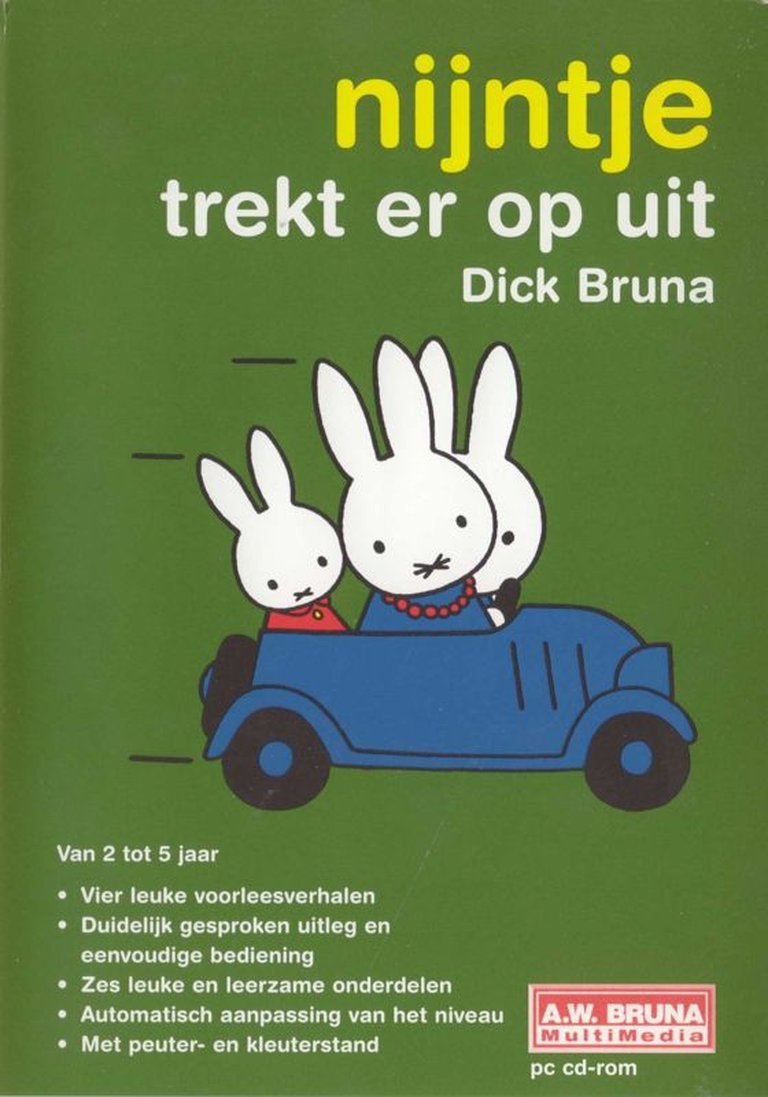
Nijntje trekt er op uit is an educational game for toddlers featuring the beloved Dutch character Nijntje, created by Dick Bruna. The game offers a variety of engaging activities designed for young children, including drawing with magical lines, listening to narrated stories, solving spot-the-difference puzzles, navigating a flying game to reach Nijntje’s grandma, coloring pictures, and completing block puzzles. With its simple mouse-based controls and bright, child-friendly visuals, the game provides a fun and interactive learning experience tailored for preschoolers.
Nijntje trekt er op uit Reviews & Reception
sockscap64.com (70/100): This Game has no review yet, please come back later…
Nijntje trekt er op uit: A Deep Dive into a Dutch Educational Classic
Introduction: The Enduring Legacy of Nijntje
Few characters in Dutch children’s literature have achieved the cultural ubiquity of Nijntje (known internationally as Miffy), the creation of artist Dick Bruna. Since her debut in 1955, Nijntje has become a symbol of childhood innocence, simplicity, and educational value. Nijntje trekt er op uit (2005), developed by A.W. Bruna Uitgevers B.V. and programmed by Remco de Korte of Onwijs, is a digital adaptation that seeks to translate Bruna’s minimalist aesthetic and pedagogical philosophy into an interactive experience for toddlers. This review explores how the game captures the essence of Nijntje while navigating the technological and design constraints of early 2000s educational software.
At its core, Nijntje trekt er op uit is a collection of six mini-games and four narrated stories, all designed to engage preschoolers in playful learning. The game’s significance lies not in its complexity but in its fidelity to Bruna’s vision: a world where simplicity fosters creativity, and repetition builds confidence. Yet, as we’ll examine, its reception and legacy are shaped by its limitations as much as its strengths.
Development History & Context: Bruna’s Vision Meets Early 2000s Edutainment
The Studio and Creative Vision
A.W. Bruna Uitgevers B.V., the publisher behind Nijntje trekt er op uit, is the same company that has shepherded Nijntje’s literary journey since her inception. The game’s development was a collaboration with Onwijs, a Dutch studio specializing in educational software, and programmer Remco de Korte. The project was licensed by Mercis Media bv, the rights holder for Dick Bruna’s work, ensuring the game adhered to the iconic visual style and tone of the original books.
The creative vision was straightforward: create a digital playground that mirrored the tactile, low-stimulation environment of Bruna’s illustrations. Unlike the flashy, high-stimulus edutainment titles of the era (e.g., JumpStart or Reader Rabbit), Nijntje trekt er op uit embraced minimalism. The game’s fixed/flip-screen perspective and first-person interactions were deliberate choices to avoid overwhelming young players.
Technological Constraints
Released in 2005, the game was built for Windows 95 or higher, a reflection of the era’s hardware limitations. The CD-ROM format and 200MB installation requirement were standard for the time, but the game’s simplicity meant it could run on modest systems—a critical consideration for its target audience of families and schools. The reliance on mouse input (with no keyboard support) was another nod to accessibility, though it also limited interactivity to basic point-and-click mechanics.
The Edutainment Landscape of 2005
The early 2000s were a golden age for educational games, with titles like The ClueFinders and Zoombinis dominating the market. However, Nijntje trekt er op uit stood apart by targeting an even younger demographic (ages 2–6) and prioritizing passive engagement (e.g., story narration) over skill-based challenges. Its Dutch-exclusive release (with no localized versions) further narrowed its reach, positioning it as a niche product for Dutch-speaking households.
Narrative & Thematic Deep Dive: Stories of Simplicity and Discovery
Plot and Structure
The game’s narrative is fragmented across four Voorleesverhaal (reading story) segments, each a self-contained vignette:
1. Nijntje aan zee (Nijntje at the Sea)
2. Nijntje vliegt (Nijntje is Flying)
3. Nijntje in de speeltuin (Nijntje in the Playground)
4. Nijntje op de fiets (Nijntje Rides a Bicycle)
These stories, narrated by Liesbeth Groot, are direct adaptations of Bruna’s books, retaining their signature brevity and lack of conflict. Themes of exploration, familial bonds (e.g., visiting grandma in Vliegspel), and everyday adventures dominate. The absence of antagonists or moral lessons is striking—Nijntje’s world is one of pure, unstructured play.
Characters and Dialogue
Nijntje herself is the sole recurring character, with peripheral figures like her parents and grandma appearing in supporting roles. The dialogue (delivered via narration) is sparse, with sentences often limited to three or four words. This minimalism aligns with Bruna’s belief that children’s media should avoid overstimulation, but it also results in a lack of emotional depth or character development.
Underlying Themes
- Autonomy and Agency: Games like Vliegspel (where the player pilots a plane) and Nijntje op de fiets emphasize independence, reflecting Bruna’s focus on childhood autonomy.
- Sensory Exploration: Toverlijnen (magical lines) and Kleurplaat (coloring) encourage tactile engagement, mimicking the physicality of Bruna’s books.
- Repetition as Learning: The Verschillenspel (spot-the-difference) and Blokkenpuzzel (block puzzle) reinforce pattern recognition through iterative play.
Gameplay Mechanics & Systems: Simplicity as a Double-Edged Sword
Core Gameplay Loops
The game’s six activities fall into three categories:
1. Passive Engagement:
– Voorleesverhaal: A linear storytelling experience with no interactivity beyond story selection.
– Toverlijnen: A “magic drawing” mode where moving the mouse reveals hidden lines—essentially a digital etch-a-sketch.
2. Puzzle-Based:
– Verschillenspel: A spot-the-difference game with three images, one of which is altered.
– Blokkenpuzzel: A sliding block puzzle where players rotate tiles to complete a picture.
3. Creative/Explorative:
– Vliegspel: A rudimentary flight simulator where players navigate obstacles to reach Nijntje’s grandma.
– Kleurplaat: A coloring book with predefined palettes.
Combat and Progression
There is no combat, failure state, or progression system. The Vliegspel is the closest to a “challenge,” but collisions with obstacles merely reset the player’s position without penalty. This design philosophy aligns with Bruna’s ethos but may frustrate older children accustomed to goal-oriented gameplay.
UI and Accessibility
The interface is stark, with large buttons and minimal text—ideal for toddlers but potentially alienating for parents seeking guided play. The lack of save functionality or adaptive difficulty further limits replayability.
Innovations and Flaws
- Innovations:
- The Toverlijnen mechanic is a clever translation of Bruna’s line art into interactive form.
- The Vliegspel’s obstacle course introduces light problem-solving without pressure.
- Flaws:
- The Blokkenpuzzel’s fixed four-tile grid lacks scalability for skill development.
- No parental controls or progress tracking, a missed opportunity for educational software.
World-Building, Art & Sound: A Faithful Homage to Bruna
Visual Design
The game’s art direction is a meticulous recreation of Dick Bruna’s style:
– Minimalist Aesthetics: Flat colors, thick outlines, and limited detail mirror the books’ illustrations.
– Fixed Perspectives: The flip-screen transitions between activities maintain a storybook feel but feel dated compared to contemporary 3D edutainment titles.
– Character Design: Nijntje’s iconic cross-shaped face and primary-color palette are preserved, though animations are limited to basic movements.
Sound and Atmosphere
- Narration: Liesbeth Groot’s gentle voice work is the auditory backbone, delivering stories with warmth but little dramatic range.
- Ambient Sounds: The Vliegspel includes subtle engine noises, but most activities rely on silence or sparse sound effects.
- Music: Notably absent—Bruna’s books rarely featured musical accompaniment, and the game follows suit.
The overall atmosphere is one of quietude, which may soothe toddlers but risks feeling sterile to older players.
Reception & Legacy: A Cult Classic in Dutch Edutainment
Critical and Commercial Reception
Nijntje trekt er op uit received no formal critical reviews (as evidenced by the lack of entries on MobyGames or Metacritic), likely due to its niche audience and regional release. However, its inclusion in the Nationaal Archief Educatieve Games (National Archive of Educational Games) suggests it was well-regarded in Dutch educational circles. The game’s commercial performance is undocumented, but its presence in libraries (e.g., Bibliotheek.nl) indicates institutional adoption.
Evolution of the Nijntje Franchise
The game is one of several Nijntje-themed titles released in the 2000s, including Nijntje Gaat Spelen (2005) and Nijntje Verzamelbox (2004). While later entries introduced more interactive elements, Nijntje trekt er op uit remains a purist adaptation of Bruna’s work.
Influence on Edutainment
The game’s legacy is modest but meaningful:
– Minimalism in Design: It predated the “less is more” trend in modern preschool apps (e.g., Sago Mini).
– Cultural Preservation: As one of the few digital adaptations of Nijntje, it serves as a time capsule of Dutch children’s media.
Conclusion: A Time Capsule of Dutch Childhood
Nijntje trekt er op uit is a game of contradictions: it is both revolutionary in its adherence to Bruna’s philosophy and limited by its refusal to evolve beyond it. For toddlers, it offers a safe, uncluttered introduction to digital play. For historians, it is a fascinating artifact of early 2000s edutainment, unburdened by the commercial pressures that shaped its peers.
Final Verdict: 7/10 – A charming but flawed homage to Nijntje’s legacy, best appreciated as a cultural relic rather than a timeless classic.
Recommended For:
– Parents of Dutch-speaking toddlers seeking low-stimulation edutainment.
– Educators studying the intersection of literature and interactive media.
– Collectors of niche educational software.
Not Recommended For:
– Older children or those expecting dynamic gameplay.
– Non-Dutch speakers (no localization exists).
– Players seeking depth or replayability.
In the pantheon of educational games, Nijntje trekt er op uit is a quiet footnote—but one that deserves recognition for its unwavering commitment to simplicity.