
- Release Year: 2008
- Platforms: iPhone, Macintosh, Windows
- Publisher: Big Fish Games, Inc, Educational Initiatives Group, Inc.
- Developer: GameMill Entertainment LLC, Gunnar Games, Inc.
- Genre: Action, Puzzle
- Perspective: Side view
- Game Mode: Single-player
- Gameplay: Cooking simulation, Hidden object, Ingredient collection, Point and select, Time management
- Setting: Cooking competition, Restaurant
- Average Score: 60/100
Description
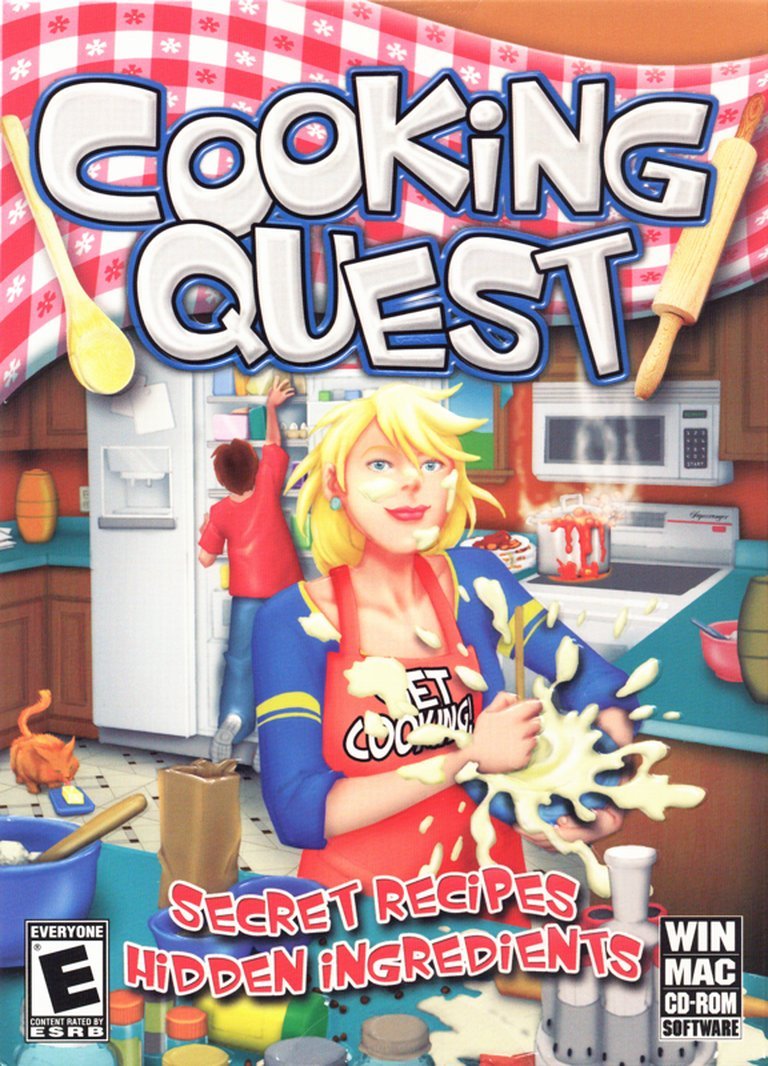
Cooking Quest is a hidden object game set in a restaurant-themed cooking competition. Players take on the role of a chef who must search for ingredients within a time limit, avoiding wrong clicks that deduct time and money. Once ingredients are collected, they are used to prepare meals by combining them with kitchen utensils, with the final dish receiving a star rating based on skill and ingredient quality.
Gameplay Videos
Cooking Quest Free Download
Cooking Quest Cracks & Fixes
Cooking Quest Guides & Walkthroughs
Cooking Quest Reviews & Reception
mobygames.com (60/100): A hidden object game with a restaurant theme.
virtualworldsland.com : Cooking Quest is an idle-like 2D food truck sim where you’ll get to discover and craft a variety of food, send heroes to various locations to hunt for ingredients, and develop the nearby village just so you can get more customers!
Cooking Quest: A Flavorful but Flawed Culinary Adventure
Introduction: The Rise of the Hidden Object Cooking Sim
Cooking Quest (2008) is a curious artifact of the late 2000s casual gaming boom—a hybrid of hidden object mechanics and cooking simulation, wrapped in a competitive culinary narrative. Developed by Gunnar Games and GameMill Entertainment, and published by Big Fish Games and Educational Initiatives Group, the game arrived at a time when the casual gaming market was flooded with time-management and hidden object titles. Yet, Cooking Quest carved out a niche by blending the frenetic search-and-find gameplay of Mystery Case Files with the culinary pressure of Diner Dash.
At its core, Cooking Quest is a two-phase experience: first, players scour cluttered environments for ingredients under a strict time limit, then they transition to a cooking mini-game where precision timing and resource management determine their dish’s final rating. The game’s premise—competing in a high-stakes cooking competition—taps into the early 2000s fascination with reality TV shows like Iron Chef and Hell’s Kitchen, offering players a virtual taste of culinary glory.
However, despite its ambitious fusion of genres, Cooking Quest remains a forgotten relic—a game that was fun “while it lasted,” as GameZebo’s 2008 review noted, but ultimately failed to leave a lasting impression. This review will dissect why: examining its development context, narrative (or lack thereof), gameplay systems, and its place in gaming history.
Development History & Context: The Casual Gaming Gold Rush
The Studio & the Vision
Cooking Quest was born from Gunnar Games, a studio primarily known for hidden object and puzzle games (Lost Secrets: Bermuda Triangle, Mystery Case Files: Return to Ravenhearst). The game was co-developed by GameMill Entertainment, a company that specialized in budget-friendly, family-oriented titles. The collaboration suggests a low-risk, high-reward approach—leveraging Gunnar’s expertise in hidden object design with GameMill’s distribution prowess.
The lead designer and programmer, Jamie Nye, was a key figure in the project, having worked on multiple hidden object games. The art direction, led by Ramon Mujica, adopted a cartoonish, side-view aesthetic, a common choice for casual games of the era. The game’s shareware business model (with a CD-ROM and digital download option) aligned with Big Fish Games’ strategy of microtransactions and trial versions, a model that dominated the casual gaming market in the late 2000s.
Technological Constraints & the Casual Gaming Landscape
Released in 2008, Cooking Quest was constrained by the technical limitations of the time:
– Minimum system requirements (Pentium III, 128MB RAM, DirectX 9.0) reflect a game designed for low-end PCs and early Macs (including PowerPC G3 support).
– The side-view perspective and static 2D environments were optimized for quick loading times—essential for a casual audience.
– The iPhone port (2009) was an early attempt to capitalize on the burgeoning mobile gaming market, though it lacked the polish of later touchscreen cooking games like Cooking Mama.
The gaming landscape in 2008 was dominated by:
– Time-management sims (Diner Dash, Cake Mania)
– Hidden object adventures (Mystery Case Files, Hidden Expedition)
– Early mobile gaming experiments (Apple’s App Store had just launched in 2008)
Cooking Quest attempted to bridge these trends, but its shallow narrative and repetitive mechanics prevented it from standing out.
Narrative & Thematic Deep Dive: A Recipe Without a Story
The Plot (or Lack Thereof)
Cooking Quest’s narrative is barebones: players assume the role of a competitive chef entering a cooking tournament in Foodville’s Restaurant Row. The game’s official description frames it as a high-stakes culinary battle, but in practice, the story is nonexistent beyond the premise.
- There are no named characters, no rival chefs, and no judges with distinct personalities.
- The only “antagonist” is the time limit and the food critic’s unseen judgment.
- The progression is purely mechanical: buy ingredients → cook dish → earn stars → unlock next level.
This lack of narrative depth is a missed opportunity. Compare it to later cooking games like Cooking Mama (which had a whimsical, character-driven approach) or Overcooked (which thrived on chaotic multiplayer storytelling), and Cooking Quest feels sterile.
Themes: Pressure, Precision, and the Illusion of Creativity
Despite its thin story, Cooking Quest accidentally taps into real-world culinary themes:
1. The Pressure of Perfection – The thermometer-based cooking mechanic (where players must click at the exact right moment) mirrors the stress of real cooking, where timing is everything.
2. Budget Management as a Metaphor for Restaurant Life – Players must balance cost vs. quality, a nod to the economic realities of running a kitchen.
3. The Illusion of Creativity – While the game claims to let players “prepare and serve meals,” the actual cooking is reduced to a mini-game, stripping away any real culinary expression.
The game’s biggest thematic flaw is its disconnect between mechanics and fantasy. Players are told they’re master chefs, but the gameplay reduces them to ingredient hunters and button-pressers.
Gameplay Mechanics & Systems: A Two-Phase Grind
Phase 1: The Hidden Object Hunt
The first half of each level is a timed hidden object challenge:
– Players are given a list of ingredients (e.g., “carrot,” “chicken,” “salt”) and must find them in a cluttered room.
– Wrong clicks penalize time and money, adding tension.
– Once all items are found, players purchase ingredients, with higher-quality items costing more but improving the final dish rating.
Pros:
✅ Fast-paced and addictive – The time pressure creates a rush similar to Mystery Case Files.
✅ Replayability – Objects are randomized, so no two playthroughs are identical.
Cons:
❌ Repetitive – The same rooms recycle with different ingredient lists.
❌ Arbitrary penalties – The money deduction for wrong clicks feels unfair, especially since some objects blend into the background.
Phase 2: The Cooking Mini-Game
After gathering ingredients, players enter the kitchen phase:
– A top-down inventory holds ingredients.
– Kitchen appliances (stove, oven, blender) appear as small windows with thermometers.
– Players must click at the precise moment the thermometer hits the yellow zone to cook perfectly.
Pros:
✅ Unique timing mechanic – The thermometer system is an interesting twist on cooking sims.
✅ Strategic ingredient selection – Choosing higher-quality ingredients affects the final score.
Cons:
❌ Clunky controls – The drag-and-drop system feels imprecise, especially on the iPhone version.
❌ Lack of depth – There’s no recipe variation—just repeating the same steps for different dishes.
Progression & Replayability
- 24 levels with 6 meal-preparation mini-games.
- No unlockable recipes or chef customization—just higher difficulty settings.
- Replaying levels only serves to earn more stars, with no meaningful rewards.
Verdict: The gameplay loop is fun in short bursts but lacks long-term engagement.
World-Building, Art & Sound: A Bland Buffet
Visual Design: Functional but Forgettable
- Side-view perspective with static 2D backgrounds.
- Cartoonish, low-detail sprites—typical of 2008 casual games.
- No animation flourishes—ingredients pop into existence rather than being realistically prepared.
Comparison to Peers:
– Diner Dash (2003) had more vibrant character designs.
– Cooking Mama (2006) used 3D models and expressive animations.
– Cooking Quest feels visually outdated even for its time.
Sound & Music: The Silent Kitchen
- No voice acting—just text prompts.
- Generic background music—a looping mid-tempo tune that fades into the background.
- Sound effects are minimal—just clicks and dings for correct/incorrect actions.
Missed Opportunity: A dynamic soundtrack (e.g., tense music during time limits, triumphant fanfares for high scores) could have elevated the experience.
Reception & Legacy: A Forgotten Dish
Critical & Commercial Reception
- GameZebo (2008): 60/100 – “Fun while it lasts, but ends just when it’s starting to cook.”
- MacGameStore User Reviews: 3.6/5 – Praised for addictive gameplay but criticized for poor graphics and repetition.
- No Metacritic user reviews—indicating low player engagement.
Legacy: The Ghost of Cooking Sims Past
Cooking Quest failed to leave a mark on the genre, but its hybrid design foreshadowed later trends:
✅ Hidden object + simulation hybrids (Cooking Companions, 2021).
✅ Mobile cooking games (Cooking Madness, Cooking Fever).
❌ Lack of narrative depth—later games like Battle Chef Brigade (2017) proved that cooking games could have story and strategy.
Why It Faded:
1. Repetitive gameplay – No progression beyond high scores.
2. Weak presentation – Bland visuals and sound.
3. Overshadowed by competitors – Cooking Mama and Diner Dash dominated the market.
Conclusion: A Flavorful Experiment, But Half-Baked
Cooking Quest is a fascinating time capsule of 2008 casual gaming—a bold attempt to merge hidden object mechanics with cooking simulation, but one that lacked the depth and polish to endure.
Final Verdict: 6/10 – “A Decent Appetizer, But No Main Course”
✅ Pros:
– Unique two-phase gameplay (hidden object + cooking).
– Addictive in short bursts.
– Early example of hybrid casual game design.
❌ Cons:
– Repetitive and shallow.
– Weak presentation (graphics, sound, narrative).
– Lack of long-term progression.
Where It Stands in History:
Cooking Quest is not a classic, but it’s a notable experiment—a game that tried something different in a crowded market. Its biggest sin was not being memorable enough in an era where casual games needed personality to survive.
For Historians & Curious Gamers:
If you’re studying the evolution of cooking sims or hidden object games, Cooking Quest is worth a brief playthrough—but don’t expect a Michelin-star experience.
Final Thought:
“Cooking Quest is like a decent diner meal—filling in the moment, but forgotten by dessert.”*
Would you like a deeper dive into any specific aspect (e.g., comparison to Cooking Mama, analysis of the iPhone port’s flaws)? Let me know!