
- Release Year: 1980
- Platforms: 64, Amstrad CPC, Android, Arcade, BBC Micro, Commodore 64, Dragon 32, Nintendo Switch, PlayStation 3, PlayStation 4, PlayStation, PS Vita, PSP, Wii, Windows, ZX Spectrum
- Publisher: Alternative Software Ltd., Centuri, Inc., Hamster Corporation, Incentive Software Ltd., Nichibutsu, Taito Corporation
- Developer: Nichibutsu
- Genre: Action, Scrolling shoot ’em up
- Perspective: Top-down
- Game Mode: Hotseat, Single-player
- Gameplay: Arcade, Shooter
- Setting: Futuristic, Sci-fi
- Average Score: 68/100
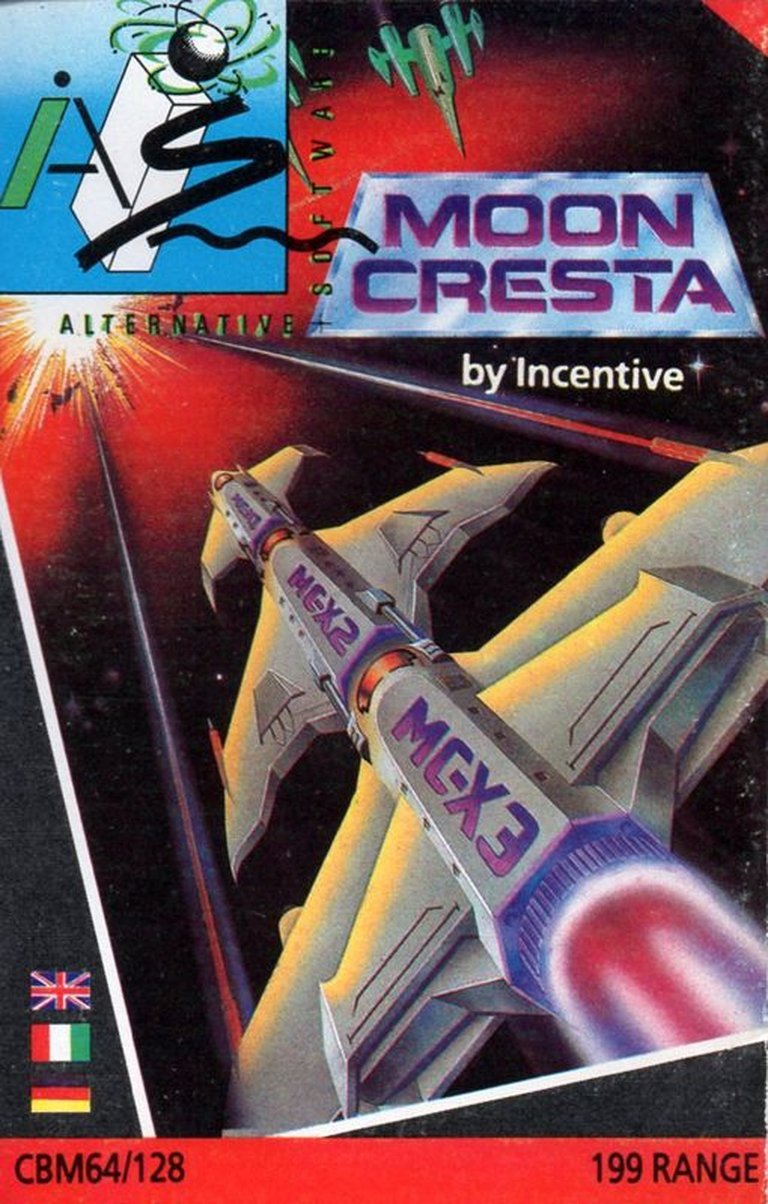
Description
Moon Cresta is a classic vertical scrolling shoot-’em-up arcade game set in a sci-fi universe. Players control a spaceship at the bottom of the screen, battling waves of aliens—some of which split when shot—while navigating through a futuristic battlefield. The game’s unique challenge lies in manually docking the ship within a time limit to earn bonus points, adding a strategic layer to the fast-paced action. Originally released in 1980, Moon Cresta is part of the Cresta series and is known for its top-down perspective, 2D scrolling visuals, and direct control interface, offering both single-player and hot-seat multiplayer modes.
Gameplay Videos
Moon Cresta Guides & Walkthroughs
Moon Cresta Reviews & Reception
mobygames.com (68/100): A faithful conversion done at the right speed that holds up reasonably well to the original.
atari7800forever.com : I have a love/hate relationship with Moon Cresta.
Moon Cresta Cheats & Codes
SNES (USA) – Pro Action Replay
Enter codes using Pro Action Replay or Game Genie on an emulator or physical device.
| Code | Effect |
|---|---|
| 7E095809 | Always Have First Ship |
| 7E095806+7E095A02 | Unlimited (II) Ships After Destroying the (I) Ship |
| 7E095804+7E095A04 | Unlimited (III) Ships After Destroying the (II) Ship |
SNES (JP) – Game Genie
Enter codes using Game Genie or Pro Action Replay on an emulator or physical device.
| Code | Effect |
|---|---|
| 7E095806+7E095A02 | Infinite (II) Ships Once You Destroy The (I) Ship |
| 7E095804+7E095A04 | Infinite (III) Ships Once You Destroy The (I & II) Ships |
| 7E0A9EXX | Ship Modifier (Buggy) |
| 7E095809 | Always Have 1st Ship |
Moon Cresta: A Pioneering Masterpiece of the Golden Age of Arcade Shooters
Introduction
In the annals of video game history, few titles embody the spirit of innovation and challenge quite like Moon Cresta. Released in 1980 by Nichibutsu, this fixed shooter is a testament to the creativity and technical prowess of early arcade developers. Moon Cresta stands as a pivotal title in the evolution of the shoot ’em up genre, introducing mechanics that would influence countless games to come. This review delves deep into the game’s development, gameplay, legacy, and its enduring impact on the video game landscape.
Development History & Context
The Studio and Creators
Moon Cresta was developed by Nichibutsu, a Japanese company that, while not as globally renowned as Namco or Taito, made significant contributions to the arcade scene. The game was designed by Shigeki Fujiwara, a prolific figure in the industry who worked on numerous titles. Fujiwara’s vision for Moon Cresta was to create a shooter that combined the addictive gameplay of Space Invaders with the dynamic enemy patterns of Galaxian, while introducing a unique docking mechanic that set it apart from its contemporaries.
Technological Constraints and Innovations
The game was built on the Namco Galaxian hardware, which featured a Zilog Z80 CPU running at 3.072 MHz. This hardware allowed for smooth enemy movements and a sparkling star field background, reminiscent of Galaxian. However, Moon Cresta distinguished itself with its innovative ship-docking concept, which added a strategic layer of risk and reward. This mechanic required players to precisely align their ships during docking sequences, a feature that was both challenging and rewarding.
The Gaming Landscape of 1980
The late 1970s and early 1980s were a golden age for arcade games. Titles like Space Invaders and Galaxian had captivated audiences worldwide, and the market was ripe for new innovations. Moon Cresta entered this competitive landscape with its unique blend of familiar gameplay and groundbreaking mechanics. The game’s release in Japan in February 1980, followed by its North American debut in June of the same year, marked a significant moment in the evolution of the shoot ’em up genre.
Narrative & Thematic Deep Dive
Plot and Setting
Moon Cresta is set in a futuristic sci-fi universe where the player takes on the role of a pilot defending against waves of alien invaders. The game’s narrative is minimal, focusing instead on the immediate action and challenge of surviving each wave. The player begins with a small spaceship armed with a single laser cannon, and as they progress, they have the opportunity to dock with additional ship modules, increasing their firepower and size.
Characters and Dialogue
The game features a simple yet effective cast of characters, primarily the player’s ship and the various alien enemies. The enemies, such as the Cold Eyes and Super Flies, exhibit distinct behaviors and patterns, adding depth to the gameplay. The dialogue is minimal, with the game relying on visual and auditory cues to convey its narrative.
Underlying Themes
At its core, Moon Cresta is a game about strategy and risk management. The docking mechanic introduces a layer of complexity that requires players to balance the benefits of increased firepower against the risks of a larger, more vulnerable ship. This theme of risk and reward is central to the game’s appeal, challenging players to make strategic decisions that can significantly impact their success.
Gameplay Mechanics & Systems
Core Gameplay Loop
The core gameplay loop of Moon Cresta revolves around surviving waves of alien attacks and docking with additional ship modules. The player starts with a small fighter and must clear the first four waves of enemies before attempting to dock with the second ship module. Successful docking increases the player’s firepower, making it easier to tackle subsequent waves. However, the larger ship is also a bigger target, adding an element of risk.
Combat and Enemy Patterns
The enemies in Moon Cresta exhibit a variety of behaviors and patterns, reminiscent of Galaxian. The Cold Eyes, for example, swirl above the player in figure-eight patterns before swooping down for the kill. Shooting a Cold Eye splits it into two smaller ships, adding to the onscreen chaos. The Super Flies, on the other hand, are more numerous but less agile. These diverse enemy patterns keep the gameplay engaging and challenging.
Docking Mechanic
The docking mechanic is the standout feature of Moon Cresta. After clearing specific waves, the player must attempt to dock their ship with the next module. This mini-game requires precise maneuvering, with the player using thrusters to align and connect the ships. A successful dock merges the ships, increasing firepower and preparing the player for future waves. Failure to dock correctly results in the loss of the module, reducing the player’s firepower and increasing vulnerability.
UI and Controls
The game’s UI is straightforward, with a score display at the top of the screen and the player’s ship at the bottom. The controls are simple, with a joystick for movement and a single button for firing. This simplicity allows players to focus on the action and strategy, making the game accessible yet challenging.
World-Building, Art & Sound
Setting and Atmosphere
Moon Cresta is set in a futuristic sci-fi universe, with the player’s ship battling against waves of alien invaders. The game’s atmosphere is intense and fast-paced, with the player constantly under pressure to survive each wave. The sparkling star field background and the dynamic enemy patterns contribute to the game’s immersive atmosphere.
Visual Direction
The game’s visual direction is a blend of simplicity and elegance. The player’s ship and the alien enemies are designed with clear, distinct shapes that are easy to recognize and target. The star field background adds a sense of depth and movement, enhancing the game’s visual appeal. The use of color is effective, with different enemy types distinguished by their unique hues.
Sound Design
The sound design of Moon Cresta is a standout feature, with distinctive sound effects that add to the game’s intensity. The whistling of missiles as they leave the player’s ship, the explosions of destroyed enemies, and the background music all contribute to the game’s immersive atmosphere. The sound effects are simple yet effective, enhancing the gameplay experience without overwhelming the player.
Reception & Legacy
Critical and Commercial Reception
Upon its release, Moon Cresta was met with critical acclaim and commercial success. In Japan, it was the fourth highest-earning arcade game of 1980, behind Pac-Man, Galaxian, and Crazy Climber. The game’s innovative docking mechanic and challenging gameplay were praised by critics, who highlighted its unique blend of familiar and groundbreaking elements.
Evolution of Reputation
Over the years, Moon Cresta has maintained a strong reputation among retro gaming enthusiasts. Its innovative mechanics and challenging gameplay have ensured its place in the annals of video game history. The game’s influence can be seen in numerous subsequent titles, and its legacy continues to be celebrated by fans and critics alike.
Influence on Subsequent Games
Moon Cresta has had a significant impact on the shoot ’em up genre, influencing numerous subsequent titles. Its docking mechanic, in particular, has been emulated and expanded upon in games like Terra Cresta and Gradius. The game’s emphasis on strategy and risk management has also influenced the design of many modern shooters, making Moon Cresta a pivotal title in the evolution of the genre.
Conclusion
Moon Cresta is a pioneering masterpiece of the golden age of arcade shooters. Its innovative docking mechanic, challenging gameplay, and immersive atmosphere have ensured its place in video game history. The game’s influence can be seen in numerous subsequent titles, and its legacy continues to be celebrated by fans and critics alike. For its groundbreaking mechanics, engaging gameplay, and enduring impact, Moon Cresta deserves a place among the greatest arcade games of all time.
Final Verdict
Rating: 9/10
Moon Cresta is a must-play for fans of retro gaming and shoot ’em ups. Its innovative mechanics, challenging gameplay, and immersive atmosphere make it a standout title in the genre. While its difficulty may be a barrier for some players, its strategic depth and rewarding gameplay ensure that it remains a beloved classic. For its contributions to the evolution of the shoot ’em up genre and its enduring appeal, Moon Cresta is a game that deserves to be remembered and celebrated.