
- Release Year: 1999
- Platforms: Macintosh, Windows
- Publisher: Lucas Learning Ltd.
- Developer: Lucas Learning Ltd.
- Genre: Driving, Educational, Racing
- Perspective: Top-down
- Game Mode: Single-player
- Gameplay: Printable trading cards, Track Building
- Setting: Ando Prime, Dagobah, Tatooine
- Average Score: 45/100
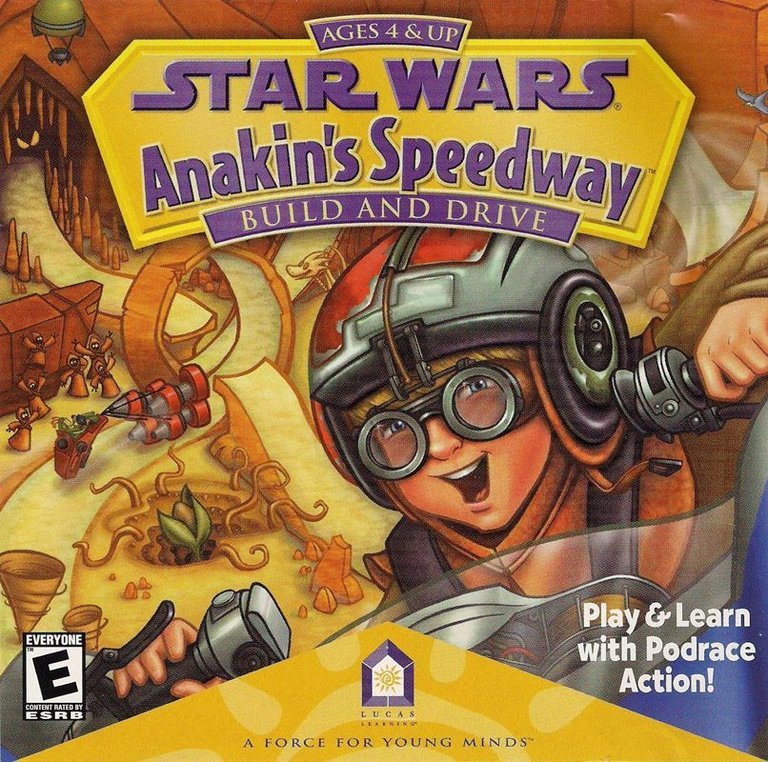
Description
Star Wars: Anakin’s Speedway is a 2D educational racing game designed for children, set in the Star Wars universe. Players can create custom pod race tracks on planets like Tatooine, Ando Prime, or Dagobah, then race as characters like Anakin Skywalker, Sebulba, or Ben Quadinaros at varying speeds. The game features a top-down perspective, simple controls focused on speed adjustment, and the ability to print tracks as trading cards. Aimed at young fans, it blends light racing mechanics with creative track-building, though reviews note its limited depth and repetitive gameplay.
Gameplay Videos
Star Wars: Anakin’s Speedway Free Download
Star Wars: Anakin’s Speedway Cracks & Fixes
Star Wars: Anakin’s Speedway Reviews & Reception
mobygames.com (30/100): Average score: 30% (based on 2 ratings)
myabandonware.com (50/100): 2.5 / 5 – 4 votes
vgtimes.com (55/100): Gameplay 5.5, Graphics 5.5, Story 5.5, Controls 5.5, Sound and Music 5.5, Multiplayer 5.5, Localization 5.5, Optimization 5.5
swtorstrategies.com : A unique blend of education and entertainment, a game that fostered creativity and learning while immersing players in the rich lore of the Star Wars universe.
Star Wars: Anakin’s Speedway: A Forgotten Gem of Educational Gaming
Introduction
In the vast, sprawling galaxy of Star Wars video games, few titles are as peculiar—or as overlooked—as Star Wars: Anakin’s Speedway. Released in 1999 by Lucas Learning Ltd., this game is a fascinating anomaly: a 2D, top-down racing title designed not for adrenaline-fueled competition, but for education and creativity. It arrived at a time when Star Wars was riding the crest of The Phantom Menace hype, yet it eschewed the franchise’s typical focus on combat and heroism in favor of something far more subdued: a digital toybox where children could design their own pod race tracks and learn the fundamentals of game design, physics, and artistic expression.
This review aims to dissect Anakin’s Speedway in exhaustive detail, exploring its development, narrative (or lack thereof), gameplay mechanics, and the broader context of its existence. Was it a misguided experiment, a noble failure, or an underappreciated pioneer in educational gaming? By examining its strengths, flaws, and legacy, we can better understand its place in both Star Wars history and the evolution of video games as a medium.
Development History & Context
The Studio: Lucas Learning Ltd.
Star Wars: Anakin’s Speedway was developed and published by Lucas Learning Ltd., a subsidiary of LucasArts dedicated to creating educational software. Founded in 1996, Lucas Learning was part of a broader push in the late ’90s to leverage popular franchises—particularly Star Wars—to create engaging, child-friendly learning tools. The studio’s mission was to blend entertainment with education, a philosophy that aligned with the growing edutainment movement of the era.
Lucas Learning was responsible for several Star Wars-themed educational titles, including Star Wars: DroidWorks (1998), Star Wars: Yoda’s Challenge (1999), and Star Wars: Episode I – The Gungan Frontier (1999). These games were designed to teach subjects like logic, problem-solving, and environmental science, all while immersing players in the Star Wars universe. Anakin’s Speedway was part of this lineage, but with a unique focus: creativity and spatial reasoning.
The Vision: A Creative Sandbox
The game’s initial design was spearheaded by Jonathan Blossom, with Laura Hatton serving as project leader and Colleen Brode as associate project leader. The team’s goal was to create a game that would allow children to build their own pod race tracks, fostering an understanding of basic physics (speed, momentum, gravity) and graphic design principles. Unlike Star Wars: Episode I Racer (1999), which was a high-speed, 3D racing simulator, Anakin’s Speedway was intentionally simplified, targeting a younger audience (ages 4 and up).
The game’s development coincided with the release of The Phantom Menace, and it capitalized on the film’s most visually striking element: podracing. However, instead of replicating the film’s breakneck races, the developers opted for a top-down, 2D perspective, which made the game more accessible to young children. The tracks could be designed on three iconic Star Wars planets: Tatooine, Ando Prime, and Dagobah, each offering distinct visual themes.
Technological Constraints
Anakin’s Speedway was released in 1999, a time when 3D graphics were becoming the industry standard. However, the game’s 2D, top-down perspective was a deliberate choice, driven by both technical limitations and the target audience. The developers used Adobe Director and other multimedia tools to create the game’s interface and animations, ensuring it would run smoothly on the modest hardware of late-’90s family computers.
The game’s track editor was its most technically ambitious feature. Players could drag and drop track pieces (straightaways, curves, loops, jumps) to create custom courses. The editor was designed to be intuitive, with snapping mechanics to ensure tracks connected properly. Once a track was built, players could race on it using one of four characters: Anakin Skywalker, Sebulba, Gasgano, or Ben Quadinaros.
The Gaming Landscape of 1999
1999 was a pivotal year for Star Wars gaming. Star Wars: Episode I Racer (LucasArts) and Star Wars: Rogue Squadron (Factor 5) were the franchise’s flagship titles, offering high-octane action and cutting-edge graphics. In contrast, Anakin’s Speedway was a niche product, aimed at a much younger demographic.
The edutainment genre was also in flux. Titles like The Oregon Trail and Where in the World Is Carmen Sandiego? had proven that games could teach, but the market was becoming saturated with low-effort, licensed cash-ins. Anakin’s Speedway stood out by tying its educational goals directly to its gameplay mechanics, rather than slapping a Star Wars skin onto a generic math quiz.
Narrative & Thematic Deep Dive
Plot: A Minimalist Approach
Star Wars: Anakin’s Speedway is not a story-driven game. There is no overarching narrative, no quest to save the galaxy, and no villain to defeat. Instead, the game’s “story” is player-generated: children are encouraged to imagine their own races, their own rivalries, and their own victories.
The game’s dialogue writer, Kevin O’Donnell, crafted brief, encouraging voice lines for Anakin Skywalker (voiced by Jake Lloyd, reprising his role from The Phantom Menace). These lines—such as “Great job!” or “Watch out for that turn!”—were designed to reinforce positive play rather than advance a plot. The lack of narrative was intentional: the game was meant to be a creative tool, not a cinematic experience.
Characters: Familiar Faces in a New Context
The game features four playable racers:
1. Anakin Skywalker – The young protagonist of The Phantom Menace, serving as the game’s de facto mascot.
2. Sebulba – Anakin’s rival from the film, included to add a competitive edge.
3. Gasgano – A minor podracer from the film, chosen for his distinctive design.
4. Ben Quadinaros – Another obscure racer, likely included for variety.
These characters are stripped of their cinematic context and reduced to simple avatars. There are no cutscenes, no character arcs, and no interactions beyond the race itself. The game’s Wookieepedia entry lists a vast array of Star Wars characters, creatures, and locations that are either mentioned, pictured, or referenced, but none of them play a meaningful role in the gameplay.
Themes: Creativity Over Conflict
The most striking theme of Anakin’s Speedway is its rejection of violence. Unlike nearly every other Star Wars game, there are no blasters, no lightsabers, and no battles. Instead, the game emphasizes:
– Creativity – Players design their own tracks, experimenting with layouts and obstacles.
– Problem-Solving – Successful tracks require an understanding of speed and momentum.
– Self-Expression – The ability to print tracks as “trading cards” encourages players to share their creations.
In this sense, Anakin’s Speedway is a subversive Star Wars game. It takes a franchise built on war and heroism and repurposes it into a peaceful, constructive experience. This was likely a deliberate choice by Lucas Learning, which sought to create games that were safe, educational, and non-threatening for young children.
Gameplay Mechanics & Systems
Core Gameplay Loop
Anakin’s Speedway is divided into two primary modes:
1. Track Builder – A drag-and-drop editor where players design custom racetracks.
2. Race Mode – Players select a racer and compete on their custom tracks.
The Track Builder is the game’s most innovative feature. Players can:
– Choose from three planets (Tatooine, Ando Prime, Dagobah), each with unique visual themes.
– Place track pieces (straightaways, curves, loops, jumps, tunnels).
– Add obstacles (rocks, sand dunes, etc.) to increase difficulty.
– Test their tracks in real-time.
Once a track is built, players can race on it using one of the four characters. The racing itself is simplified:
– There is no steering—players only control their speed (slow, medium, fast).
– The podracer moves automatically along the track, requiring players to adjust speed to avoid crashes.
– Races are timed, with the goal of completing the track as quickly as possible.
Innovative Systems
- Printable Tracks – Players could print their custom tracks as “trading cards,” a novel feature that encouraged offline play and social sharing.
- Three Speed Settings – The game’s difficulty could be adjusted by selecting different speeds, making it accessible to younger players.
- Top-Down Perspective – Unlike Episode I Racer, which used a first-person view, Anakin’s Speedway opted for a bird’s-eye perspective, making it easier for children to understand track layouts.
Flawed Systems
- Lack of Depth – The racing mechanics are extremely basic, with no steering or competitive AI. This limits replayability.
- Limited Customization – While players can build tracks, there are no options to customize podracers or characters.
- Repetitive Gameplay – Without a narrative or progression system, the game quickly becomes monotonous.
UI & Controls
The game’s user interface is simple and child-friendly, with large buttons and clear icons. The track editor is intuitive, using a drag-and-drop system that even young children could grasp. However, the racing controls are overly simplistic, reducing the game to a series of speed adjustments rather than a true racing experience.
World-Building, Art & Sound
Setting & Atmosphere
Anakin’s Speedway takes place on three iconic Star Wars planets:
1. Tatooine – The desert planet from A New Hope and The Phantom Menace, featuring sand dunes and rock formations.
2. Ando Prime – A lush, forested world, offering a stark contrast to Tatooine.
3. Dagobah – The swamp planet from The Empire Strikes Back, complete with murky waters and dense foliage.
Each planet is rendered in 2D, top-down sprites, with colorful, cartoonish visuals that appeal to young children. The game’s art style is whimsical rather than realistic, prioritizing clarity and charm over detail.
Visual Direction
The game’s lead artist, Maryn Roos, oversaw a team that included 2D animators, 3D modelers, and background artists. The visuals are bright, bold, and easy to parse, with exaggerated track pieces and vibrant planetary backdrops. The podracers are simplified versions of their film counterparts, designed to be immediately recognizable to young fans.
Sound Design
The game’s audio is minimalist but effective:
– Voice Acting – Jake Lloyd’s Anakin provides encouraging commentary, reinforcing positive play.
– Sound Effects – The hum of podracers, the crash of collisions, and the ambient noises of each planet.
– Music – The game features light, upbeat tunes that evoke the Star Wars universe without overwhelming the player.
The sound design is functional rather than immersive, serving to guide and reward the player rather than create a cinematic experience.
Reception & Legacy
Critical Reception
Anakin’s Speedway received mixed-to-negative reviews from critics:
– Macworld (40%) – Praised the game’s educational potential but criticized its lack of depth and imagination.
– Absolute Games (AG.ru) (20%) – Dismissed it as a cynical cash-in, calling the gameplay repetitive and unengaging.
Players, however, were slightly more forgiving, giving it an average score of 3.2/5 on MobyGames. Many appreciated its creative freedom and child-friendly design, even if it lacked the excitement of other Star Wars games.
Commercial Performance
The game was not a major commercial success, likely due to its niche appeal. It was overshadowed by Episode I Racer and other high-profile Star Wars titles, and its educational focus limited its audience to young children and parents.
Legacy & Influence
Despite its flaws, Anakin’s Speedway remains a fascinating footnote in Star Wars gaming history. It was one of the few Star Wars games to:
– Prioritize education over action.
– Encourage creativity and problem-solving.
– Target a preschool-age audience.
Its track-building mechanics foreshadowed later games like TrackMania and Mario Kart’s custom track features. While it was not a critical or commercial darling, it proved that Star Wars could be more than just blasters and lightsabers—it could also be a tool for learning and imagination.
Conclusion: A Noble Experiment
Star Wars: Anakin’s Speedway is not a great game by conventional standards. Its simplistic racing mechanics, lack of depth, and repetitive gameplay make it a hard sell for anyone beyond its target demographic. Yet, within its narrow scope, it achieves something remarkable: it transforms Star Wars into a creative sandbox, where children can experiment, learn, and play without the pressure of combat or competition.
In the grand tapestry of Star Wars gaming, Anakin’s Speedway is a minor thread, but an important one. It represents a bold experiment in blending education with entertainment, and while it may not have succeeded as a game, it succeeded as a learning tool. For the children who played it in 1999, it was more than just a racing game—it was a gateway to creativity, a chance to build their own corner of the Star Wars universe.
Final Verdict: 6/10 – A Flawed but Fascinating Educational Experiment
Star Wars: Anakin’s Speedway is not for everyone, but for its intended audience—young children with a love of Star Wars and a budding interest in design—it remains a unique and valuable experience. It may not be a classic, but it is a testament to the potential of games as tools for learning and imagination. In a galaxy far, far away, there’s always room for creativity—and Anakin’s Speedway proved that.