
- Release Year: 2002
- Platforms: Windows Mobile, Windows
- Developer: Zenops
- Genre: Action, Puzzle
- Perspective: Side view
- Game Mode: Single-player
- Gameplay: Falling block puzzle
Description
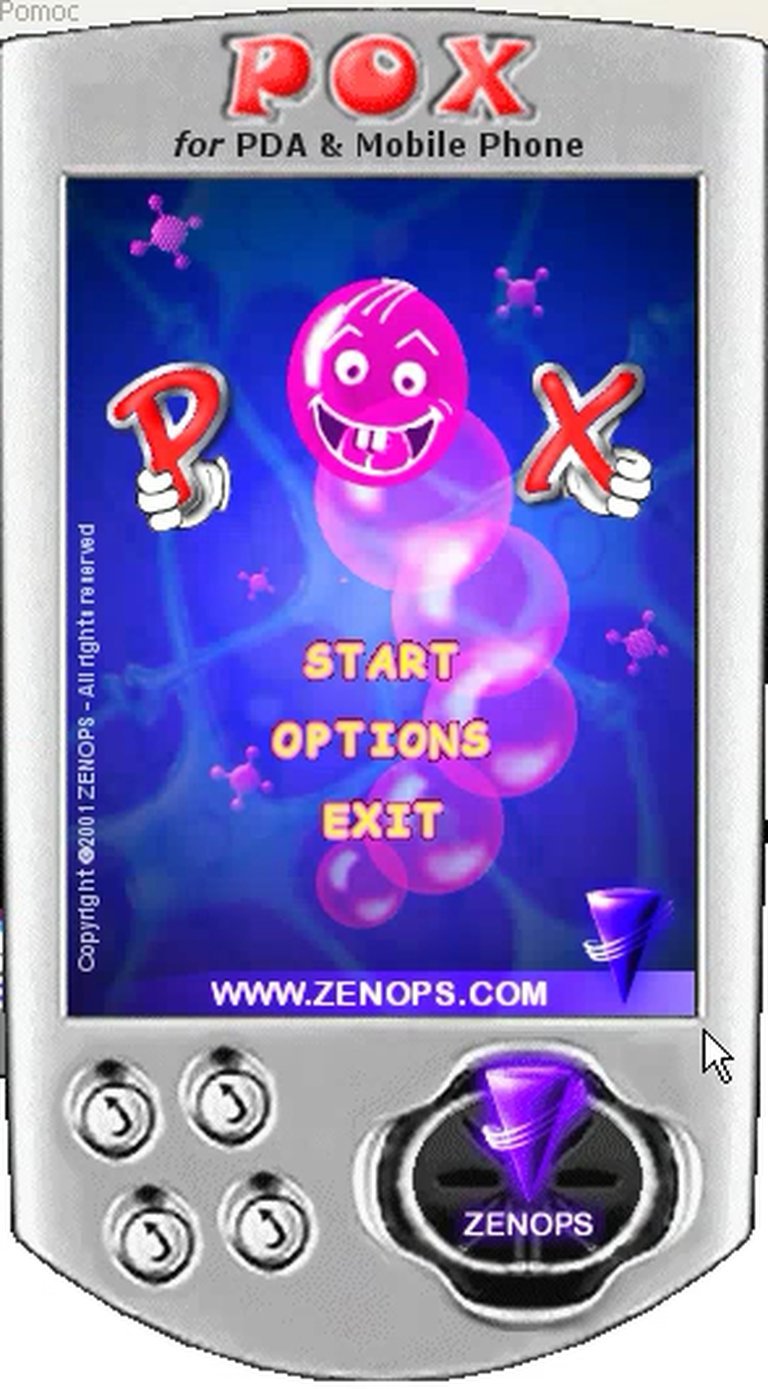
Pox is a Tetris-inspired puzzle game where players connect four or more colored balls to clear them from the screen, aiming to survive as long as possible before the stack reaches the top. Released in 2002 for Windows and Windows Mobile, the game features 80 levels, various bonuses like line clears and color changes, and simple controls using arrow keys for movement and rotation.
Where to Buy Pox
PC
Pox Cheats & Codes
Hasbro Pox
Enter codes during gameplay.
| Code | Effect |
|---|---|
| T, T, T, H, H, H, B, B, B | Cycro or Spino recommended codes |
| T, H, B, B, T, H, H, B, T | Cycro or Spino recommended codes |
| W.A.D. | Flamethrower for Spino |
| T, H, B, H, B, T, B, H, T | Flamethrower for Spino |
| B, H, T, H, B, T, T, H, B | Flamethrower for Spino |
| B, H, B, H, B, T, T, T, H | Missiles on for the Cycro |
| T, B, H, H, T, B, B, H, T | Counter Attack for Plasmo |
| B, H, T, T, H, B, B, H, T | Spear for Spino |
| B, H, T, T, H, B, B, H, T | Cannon Ball for Spino |
| T, H, B, H, B, T, B, H, T | Special attacks for the Clan Cycros |
| B, T, H, H, B, T, T, B, H | Wooping |
| T, H, T, B, H, B, H, H, H | Flamethrower and bomb for Spino |
| B, H, B, H, B, T, T, T, H | Missiles on for the Cycro |
Pox: A Viral Marketing Experiment Gone Wrong
Introduction
In the early 2000s, Hasbro attempted to capitalize on the burgeoning trend of handheld electronic games with P-O-X, a unique and ambitious project that blended viral marketing, wireless multiplayer, and creature customization. Designed to ride the wave of popularity enjoyed by Tamagotchi and Pokémon, P-O-X was a bold departure from traditional toy marketing strategies. However, its launch was tragically derailed by the geopolitical turmoil of 2001, leaving it as one of the most fascinating “what if” stories in gaming history. This review explores the game’s development, its innovative (and controversial) marketing campaign, its gameplay mechanics, and the unfortunate circumstances that led to its demise.
Development History & Context
The Birth of a Concept
Hasbro, a titan in the toy and game industry, partnered with Ocean Unicorn Technology Limited to develop P-O-X in 2001. The goal was to create a handheld electronic game that would leverage the popularity of creature-collecting and battling games, similar to Pokémon, but with a twist: wireless multiplayer functionality. The game allowed players to customize creatures called “POX Infectors” and battle against others using radio-frequency (RF) technology with a range of up to 30 feet (9 meters). This feature was groundbreaking at the time, enabling spontaneous battles even when the device was stashed in a backpack or school locker.
The Viral Marketing Campaign
Hasbro’s marketing strategy for P-O-X was as unconventional as the game itself. Instead of a traditional advertising blitz, the company opted for a viral marketing approach. The campaign began in Chicago, where Hasbro identified 1,600 “alpha children”—natural leaders in their schools—and distributed free P-O-X units to them, along with 10 additional units to share with friends. This “patient zero” strategy quickly spread the game through Chicago’s schools, with 900 of the city’s 1,400 schools becoming “infected” with P-O-X by the summer of 2001.
The campaign was a resounding success in its test market, selling over 1 million units and generating enough momentum for a planned nationwide launch on September 23, 2001. Hasbro had even secured a partnership with Toys R’ Us for a “Conquer the World With Pox” campaign.
The Tragic Timing
However, the terrorist attacks of September 11, 2001, and the subsequent anthrax attacks in the U.S. cast a dark shadow over P-O-X‘s future. The game’s premise—centered around Earth being attacked by bug-like viruses—suddenly became tone-deaf in a climate of fear and uncertainty. Focus groups with parents revealed widespread discomfort with the game’s themes of infection and viral outbreaks. Facing potential backlash, Toys R’ Us executives pulled the plug on the nationwide launch, and P-O-X was quietly discontinued, leaving its remaining units to fade into obscurity.
Narrative & Thematic Deep Dive
The World of POX Infectors
P-O-X presented a dystopian narrative where Earth is under siege by alien viruses known as “POX Infectors.” Players took on the role of a “POX Trainer,” tasked with capturing, customizing, and battling these creatures. The game’s lore was minimal but effective, framing the battles as a struggle for survival against an invasive force. The creatures themselves were designed with a bio-mechanical aesthetic, blending organic and robotic elements to emphasize their alien nature.
Themes of Infection and Control
The game’s central themes revolved around infection, mutation, and control. Players could “infect” other P-O-X devices wirelessly, stealing body parts from defeated opponents to enhance their own creatures. This mechanic reinforced the game’s viral marketing campaign, where the spread of P-O-X units mirrored the spread of an actual virus. However, these themes also contributed to the game’s downfall, as they became uncomfortably resonant in the wake of the anthrax attacks.
The Missed Opportunity for Depth
While P-O-X had a compelling premise, its narrative depth was limited by the hardware constraints of the time. The handheld device’s small screen and lack of advanced processing power meant that the story was conveyed primarily through brief text snippets and static images. Had the game been given the opportunity to evolve—perhaps into a full-fledged console or mobile title—it could have explored its themes in greater detail, potentially becoming a cult classic.
Gameplay Mechanics & Systems
Core Gameplay Loop
P-O-X was structured around two primary modes: single-player “Arena” battles and wireless multiplayer combat.
-
Single-Player Arena Mode: In this mode, players navigated a maze-like environment, battling various POX Infectors to reach the end of each level. At the conclusion of each maze, players faced an “Overspore,” a boss-level POX Infector guarding a new body part. Defeating the Overspore allowed players to claim the body part and use it to customize their own creature. The difficulty of these battles scaled with the player’s strongest body part, ensuring a challenging but fair progression system.
-
Multiplayer Mode: The game’s most innovative feature was its wireless multiplayer functionality. Using RF technology, P-O-X devices could detect and automatically engage in battles with other nearby units. Victors could claim a copy of a defeated opponent’s body part, complete with a 10 HP bonus. This mechanic encouraged players to seek out others, fostering a sense of community and competition.
Customization and Progression
The customization system was a standout feature of P-O-X. Players could mix and match body parts from defeated POX Infectors to create unique creatures. Each body part had its own stats and abilities, allowing for a high degree of strategic depth. The game featured 17 arena levels, each offering new body parts to collect, ensuring that players had ample opportunities to experiment with different builds.
Innovations and Flaws
P-O-X was ahead of its time in several ways:
– Wireless Multiplayer: The RF-based multiplayer was a novel concept in 2001, predating the widespread adoption of wireless gaming by several years.
– Viral Marketing Integration: The game’s marketing campaign was seamlessly tied to its gameplay, with the spread of P-O-X units mirroring the in-game mechanics of infection and spread.
However, the game was not without its flaws:
– Hardware Limitations: The handheld device’s small screen and limited controls made navigation and combat somewhat clunky.
– Lack of Depth: While the customization system was robust, the overall gameplay lacked the depth and polish of more established handheld games like Pokémon.
World-Building, Art & Sound
Visual Design
P-O-X featured a distinctive art style that blended biological and mechanical elements. The POX Infectors were designed to look like alien viruses, with jagged, organic forms and glowing, cybernetic accents. The game’s color palette was dominated by dark blues, greens, and purples, reinforcing its sci-fi horror aesthetic. The maze-like arenas were rendered in a top-down perspective, with simple but effective pixel art that conveyed a sense of alien otherworldliness.
Sound Design
The game’s sound design was minimal but atmospheric. The handheld device’s limited audio capabilities meant that the soundtrack consisted of simple beeps and bloops, but these were used effectively to create tension during battles and exploration. The sound of a nearby P-O-X unit detecting another player’s device was particularly iconic, signaling an impending battle with a distinctive electronic chirp.
Atmosphere
Despite its hardware limitations, P-O-X managed to create a compelling atmosphere of alien invasion and survival. The combination of its visual design, sound effects, and gameplay mechanics immersed players in a world where they were both hunter and hunted. The wireless multiplayer feature added an element of unpredictability, as battles could erupt at any moment, further enhancing the game’s tense, competitive atmosphere.
Reception & Legacy
Initial Reception
P-O-X was met with enthusiasm during its test market phase in Chicago. The viral marketing campaign was a resounding success, generating significant buzz and driving sales. The game’s innovative wireless multiplayer feature was particularly praised, with players enjoying the spontaneity of battles and the customization options.
However, the game’s reception took a dramatic turn following the events of September 11, 2001. The themes of infection and viral outbreaks, which had previously been seen as fun and edgy, suddenly became deeply unsettling. Focus groups with parents revealed widespread discomfort with the game’s premise, leading to its cancellation.
Legacy and Influence
Despite its short-lived existence, P-O-X has left a lasting legacy in the gaming industry. Its viral marketing campaign is often cited as a pioneering example of guerrilla marketing, demonstrating the power of word-of-mouth and influencer-driven promotion. The game’s wireless multiplayer feature was also ahead of its time, predating the rise of mobile gaming and location-based multiplayer experiences.
P-O-X has also become a cult favorite among collectors and retro gaming enthusiasts. Its rarity—due to its limited release and subsequent cancellation—has made it a sought-after item, with surviving units fetching high prices on the secondary market.
Lessons Learned
The story of P-O-X serves as a cautionary tale about the importance of timing and cultural sensitivity in marketing. While the game’s themes were intended to be fun and engaging, they became problematic in the context of a national crisis. The experience likely influenced Hasbro’s future marketing strategies, leading to a greater emphasis on cultural awareness and risk assessment.
Conclusion
P-O-X was a game of bold ideas and innovative mechanics, hampered by circumstances beyond its control. Its viral marketing campaign was a stroke of genius, and its wireless multiplayer feature was a glimpse into the future of gaming. However, its themes of infection and viral outbreaks, while intended to be playful, became tragically resonant in the wake of the 9/11 attacks and the anthrax scare.
Had P-O-X been released in a different era, it might have become a landmark title, remembered for its groundbreaking multiplayer features and creative marketing. Instead, it remains a fascinating footnote in gaming history—a reminder of the fragility of even the most well-laid plans.
Final Verdict: P-O-X is a compelling case study in innovation, marketing, and the unpredictable nature of cultural timing. While it may not have achieved the success it deserved, its legacy as a pioneer in viral marketing and wireless gaming ensures its place in the annals of video game history. For collectors and historians, P-O-X is a rare gem—a game that could have been great, if only the world had been ready for it.