
- Release Year: 2012
- Platforms: Windows
- Publisher: Game Mill Publishing, Inc.
- Developer: Gunnar Games, Inc.
- Genre: Adventure
- Perspective: 1st-person
- Game Mode: Single-player
- Gameplay: Hidden object, Mini-games, Point and select, Puzzle elements
- Setting: Ghostly, Historical, Titanic
- Average Score: 50/100
Description
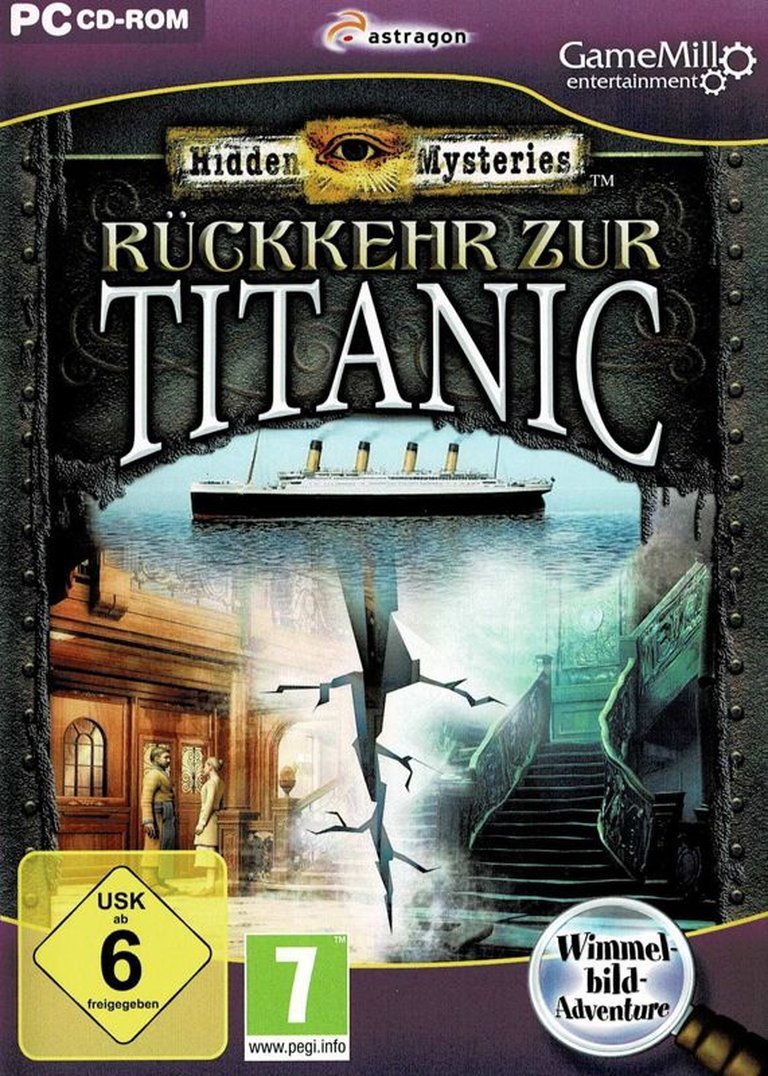
Hidden Mysteries: Return to Titanic is a hidden object adventure game where the player takes on the role of a journalist tasked with getting close to a member of the London aristocracy aboard the ill-fated Titanic. After the ship strikes an iceberg and sinks, the player’s ghost becomes trapped on the wrecked vessel alongside other spectral passengers, each haunted by past mistakes. To escape, the player must solve puzzles, complete hidden object scenes, and help these ghosts resolve their unfinished business by creating portals back in time. The game features a mix of hidden object challenges, mini-games, and inventory-based puzzles, all set against the eerie backdrop of the Titanic’s wreckage.
Gameplay Videos
Where to Buy Hidden Mysteries: Return to Titanic
PC
Hidden Mysteries: Return to Titanic Free Download
Hidden Mysteries: Return to Titanic Guides & Walkthroughs
Hidden Mysteries: Return to Titanic Reviews & Reception
gamezebo.com (50/100): Hidden Mysteries: Return to Titanic seems to hit a few icebergs of its own
Hidden Mysteries: Return to Titanic: A Haunting Voyage Through Time and Redemption
Introduction: A Ghostly Premise Adrift in the Wreckage of History
Hidden Mysteries: Return to Titanic (2012) is a hidden object adventure game that daringly treads the line between historical reverence and supernatural fiction. Developed by Gunnar Games and published by Game Mill Entertainment, the game invites players to step into the waterlogged shoes of a journalist-turned-ghost, trapped aboard the doomed RMS Titanic. Tasked with freeing the tormented souls of fellow passengers—and ultimately themselves—players must navigate the ship’s opulent past and its decaying present, solving puzzles and unraveling mysteries to rewrite fate itself.
At its core, Return to Titanic is a meditation on regret, redemption, and the fragility of human ambition. Yet, it is also a product of its time, reflecting the early 2010s boom in casual hidden object games (HOGs) and the industry’s occasional tendency to exploit historical tragedies for commercial gain. This review will dissect the game’s narrative ambitions, mechanical execution, and artistic choices, while also examining its place within the broader landscape of adventure gaming and the Hidden Mysteries series.
Development History & Context: Riding the Wave of a Centennial
The Studio and the Series
Gunnar Games, the developer behind Return to Titanic, was a prolific studio in the casual gaming space, specializing in hidden object and adventure titles. The Hidden Mysteries series, launched in 2008 with Hidden Mysteries: Buckingham Palace, quickly became a staple of the genre, blending real-world locations with fictional conspiracies. By 2012, the series had tackled everything from the JFK assassination (Hidden Mysteries: JFK Conspiracy) to the secrets of Notre Dame (Hidden Mysteries: Notre Dame – Secrets of Paris).
Return to Titanic was not the studio’s first foray into the ill-fated ship’s lore. In 2009, Gunnar Games released Hidden Mysteries: Titanic – Secrets of the Fateful Voyage, a prequel of sorts that focused on the ship’s maiden voyage. The 2012 sequel, however, took a bolder narrative leap by introducing time-travel and supernatural elements, capitalizing on the 100th anniversary of the Titanic’s sinking—a milestone that saw a resurgence of public fascination with the disaster.
Technological Constraints and Design Philosophy
Released exclusively for Windows (with a later Mac port), Return to Titanic was built using the technical frameworks common to casual games of the era. The game employs a fixed/flip-screen first-person perspective, a design choice that limits player movement to static scenes but allows for highly detailed, pre-rendered environments. This approach was practical for a small studio working within the constraints of budget and time, but it also resulted in a somewhat rigid exploration experience.
The gameplay loop revolves around hidden object scenes (HOS), inventory-based puzzles, and mini-games, all staples of the genre. The game’s engine supports a recharging hint system, a feature that had become standard in HOGs by the early 2010s, catering to casual players who might otherwise find themselves stuck. The art style leans toward illustrated realism, with hand-drawn backgrounds and 2D character sprites, a aesthetic that, while dated by modern standards, was serviceable for its time.
The Gaming Landscape of 2012
The early 2010s were a golden age for hidden object games, driven by digital distribution platforms like Big Fish Games, GameHouse, and WildTangent. These games thrived on accessibility, offering simple mechanics and engaging narratives that appealed to a broad audience. Titles like Mystery Case Files, Dark Parables, and Hidden Expedition dominated the market, often blending adventure elements with light puzzle-solving.
Return to Titanic entered this crowded field with a unique hook: time-traveling ghost storytelling. While other Titanic-themed games, such as Titanic: Adventure Out of Time (1996) and Hidden Expedition: Titanic (2006), had explored the ship’s history, none had attempted such a bold fusion of historical drama and supernatural redemption. However, this ambition was tempered by the game’s adherence to genre conventions, resulting in a title that was simultaneously innovative and formulaic.
Narrative & Thematic Deep Dive: A Tale of Souls and Second Chances
Plot Overview: From Journalism to the Afterlife
The game opens with the player assuming the role of an unnamed journalist (whose gender is left ambiguous, though the walkthrough refers to them as male) tasked with infiltrating the Titanic’s first-class passenger list under a false identity. The goal? To uncover the secrets of Robert Ashley, a mysterious member of the London aristocracy. Before the player can complete their mission, the Titanic strikes an iceberg, and the ship sinks, taking the protagonist—and most of its passengers—to a watery grave.
Upon awakening, the player finds themselves a ghost, trapped aboard the wreckage of the Titanic. They are greeted by a shadowy, smoke-like entity known only as the Overseer, who reveals that the player’s soul is bound to the ship due to their “questionable history in life.” To earn their freedom, the player must help other trapped spirits resolve their unfinished business by traveling through time portals that connect the wreckage (the “present”) to the ship’s final hours (the “past”).
Each of the game’s seven chapters focuses on freeing a different soul:
1. Diana, a young woman haunted by her brother’s death.
2. Janeck, a crew member whose negligence led to a tragic accident.
3. Montague, a wealthy passenger whose vanity caused him to miss his chance at survival.
4. Joseph, a stoker whose greed doomed him.
5. The Captain, whose pride blinded him to the dangers ahead.
6. The Player’s Own Soul, which requires confronting their past mistakes.
The narrative culminates in a final act of redemption, where the player must use the lessons learned from helping others to secure their own escape.
Themes: Guilt, Redemption, and the Weight of History
Return to Titanic is, at its heart, a story about regret and absolution. Each ghost the player encounters is trapped by a moral failing—pride, greed, negligence, vanity—that they must confront before moving on. The game’s central thesis is that redemption is earned through service, a theme reinforced by the player’s journey from self-interest (their initial mission to spy on Robert Ashley) to self-sacrifice (helping others find peace).
The Titanic itself serves as a powerful metaphor for human hubris. The “unsinkable” ship, a symbol of early 20th-century technological arrogance, becomes a purgatorial prison for those who failed to heed its warnings. The game’s time-travel mechanic further emphasizes this idea, as players are forced to relive the ship’s final moments, attempting to rewrite history in small, personal ways—though the larger tragedy remains unchanged.
However, the game’s treatment of its historical setting is uneven. While it captures the opulence of the Titanic’s first-class accommodations and the desperation of its final hours, it also takes significant creative liberties. The supernatural elements, while compelling from a narrative standpoint, occasionally feel disrespectful to the real-life victims of the disaster. The game’s decision to frame the Titanic as a haunted playground for ghostly redemption risks trivializing the very real human suffering that occurred.
Characters and Dialogue: Spectral Archetypes
The characters in Return to Titanic are largely archetypal, serving as vessels for the game’s themes rather than fully fleshed-out individuals. Here’s a breakdown of the key figures:
- The Player (Journalist): A morally ambiguous protagonist whose past sins are only hinted at. Their lack of a defined backstory makes them a blank slate, allowing players to project themselves into the role.
- The Overseer: A cryptic, smoke-like entity who acts as the game’s narrator and gatekeeper. His dialogue is poetic but vague, offering more atmosphere than substance.
- Robert Ashley: The initial target of the player’s investigation, Robert is a mysterious aristocrat whose true nature is never fully explored. His role in the story is underdeveloped, making his significance feel unearned.
- The Ghosts (Diana, Janeck, Montague, etc.): Each ghost represents a different sin or regret. Their stories are tragic but predictable, following a formula of “reveal the sin → resolve the sin → move on.”
The dialogue in Return to Titanic is functional but unremarkable. Most interactions are brief, serving to advance the plot or provide puzzle hints rather than deepen character relationships. The game’s lack of voice acting (a common limitation in casual HOGs of the era) further flattens the emotional impact of these exchanges.
Narrative Strengths and Weaknesses
Strengths:
– Thematic Cohesion: The game’s focus on redemption and the cyclical nature of regret is consistently executed, giving the story a sense of purpose.
– Atmospheric Storytelling: The dual timelines (past and present) create a haunting juxtaposition between the Titanic’s former grandeur and its current decay.
– Player Agency: While the overarching narrative is linear, the ability to rewrite small moments in time gives players a sense of influence over the story.
Weaknesses:
– Underdeveloped Characters: The ghosts and supporting cast lack depth, making their emotional arcs feel superficial.
– Historical Liberties: The game’s supernatural premise clashes with the real-world tragedy of the Titanic, occasionally undermining its own gravitas.
– Pacing Issues: The story’s slow start (the first chapter is largely tutorial-based) and repetitive structure (free one ghost, rinse, repeat) can make the narrative feel dragging.
Gameplay Mechanics & Systems: A Casual Adventure with Hidden Depths
Core Gameplay Loop: Find, Solve, Repeat
Return to Titanic adheres closely to the hidden object adventure (HOA) formula, blending three primary mechanics:
1. Hidden Object Scenes (HOS): Players search cluttered environments for items listed at the bottom of the screen. These scenes are randomized, meaning item placements vary between playthroughs.
2. Inventory Puzzles: Collected items are used to solve environmental puzzles (e.g., using a crowbar to pry open a crate).
3. Mini-Games: These range from logic puzzles (e.g., rearranging paintings, setting clocks) to physical challenges (e.g., chopping wood, catching fish).
The game’s structure is chapter-based, with each chapter focusing on freeing a different ghost. Progress is gated by puzzle completion, ensuring players cannot advance until they’ve resolved the current objective.
Hidden Object Scenes: A Mixed Bag
The HOS in Return to Titanic are competently designed but unexceptional. Items are visually distinct from their backgrounds, making them relatively easy to spot—a design choice that caters to casual players but may frustrate those seeking a challenge. The randomized item placement adds replayability, but the scenes themselves are static and repetitive, with little variation in setting or theme.
The hint system is a double-edged sword. While it recharges slowly, it is unlimited, ensuring players are never permanently stuck. However, the lack of penalty for overuse removes any tension from the HOS, making them feel like chores rather than engaging challenges.
Inventory and Puzzle Design: Logic with Limitations
The inventory system is intuitive, with items stored in a journal that also doubles as a quest log and map. Players can combine items (e.g., attaching a rope to a hook) or use them in context-sensitive ways (e.g., using a lighter to start a fire).
The puzzles themselves are varied but inconsistent in quality:
– Logic Puzzles (e.g., the clock-setting mini-game in Chapter 3) are well-designed, requiring players to think critically about cause and effect.
– Physical Puzzles (e.g., chopping wood, catching fish) are simplistic, often devolving into repetitive clicking.
– Sliding Tile Puzzles (e.g., the medallion puzzle in Chapter 3) are overused, appearing in multiple chapters with only minor variations.
One of the game’s most innovative mechanics is the time-traveling portal system, which allows players to switch between the past and present to solve puzzles. For example:
– In Chapter 2, players must retrieve a golf club from the past to use it in the present.
– In Chapter 4, they must chop ice in the present to access a frozen compartment in the past.
This mechanic is brilliantly executed, adding a layer of strategic depth to the gameplay. However, it is underutilized, with only a handful of puzzles truly leveraging the dual-timeline concept.
Mini-Games: Hit or Miss
The mini-games in Return to Titanic are a mixed bag:
– Highlights:
– The dartboard puzzle (Chapter 4), which requires players to aim and throw darts to reveal a hidden compartment.
– The luggage-packing puzzle (Chapter 4), a Tetris-like challenge that tests spatial reasoning.
– The pool table puzzle (Chapter 7), a physics-based mini-game where players must sink all 15 pool balls.
– Lowlights:
– The repeated sliding tile puzzles, which grow tedious due to their frequency.
– The clock-setting puzzle (Chapter 3), which is overly complex and poorly explained.
The lack of a skip button for mini-games (except after a lengthy cooldown) is a significant flaw, particularly for players who struggle with spatial reasoning puzzles.
User Interface and Navigation: Functional but Flawed
The UI in Return to Titanic is clean and functional, with a journal that tracks objectives, a map for navigation, and an inventory for item management. However, it suffers from several design oversights:
– No Voice Acting: The absence of spoken dialogue makes the game feel sterile, particularly in emotional moments.
– Clunky Navigation: Moving between scenes requires multiple clicks, and the lack of a “back” button forces players to manually retrace their steps.
– Poor Feedback: Some interactive objects lack visual cues, making it unclear what can be clicked or examined.
The blueprint map is a useful tool, allowing players to jump between locations without backtracking. However, it is not always clear which areas are accessible, leading to unnecessary confusion.
Innovation and Flaws
Innovative Elements:
– Time-Traveling Puzzles: The dual-timeline mechanic is the game’s standout feature, offering a fresh twist on the HOA formula.
– Thematic Integration: The puzzles are tightly tied to the narrative, with each ghost’s redemption arc informing the challenges players face.
Flawed Systems:
– Repetitive HOS: The lack of variety in hidden object scenes makes them feel grindy.
– Unbalanced Difficulty: Some puzzles are trivially easy, while others are frustratingly obscure.
– Technical Issues: The game suffers from graphical glitches (e.g., pixelated edges, misaligned textures) and occasional bugs (e.g., items not registering when clicked).
World-Building, Art & Sound: A Ship of Dreams and Nightmares
Setting and Atmosphere: The Titanic as Character
Return to Titanic excels in world-building, transforming the RMS Titanic into a living, breathing character. The game’s dual timelines create a stark contrast between the ship’s past glory and its present decay:
– The Past (Flashback): The Titanic is opulent and vibrant, with gleaming wood paneling, luxurious furnishings, and elegant passengers. The first-class accommodations (e.g., the Grand Staircase, the Smoking Lounge) are rendered in rich detail, capturing the Edwardian splendor of the era.
– The Present (Underwater): The wreckage is dark and foreboding, with rusted metal, broken glass, and swirling debris. The ghostly apparitions of past passengers linger in the shadows, their flickering forms adding to the haunting atmosphere.
The game’s fixed-screen perspective enhances this dichotomy, as players are forced to linger in each scene, absorbing the weight of history in both timelines.
Visual Design: Illustrated Realism with Flaws
The art style in Return to Titanic is illustrated realism, a common approach in casual HOGs of the era. The pre-rendered backgrounds are highly detailed, with hand-drawn textures and subtle animations (e.g., floating debris, flickering lights) that bring the environments to life.
However, the visuals are not without flaws:
– Character Models: The 2D sprites for characters are stiff and expressionless, lacking the emotional range needed for a story about redemption.
– Graphical Glitches: The game suffers from pixelated edges, misaligned textures, and occasional tearing, particularly in transition scenes.
– Repetitive Assets: Some environments (e.g., corridors, cabins) are reused frequently, breaking the immersion.
Despite these issues, the game’s art direction is effective, particularly in its use of lighting and color:
– Past Scenes: Bathed in warm golds and blues, evoking the elegance of the Edwardian era.
– Present Scenes: Dominated by cold greens and grays, emphasizing the decay and despair of the wreckage.
Sound Design: Silence and Echoes
The sound design in Return to Titanic is minimalist but atmospheric:
– Ambient Noise: The creaking of the ship, the distant echoes of ghostly whispers, and the murmur of the ocean create a haunting soundscape that immerses players in the Titanic’s eerie atmosphere.
– Music: Composed by Joe Abbati, the score is subtle and melancholic, with piano-driven melodies that evoke nostalgia and sorrow. The lack of a dynamic soundtrack (music does not change based on player actions) is a missed opportunity, but the existing tracks are well-suited to the game’s tone.
– Sound Effects: The clinking of items, the splashing of water, and the ghostly wails of trapped souls add depth to the environments.
The absence of voice acting is the sound design’s biggest weakness. While text-based dialogue is serviceable, the lack of vocal performances makes emotional moments feel flat and unengaging.
Contribution to the Experience
The art and sound design in Return to Titanic work in tandem to create a mood of melancholy and mystery. The visual contrast between past and present, combined with the haunting ambient sounds, ensures that the Titanic feels like a character in its own right—a once-grand vessel now reduced to a purgatorial prison.
However, the technical limitations of the era (e.g., low-resolution textures, lack of voice acting) prevent the game from achieving true immersion. While the atmosphere is strong, the execution is uneven, leaving players with a mixed impression of the game’s artistic merits.
Reception & Legacy: A Forgotten Voyage
Critical Reception: A Lukewarm Response
Hidden Mysteries: Return to Titanic received mixed reviews upon its release in September 2012. Critics praised its ambitious narrative and innovative time-travel mechanics but criticized its repetitive gameplay, technical flaws, and superficial treatment of history.
- Gamezebo (50/100): The review highlighted the game’s creative liberties with the Titanic’s history, calling it a “cash-in” on the 100th anniversary of the disaster. The critic noted that while the time-travel mechanic was promising, the execution was flawed, with glitches and unpolished puzzles detracting from the experience.
- Adventure Gamers: The site acknowledged the game’s atmospheric strengths but criticized its lack of voice acting and underdeveloped characters.
- Metacritic: The game has no critic reviews listed, suggesting it was largely overlooked by major gaming outlets.
Player reception was similarly divided:
– Positive Feedback: Fans of the Hidden Mysteries series appreciated the dual-timeline concept and the haunting atmosphere. Many praised the puzzle variety and the satisfaction of freeing each ghost.
– Negative Feedback: Critics among the player base cited the repetitive HOS, unbalanced difficulty, and technical issues as major drawbacks. Some also expressed discomfort with the game’s supernatural take on a real-life tragedy.
Commercial Performance: A Niche Success
Return to Titanic was not a commercial blockbuster, but it found a steady audience within the casual gaming market. The game was bundled in several collections, including:
– Hidden Mysteries: Coffret 4 Jeux (2015)
– Hidden Mysteries: Return to Titanic – 100th Anniversary Deluxe Edition (2012), which included the original Hidden Mysteries: Titanic – Secrets of the Fateful Voyage as a bonus.
The game’s digital distribution (via platforms like Big Fish Games, GameHouse, and WildTangent) ensured it remained accessible to casual players, though it never achieved the mainstream recognition of titles like Mystery Case Files or Dark Parables.
Legacy and Influence: A Footnote in HOG History
Return to Titanic occupies a unique but minor place in the history of hidden object games. Its time-traveling ghost story was innovative for the genre, but its execution was hampered by technical limitations and narrative shortcomings.
The game’s biggest contribution to the Hidden Mysteries series was its willingness to experiment with non-linear storytelling and dual-timeline puzzles. Later entries in the series (e.g., Hidden Mysteries: Salem Secrets, Hidden Mysteries: Vampire Secrets) would continue to blend historical settings with supernatural intrigue, though none would attempt anything as ambitious as Return to Titanic’s ghostly redemption arc.
In the broader adventure gaming landscape, Return to Titanic is largely forgotten, overshadowed by more polished or innovative titles. However, it remains a cult favorite among fans of narrative-driven HOGs, particularly those who appreciate its atmospheric storytelling and thematic depth.
Conclusion: A Flawed but Fascinating Journey
Hidden Mysteries: Return to Titanic is a game of contradictions. It is ambitious in its narrative scope but limited in its execution. It is hauntingly atmospheric but technically flawed. It is respectful of history in its setting but disrespectful in its supernatural liberties.
Final Verdict: 6.5/10 – A Noble Failure with Moments of Brilliance
Strengths:
✅ Innovative Time-Travel Mechanics: The dual-timeline puzzles are the game’s standout feature, offering a fresh twist on the HOG formula.
✅ Strong Atmosphere: The contrast between past and present creates a powerful sense of melancholy that lingers long after the game ends.
✅ Thematic Depth: The focus on redemption and regret gives the story a sense of purpose that elevates it above typical casual fare.
Weaknesses:
❌ Repetitive Gameplay: The hidden object scenes and sliding tile puzzles grow tedious due to lack of variety.
❌ Technical Issues: Graphical glitches, misaligned textures, and clunky navigation detract from the experience.
❌ Underdeveloped Characters: The ghosts and supporting cast lack depth, making their emotional arcs feel superficial.
Who Should Play It?
– Fans of Narrative-Driven HOGs: If you enjoy story-rich hidden object games with atmospheric settings, Return to Titanic is worth a look.
– History Buffs (with Caveats): Those fascinated by the Titanic’s legacy may appreciate the game’s attention to detail, though they should be prepared for supernatural liberties.
– Casual Players: The recharging hint system and unlimited skips make it accessible, but the repetitive puzzles may test patience.
Who Should Avoid It?
– Purists: If you’re looking for a historically accurate or respectful portrayal of the Titanic, this game is not for you.
– Puzzle Enthusiasts: The lack of variety in mini-games and unbalanced difficulty may frustrate those seeking deep challenge.
– Voice Acting Aficionados: The absence of spoken dialogue makes the story feel sterile at times.
Final Thoughts:
Hidden Mysteries: Return to Titanic is not a masterpiece, but it is far from a disaster. It is a flawed gem—a game that dares to dream big but stumbles in execution. For those willing to overlook its rough edges, it offers a hauntingly beautiful journey through time, regret, and redemption. For others, it will remain another forgotten casual game, lost in the wreckage of gaming history.
Rating Breakdown:
– Narrative & Themes: 7/10
– Gameplay & Mechanics: 6/10
– Art & Sound: 7/10
– Reception & Legacy: 5/10
– Overall: 6.5/10 – “A Noble Failure”
Hidden Mysteries: Return to Titanic is not the definitive Titanic game, but it is a fascinating experiment—one that deserves to be remembered, if only as a cautionary tale of ambition unfulfilled.