
- Release Year: 2011
- Platforms: PlayStation 3, Windows, Xbox 360
- Publisher: dtp entertainment AG
- Developer: FAKT Software GmbH
- Genre: Puzzle, Rube Goldberg machine
- Perspective: Side view
- Game Mode: Single-player
- Gameplay: Editor, Machine building, Physics-based, Puzzle-solving
- Average Score: 75/100
Description
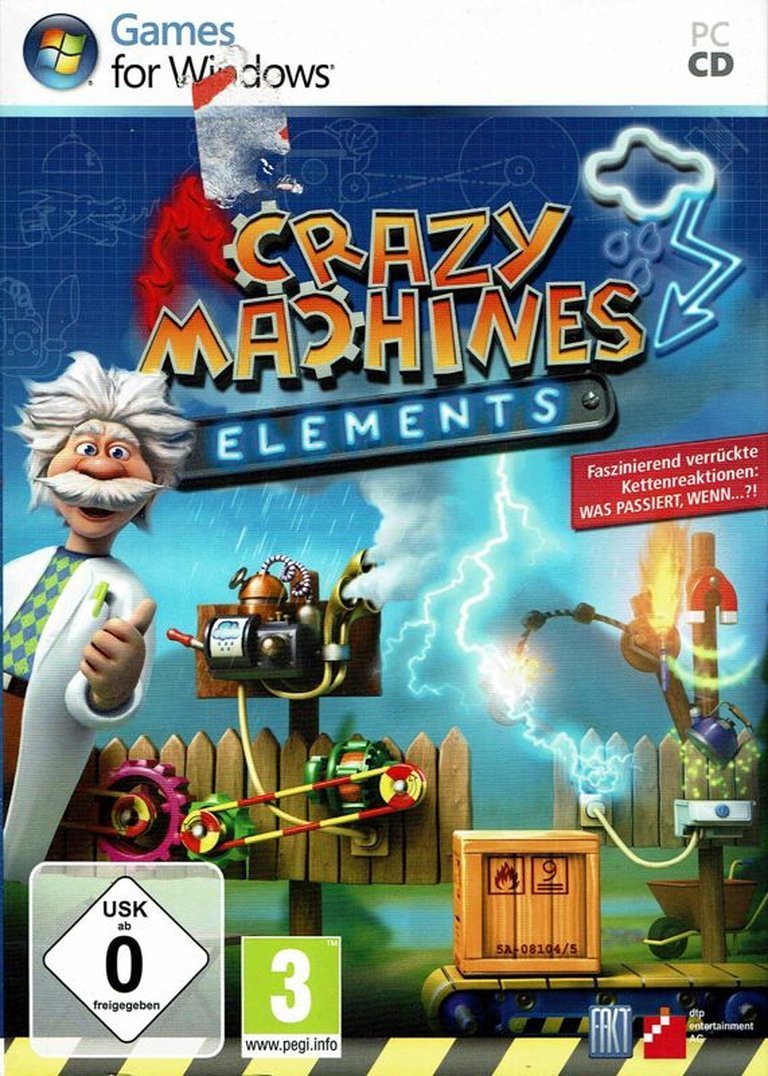
Crazy Machines: Elements is a puzzle game where players solve over 100 physics-based challenges by constructing Rube Goldberg-style machines using various components like flame throwers and windmills. The goal is to complete incomplete experiments, such as blasting a vase with nitroglycerine, while also collecting golden cogwheels for extra challenges. The game features an editor for creating custom puzzles and emphasizes creative problem-solving with limited resources.
Gameplay Videos
Where to Buy Crazy Machines: Elements
PC
Crazy Machines: Elements Cracks & Fixes
Crazy Machines: Elements Guides & Walkthroughs
Crazy Machines: Elements Reviews & Reception
metacritic.com (75/100): There’s a ton of content here, and the various challenges are a blast to figure out.
gamerevolution.com : Crazy Machines Elements is nothing to scoff at in terms of its challenge and value.
Crazy Machines: Elements: A Comprehensive Retrospective
Introduction: The Legacy of a Puzzle Classic
Crazy Machines: Elements (2011) is a puzzle game that embodies the spirit of Rube Goldberg machines—elaborate contraptions designed to perform simple tasks through convoluted chain reactions. Developed by FAKT Software and published by DTP Entertainment, it is the third major entry in the Crazy Machines series, following Crazy Machines (2010) and preceding Crazy Machines 3 (2016). The game tasks players with solving over 100 physics-based puzzles by assembling machines from a vast array of components, including ramps, springs, steam engines, and elemental tools like flamethrowers and windmills.
At its core, Crazy Machines: Elements is a celebration of creativity and problem-solving, blending the satisfaction of engineering with the whimsy of cartoonish experimentation. However, its reception was mixed, with critics praising its depth and charm while lamenting its clunky controls, slow pacing, and lack of innovation. This review will dissect the game’s development, mechanics, artistic direction, and legacy, offering a definitive analysis of its place in the puzzle genre.
Development History & Context
The Studio and Vision
FAKT Software, a German developer known for its work on the Crazy Machines series, sought to refine the formula established by its predecessors while introducing new elements (literally and figuratively). The game was built using NVIDIA’s PhysX engine, which allowed for realistic simulations of physics, including fire propagation, electrical conductivity, and fluid dynamics. This technological backbone was crucial in differentiating Elements from earlier entries, as it enabled more dynamic interactions between objects and environmental factors like wind and rain.
The game’s director, Bodo Pfeifer, and lead designer Sabrina Meyer aimed to create a title that appealed to both casual players and hardcore puzzle enthusiasts. The inclusion of elemental mechanics (fire, water, ice, wind, and electricity) was a deliberate attempt to add complexity and variety to the puzzles, ensuring that players would need to think beyond mere mechanical interactions.
The Gaming Landscape of 2011
Released in March 2011 for Windows and later ported to Xbox 360 (August 2011) and PlayStation 3 (2012), Crazy Machines: Elements entered a market saturated with physics-based puzzle games. Titles like Angry Birds (2009) and Fruit Ninja (2010) had popularized the genre on mobile platforms, while console and PC audiences were familiar with franchises like Portal (2007) and The Incredible Machine (1992). Elements had to carve out its niche by offering something distinct: a sandbox-like experience with a strong emphasis on user creativity and elemental interactions.
However, the game’s console ports faced criticism for their control schemes, which were ill-suited to the precision required for puzzle-solving. The lack of a fast-forward feature and the absence of online sharing for user-created levels further hindered its appeal, particularly on platforms like Xbox Live Arcade and PlayStation Network, where digital distribution was becoming increasingly competitive.
Narrative & Thematic Deep Dive
Plot and Characters
Crazy Machines: Elements is not a narrative-driven game. There is no overarching story or character development. Instead, the game presents players with a series of abstract challenges, each framed as an experiment conducted in a mad scientist’s laboratory. The only recurring character is a caricatured Einstein-like figure who occasionally offers hints during loading screens, but his presence is purely decorative.
The thematic focus is on experimentation and discovery. Each puzzle is a self-contained vignette, often with humorous or absurd objectives (e.g., cooking a hot dog, popping a balloon, or blasting a vase with nitroglycerin). The game’s charm lies in its embrace of the absurd, encouraging players to approach problems with a playful, inventive mindset.
Underlying Themes
- Creativity and Problem-Solving: The game celebrates the joy of tinkering, rewarding players for thinking outside the box. The optional golden cogwheels scattered throughout levels serve as incentives for exploring unconventional solutions.
- The Beauty of Complexity: Crazy Machines: Elements revels in the idea that simple tasks can be accomplished through ridiculously complex means. This theme is central to the Rube Goldberg aesthetic, which the game faithfully recreates.
- Elemental Mastery: The introduction of fire, water, ice, wind, and electricity as interactive elements adds a layer of depth, forcing players to consider how these forces can be harnessed or mitigated to achieve their goals.
Gameplay Mechanics & Systems
Core Gameplay Loop
The gameplay in Crazy Machines: Elements revolves around assembling machines to complete specific objectives. Players are given a toolbox of components for each puzzle and must place them strategically to create a functional chain reaction. The steps are as follows:
1. Objective Briefing: The player is presented with a goal (e.g., “Pop the balloon”).
2. Component Selection: A limited set of parts is provided, ranging from basic ramps and gears to advanced tools like flamethrowers and tesla coils.
3. Assembly: The player drags and rotates components into place, testing their configuration as they go.
4. Execution: Once satisfied, the player activates the machine and watches the chain reaction unfold.
5. Evaluation: Success is rewarded with points and a bronze, silver, or gold lug nut, depending on efficiency. Optional objectives (e.g., collecting golden cogwheels) can yield additional rewards.
Innovations and Flaws
Strengths:
– Elemental Integration: The use of fire, water, and other elements adds a refreshing twist to the traditional Rube Goldberg formula. For example, players might need to use a flamethrower to melt ice blocking a path or harness wind to propel an object.
– Challenge Mode: This mode tasks players with solving puzzles using the fewest components possible, adding a layer of strategic depth.
– Editor Mode: The inclusion of a level editor allows for near-limitless creativity, though its potential is hampered by the lack of online sharing.
Weaknesses:
– Precision Issues: The game’s controls, particularly on consoles, are clunky. Placing objects with the precision required for success is often frustrating, especially when a component is just a pixel off from its intended position.
– Slow Pacing: The early puzzles serve as an extended tutorial, and the game takes too long to introduce its most interesting mechanics. This gradual ramp-up can feel tedious for experienced players.
– Lack of Freedom: Many puzzles have a single “correct” solution, punishing creativity. The scoring system favors the developer’s intended approach, which can feel restrictive.
– No Online Features: The inability to share user-created levels online severely limits the editor’s appeal, particularly in an era where community-driven content was becoming a staple of puzzle games.
UI and Accessibility
The user interface is functional but unremarkable. The inventory system is straightforward, but the lack of a fast-forward button during machine execution is a notable oversight. Watching a slow-moving contraption play out can test the player’s patience, especially in later levels where trial and error are frequent.
World-Building, Art & Sound
Visual Direction
Crazy Machines: Elements adopts a bright, cartoonish aesthetic that complements its whimsical tone. The environments are varied, ranging from rainy backyards to foggy streets, each rendered with a soft, almost painterly quality. The art style is reminiscent of classic children’s science shows, evoking a sense of nostalgia while remaining visually distinct.
The machine components are detailed and animated with a satisfying level of polish. Gears turn smoothly, flames flicker realistically, and water flows dynamically, thanks to the PhysX engine. However, the game’s visuals are not without their flaws. Some objects can blend into the background, making them difficult to spot, and the camera angles are occasionally unhelpful, obscuring critical parts of the machine.
Sound Design and Music
The soundtrack, composed by Markus Schmidt and produced by Dynamedion, is a standout feature. The music is soothing and atmospheric, with tracks tailored to each environment. Beach levels feature the gentle lapping of waves and acoustic guitar melodies, while urban settings are accompanied by more upbeat, jazzy tunes. The sound design enhances the game’s relaxed, cerebral mood, making it a pleasure to listen to even during repeated attempts at a puzzle.
Sound effects are equally well-crafted, with each component emitting distinct noises that contribute to the machine’s auditory feedback. The clanking of gears, the hiss of steam, and the crackle of fire all combine to create a satisfying sensory experience.
Reception & Legacy
Critical Reception
Crazy Machines: Elements received “mixed or average” reviews across all platforms, according to Metacritic:
– PC: 63/100
– PlayStation 3: 62/100
– Xbox 360: 55/100
Critics praised the game’s depth, creativity, and relaxing atmosphere but criticized its controls, pacing, and lack of innovation. GameStar (73%) commended its engaging puzzles but noted the absence of helpful features for beginners. Destructoid (70%) highlighted the satisfaction of solving puzzles but acknowledged the genre’s stagnation. Eurogamer (40%) was far less forgiving, calling it a “step into a murky past best forgotten.”
Player reception was slightly more favorable, with an average score of 3.7/5 on MobyGames. Many players appreciated the game’s charm and creativity but echoed critics’ frustrations with its technical limitations.
Legacy and Influence
Despite its mixed reception, Crazy Machines: Elements holds a special place in the hearts of puzzle enthusiasts. It is one of the few modern games to faithfully recreate the Rube Goldberg experience, offering a level of complexity and creativity rarely seen in contemporary puzzle titles. Its emphasis on elemental interactions and physics-based problem-solving has influenced later entries in the series, including Crazy Machines 3 (2016) and Crazy Machines VR (2018).
However, the game’s flaws—particularly its clunky controls and lack of online features—have prevented it from achieving the same level of acclaim as its spiritual predecessor, The Incredible Machine. In hindsight, Crazy Machines: Elements serves as a reminder of the challenges of adapting a precision-driven genre to console platforms and the importance of community features in extending a game’s lifespan.
Conclusion: A Flawed but Charming Puzzle Experience
Crazy Machines: Elements is a game of contradictions. It is simultaneously brilliant and frustrating, creative and restrictive, charming and clunky. Its greatest strength lies in its celebration of the Rube Goldberg aesthetic, offering players a sandbox in which to indulge their inner mad scientist. The elemental mechanics and PhysX-powered interactions add depth and variety, ensuring that no two puzzles feel alike.
Yet, the game is held back by its technical limitations. The controls, particularly on consoles, are ill-suited to the precision required for success, and the lack of online sharing for user-created levels is a missed opportunity. The slow pacing and restrictive scoring system further detract from the experience, making it difficult to recommend unreservedly.
Final Verdict: 7/10 – A Niche Classic with Notable Flaws
Crazy Machines: Elements is a game best enjoyed by patient, creative players who are willing to overlook its rough edges. It is not a perfect puzzle game, but it is a unique one, offering a level of depth and charm that is rare in the genre. For fans of Rube Goldberg machines and physics-based puzzles, it remains a worthwhile experience—just be prepared to endure some frustration along the way.
In the grand tapestry of puzzle games, Crazy Machines: Elements stands as a testament to the enduring appeal of creative problem-solving. It may not have achieved the critical or commercial success of its contemporaries, but it has earned its place as a cult classic—a game that rewards persistence, ingenuity, and a willingness to embrace the absurd.