
- Release Year: 2004
- Platforms: Windows
- Publisher: Wargaming.net, Inc.
- Developer: Wargaming.net, Inc.
- Genre: Strategy, Tactics
- Perspective: Top-down
- Game Mode: Online PVP, Single-player
- Gameplay: Resource Management, Territory control, Turn-based combat
- Setting: Futuristic, Sci-fi
- Average Score: 80/100
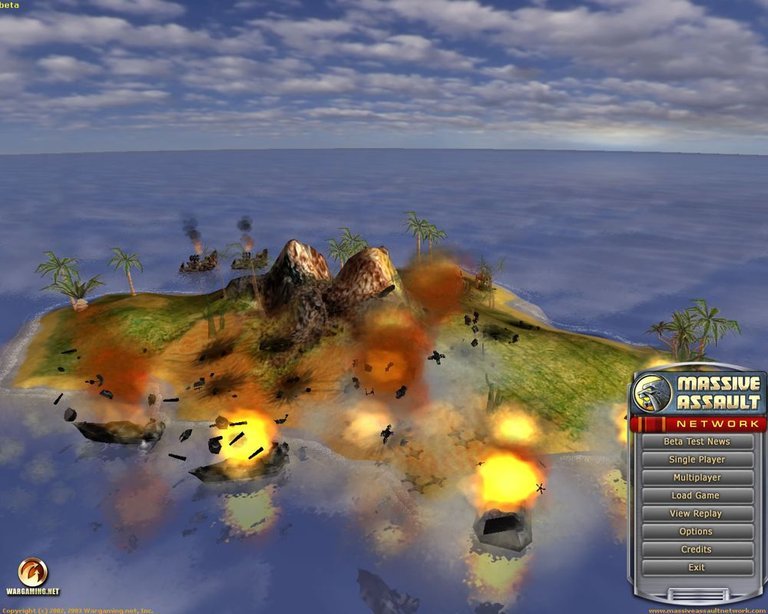
Description
Massive Assault Network is a turn-based multiplayer strategy game set in a futuristic sci-fi universe, where players engage in a large-scale war between the Free Nations Union and the Phantom League across multiple planets. Players choose a faction and compete in deathmatches to conquer regions on a map, using a variety of land, water, and air units. The game features a play-by-mail style system, allowing players up to a week to make their moves, and includes a scaled-down single-player mode with tutorials and AI battles. Points earned from conquered regions are used to purchase additional units, adding a strategic layer to the gameplay.
Gameplay Videos
Where to Buy Massive Assault Network
PC
Massive Assault Network Patches & Updates
Massive Assault Network Mods
Massive Assault Network Guides & Walkthroughs
Massive Assault Network Reviews & Reception
metacritic.com (85/100): Through MA and MAN, Wargaming.net has managed to revitalize the good old TBS genre.
gamespot.com : Massive Assault Network isn’t so much a step forward as it is a step sideways–or even backward.
mobygames.com (76/100): A turn-based multiplayer game and strongly based on its predecessor Massive Assault.
Massive Assault Network: A Strategic Deep Dive into a Forgotten Gem
Introduction
In the annals of turn-based strategy games, few titles have sparked as much debate and divided opinion as Massive Assault Network (2004). Developed by Wargaming.net, this game emerged as a multiplayer-focused iteration of its predecessor, Massive Assault (2003), stripping away much of the single-player content to hone in on asynchronous online warfare. While it may not have achieved the mainstream acclaim of contemporaries like Civilization or Advance Wars, Massive Assault Network carved out a niche for itself, offering a unique blend of tactical depth, strategic nuance, and a distinctive “secret allies” mechanic that set it apart from the crowd.
This review aims to dissect Massive Assault Network in exhaustive detail, exploring its development history, narrative context, gameplay mechanics, and lasting legacy. By drawing from a wealth of sources—including critical reviews, developer retrospectives, and community discussions—we will uncover why this game remains a fascinating artifact of early 2000s strategy gaming, despite its flaws and controversies.
Development History & Context
The Rise of Wargaming.net
Massive Assault Network was developed by Wargaming.net, a Belarusian studio that would later achieve global fame with World of Tanks. In the early 2000s, however, Wargaming was a fledgling company seeking to make its mark in the strategy genre. The original Massive Assault (2003) was their first major release, a turn-based wargame that blended 3D graphics with hex-based mechanics reminiscent of classic tabletop games. It was well-received for its accessibility and strategic depth, though criticized for its punishing AI and lack of balance in some scenarios.
The development of Massive Assault was a tumultuous process, as detailed in Wargaming’s retrospective. The team struggled with technical limitations, including a rudimentary AI that initially crashed after a few moves and a server infrastructure that was prone to instability. Early prototypes featured crude, boxy vehicle models and barren landscapes, but after extensive testing and community feedback, the game evolved into a more polished product. The addition of flora and fauna, despite initial resistance from programmers, transformed the game’s aesthetic, making its planets feel alive rather than desolate.
The Shift to Multiplayer
Massive Assault Network was conceived as a multiplayer-focused sequel, capitalizing on the growing popularity of online gaming in the mid-2000s. Released in April 2004, it retained the core mechanics of its predecessor but stripped away much of the single-player content, reducing it to a tutorial and AI skirmishes. The game’s primary innovation was its asynchronous multiplayer mode, which allowed players to take turns over the course of days or even weeks, similar to play-by-mail games of old.
This shift was not without controversy. Many critics and players questioned the decision to charge for what was essentially a multiplayer expansion of the original game. However, Wargaming justified this by offering a free trial version and providing three months of free access to owners of the original Massive Assault. The game’s business model was ahead of its time, featuring a monthly subscription fee of $6.95, which granted access to additional maps, naval units, and online tournaments.
Technological Constraints
The early 2000s were a period of rapid technological advancement, but Massive Assault Network was constrained by the hardware of its era. The game’s 3D engine, while functional, was not cutting-edge, and its visuals were often described as “generic” or “anonymous.” The lack of dynamic weather effects, destructible environments, and advanced lighting limited its immersive potential. However, the game’s clean, functional aesthetic served its purpose, ensuring that unit types and terrain features were easily distinguishable—a critical factor in a strategy game where clarity is paramount.
The game’s network infrastructure was another challenge. Asynchronous play required a robust server system to handle turn submissions and matchmaking, and early iterations of the game suffered from instability. Wargaming’s retrospective highlights the difficulties of managing a global player base with varying internet speeds and connection reliability. Despite these hurdles, the team succeeded in creating a stable platform that allowed players to engage in long-term strategic battles.
Narrative & Thematic Deep Dive
The Conflict: Free Nations Union vs. Phantom League
Massive Assault Network is set in a distant future where two factions, the Free Nations Union (FNU) and the Phantom League, are locked in a galactic struggle for dominance. The FNU is portrayed as a noble, UN-like alliance of democratic nations, while the Phantom League is a shadowy conglomerate of military organizations and corporations operating in secrecy. This binary conflict is a classic trope of sci-fi strategy games, drawing parallels to StarCraft‘s Terrans vs. Zerg or Command & Conquer‘s GDI vs. Nod.
However, Massive Assault Network does little to develop this narrative beyond a superficial framework. The game’s story is largely confined to its manual and promotional materials, with no in-game cutscenes, dialogue, or branching narratives. Each match is a self-contained deathmatch, with no overarching campaign or persistent world. This lack of narrative depth was a common criticism, with reviewers noting that the game’s setting felt “utterly anonymous and generic.”
Thematic Depth: Secret Allies and Geopolitical Strategy
Where Massive Assault Network excels is in its thematic exploration of geopolitical strategy. The game’s defining mechanic is its “secret allies” system, which adds a layer of unpredictability and psychological warfare to each match. At the start of a game, players select their starting territories from a pool of options, but not all allies are disclosed immediately. Some regions are marked as “Undisclosed Ally,” “Disclosed Ally,” or “True Neutral,” and the gradual revelation of these alliances can dramatically shift the balance of power.
This mechanic forces players to think beyond immediate tactical concerns and consider the long-term strategic implications of their actions. Do you commit forces to a seemingly neutral region, risking over-extension if it turns out to be an enemy stronghold? Or do you play it safe, allowing your opponent to seize the initiative? The secret allies system transforms Massive Assault Network from a straightforward wargame into a battle of wits, where deception and misdirection are as important as firepower.
Characters and Dialogue
Massive Assault Network features minimal character development, with no named protagonists or antagonists. The only voice acting in the game is provided by Natalia Schiuka, who delivers lines with a heavy Eastern European accent. While her performance is serviceable, the limited dialogue and repetitive phrases (“win” pronounced as “ween,” “enemy” as “enema”) detract from the game’s immersion. Critics frequently cited the voice acting as a weak point, with GameSpot noting that it “ruins the mood in a hurry.”
The lack of character-driven storytelling is a deliberate choice, reflecting the game’s focus on pure strategy. However, this absence of narrative personality makes Massive Assault Network feel cold and mechanical compared to contemporaries like Homeworld or Sid Meier’s Alpha Centauri, which wove rich storytelling into their strategic frameworks.
Gameplay Mechanics & Systems
Core Gameplay Loop
At its heart, Massive Assault Network is a turn-based strategy game where two players compete to conquer all regions on a hex-based map. Each match begins with players selecting their starting territories, which include a mix of disclosed and undisclosed allies. The goal is to capture neutral regions, reveal secret allies, and ultimately dominate the entire map.
The gameplay loop is straightforward but deeply strategic:
1. Movement Phase: Players move their units across the hex grid, with each unit type having specific movement ranges and restrictions.
2. Combat Phase: Units engage in combat, with outcomes determined by unit stats, terrain bonuses, and positional advantages.
3. Resource Phase: After each turn, players earn points based on the number of regions they control. These points are used to purchase new units or reinforce existing ones.
4. Reinforcement Phase: Players deploy new units or upgrade existing forces, preparing for the next turn.
This loop is repeated until one player achieves total dominance or the other concedes. The asynchronous nature of the game means that players can take up to a week to make their moves, allowing for careful deliberation and long-term planning.
Unit Diversity and Combat
Massive Assault Network features 13 distinct unit types, divided into ground, air, sea, and amphibious categories. Each unit has unique strengths and weaknesses, encouraging players to adopt a combined arms approach. For example:
– Ground Units: Include tanks, mechs, and artillery, each excelling in different terrain types.
– Air Units: Provide reconnaissance and air superiority, with bombers capable of devastating enemy positions.
– Sea Units: Dominate coastal regions, with battleships and submarines offering long-range firepower.
– Amphibious Units: Can traverse both land and water, making them versatile but often underpowered in direct combat.
Combat is resolved through a simple but effective system. When units engage, the game calculates damage based on their stats, terrain bonuses, and positional advantages. Players can watch the combat animations or skip to the results, making the game accessible to both casual and hardcore strategists.
The Secret Allies Mechanic
The secret allies system is the game’s most innovative feature, adding a layer of psychological warfare to each match. At the start of a game, players select their starting territories, but not all allies are revealed immediately. Some regions are marked as “Undisclosed Ally,” meaning their allegiance is hidden until a player moves into or attacks them. This creates a dynamic where players must constantly reassess their strategies based on new information.
For example, a player might assume a neutral region is safe to attack, only to discover it is an enemy stronghold, forcing a costly retreat. Conversely, revealing a secret ally in a strategic location can turn the tide of battle, allowing for surprise offensives or defensive maneuvers. This mechanic rewards players who can adapt to changing circumstances and anticipate their opponent’s moves.
Asynchronous Multiplayer
Massive Assault Network‘s defining feature is its asynchronous multiplayer mode, which allows players to take turns over extended periods. This “play-by-mail” style of gameplay was a novel approach in 2004, offering a more relaxed and contemplative experience compared to real-time strategy games.
Players can participate in multiple matches simultaneously, with each turn taking up to a week to complete. This system is ideal for players who prefer deep, strategic thinking over fast-paced action. However, it also means that matches can drag on for weeks or even months, which may frustrate players seeking immediate gratification.
The game’s online lobby facilitates matchmaking, allowing players to issue challenges, join tournaments, and track their rankings. The subscription model grants access to additional maps and features, but the free trial version offers a limited but functional experience.
AI and Single-Player Content
Massive Assault Network scales back its single-player content significantly compared to its predecessor. The game includes a tutorial mode and AI skirmishes, but no full campaign or narrative-driven missions. The AI, while improved from the original Massive Assault, is still criticized for its relentless aggression and lack of adaptability.
The tutorial missions are brief and focus on basic mechanics, leaving players to discover advanced strategies through trial and error. The AI skirmishes offer a decent challenge, but the lack of variety and depth makes them feel repetitive over time. Critics noted that the single-player experience is “scaled-down” and “not spannend,” with GameSpot describing it as “more or less intact” but lacking in innovation.
World-Building, Art & Sound
Visual Design: Functional but Uninspired
Massive Assault Network‘s visual design is clean and functional, but it lacks the polish and personality of its contemporaries. The game’s 3D engine renders hex-based maps with distinct terrain types, including forests, deserts, ice, and water. Each terrain type offers strategic advantages and disadvantages, such as movement penalties or defensive bonuses.
Unit models are distinct and easily recognizable, even when zoomed out, which is crucial for tactical clarity. However, the game’s aesthetic is often described as “generic” or “anonymous,” with little to distinguish it from other sci-fi strategy games of the era. The lack of dynamic weather effects, destructible environments, and advanced lighting limits its immersive potential.
The game’s UI is well-designed, with clear icons and tooltips that make it accessible to newcomers. The camera controls are intuitive, allowing players to pan, zoom, and rotate the view to inspect the battlefield. However, the overall presentation feels dated, with GameSpot noting that the game “leaves a lot to be desired stylistically.”
Sound Design: A Mixed Bag
The sound design in Massive Assault Network is functional but unremarkable. The game features a mix of ambient music and sound effects, with combat noises and unit movements providing auditory feedback. However, the soundtrack is often described as forgettable, with little to distinguish it from other strategy games.
The voice acting, provided by Natalia Schiuka, is a notable weak point. Her heavy Eastern European accent and limited dialogue make the game feel amateurish, with critics citing it as a detractor from the overall experience. The repetitive phrases and awkward delivery undermine the game’s immersion, making it difficult to take the conflict seriously.
Atmosphere and Immersion
Massive Assault Network struggles to create a compelling atmosphere due to its lack of narrative depth and generic visual design. The game’s sci-fi setting is underdeveloped, with no lore or world-building to contextualize the conflict between the FNU and Phantom League. The absence of cutscenes, dialogue, or branching narratives makes the game feel mechanical and impersonal.
However, the game’s strategic depth and asynchronous multiplayer mode create a unique form of immersion. The slow, deliberate pace of matches allows players to form long-term strategies and adapt to their opponent’s moves. The secret allies mechanic adds a layer of psychological tension, making each match feel like a high-stakes game of chess.
Reception & Legacy
Critical Reception: A Divided Response
Massive Assault Network received a mixed but generally positive reception from critics. The game holds a Metacritic score of 74, based on 10 critic reviews, with praise for its strategic depth and multiplayer innovation. However, it was also criticized for its lack of single-player content, generic presentation, and punishing AI.
Positive Reviews:
– Game Vortex (90%): Praised the game as “pure gaming gold,” noting its addictive gameplay and improved multiplayer features.
– FileFactory Games (85%): Highlighted the game’s focus on multiplayer and its fixes to the original’s online play.
– GBase (85%): Described it as a “grundsolides Strategiespiel” (solid strategy game) with appealing graphics and sound.
– Fragland.net (85%): Called it a “fantastic gameplay” experience, despite the monthly subscription fee.
Mixed Reviews:
– GameSpot (70%): Criticized the game for its lack of innovation and scaled-back single-player content, but acknowledged its strategic depth.
– GameStar (68%): Noted the game’s appeal to hardcore strategists but criticized its slow pace and subscription model.
– GameShark (25%): Dismissed the game as “ideally suited to hard core strategy gamers” but found it tedious and uninspired.
Player Reception:
Player reception was similarly divided, with a Metacritic user score of 4.6 based on 5 ratings. Some players appreciated the game’s strategic depth and asynchronous multiplayer, while others found it repetitive and lacking in content.
Commercial Performance and Longevity
Massive Assault Network did not achieve significant commercial success, but it developed a dedicated niche following. The game’s subscription model and lack of single-player content limited its appeal to a broader audience, but its innovative multiplayer features attracted a core group of strategy enthusiasts.
The game’s longevity was supported by its active community, which organized tournaments and shared strategies. Wargaming continued to support the game with updates and additional maps, but it was ultimately overshadowed by the studio’s later successes, particularly World of Tanks.
Influence on Subsequent Games
Massive Assault Network had a limited but notable influence on the strategy genre. Its asynchronous multiplayer mode was a precursor to later games like XCOM: Enemy Unknown‘s multiplayer and Wargroove‘s online battles. The secret allies mechanic also inspired similar systems in games like Diplomacy and Risk, where hidden alliances and shifting loyalties play a crucial role.
However, the game’s lack of commercial success and niche appeal meant that its innovations were not widely adopted. Wargaming’s later focus on real-time strategy and massively multiplayer online games shifted the studio’s direction away from turn-based titles, leaving Massive Assault Network as a fascinating but largely forgotten experiment.
Conclusion: A Flawed but Fascinating Strategy Gem
Massive Assault Network is a game of contradictions. It is a strategic masterpiece with a punishing AI, a multiplayer innovator with a lackluster single-player experience, and a visually functional but artistically uninspired title. Its secret allies mechanic and asynchronous multiplayer mode set it apart from its contemporaries, offering a unique blend of psychological warfare and long-term strategy. However, its generic presentation, repetitive voice acting, and scaled-back content limit its broader appeal.
For hardcore strategy enthusiasts, Massive Assault Network is a hidden gem—a game that rewards patience, adaptability, and tactical foresight. Its asynchronous multiplayer mode allows for deep, contemplative gameplay that is rare in modern strategy titles. However, for casual players or those seeking a rich narrative experience, the game may feel cold, mechanical, and overly punishing.
In the grand tapestry of strategy gaming, Massive Assault Network occupies a niche but important place. It is a testament to the potential of turn-based warfare, a reminder of the innovations that can emerge from small studios, and a cautionary tale about the challenges of balancing single-player and multiplayer content. While it may not have achieved the acclaim of Civilization or XCOM, it remains a fascinating artifact of its era—a game that dared to be different, even if it didn’t always succeed.
Final Verdict: 7.5/10 – A flawed but compelling strategy experience that rewards patience and tactical depth, but struggles with presentation and accessibility.
Additional Resources
For those interested in exploring Massive Assault Network further, the following resources provide additional context and insights:
– Wargaming’s Retrospective on Massive Assault
– MobyGames Entry
– Metacritic Reviews
– GameSpot Review
Whether you’re a veteran strategist or a curious newcomer, Massive Assault Network offers a unique and challenging experience that is well worth exploring.