
- Release Year: 2006
- Platforms: Windows, Xbox 360
- Publisher: 1C Company, ak tronic Software & Services GmbH, Koch Media GmbH (Austria), Techland Sp. z o.o., Ubisoft Entertainment SA
- Developer: Techland Sp. z o.o.
- Genre: Action
- Perspective: 1st-person
- Game Mode: Online PVP, Single-player
- Gameplay: Horse riding, Shooter, Stealth, Time manipulation
- Setting: 1880s, Mexican, Old West, Western
- Average Score: 70/100
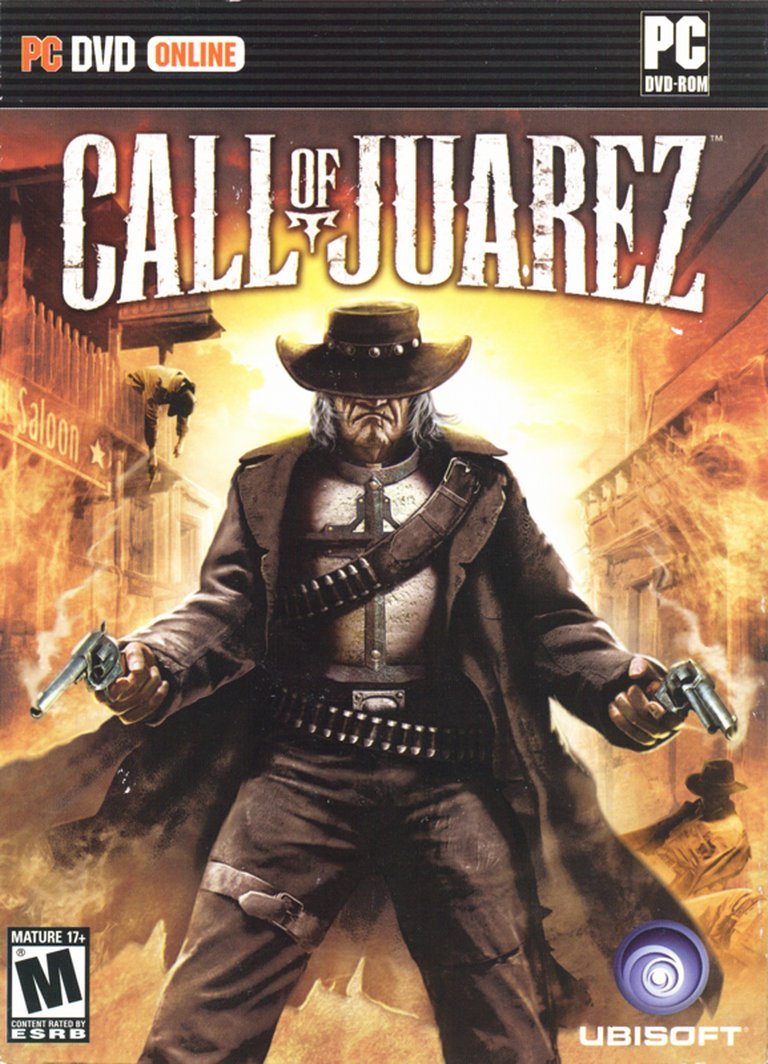
Description
Call of Juarez is a first-person Western shooter set in the late 1800s, following two protagonists: Billy Candle, a young fugitive framed for murder, and Reverend Ray McCall, his gunslinger uncle seeking vengeance. The game alternates between their perspectives, offering distinct gameplay styles—Ray’s brute-force approach with dual-wielded revolvers and a bible for stunning enemies, and Billy’s stealthy, agile tactics with a whip and bow. The story unfolds across villages, mines, and train robberies, featuring dynamic environments, time-slowing ‘concentration mode,’ and multiplayer modes like deathmatch and gold-rush challenges.
Gameplay Videos
Where to Buy Call of Juarez
Call of Juarez Free Download
Call of Juarez Cracks & Fixes
Call of Juarez Patches & Updates
Call of Juarez Mods
Call of Juarez Reviews & Reception
metacritic.com (71/100): Call of Juarez does a fascinating job of blending an epic period in history with an already proven gaming genre.
ign.com (80/100): The dual-protagonist storytelling manages to be both compelling and original, the multiplayer is a guns-blazing good time, and the entire aesthetic will have you ordering up a good sarsaparilla in no time.
imdb.com (60/100): The game looks attractive, the music theme, the main menu, graphics are good and the plot is interesting. But, the gameplay sucks.
Call of Juarez Cheats & Codes
PC
Press ~ during gameplay to open the console window. Enter the following codes for the corresponding effect.
| Code | Effect |
|---|---|
| Cheat.God(1) | God Mode On |
| Cheat.God(0) | God Mode Off |
| Cheat.GiveAmmo() | Additional ammunition |
| Cheat.Heal() | Full health |
| Cheat.MagicAmmo(1) | Unlimited Ammo/No Reload On |
| Cheat.MagicAmmo(0) | Unlimited Ammo/No Reload Off |
| Cheat.GiveRifle() | Spawn rifle |
| Cheat.GiveDynamite() | Spawn dynamite |
PC (Multiplayer)
Press Y or U to display the chat window while playing on a multiplayer server.
| Code | Effect |
|---|---|
| /Nick [nickname] | Changes nickname; 14 character limit |
| /PlayerList | List all players |
| /KillMe | Suicide |
| /Exit | Exit game |
PC (Server Administrator)
The following commands are for Server Administrators only, again to be entered in the chat area.
| Code | Effect |
|---|---|
| /AdminLogin [username] [password] | Logs you in as an admin; users and passwords are defined on the server in the ServerAdmins.scr file in the game’s profile. |
| /AdminLogout | Logs you out as the admin. |
| /Kick [nickname or ID] [reason] | Kicks a specified player off the server. |
| /Kill [nickname or ID] | Kills a specified player instantly. |
| /MapNext | Switches server to the next map. |
| /ServerShutDown | Shuts down server after a few seconds |
Call of Juarez: A Deep Dive into the Wild West’s Most Ambitious Shooter
Introduction
In the mid-2000s, the first-person shooter (FPS) genre was dominated by World War II epics and sci-fi spectacles. Amidst this landscape, Call of Juarez emerged as a bold anomaly—a Western-themed FPS that dared to blend the grit of Spaghetti Westerns with innovative gameplay mechanics. Developed by Techland and published by Ubisoft, Call of Juarez (2006) was more than just a shooter; it was an atmospheric journey into the heart of the American frontier, where morality was as murky as the dust kicked up by a galloping horse.
This review will dissect Call of Juarez in exhaustive detail, exploring its development history, narrative depth, gameplay innovations, and lasting legacy. We’ll examine how it carved a niche in a crowded genre, why its dual-protagonist structure was both a triumph and a frustration, and how its flaws and strengths shaped its reception and influence.
Development History & Context
The Studio and Vision
Techland, a Polish studio founded in 1991, was no stranger to ambitious projects. Known for titles like Chrome (2003), a futuristic FPS, Techland sought to break new ground with Call of Juarez. The game’s lead designer and artist, Paweł Selinger, envisioned a Western that wasn’t just a backdrop but a living, breathing entity. The goal was to create a shooter that felt like a classic Western film, blending the moral ambiguity of Unforgiven with the action-packed spectacle of Pale Rider.
The development team drew heavily from cinematic influences. Clint Eastwood’s Unforgiven (1992) and Pale Rider (1985) were key inspirations, as was John Ford’s The Searchers (1956). The character of Reverend Ray McCall was partially modeled after Eastwood’s Will Munny, a man of faith grappling with his violent past. Visually, Ray was inspired by Carl McCoy, the gothic frontman of Fields of the Nephilim, lending him an eerie, almost supernatural presence.
Technological Constraints and Innovations
Call of Juarez was built on Techland’s proprietary Chrome Engine 3, which had been refined for Chrome and its expansion. The engine was a marvel for its time, supporting advanced features like per-pixel lighting, normal mapping, and dynamic shadows. For Call of Juarez, Techland collaborated with NVIDIA to incorporate Shader Model 3.0, enabling effects like heat distortion, light blooms, and realistic vegetation animation.
The game’s physics system was another standout feature. Objects could be picked up, moved, and used as cover or improvised weapons. Enemies reacted dynamically to gunfire, tumbling off roofs and through windows with a cinematic flair. The engine also supported day-night cycles and weather effects, immersing players in the harsh, sun-scorched landscapes of the Wild West.
The Gaming Landscape of 2006
When Call of Juarez launched in September 2006 (Europe) and June 2007 (North America), the FPS genre was in a state of flux. Half-Life 2 (2004) had set a new standard for storytelling and physics, while Call of Duty 2 (2005) and Battlefield 2 (2005) dominated the military shooter space. Western-themed games were rare, with GUN (2005) being one of the few notable exceptions. Call of Juarez stood out not just for its setting but for its willingness to experiment with gameplay mechanics, from stealth to horseback chases to slow-motion gunfights.
Narrative & Thematic Deep Dive
Plot Summary
Call of Juarez unfolds in the late 19th century, primarily in the fictional town of Hope and the surrounding deserts of Texas and Mexico. The story begins with Billy Candle, a young half-Apache man, returning to his hometown after years of searching for the legendary Gold of Juarez. His homecoming is marred by tragedy when he witnesses the murder of his parents and is framed for the crime. The prime suspect, Billy flees, pursued by his uncle, Reverend Ray McCall, a former gunslinger turned preacher.
The game’s narrative is structured around a dual-protagonist system, with players alternating between Billy and Ray. Billy’s levels are stealth-focused, emphasizing survival and evasion, while Ray’s are action-packed shootouts. The story unfolds in a non-linear fashion, with each character’s perspective shedding light on the other’s motivations and the broader conspiracy at play.
Characters and Dialogue
- Billy Candle: A young, agile half-Apache with a tragic past. Billy’s levels are defined by stealth, climbing, and the use of a bow and whip. His character arc is one of survival and self-discovery, as he grapples with his identity and the injustice of his situation.
- Reverend Ray McCall: A former gunslinger turned preacher, Ray is a complex figure torn between his faith and his violent past. His levels are brutal, fast-paced shootouts, with Ray wielding dual revolvers and even quoting scripture to stun enemies. His voice, modeled after Johnny Cash, adds a gravelly gravitas to his character.
The dialogue in Call of Juarez is sharp and often laced with dark humor. Ray’s biblical quotations and Billy’s defiant retorts create a dynamic tension that drives the narrative forward. The game’s script, penned by Haris Orkin and Paweł Selinger, balances action with introspection, making the characters feel more than just archetypes.
Themes
-
Revenge and Redemption: At its core, Call of Juarez is a tale of vengeance and the futility of violence. Ray’s pursuit of Billy is driven by a desire for justice, but his methods are brutal and unrelenting. Billy, on the other hand, is a victim of circumstance, forced to fight for his survival. The game questions whether revenge can ever bring true justice or if it only perpetuates a cycle of violence.
-
Faith and Violence: Ray’s character embodies the conflict between faith and action. He is a man of God who wields guns with deadly precision, quoting scripture even as he mows down enemies. This duality is central to the game’s themes, exploring how faith can both justify and condemn violence.
-
The Myth of the West: Call of Juarez deconstructs the romanticized myths of the American frontier. The Wild West is depicted as a harsh, unforgiving place where survival often requires moral compromise. The game’s setting is not the glamorous world of cowboys and outlaws but a gritty, realistic portrayal of life on the frontier.
-
Identity and Belonging: Billy’s struggle as a half-Apache in a world dominated by white settlers and Mexican warlords highlights themes of identity and belonging. His journey is one of self-discovery, as he navigates the complexities of his heritage and his place in a society that often rejects him.
Gameplay Mechanics & Systems
Dual-Protagonist Structure
The most innovative aspect of Call of Juarez is its dual-protagonist system. Players alternate between Billy and Ray, each with distinct gameplay styles:
- Billy’s Levels: Stealth and survival are key. Billy can climb, sneak, and use a bow and whip to navigate environments. His levels often involve avoiding detection, solving environmental puzzles, and using the terrain to his advantage.
- Ray’s Levels: Action and aggression define Ray’s gameplay. He dual-wields revolvers, uses shotguns, and can even quote scripture to stun enemies. His levels are fast-paced shootouts, with Ray mowing down waves of enemies in dramatic fashion.
This duality creates a compelling contrast, with Billy’s levels offering a slower, more methodical pace and Ray’s providing adrenaline-fueled action. However, the transition between the two can be jarring, and some players found Billy’s stealth sections frustrating due to inconsistent AI and clunky controls.
Combat and Weapons
Call of Juarez features a robust arsenal of period-accurate weapons, including revolvers, shotguns, rifles, and even a Gatling gun. Each weapon has a distinct feel, with revolvers offering quick, precise shots and shotguns delivering devastating close-range blasts.
-
Concentration Mode: A standout feature is the “Concentration Mode,” a slow-motion mechanic that allows players to take out multiple enemies in quick succession. When activated, the screen slows down, and crosshairs appear, moving toward the center. Players must time their shots to hit enemies as the crosshairs align. This mechanic is reminiscent of Max Payne’s bullet time but adds a unique Western flair.
-
Duels: The game also features one-on-one duels, where players must draw their weapon at the right moment to outgun their opponent. These duels are tense, cinematic affairs, requiring precise timing and quick reflexes.
Stealth and Environmental Interaction
Billy’s levels emphasize stealth, with players needing to avoid detection by enemies. The game’s AI responds to sound, light, and movement, making stealth a challenging but rewarding experience. Players can use shadows, cover, and environmental objects to stay hidden.
The game’s physics system allows for extensive environmental interaction. Players can move objects like barrels and crates to create cover or block enemy paths. Oil lamps can be shot to create explosions, and doors can be kicked open for dramatic effect.
Horseback Chases and Platforming
Call of Juarez includes several horseback chase sequences, where players must ride through deserts and towns while fending off pursuers. These sequences are exhilarating, blending action and platforming as players leap over obstacles and shoot at enemies.
Platforming is another key element, particularly in Billy’s levels. Players must climb rocks, swing from branches, and navigate treacherous terrain. While these sections add variety, they can be frustrating due to imprecise controls and inconsistent jump mechanics.
Multiplayer
The game’s multiplayer mode features several modes, including Deathmatch, Team Deathmatch, and Gold Rush, where players collect gold scattered across the map. The Xbox 360 version includes additional modes like Capture the Bag and Wanted, where one player is designated as the target.
Multiplayer is a fun but somewhat shallow experience, with limited maps and modes. The game’s focus on single-player storytelling means that multiplayer feels like an afterthought, though it’s still enjoyable for fans of Western-themed shootouts.
World-Building, Art & Sound
Setting and Atmosphere
Call of Juarez excels in creating an immersive Wild West atmosphere. The game’s environments are richly detailed, from dusty towns to sun-scorched deserts. The day-night cycle and dynamic weather effects add to the realism, making the world feel alive and unpredictable.
The game’s art direction is heavily influenced by Spaghetti Westerns, with a color palette dominated by earthy browns, fiery reds, and stark blacks. The character designs are equally impressive, with Ray’s gothic preacher aesthetic and Billy’s rugged, youthful appearance standing out.
Sound Design
The sound design in Call of Juarez is top-notch, with realistic gunfire, ambient noises, and a hauntingly beautiful score. The game’s soundtrack, composed by Paweł Błaszczak, blends traditional Western themes with eerie, atmospheric tracks that enhance the game’s tension and drama.
Voice acting is another highlight, particularly Marc Alaimo’s performance as Ray McCall. His gravelly, Johnny Cash-esque voice brings depth and gravitas to the character, making Ray one of the most memorable protagonists in gaming.
Visual Direction
The game’s visuals are a testament to the power of the Chrome Engine 3. The environments are detailed and dynamic, with realistic lighting and shadow effects. The character models are well-animated, with facial expressions and body language that convey emotion and intent.
The game’s use of color and lighting is particularly effective. Sunsets cast long, dramatic shadows, while interior spaces are often dimly lit, creating a sense of tension and mystery. The game’s visual style is a perfect match for its Western themes, evoking the cinematic grandeur of classic films.
Reception & Legacy
Critical Reception
Call of Juarez received generally positive reviews, with critics praising its innovative gameplay, atmospheric setting, and strong voice acting. The game’s dual-protagonist structure was a standout feature, though some found the transition between Billy and Ray’s levels jarring.
- Praise: Critics lauded the game’s shooting mechanics, particularly the Concentration Mode and duels. The game’s atmosphere and sound design were also highlighted as strengths, with many noting the game’s cinematic quality.
- Criticism: The game’s stealth sections and platforming were often criticized for being clunky and frustrating. Some reviewers also noted that the game’s story, while engaging, was somewhat predictable.
Commercial Performance
Call of Juarez did not perform well in North America, selling only 137,000 units across PC and Xbox 360. However, it fared better in Europe, where it gained a cult following. The game’s strong European sales helped establish Techland as a globally recognized developer.
Influence and Legacy
Call of Juarez’s influence can be seen in later Western-themed games, particularly its sequels. Call of Juarez: Bound in Blood (2009) refined the formula, focusing more on action and less on stealth, while Call of Juarez: Gunslinger (2013) introduced a narrative-driven approach with an unreliable narrator.
The game’s dual-protagonist structure and Concentration Mode have also influenced other shooters, with games like Red Dead Redemption (2010) and Dishonored (2012) drawing inspiration from its blend of action and stealth.
Conclusion
Call of Juarez is a flawed but ambitious masterpiece. Its dual-protagonist structure, innovative gameplay mechanics, and atmospheric setting make it a standout title in the FPS genre. While its stealth sections and platforming can be frustrating, the game’s strengths far outweigh its weaknesses.
For fans of Westerns and shooters alike, Call of Juarez is a must-play. It’s a game that dares to be different, blending action, stealth, and storytelling in a way that few games have matched. Its legacy is one of innovation and ambition, and it remains a cult classic in the annals of gaming history.
Final Verdict: 8.5/10 – A bold, atmospheric Western shooter that pushes the boundaries of the genre, despite its flaws.