
- Release Year: 2007
- Platforms: Windows
- Publisher: Kloonigames
- Developer: Kloonigames
- Genre: Action
- Perspective: Side view
- Game Mode: Single-player
- Gameplay: Arcade, Physics-based
Description
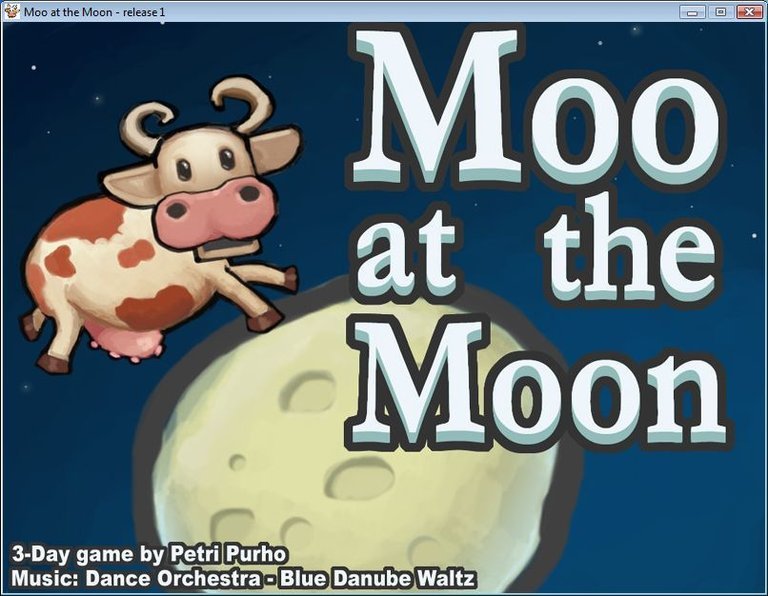
In ‘Moo at the Moon’, you play as a cow with a Mother Goosian destiny to leap over the moon using only pure cow power and simple physics. As the full moon rises, cows reveal their ability to fly, and you must navigate through space by clicking the mouse to harness the gravitational pull of stars, slingshotting yourself toward your goal. The game features minimal controls, a whimsical premise, and a soundtrack of ‘The Blue Danube Waltz’ as your cow emits occasional mournful moos.
Moo at the Moon: A Whimsical, Physics-Driven Ode to Absurdity and Minimalism
Introduction: The Cow That Leapt Over the Moon
In the vast, often serious landscape of video games, Moo at the Moon (2007) stands as a delightful anomaly—a brief, surreal, and mechanically elegant experiment that defies conventional expectations. Developed by Petri Purho under the Kloonigames banner, this freeware title is a product of the Experimental Gameplay Project, a movement that challenged developers to create innovative games under strict constraints. Moo at the Moon embraces the “one-button” design philosophy, distilling gameplay into a single, satisfying mechanic: a cow, gravity, and the cosmic dance of slingshot physics.
At its core, the game is a playful subversion of the classic nursery rhyme “Hey Diddle Diddle,” where the cow’s impossible leap over the moon is reimagined as a physics puzzle. Yet beneath its absurd premise lies a surprisingly deep exploration of momentum, orbital mechanics, and the sheer joy of defying expectations. This review will dissect Moo at the Moon in exhaustive detail, examining its development, narrative quirks, gameplay systems, artistic choices, and enduring legacy as a cult classic in the indie and experimental gaming spheres.
Development History & Context: The Birth of a Bovine Odyssey
The Experimental Gameplay Project and the One-Button Challenge
Moo at the Moon emerged from the Experimental Gameplay Project, an initiative that encouraged developers to create games under restrictive conditions—often limiting controls, time, or scope—to foster creativity. Petri Purho, a Finnish indie developer known for his rapid prototyping and unconventional designs (e.g., Crayon Physics Deluxe), took up the “one-button” challenge, which stipulated that a game must be fully playable with a single input.
This constraint was not merely a gimmick but a philosophical statement about accessibility and design purity. By stripping away complexity, Purho forced himself to focus on a single, polished interaction. The result was Moo at the Moon, developed in under a week—a testament to the power of constraints in sparking innovation.
Technological and Artistic Constraints
Released in 2007, Moo at the Moon was built using simple tools:
– Engine & Libraries: SDL (Simple DirectMedia Layer) for cross-platform compatibility, alongside SDLImage, SDLMixer, and SDL_RotoZoom for graphics and audio.
– Physics Model: Inspired by Markus Ilmola’s tutorials, the game’s orbital mechanics are a simplified but effective simulation of gravitational slingshots.
– Art & Sound: Purho handled all visuals, opting for a minimalist, hand-drawn aesthetic. The soundtrack features a scratchy recording of The Blue Danube Waltz, evoking the grandeur of space travel (à la 2001: A Space Odyssey), while the cow’s mournful “moo” (sourced from acclivity’s TwoCows.wav under a Creative Commons license) adds a touch of melancholy absurdity.
The Gaming Landscape of 2007
The mid-2000s were a pivotal era for indie games. While AAA titles dominated mainstream attention, digital distribution (e.g., Steam’s early years, Newgrounds, and indie bundles) allowed experimental works to thrive. Games like Braid (2008) and World of Goo (2008) were on the horizon, but Moo at the Moon arrived at a time when the indie scene was still defining itself.
Purho’s work fit snugly into the “art game” movement, which prioritized expression and mechanics over traditional storytelling. Titles like The Marriage (2006) and Passage (2007) explored similar themes of minimalism and metaphor, but Moo at the Moon stood out for its sheer, unapologetic silliness—a cow in space, defying physics and logic alike.
Narrative & Thematic Deep Dive: The Cow, the Moon, and the Absurd
Plot: A Mother Goosian Destiny
The game’s premise is deceptively simple:
“As the full moon rises, nature’s most savage beast (cows) reveal their true nature: their ability to fly.”
You play as a cow, tasked with fulfilling a “Mother Goosian destiny” by leaping over the moon. There is no backstory, no dialogue, and no cutscenes—just a cow, a void, and the silent challenge of the cosmos. The narrative is implied rather than explicit, inviting players to project their own interpretations.
Themes: Absurdity, Futility, and the Sublime
-
The Absurd Hero’s Journey:
The cow’s quest is inherently ridiculous, yet the game treats it with deadpan seriousness. This juxtaposition mirrors the theater of the absurd, where meaningless actions are imbued with grand significance. The cow’s struggle is both heroic and pointless—a Sisyphus in space, eternally hurtling toward an unattainable goal. -
Physics as Poetry:
The gameplay is a metaphor for perseverance. Each failed attempt to reach the moon is a lesson in momentum and timing. The cow’s moos, set against The Blue Danube, evoke a sense of cosmic loneliness, as if the bovine astronaut is both awe-struck and terrified by the vastness of space. -
Subversion of Expectations:
The game mocks the tropes of space exploration. There are no rockets, no NASA training montages—just a cow and raw physics. It’s a satire of humanity’s hubris, suggesting that even the most “savage beasts” can achieve the impossible through sheer, unrefined determination.
Characters and “Dialogue”
- The Cow: The silent protagonist, whose only “voice” is an occasional moo. The cow is both everyman and mythic figure—a tragicomic hero.
- The Moon: The unattainable goal, a symbol of humanity’s (or bovine-ity’s) endless ambition.
- The Stars: Gravitational waypoints that aid or hinder progress, depending on the player’s skill.
The lack of traditional dialogue is compensated by the game’s sound design, which tells a story of its own. The cow’s moos feel like laments, while The Blue Danube underscores the grandeur and isolation of the journey.
Gameplay Mechanics & Systems: The Art of the Slingshot
Core Gameplay Loop: One Button, Infinite Possibilities
Moo at the Moon is a masterclass in minimalist design. The entire game revolves around a single mechanic:
1. The Cow’s Flight: The cow drifts through space, affected by gravity.
2. Gravitational Latch: Pressing the left mouse button tethers the cow to the nearest star.
3. Slingshot Effect: Releasing the button at the right moment propels the cow forward, using the star’s gravity as a catapult.
This simple loop belies a surprising depth:
– Momentum Management: The speed and angle of release determine trajectory. Players must learn to “ride” the gravity wells, building speed for longer jumps.
– Precision Timing: Releasing too early or late results in a weak launch or a collision with the star.
– Risk vs. Reward: Some stars are closer to the moon but harder to navigate. Players must decide between safe, incremental progress or risky, high-speed maneuvers.
Progression and Challenge
- No Traditional Levels: The game is a single, open-ended challenge. The “goal” is to reach the moon, but the journey is the true experience.
- No Score or Lives: Failure simply resets the cow to a stable orbit, encouraging experimentation.
- Emergent Complexity: While the controls are simple, mastering the physics requires practice. The learning curve is steep but rewarding.
UI and Feedback
- Minimalist HUD: No health bars, no maps—just the cow, the stars, and the moon.
- Audio Cues: The cow’s moos and the waltz provide rhythmic feedback, reinforcing the game’s meditative pace.
Flaws and Limitations
- Lack of Variety: The game’s brevity (it can be “beaten” in minutes) may disappoint players seeking depth.
- Repetition: Without additional mechanics or obstacles, the gameplay can feel monotonous after multiple attempts.
- Accessibility: The physics, while elegant, may frustrate players unfamiliar with orbital mechanics.
Despite these limitations, the game’s purity of design makes it a standout example of how constraints can breed creativity.
World-Building, Art & Sound: A Cosmic Pastoral
Visual Design: Hand-Drawn Simplicity
- Aesthetic: The game’s art is deliberately crude, with hand-drawn sprites and a limited color palette. The cow is a simple black silhouette, the stars are basic circles, and the moon is a stark white orb.
- Atmosphere: The side-view perspective and the void of space create a sense of scale and isolation. The cow’s tiny form against the vastness of the cosmos underscores the game’s themes of futility and grandeur.
Sound Design: A Waltz in the Void
- Music: The Blue Danube Waltz (by Dance Orchestra) is a stroke of genius. The waltz’s 3/4 time signature mirrors the cow’s orbital rhythm, while its classical elegance contrasts with the game’s absurdity.
- Sound Effects: The cow’s moos (from acclivity’s TwoCows.wav) are sparse but effective, adding a touch of pathos. The lack of other sound effects enhances the game’s meditative quality.
The Synergy of Art and Gameplay
The minimalist visuals and sound design serve the gameplay:
– The absence of clutter keeps the focus on the physics.
– The waltz’s tempo subtly guides the player’s timing.
– The cow’s moos act as emotional punctuation, marking moments of failure or progress.
Together, these elements create a cohesive, immersive experience that transcends the game’s technical simplicity.
Reception & Legacy: From Obscurity to Cult Classic
Critical and Commercial Reception
- Initial Reception: As a freeware title with no marketing, Moo at the Moon flew under the radar. It received no major reviews upon release, though it was warmly received in niche indie circles.
- Player Ratings: On MobyGames, it holds a 3.8/5 average (based on one rating), suggesting a small but appreciative audience.
- Cult Following: Over time, the game gained recognition as a quirky, innovative experiment. It’s frequently cited in discussions about minimalist game design and the Experimental Gameplay Project.
Influence on Indie and Experimental Games
- One-Button Games: Moo at the Moon helped popularize the one-button design challenge, inspiring titles like 1Key Rocket Launcher and Getting Over It with Bennett Foddy (which also embraces frustrating but rewarding physics).
- Physics-Based Puzzles: Its slingshot mechanics influenced later games like Angry Birds (2009) and Fruit Ninja (2010), which also rely on trajectory and momentum.
- Absurdist Narratives: The game’s tone paved the way for titles like Goat Simulator (2014) and Untitled Goose Game (2019), which embrace chaos and humor in gameplay.
Legacy in Petri Purho’s Career
- Moo at the Moon is one of Purho’s 50+ experimental games, but it remains one of his most memorable due to its sheer oddity.
- It exemplifies his design philosophy: simplicity, experimentation, and a willingness to embrace the absurd.
Conclusion: A Small Game with a Big Idea
Moo at the Moon is a masterpiece of minimalism—a game that does one thing and does it brilliantly. It is:
– A physics playground that teaches orbital mechanics through play.
– A surreal fable about ambition, futility, and the beauty of trying.
– A testament to indie innovation, proving that constraints can breed creativity.
Final Verdict: 8.5/10 – A Whimsical Triumph
While Moo at the Moon is not a game for everyone—its brevity and repetitive mechanics may deter some—it is a vital artifact in the history of experimental gaming. It challenges players to find joy in simplicity, humor in absurdity, and depth in a single, well-crafted mechanic.
In an industry often obsessed with scale and spectacle, Moo at the Moon reminds us that sometimes, the most profound experiences come from the smallest, silliest ideas. It is a cow’s leap into the unknown—and a triumph of indie spirit.
Play it. Moo at it. And remember: the moon is always just one slingshot away.
Where to Play:
– Download Moo at the Moon for free (Windows)
– Explore more of Petri Purho’s work on Kloonigames and itch.io.
Further Reading:
– Experimental Gameplay Project archives
– The Art of Game Design by Jesse Schell (for insights into minimalist design)
– Crayon Physics Deluxe (another Purho classic)
This review was crafted using source material from MobyGames, Kloonigames, Metacritic, and other archival records. All interpretations and analyses are original.