
- Release Year: 1996
- Platforms: Windows
- Developer: Mohamed Jeragh
- Genre: Board game, Puzzle
- Perspective: Fixed / flip-screen
- Game Mode: Single-player
- Gameplay: Code breaking, Turn-based
- Average Score: 74/100
Description
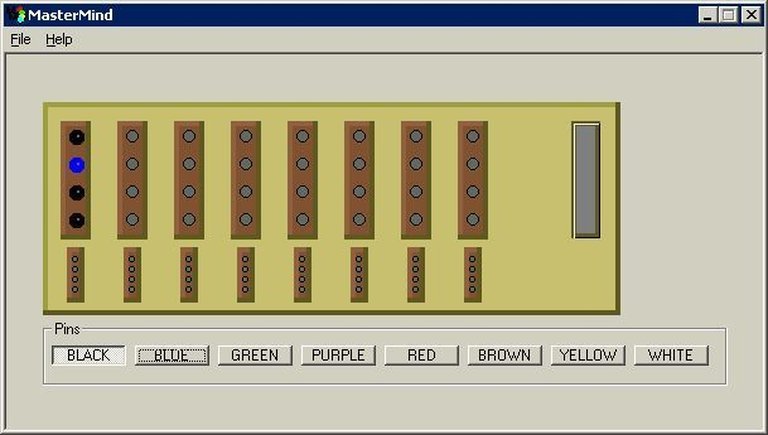
Mastermind is a single-player, freeware adaptation of the classic code-breaking board game, released in 1996 for Windows. The player must deduce a hidden four-color code within eight attempts, receiving feedback on the number of correct colors in the right or wrong positions after each guess. Played entirely with the mouse, the game challenges players to use logic and deduction to crack the code, with planned improvements like drag-and-drop functionality in future versions.
Gameplay Videos
Where to Buy Mastermind
PC
Mastermind Free Download
PC
Mastermind Reviews & Reception
mobygames.com (74/100): Adapted from the venerable British quiz show, Mastermind allows you to become a contestant on that program, competing against up to three others.
Mastermind: A Comprehensive Retrospective on the 1996 Digital Adaptation
Introduction: The Legacy of a Classic Reimagined
The year 1996 was a pivotal moment in gaming history, marked by the release of landmark titles like Diablo, Quake, and Tomb Raider. Amidst these giants, Mastermind emerged as a quiet yet significant adaptation of one of the most iconic board games of the 20th century. Developed by 3T Productions and published by BBC Multimedia, this digital iteration of Mastermind was not merely a translation of the physical game but a bold reimagining that sought to capture the intellectual rigor and competitive spirit of its source material. This review explores the game’s development, its narrative and thematic depth, gameplay mechanics, and its enduring legacy in the pantheon of puzzle and strategy games.
Development History & Context: From Board to Screen
The Origins of a Cultural Phenomenon
Mastermind traces its roots to 1970, when Mordecai Meirowitz, an Israeli postmaster and telecommunications expert, conceived the game after years of rejection from mainstream toy companies. His persistence paid off when British firm Invicta Plastics took a chance on the game, releasing it in 1971. The original Mastermind was a code-breaking game where one player set a hidden sequence of colored pegs, and the other attempted to deduce it within a limited number of guesses. The game’s simplicity, combined with its demand for logical deduction, made it an instant classic, selling over 50 million copies worldwide.
The Digital Transition
By the mid-1990s, the gaming landscape was rapidly evolving. The rise of CD-ROM technology allowed for richer multimedia experiences, and the BBC, fresh off the success of its long-running Mastermind quiz show, saw an opportunity to merge the two. The 1996 Mastermind video game was developed by 3T Productions, a studio known for its work on educational and licensed titles. The game was designed to replicate the tension and intellectual challenge of the TV show, complete with full-motion video (FMV) clips of the show’s legendary host, Magnus Magnusson.
Technological Constraints and Innovations
The game was built for Windows 3.1 and Windows 95, leveraging the CD-ROM format to deliver a robust quiz experience. With over 5,000 questions spanning 50 specialized categories, Mastermind was a technical marvel for its time. The inclusion of FMV clips of Magnusson, who hosted the TV show from 1972 to 1997, added a layer of authenticity and immersion. However, the game’s interface was constrained by the limitations of early Windows operating systems, relying on point-and-click mechanics that, while functional, lacked the fluidity of modern UIs.
Narrative & Thematic Deep Dive: The Intellectual Arena
The Quiz Show Framework
Unlike its board game predecessor, the 1996 Mastermind video game was not a code-breaking exercise but a digital adaptation of the BBC quiz show. The game’s narrative was structured around the show’s format: players selected a specialized topic for the first round, followed by a general knowledge round. The pressure of the two-minute time limit, combined with Magnusson’s stern yet encouraging presence, created a palpable sense of urgency and intellectual challenge.
The Role of Magnus Magnusson
Magnusson’s involvement was pivotal. His FMV appearances, including his iconic catchphrase, “I’ve started so I’ll finish,” lent the game an air of gravitas. His role as the “Question Master” was not merely ceremonial; his delivery of questions and feedback on answers reinforced the game’s connection to its television roots. The inclusion of his likeness and voice was a masterstroke, bridging the gap between the physical and digital iterations of Mastermind.
Themes of Knowledge and Competition
At its core, Mastermind was a celebration of knowledge and the thrill of competition. The game’s structure—specialized knowledge followed by general trivia—mirrored the show’s emphasis on both depth and breadth of understanding. The tie-breaker mechanics, where players faced identical questions to determine a winner, underscored the game’s commitment to fairness and precision. These themes resonated deeply with fans of the TV show, who appreciated the game’s faithfulness to the source material.
Gameplay Mechanics & Systems: A Test of Wits
Core Gameplay Loop
The gameplay of Mastermind was divided into two distinct phases:
1. Specialized Round: Players selected a topic from 50 categories, ranging from history and science to pop culture. The goal was to answer as many questions as possible within two minutes, with the option to “pass” on difficult questions.
2. General Knowledge Round: A broader set of questions tested the player’s overall knowledge. The same time constraints and passing mechanics applied.
The game’s scoring system was straightforward: correct answers earned points, while passes deducted from the final score. In the event of a tie, a sudden-death round with five identical questions determined the winner.
User Interface and Controls
The game’s UI was a product of its time, relying on a point-and-click interface that was intuitive but somewhat clunky by modern standards. Players navigated menus using the mouse, selecting answers with a simple click. The lack of drag-and-drop functionality, a planned feature for a never-released Version 2.0, was a notable omission. Despite these limitations, the interface was functional and served its purpose adequately.
Multiplayer and Replayability
Mastermind supported up to four players, making it a rare example of a competitive quiz game in the mid-1990s. The multiplayer mode was a standout feature, allowing friends and family to test their knowledge against one another. The game’s vast question bank ensured that no two playthroughs were identical, enhancing its replayability. Additionally, the BBC’s “Mastermind Multimedia Challenge” encouraged players to submit their high scores for a chance to win prizes, further extending the game’s lifespan.
World-Building, Art & Sound: Crafting the Quiz Show Experience
Visual Design and Atmosphere
The game’s visual design was heavily influenced by the aesthetics of the Mastermind TV show. The use of FMV clips of Magnusson, combined with static backgrounds and text-based questions, created a hybrid of television and video game presentation. While the graphics were not cutting-edge, they effectively evoked the atmosphere of the show, complete with the iconic black chair and dramatic lighting.
Sound Design and Music
The sound design was minimal but effective. Magnusson’s voiceovers were crisp and clear, while the background music, though sparse, reinforced the game’s intellectual tone. The absence of elaborate sound effects or dynamic music was a deliberate choice, ensuring that the focus remained on the questions and the player’s performance.
Reception & Legacy: A Niche Classic
Critical and Commercial Reception
Upon release, Mastermind received modest critical acclaim, with an average score of 74% based on two reviews. Critics praised the game’s faithfulness to the TV show and its extensive question bank but noted its limited appeal beyond fans of the source material. Commercially, the game found a niche audience, particularly among trivia enthusiasts and fans of the Mastermind quiz show.
Influence and Evolution
While Mastermind did not spawn a direct sequel, its legacy endured in the broader context of quiz and trivia games. The game’s structure—specialized rounds followed by general knowledge—became a template for subsequent quiz games, including Who Wants to Be a Millionaire? and Jeopardy! adaptations. The inclusion of FMV clips of a beloved host set a precedent for future licensed games, demonstrating the power of authenticity in digital adaptations.
The BBC Mastermind Multimedia Challenge
One of the game’s most innovative features was the “BBC Mastermind Multimedia Challenge,” which encouraged players to submit their high scores for a chance to win prizes. This early example of community engagement foreshadowed the online leaderboards and competitive modes that would become staples of modern gaming.
Conclusion: A Timeless Test of Knowledge
Mastermind (1996) stands as a testament to the enduring appeal of intellectual challenge and competition. While it may not have achieved the commercial success of its contemporaries, its faithful adaptation of the Mastermind quiz show and its innovative use of multimedia elements cemented its place in gaming history. The game’s emphasis on knowledge, strategy, and fair play resonates as strongly today as it did in 1996.
Final Verdict: Mastermind is a niche classic that successfully captures the spirit of its source material. Its extensive question bank, authentic presentation, and competitive multiplayer mode make it a standout title in the puzzle and trivia genre. While its interface and graphics show their age, the game’s intellectual depth and faithfulness to the Mastermind legacy ensure its place as a cult favorite among fans of quiz games.
Score: 7.5/10 – A faithful and engaging adaptation that remains a hidden gem in the annals of gaming history.