
- Release Year: 2003
- Platforms: Windows
- Publisher: Electronic Arts, Inc.
- Genre: Compilation
- Game Mode: Online PVP
Description
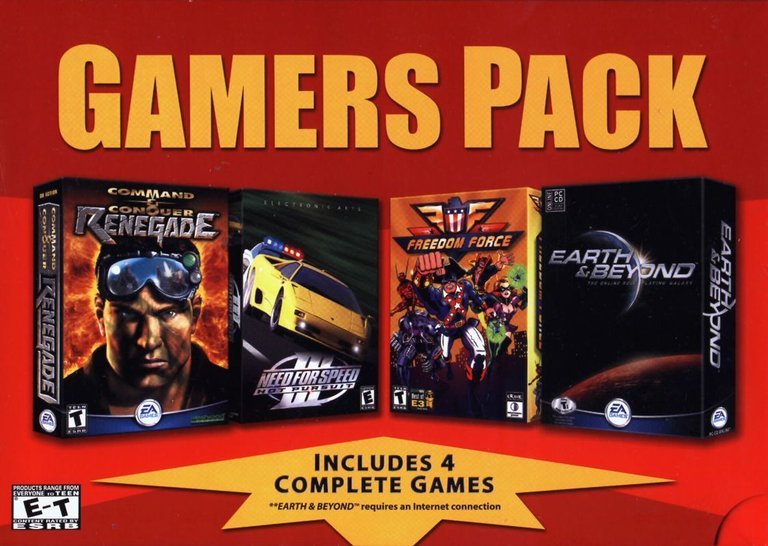
Gamers Pack is a budget-friendly compilation released in 2003 for Windows, bundling four popular games: Command & Conquer: Renegade (a first-person shooter set in the Command & Conquer universe), Earth & Beyond (a sci-fi MMORPG), Freedom Force (a superhero-themed tactical RPG), and Need for Speed III: Hot Pursuit (a high-speed racing game). Designed for casual and hardcore gamers alike, the pack offers a diverse mix of genres, from real-time strategy and action to racing and role-playing, all in one convenient package.
Gamers Pack: A Retrospective on a Forgotten Compilation
Introduction
In the annals of video game history, few titles are as enigmatic as Gamers Pack, a compilation released by Electronic Arts in 2003. Unlike standalone masterpieces that define genres or epochs, Gamers Pack is a curio—a time capsule of early 2000s gaming, bundling four distinct titles into a single, budget-friendly package. While it may lack the cultural resonance of a Grand Theft Auto or Halo, its existence speaks volumes about the industry’s transition into the modern era. This review dissects Gamers Pack in exhaustive detail, exploring its development, narrative themes, gameplay mechanics, and legacy, while situating it within the broader context of gaming in 2003.
Development History & Context
The Studio and Creators’ Vision
Gamers Pack was not the product of a single studio but rather a collaboration between multiple developers under the Electronic Arts umbrella. The compilation includes:
1. Command & Conquer: Renegade (2002) – Developed by Westwood Studios, a pioneer in real-time strategy (RTS) games.
2. Earth & Beyond (2002) – A massively multiplayer online role-playing game (MMORPG) by Westwood Studios and EA.
3. Freedom Force (2002) – A superhero-themed tactical RPG by Irrational Games, led by Ken Levine.
4. Need for Speed III: Hot Pursuit (1998) – A racing classic by EA Canada.
The vision behind Gamers Pack was straightforward: offer a diverse sampling of genres at a bargain price. This strategy was not uncommon in the early 2000s, as publishers sought to capitalize on back-catalog titles while introducing new audiences to older games. However, the inclusion of Earth & Beyond, an MMORPG, was particularly notable, as it required an internet connection and subscription, making it an unusual choice for a budget compilation.
Technological Constraints and the Gaming Landscape of 2003
The early 2000s were a period of rapid technological advancement. The PlayStation 2 dominated the console market, while PC gaming was transitioning from DOS-based systems to Windows XP. Graphics cards like NVIDIA’s GeForce and ATI’s Radeon were pushing the boundaries of 3D rendering, and online multiplayer was becoming mainstream thanks to services like Battle.net and Gamespy.
Gamers Pack reflected this transitional phase. Need for Speed III: Hot Pursuit, released in 1998, was already five years old by 2003, showcasing the limitations of late-90s 3D graphics. Conversely, Freedom Force and Command & Conquer: Renegade leveraged more advanced engines, offering smoother animations and more complex gameplay mechanics. Earth & Beyond, however, was a gamble—its MMORPG nature required a stable internet connection, which was not yet ubiquitous in 2003.
The gaming landscape of 2003 was dominated by sequels and franchises. Titles like Grand Theft Auto: Vice City, The Legend of Zelda: The Wind Waker, and Star Wars: Knights of the Old Republic set new standards for storytelling and immersion. In this context, Gamers Pack was a modest offering, targeting budget-conscious gamers rather than those seeking cutting-edge experiences.
Narrative & Thematic Deep Dive
Plot and Characters
Gamers Pack does not present a unified narrative; instead, each game within the compilation offers its own distinct story and themes:
-
Command & Conquer: Renegade
- Plot: A first-person shooter (FPS) set in the Command & Conquer universe, Renegade follows Havoc, a commando for the Global Defense Initiative (GDI), as he battles the Brotherhood of Nod. The story is a typical military sci-fi affair, with Havoc undertaking missions to sabotage Nod’s operations.
- Characters: Havoc is a generic action hero, but the game’s strength lies in its world-building, tying into the larger C&C lore.
- Themes: The game explores themes of war, technology, and the moral ambiguity of military conflict.
-
Earth & Beyond
- Plot: Set in a distant future, players assume the role of a spaceship pilot navigating a galaxy teeming with factions, alien species, and political intrigue. The narrative is open-ended, with players shaping their own stories through exploration and combat.
- Characters: The game features a cast of NPCs representing various factions, but the focus is on player-driven storytelling.
- Themes: Earth & Beyond delves into themes of exploration, diplomacy, and the human condition in a vast, indifferent universe.
-
Freedom Force
- Plot: A superhero RPG where players control a team of heroes defending Patriot City from villains like the Red Menace and Energy X. The story is a love letter to comic books, blending humor, drama, and over-the-top action.
- Characters: The game’s roster includes original heroes like the Patriot, Minuteman, and El Diablo, each with unique abilities and backstories.
- Themes: Freedom Force celebrates the golden age of comics, exploring themes of heroism, teamwork, and the struggle between good and evil.
-
Need for Speed III: Hot Pursuit
- Plot: Unlike the other titles, Hot Pursuit is devoid of a traditional narrative. Instead, it focuses on high-speed racing and police chases.
- Characters: The game’s “characters” are the cars themselves, each with distinct handling and performance attributes.
- Themes: The themes revolve around speed, competition, and the thrill of the chase.
Dialogue and Underlying Themes
The dialogue in Gamers Pack varies widely:
– Command & Conquer: Renegade features military jargon and radio chatter, reinforcing its war-themed setting.
– Earth & Beyond relies on text-based interactions, with NPCs providing exposition and quest details.
– Freedom Force stands out with its witty, comic-book-style dialogue, filled with puns and references to superhero tropes.
– Need for Speed III has no dialogue, relying instead on engine roars and police sirens.
The underlying themes of the compilation are diverse but coalesce around the idea of escapism. Whether it’s the high-stakes warfare of Renegade, the cosmic adventure of Earth & Beyond, the superheroics of Freedom Force, or the adrenaline rush of Hot Pursuit, each game offers a distinct form of fantasy fulfillment.
Gameplay Mechanics & Systems
Core Gameplay Loops
Each game in Gamers Pack has its own unique gameplay loop:
-
Command & Conquer: Renegade
- Combat: A mix of FPS mechanics and RTS elements, with players controlling Havoc while issuing commands to AI-controlled units.
- Progression: Mission-based, with objectives ranging from sabotage to full-scale assaults.
- UI: The interface blends FPS controls with an RTS-style command wheel, allowing players to switch between direct control and tactical oversight.
-
Earth & Beyond
- Combat: Space combat is real-time, with players managing shields, weapons, and ship systems.
- Progression: Character progression is tied to faction reputation and skill development, with players unlocking new ships and abilities.
- UI: The UI is complex, with multiple windows for navigation, combat, and inventory management.
-
Freedom Force
- Combat: Turn-based tactical combat, with players positioning heroes and using their abilities strategically.
- Progression: Heroes gain experience and new powers, allowing for customization and team synergy.
- UI: The interface is intuitive, with a grid-based combat system and a menu for managing hero abilities.
-
Need for Speed III: Hot Pursuit
- Combat: High-speed racing with a focus on precision driving and police evasion.
- Progression: Players unlock new cars and tracks by winning races and completing challenges.
- UI: The UI is minimal, with a focus on the racing experience.
Innovative and Flawed Systems
-
Innovative:
- Freedom Force’s superhero team mechanics were ahead of their time, offering deep customization and tactical depth.
- Earth & Beyond’s faction-based progression system was ambitious, blending RPG elements with MMORPG mechanics.
-
Flawed:
- Command & Conquer: Renegade’s hybrid FPS/RTS mechanics were clunky, with the AI often failing to respond effectively to commands.
- Earth & Beyond’s reliance on an internet connection and subscription model made it inaccessible to many players.
- Need for Speed III’s lack of a narrative or progression system beyond unlocking cars made it feel shallow compared to modern racing games.
World-Building, Art & Sound
Setting and Atmosphere
- Command & Conquer: Renegade: The game’s dystopian military setting is immersive, with detailed environments and a grim, war-torn atmosphere.
- Earth & Beyond: The sci-fi setting is vast and visually stunning, with alien worlds and futuristic cities.
- Freedom Force: Patriot City is a vibrant, comic-book-inspired metropolis, bursting with color and personality.
- Need for Speed III: The racing environments are varied, from urban streets to coastal highways, each designed for high-speed thrills.
Visual Direction
- Freedom Force stands out with its cel-shaded graphics, which mimic the look of a comic book.
- Earth & Beyond features detailed 3D models and expansive space environments.
- Command & Conquer: Renegade and Need for Speed III are more dated visually but still hold up as examples of late-90s/early-2000s 3D graphics.
Sound Design
- Command & Conquer: Renegade features a mix of military radio chatter and explosive sound effects, enhancing the combat experience.
- Earth & Beyond’s soundtrack is atmospheric, with ambient space sounds and orchestral scores.
- Freedom Force’s sound design is playful, with heroic music and exaggerated sound effects that complement its comic-book aesthetic.
- Need for Speed III’s engine roars and police sirens create a sense of urgency and excitement.
Reception & Legacy
Critical and Commercial Reception
Gamers Pack received little critical attention upon release, as it was marketed as a budget title rather than a flagship product. However, the individual games within the compilation had their own reception histories:
- Command & Conquer: Renegade was met with mixed reviews, praised for its ambition but criticized for its clunky mechanics.
- Earth & Beyond was well-received for its depth but struggled with its subscription model and server issues.
- Freedom Force was a critical darling, lauded for its innovation and charm.
- Need for Speed III: Hot Pursuit was a commercial success, cementing the Need for Speed franchise as a staple of racing games.
Evolution of Reputation
Over time, Gamers Pack has faded into obscurity, remembered more as a footnote in gaming history than a landmark title. However, Freedom Force has gained a cult following, with fans still advocating for a modern sequel. Earth & Beyond’s servers were shut down in 2004, making it a relic of the early MMORPG era. Command & Conquer: Renegade and Need for Speed III are remembered fondly by fans of their respective franchises but are overshadowed by later entries.
Influence on Subsequent Games
- Freedom Force’s superhero mechanics influenced later titles like Marvel: Ultimate Alliance and XCOM.
- Earth & Beyond’s faction-based progression system can be seen in modern MMORPGs like EVE Online.
- Command & Conquer: Renegade’s hybrid FPS/RTS mechanics were refined in later games like Battlefield and StarCraft II.
- Need for Speed III’s police chase mechanics became a staple of the Need for Speed series.
Conclusion
Gamers Pack is a fascinating artifact of its time—a budget compilation that offered a diverse sampling of early 2000s gaming. While it may not have left a lasting impact on the industry, its individual components showcase the creativity and ambition of their developers. Freedom Force remains a standout, demonstrating the potential of superhero RPGs, while Earth & Beyond offers a glimpse into the early days of MMORPGs. Command & Conquer: Renegade and Need for Speed III are solid entries in their respective genres, though they have been surpassed by later titles.
Ultimately, Gamers Pack is a testament to the diversity of gaming in the early 2000s. It may not be a masterpiece, but it is a valuable piece of gaming history, offering a snapshot of an era when the industry was rapidly evolving. For collectors and historians, it is a worthy addition to any library, representing a moment when gaming was transitioning from the past to the future.