
- Release Year: 1981
- Platforms: Atari 2600, Windows, Xbox 360
- Publisher: Activision, Inc., Microsoft Corporation
- Developer: Activision, Inc.
- Genre: Sports
- Perspective: Fixed / flip-screen
- Game Mode: Hotseat, Single-player
- Gameplay: Forehand and backhand shots, Tennis simulation
- Setting: Sports, Tennis court
- Average Score: 61/100
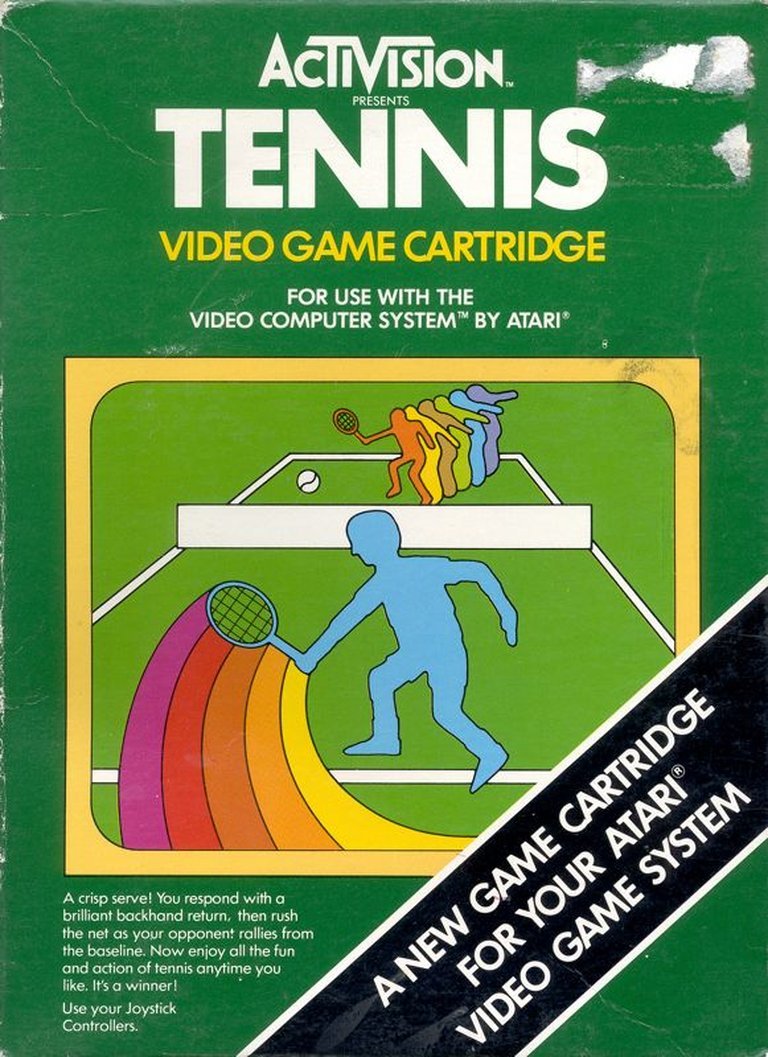
Description
Tennis is a classic sports game released in 1981 for the Atari 2600, offering singles tennis gameplay for one or two players. Players can compete against the computer or each other, following standard tennis rules with forehand and backhand shots. The game features two skill levels—a slower practice mode and a faster, more challenging mode—providing a straightforward yet engaging experience for fans of the sport.
Gameplay Videos
Where to Buy Tennis
PC
Tennis Reviews & Reception
mobygames.com (60/100): Tennis is as far removed from the primitive Pong-style games from which it derives as gasoline is from the dinosaurs.
thealmightyguru.com : The game is so repetitive it drags on for a long time.
boardgamegeek.com (63/100): Activision Tennis is played for one set of games, in which the first player to win six games won the competition.
Tennis Cheats & Codes
Nintendo Entertainment System (NES)
Enter Game Genie codes.
| Code | Effect |
|---|---|
| PEKVGGZA | All points scored by the CPU go to you |
| PEUVIGZA | All points scored by the CPU go to you |
| PEXVTGAA | All points scored by the CPU go to you |
| PEOVPGZA | All points scored by the CPU go to you |
| PAKVZZZA | All points scored by the CPU go to you |
| PAXTAZZA | All points scored by the CPU go to you |
| PAOVZZZA | All points scored by the CPU go to you |
| AEEKUIIL | Hit the ball anywhere |
| AENKUVSG | Hit the ball anywhere |
| AENGSTUI | Hit the ball anywhere |
| AAEGSYUG | Hit the ball anywhere |
| AASTZZZA | Hit the ball anywhere |
| TENNIS | Somewhat glitched character while walking |
| EIUVXAEY | Win the trophy after just 2 points played |
| APOTXAEI | Win the trophy after just 2 points played |
Tennis (1981): A Pioneering Digital Rally
Introduction
In the pantheon of early video games, few titles embody the spirit of innovation and simplicity as Tennis (1981) for the Atari 2600. Developed by Activision co-founder Alan Miller, this game is more than just a digital adaptation of a beloved sport—it is a testament to the ingenuity of early game designers who pushed the boundaries of limited hardware to create engaging experiences. While modern audiences might dismiss it as a primitive relic, Tennis stands as a pivotal title in the evolution of sports video games, bridging the gap between Pong and the complex simulations of today.
This review will dissect Tennis from every angle, exploring its development, gameplay mechanics, reception, and lasting legacy. We will argue that while Tennis may not have aged gracefully in terms of visuals or depth, its contributions to competitive gaming and its role in Activision’s early success make it a historically significant title worthy of study and appreciation.
Development History & Context
The Birth of Activision and the Atari 2600 Landscape
The late 1970s and early 1980s were a period of rapid evolution in the video game industry. The Atari 2600, released in 1977, had become the dominant home console, but its library was flooded with simplistic, often uninspired titles. Many of these games were developed by Atari itself, which treated its programmers as interchangeable cogs in a corporate machine, offering no royalties or recognition for their creative contributions.
This environment led to the formation of Activision in 1979, the industry’s first third-party developer. Founded by disgruntled Atari programmers—David Crane, Larry Kaplan, Alan Miller, and Bob Whitehead—Activision sought to revolutionize game development by crediting designers, offering royalties, and prioritizing quality over quantity. Tennis was one of Activision’s early releases, designed by Alan Miller, who had previously worked on Basketball and Checkers for Atari.
Technological Constraints and Design Philosophy
The Atari 2600’s hardware was severely limited by modern standards. The system’s graphics chip, the Television Interface Adapter (TIA), could only display a handful of sprites at once, with no support for scrolling or complex backgrounds. The console’s 128 bytes of RAM and 4KB of ROM space meant that every byte of code had to be optimized.
Miller’s challenge was to create a tennis game that felt dynamic and competitive despite these constraints. His solution was elegant: strip the sport down to its core mechanics—serving, returning, and positioning—while leveraging the Atari 2600’s strengths, such as its responsive joystick controls. The result was a game that, while visually sparse, captured the essence of tennis as a battle of reflexes and strategy.
The Gaming Landscape in 1981
By 1981, the video game market was expanding rapidly. Arcade games like Pac-Man and Donkey Kong were cultural phenomena, while home consoles were becoming a staple in households. Sports games, however, were still in their infancy. Most titles were either Pong clones or overly simplistic adaptations that failed to capture the nuances of their real-world counterparts.
Tennis arrived at a time when players were hungry for more sophisticated experiences. Activision’s marketing emphasized the game’s realism, highlighting features like authentic scoring (including deuces and advantage points) and the ability to play against a computer opponent—a rarity in early sports games. The inclusion of two difficulty settings (a slower “practice” mode and a faster “competitive” mode) further set Tennis apart from its contemporaries.
Narrative & Thematic Deep Dive
The Absence of Narrative: A Strength or a Weakness?
Tennis is a game devoid of narrative in the traditional sense. There are no characters, no storylines, and no cutscenes. The “plot,” if it can be called that, is simple: two players (or a player and the CPU) engage in a singles match, with the first to win six games declared the victor. This minimalism was a product of both technological limitations and design philosophy.
However, the lack of narrative does not mean Tennis lacks thematic depth. The game is a pure distillation of competition—a digital arena where skill, timing, and adaptability are the only currencies. In this sense, Tennis is a metaphor for the early days of video gaming itself: a test of hand-eye coordination and perseverance, where victory is earned through repetition and mastery.
The Illusion of Depth and Realism
One of Tennis’ most praised features was its “realistic illusion of depth,” a phrase used by judges at the 1982 Arkie Awards. This was achieved through clever programming tricks. For instance, the ball’s trajectory and the players’ positioning created a sense of spatial awareness, even though the court was a flat, two-dimensional plane. The game’s scoring system, which mirrored real tennis (including terms like “deuce” and “advantage”), further enhanced this illusion, making players feel as though they were participating in a legitimate match rather than a glorified Pong variant.
Themes of Competition and Accessibility
At its core, Tennis is a celebration of competition. The game’s two-player mode was its strongest selling point, fostering rivalry and camaraderie in equal measure. The Arkie Awards judges noted that Tennis gave “more methodical players a chance to taste victory against the kings and queens of hand-eye coordination,” highlighting its balance between accessibility and challenge.
This theme of accessibility is crucial. Unlike many arcade games of the era, which were designed to be punishingly difficult to extract quarters from players, Tennis was approachable. The slower practice mode allowed newcomers to learn the mechanics, while the faster mode provided a stiffer challenge for veterans. This duality made Tennis a game that could be enjoyed by casual players and competitive gamers alike.
Gameplay Mechanics & Systems
Core Gameplay Loop: Serving, Returning, and Positioning
Tennis’ gameplay is deceptively simple. Players control a tennis athlete (colored either pink or blue) using the Atari 2600’s joystick. Movement is limited to left and right along the baseline, with the fire button used to swing the racket. The game automatically determines whether the swing is a forehand or backhand based on the ball’s position relative to the player.
The core loop revolves around three actions:
1. Serving: The serving player initiates the rally by pressing the fire button. The serve’s direction is determined by the player’s position on the court.
2. Returning: The receiving player must position themselves to intercept the ball and return it. Timing is critical—hitting the ball too early or too late results in a miss.
3. Positioning: Successful play requires anticipating the opponent’s shots and moving to cover the court effectively. The game’s AI (in single-player mode) is programmed to return most shots, forcing the player to aim for the edges of the court to score points.
The Role of Physics and Ball Mechanics
Given the Atari 2600’s limitations, Tennis employs simplified physics. The ball moves at a constant speed, and its trajectory is determined by the angle at which it is struck. Unlike real tennis, where spin, speed, and court surface affect the ball’s behavior, Tennis’ ball follows a predictable arc. This predictability is both a strength and a weakness:
– Strength: It allows players to develop strategies based on positioning and timing.
– Weakness: It leads to repetitive rallies, especially in matches between equally skilled players.
The game’s manual notes that hitting the ball with the “tip” of the racket allows for wider angles, adding a layer of risk versus reward. However, this mechanic is underutilized, as the AI rarely exploits it, and human players often default to safer, straight returns.
Scoring and Match Structure
Tennis adheres to a simplified version of real tennis scoring. Matches are played as a single set, with the first player to win six games declared the winner. If the set reaches a 6-6 tie, it resets to 0-0, and players continue until one pulls ahead by two games. This structure differs from professional tennis, where matches are typically best-of-three or best-of-five sets, but it was a necessary concession to the game’s pacing and the limitations of the hardware.
The scoring system includes standard tennis terminology:
– 15, 30, 40: Points within a game.
– Deuce: A 40-40 tie.
– Advantage: The point following a deuce, where the next point wins the game.
This attention to detail was a major selling point, as it made Tennis feel more authentic than other sports games of the era.
AI and Single-Player Experience
The single-player mode pits the player against a computer-controlled opponent. The AI’s behavior is straightforward: it moves to intercept the ball and returns it with minimal error. While this makes the AI a formidable opponent in the faster difficulty setting, it also leads to a predictable and, at times, frustrating experience.
Critics have noted that the AI’s near-perfect returns can make single-player matches drag on, especially since the game lacks the stamina or fatigue mechanics of real tennis. The Video Game Critic’s review highlights this issue, stating that “playing the CPU is a tremendous bore” due to the AI’s relentless consistency. This flaw underscores the limitations of early AI programming, where developers struggled to balance challenge with fairness.
Multiplayer: The Heart of the Experience
Where Tennis truly shines is in its two-player mode. The competitive dynamic between human players transforms the game from a repetitive exercise into a thrilling test of reflexes and strategy. The lack of complex mechanics means that matches are decided purely by skill and adaptability, making victories feel earned.
The game’s multiplayer mode also benefits from the Atari 2600’s local co-op setup. Players sit side by side, each controlling their own athlete, creating a social experience that was a hallmark of early gaming. This setup fostered rivalry and camaraderie, turning Tennis into a party game as much as a sports simulation.
Innovations and Flaws
Tennis introduced several innovations that would become staples of sports games:
– Authentic Scoring: The inclusion of tennis-specific terminology and rules set a precedent for realism in sports games.
– Difficulty Settings: The option to toggle between slower and faster gameplay catered to both casual and competitive players.
– AI Opponent: While flawed, the single-player mode was a rarity in early sports games, which often required two human players.
However, the game’s flaws are equally notable:
– Repetitive Gameplay: The lack of variety in shots and strategies leads to monotonous rallies.
– Predictable AI: The computer opponent’s behavior is too consistent, making single-player matches tedious.
– Limited Visual Feedback: The Atari 2600’s graphical limitations mean that the court and players are barely distinguishable, relying on color coding (pink and blue) to differentiate athletes.
World-Building, Art & Sound
Visual Design: Minimalism as a Virtue
Tennis’ visuals are a study in minimalism. The court is represented by a series of lines, with the net depicted as a thin horizontal strip. The players are stick figures, colored pink and blue, with no discernible features beyond their rackets. The ball is a simple square, a concession to the Atari 2600’s low resolution.
Despite these limitations, the game’s visual design is functional. The court’s layout is clear, and the players’ positions are easy to track. The use of color to differentiate players was a smart choice, as it allowed for quick identification during fast-paced rallies. The game’s fixed-screen perspective (a common trait of early sports games) ensures that the entire court is visible at all times, eliminating the need for scrolling or camera adjustments.
The PAL/NTSC Color Quirk
An interesting trivia note from MobyGames highlights a quirk in the game’s color palette. When played on a PAL television (the European standard) with an NTSC cartridge (the North American standard), the court’s green hue shifts to blue. This accidental color change gives the impression of a hard court rather than a grass court, a subtle nod to the game’s adaptability across different regions.
Sound Design: The Symphony of Beeps
The Atari 2600’s sound capabilities were as limited as its graphics. Tennis’ audio consists of a series of beeps and bloops:
– A high-pitched tone accompanies the ball’s movement.
– A lower-pitched tone signals a successful hit.
– A distinct sound plays when a point is scored.
While these sounds are rudimentary, they serve a crucial purpose: providing auditory feedback in a game where visual cues are minimal. The rhythmic beeping of the ball creates a sense of tension during rallies, while the scoring sound reinforces the competitive stakes.
Atmosphere and Immersion
Tennis’ atmosphere is one of pure competition. There are no crowds, no commentators, and no environmental details—just two players and a ball. This starkness is both a limitation and a strength. On one hand, it fails to capture the spectacle of real tennis. On the other, it distills the sport to its essence, creating a focused, almost meditative experience.
The game’s lack of distractions means that players are fully immersed in the mechanics of play. Every beep of the ball, every pixel of movement, becomes a critical piece of information. In this sense, Tennis is a precursor to modern competitive games like Rocket League or Pong’s spiritual successors, where the thrill comes from mastery rather than spectacle.
Reception & Legacy
Critical Reception: A Mixed but Respectful Response
Tennis received a generally positive reception upon its release, though opinions varied widely. The game’s average critic score on MobyGames is 60%, with player ratings averaging 2.9 out of 5. This disparity reflects the game’s polarizing nature: it was groundbreaking for its time but has not aged well.
Positive Reviews:
– The Atari Times (90%): Praised the game’s solid gameplay, calling it “a very fun and common game” that remains “a worthwhile purchase.”
– Tilt (83%): Highlighted the game’s emphasis on reflexes over technique, noting its competitive appeal.
– Retrogaming.it (60%): Described it as “a necessary step in the evolution” of sports games, though less gratifying for modern players.
Negative Reviews:
– Woodgrain Wonderland (42%): Called it “a rare misstep for Activision’s golden era,” criticizing its repetitive single-player mode.
– The Video Game Critic (25%): Lamented its monotonous gameplay, stating that “the action eventually becomes tedious,” especially against the AI.
Awards and Accolades
Despite mixed reviews, Tennis was recognized for its innovations. At the 3rd annual Arkie Awards, it won “Best Competitive Game” and received an honorable mention for “Best Sports Game.” The judges’ comments were effusive, comparing its evolution from Pong to the transformation of dinosaurs into gasoline—a hyperbolic but telling metaphor for how far sports games had come in a few short years.
Commercial Success and Cultural Impact
Tennis was a commercial success for Activision, contributing to the company’s early reputation for quality. The game’s inclusion in multiple Activision Anthology compilations (released on platforms ranging from the Game Boy Advance to the Xbox 360) speaks to its enduring appeal as a historical artifact.
One of the game’s most enduring legacies is the Activision Tennis Patch, a promotional reward for players who could defeat the computer in a single set. This patch, sent to players who mailed in a photograph of their television screen showing their victory, was one of gaming’s earliest examples of achievement-based rewards—a precursor to modern trophies and achievements.
Influence on Future Games
Tennis’ influence can be seen in several areas:
1. Sports Game Realism: Its adherence to real tennis rules set a precedent for future sports games, which increasingly sought to replicate the intricacies of their real-world counterparts.
2. Competitive Multiplayer: The game’s emphasis on local multiplayer foreshadowed the rise of competitive gaming, from Street Fighter II to Super Smash Bros.
3. AI in Sports Games: While flawed, Tennis’ single-player mode demonstrated the potential for AI opponents in sports games, a feature that would become standard in titles like Madden NFL and FIFA.
Modern Reappraisal: Nostalgia vs. Playability
Modern reviews of Tennis are often colored by nostalgia. Retro Arcade Memories’ review captures this sentiment, calling the game “a perfect example of how even the most minimalistic games can be timeless.” However, critics like The Video Game Critic argue that the game’s repetitive mechanics and lack of depth make it a relic best left in the past.
The game’s legacy is thus a dual one: it is celebrated for its historical significance but criticized for its lack of enduring playability. This tension is common among early video games, which are often more important as cultural artifacts than as contemporary entertainment.
Conclusion: A Landmark in Early Sports Gaming
Tennis (1981) is a game of contradictions. It is both groundbreaking and primitive, innovative and repetitive, celebrated and criticized. Its visuals are sparse, its sound design rudimentary, and its AI predictable. Yet, it remains a landmark title in the history of video games—a testament to the creativity of early developers and the potential of competitive gaming.
Final Verdict:
Tennis is not a game for modern audiences seeking depth or spectacle. However, as a historical artifact, it is invaluable. It represents a crucial step in the evolution of sports games, demonstrating how developers could leverage limited hardware to create engaging, competitive experiences. For retro gaming enthusiasts and historians, Tennis is a must-play, offering a glimpse into the infancy of a genre that would eventually dominate the industry.
Score: 7/10 (Historical Significance) | 4/10 (Modern Playability)
Tennis may not be a game you’ll return to often, but it is one that deserves to be remembered. In the annals of video game history, it stands as a pioneer—a digital rally that paved the way for the complex, immersive sports simulations of today.