
- Release Year: 1998
- Platforms: Windows
- Publisher: Dinamic Multimedia, S.A.
- Developer: Dinamic Multimedia, S.A.
- Genre: Business simulation, Managerial, Sports
- Perspective: Third-person
- Game Mode: Hotseat, Single-player
- Gameplay: Business simulation, Managerial, Tactics, Team Management
- Setting: Football (European), Soccer, Sports
- Average Score: 65/100
Description
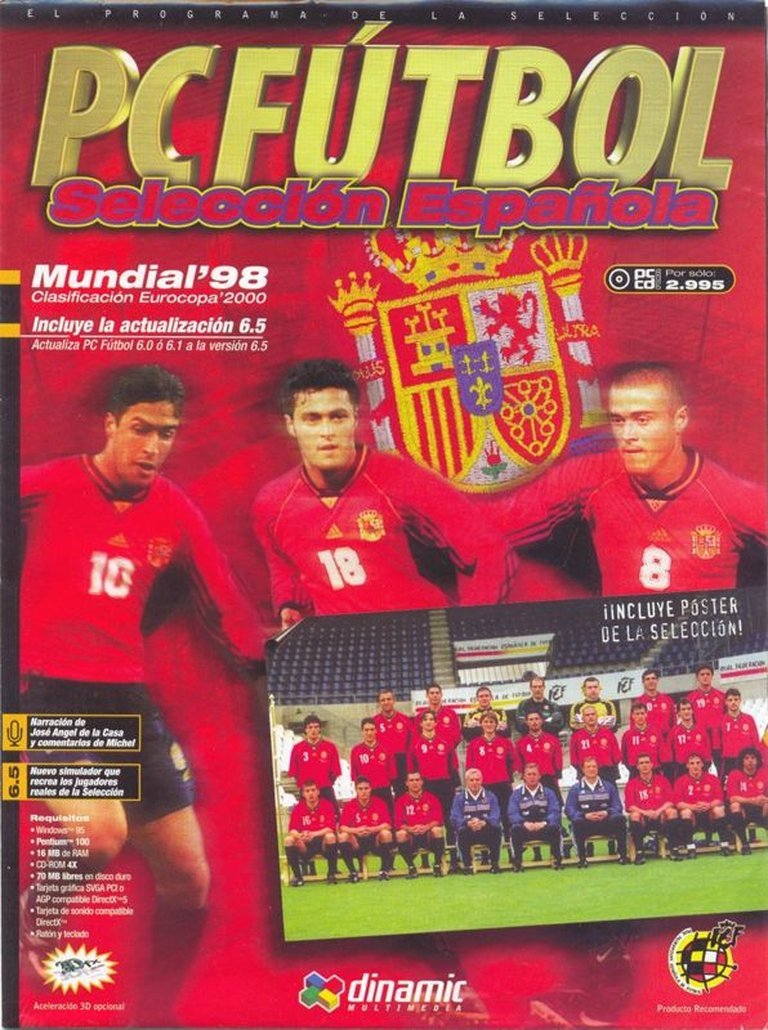
PC Fútbol Selección Española ’98 is a football management and simulation game released in 1998, centered around the Spanish national team and the 1998 FIFA World Cup in France. Players can engage in friendly matches, compete in the World Cup with any national team, or take on the role of the Spanish team’s coach in ‘Seleccionador Nacional’ mode, where they can select players from Spanish leagues or abroad, customize tactics, and manage training. The game features an updated 3D simulator with improved AI, real player rosters, and support for 3Dfx hardware, offering a realistic and immersive football experience.
Gameplay Videos
PC Fútbol Selección Española ’98 Reviews & Reception
mobygames.com (65/100): A great compilation of all competition international players and coaches.
retro-replay.com : PC Fútbol Selección Española ’98 offers a depth of gameplay that will satisfy both casual football fans and die-hard strategists.
retrolorean.com : PC Fútbol Selección Española ’98 fue un videojuego de fútbol muy esperado lanzado en 1998 para la plataforma Windows.
PC Fútbol Selección Española ’98: A Deep Dive into Spain’s 1998 World Cup Football Simulation
Introduction: The Pinnacle of Spanish Football Gaming
In the late 1990s, football video games were evolving from simple arcade-style experiences into complex simulations that aimed to capture the tactical depth and emotional highs of the beautiful game. Among these, PC Fútbol Selección Española ’98 stands as a fascinating artifact—a game that not only celebrated Spain’s national team but also pushed the boundaries of what a football management simulator could achieve on the PC platform. Developed and published by Dinamic Multimedia, this title was more than just a licensed cash-in on the 1998 World Cup; it was a meticulously crafted love letter to Spanish football, offering players unprecedented control over La Furia Roja and a chance to rewrite history.
At its core, PC Fútbol Selección Española ’98 was a hybrid of management simulation and on-pitch action, blending the strategic depth of Dinamic’s long-running PC Fútbol series with the excitement of international tournament football. Released in 1998, the game arrived at a pivotal moment in gaming history—just as 3D graphics were becoming mainstream and sports simulations were beginning to embrace realism over arcade-style gameplay. With its exhaustive database of players, coaches, and stadiums, as well as its innovative “Seleccionador Nacional” mode, the game offered Spanish football fans a chance to step into the boots of the national team manager and guide their heroes to glory.
This review will explore the game’s development history, its gameplay mechanics, its narrative and thematic depth, and its lasting legacy in the world of football gaming. We’ll examine how PC Fútbol Selección Española ’98 captured the spirit of the 1998 World Cup, why it resonated so deeply with Spanish audiences, and how it compares to other football simulations of its era. By the end, we’ll determine whether this game was a triumphant goal or a missed opportunity in the annals of sports gaming history.
Development History & Context: Dinamic’s Football Legacy
The Rise of Dinamic Multimedia
Dinamic Multimedia was one of Spain’s most prolific and influential game developers during the 1990s. Founded in 1984, the company initially focused on arcade-style games before pivoting to sports simulations in the early 1990s. Their PC Fútbol series, which debuted in 1993, quickly became a cultural phenomenon in Spain, offering a level of depth and realism that rivaled (and in some ways surpassed) international competitors like Championship Manager and FIFA.
By the late 1990s, Dinamic had established itself as the go-to developer for Spanish football fans. The PC Fútbol series was known for its detailed player databases, tactical flexibility, and realistic match simulations. Each iteration built upon the last, incorporating new features and refinements that kept the series fresh and engaging.
The 1998 World Cup: A Perfect Storm
The 1998 FIFA World Cup in France was a watershed moment for international football. For Spain, it was a chance to prove themselves on the world stage after decades of underachievement. The Spanish national team, led by stars like Raúl, Fernando Hierro, and Luis Enrique, entered the tournament with high hopes but ultimately fell short, losing to Nigeria in the group stage and failing to advance.
PC Fútbol Selección Española ’98 was Dinamic’s attempt to capitalize on the excitement surrounding the World Cup while also giving Spanish fans a chance to rewrite history. The game was released as a standalone title rather than as part of the main PC Fútbol series, allowing Dinamic to focus exclusively on the national team experience.
Technological Constraints and Innovations
Developing a football simulation in 1998 came with significant technical challenges. The game was built on an updated version of the PC Fútbol 6.0 engine, now at version 6.5, which introduced several key improvements:
– Enhanced 3D Simulator: The game featured a more advanced 3D match engine with improved player animations, AI, and physics.
– 3Dfx Hardware Support: For players with compatible graphics cards, the game offered smoother visuals and higher frame rates.
– Real Player Rosters: The database included accurate player stats, names, and positions, making the experience feel more authentic.
– Stadium Recreations: All the venues from the 1998 World Cup were faithfully recreated, complete with crowd animations and dynamic lighting.
Despite these advancements, the game was still limited by the hardware of the era. The 3D graphics, while impressive for the time, were rudimentary by modern standards, and the AI—while improved—could still be unpredictable.
The Gaming Landscape in 1998
The late 1990s were a golden age for football video games. FIFA 98: Road to World Cup and International Superstar Soccer Pro 98 dominated the console market, while Championship Manager 97/98 ruled the PC management simulation scene. PC Fútbol Selección Española ’98 occupied a unique niche: it was neither a pure management sim nor a pure arcade-style football game. Instead, it offered a hybrid experience that appealed to fans of both genres.
For Spanish gamers, the game was a must-have. It allowed them to engage with their national team in a way that no other game could, offering a level of customization and control that was unmatched at the time.
Narrative & Thematic Deep Dive: The Story of La Furia Roja
The Absence of a Traditional Narrative
Unlike story-driven games, PC Fútbol Selección Española ’98 doesn’t feature a traditional narrative with cutscenes, dialogue, or character arcs. Instead, its storytelling is emergent, unfolding through the player’s actions and the game’s systems. The “story” is the journey of the Spanish national team—from the highs of victory to the lows of defeat—and the player’s role as the architect of that journey.
Themes of National Pride and Redemption
At its heart, the game is about national pride. The Spanish national team has long been a source of both joy and frustration for its fans, and PC Fútbol Selección Española ’98 taps into that emotional resonance. The game’s “Seleccionador Nacional” mode is particularly poignant, as it allows players to take on the role of the national team coach and attempt to guide Spain to World Cup glory—a feat the real team had yet to achieve at the time.
The theme of redemption is also central to the experience. The game’s inclusion of the Euro 2000 qualifying round mode extends the narrative beyond the 1998 World Cup, giving players a chance to build a team that can succeed in future tournaments. This creates a sense of continuity and progression, as players nurture young talents and refine their tactics over multiple seasons.
The Role of Authenticity
One of the game’s greatest strengths is its commitment to authenticity. From the inclusion of real-life commentators like Paco González and Manolo Lama to the accurate recreations of World Cup stadiums, the game goes to great lengths to immerse players in the world of international football. The player database is another standout feature, with real names, stats, and abilities that reflect the strengths and weaknesses of the actual Spanish squad.
This authenticity extends to the game’s presentation. The menus, match overlays, and even the text-based commentary all contribute to a sense of realism that was rare in football games of the era. The game doesn’t just simulate football—it simulates the experience of watching and managing a national team.
The Emotional Highs and Lows of Tournament Football
The game’s narrative is driven by the emotional rollercoaster of tournament football. Friendly matches serve as warm-ups for the main event, while the World Cup itself is a high-stakes gauntlet where every decision matters. The tension of knockout matches, the elation of last-minute goals, and the despair of unexpected defeats all combine to create a compelling, if abstract, story.
The “EuroCup Qualifying Round” mode adds another layer to this narrative, as players must navigate the challenges of a long-term campaign. Injuries, suspensions, and form fluctuations all play a role, forcing players to adapt their strategies and make tough decisions. This creates a sense of investment in the team’s journey, as players see their tactical choices and squad selections play out over multiple matches.
Gameplay Mechanics & Systems: A Hybrid of Management and Action
Game Modes: From Friendlies to World Cup Glory
PC Fútbol Selección Española ’98 offers several distinct game modes, each catering to different playstyles:
1. Friendly Matches: A quick, low-stakes way to get acquainted with the controls and mechanics.
2. World Cup Mode: Jump straight into the 1998 World Cup with any national team. While this mode doesn’t allow for squad customization, it’s a great way to experience the tournament from different perspectives.
3. “Seleccionador Nacional” Mode: The game’s crown jewel. Here, players take on the role of the Spanish national team coach, with full control over squad selection, tactics, and training. This mode allows players to choose from Spanish players in La Liga (from the first division down to the fourth) or those playing abroad.
4. EuroCup Qualifying Round: A forward-looking mode that lets players guide Spain through the qualifiers for Euro 2000. This mode adds a long-term strategic element to the game, as players must manage squad rotation and player development over multiple matches.
Squad Management: Crafting Your Dream Team
The “Seleccionador Nacional” mode is where the game truly shines. Players are given unprecedented control over the Spanish squad, with the ability to:
– Select 22 players from a vast database of Spanish footballers, including those playing in lower divisions or abroad.
– Customize player numbers, positions, and roles, allowing for tactical flexibility.
– Assign individual training regimens to improve player stats over time.
– Create bespoke team tactics, from defensive formations to attacking strategies.
This level of customization was rare in football games of the era, and it gave PC Fútbol Selección Española ’98 a unique appeal. Players could experiment with different lineups, test unconventional tactics, and see how their choices played out on the pitch.
Match Simulation: The 3D Engine
The game’s match engine is built on an updated version of the PC Fútbol 6.0 simulator, now at version 6.5. Key features include:
– Improved AI: Opponents adapt to the player’s tactics, making matches more dynamic and unpredictable.
– Realistic Player Movements: Animations are fluid and weighty, with players reacting authentically to passes, tackles, and shots.
– 3Dfx Hardware Support: For players with compatible graphics cards, the game offers smoother visuals and higher frame rates.
– Stadium Atmosphere: Crowd animations, dynamic lighting, and weather effects add to the immersion.
While the 3D graphics are rudimentary by modern standards, they were impressive for the time. The game’s controls are intuitive, with a mix of keyboard and mouse inputs that allow for precise passing, shooting, and defending. The AI, while improved, can still be frustrating at times, with occasional lapses in decision-making that can lead to unrealistic outcomes.
Tactical Depth: More Than Just a Football Game
What sets PC Fútbol Selección Española ’98 apart from other football games of its era is its tactical depth. Players aren’t just controlling a team—they’re managing a squad, making strategic decisions that affect performance over the long term. Key tactical elements include:
– Formation Selection: Choose from a variety of formations, from defensive 5-4-1 setups to attacking 4-3-3 systems.
– Player Roles: Assign specific roles to players, such as playmakers, target men, or defensive anchors.
– Set Pieces: Customize corner kicks, free kicks, and penalties to exploit opponent weaknesses.
– In-Game Adjustments: Make real-time tactical changes during matches, such as switching formations or substituting players.
This depth makes the game rewarding for both casual players and hardcore strategists. Casual fans can enjoy the on-pitch action, while tactical minds can dive into the nuances of squad management and match strategy.
Multiplayer: Competing with Friends
The game also features a multiplayer mode, allowing up to 8 players to compete in friendly matches or mini-tournaments. While the multiplayer experience is limited by the technology of the era (no online play, for example), it’s a fun way to test your skills against friends. The intuitive controls and smooth gameplay make it accessible to players of all skill levels.
World-Building, Art & Sound: Capturing the Spirit of the 1998 World Cup
Stadiums and Atmosphere: Bringing France to Life
One of the game’s standout features is its faithful recreation of the 1998 World Cup stadiums. From the iconic Stade de France to the historic Parc des Princes, each venue is rendered with attention to detail, complete with crowd animations, dynamic lighting, and weather effects. The stadiums aren’t just backdrops—they’re part of the experience, adding to the immersion and making each match feel like a special event.
The game’s weather system is another nice touch. Matches can take place in sunny conditions, overcast skies, or under floodlights, each affecting the gameplay in subtle ways. Rain, for example, can make the pitch slippery, while evening matches under lights create a dramatic atmosphere.
Player Models and Animations: A Step Forward
For 1998, the game’s player models and animations were a significant step forward. Players are rendered in 3D with detailed textures, and their movements are fluid and realistic. Passing, shooting, and tackling all feel weighty and responsive, thanks to the improved physics engine. While the graphics are rudimentary by modern standards, they were impressive for the time and contributed to the game’s sense of realism.
The game also features realistic kit designs, with accurate representations of the Spanish national team’s iconic red jerseys and the kits of other participating nations. Small details, like player sweat and kit creases, add to the immersion, making the matches feel more like real football.
Sound Design: The Voice of Spanish Football
The game’s sound design is another area where it excels. The inclusion of real-life Spanish commentators Paco González and Manolo Lama is a masterstroke, adding a layer of authenticity that was rare in football games of the era. Their energetic and enthusiastic commentary brings the matches to life, making players feel like they’re watching a real broadcast.
The crowd noises are also well-implemented, with dynamic reactions to goals, near-misses, and controversial decisions. The sound of the ball being kicked, the referee’s whistle, and the roar of the crowd all contribute to the game’s immersive atmosphere.
User Interface: Functional and Intuitive
The game’s user interface is clean and functional, with menus that are easy to navigate and player portraits that load quickly. Match overlays, such as timers, scoreboards, and mini-maps, are unobtrusive, ensuring that players can focus on the action without distraction. The interface strikes a fine balance between aesthetic appeal and functionality, making it easy to manage your squad and tactics without getting bogged down in unnecessary complexity.
Reception & Legacy: How the Game Was Received and Its Lasting Impact
Critical Reception: A Mixed but Positive Response
PC Fútbol Selección Española ’98 received a generally positive reception from critics, though it wasn’t without its detractors. The game’s exhaustive database, realistic match engine, and deep tactical options were widely praised, as was its commitment to authenticity. Critics also appreciated the game’s multiplayer mode and its faithful recreation of the 1998 World Cup stadiums.
However, the game was not without its flaws. Some critics noted that the AI could be unpredictable at times, leading to unrealistic outcomes in matches. Others felt that the graphics, while impressive for the time, were still somewhat rudimentary compared to console counterparts like FIFA 98. The game’s lack of online multiplayer was also a missed opportunity, limiting its long-term appeal.
The game holds a 65% critic score on MobyGames, based on a single review from Meristation, which praised the game’s depth and authenticity but noted some technical limitations. Player reviews were slightly more favorable, with an average score of 3.4 out of 5, suggesting that the game resonated more deeply with its target audience of Spanish football fans.
Commercial Success: A Hit with Spanish Fans
While exact sales figures are difficult to come by, PC Fútbol Selección Española ’98 was a commercial success in Spain, where it tapped into the national passion for football. The game’s focus on the Spanish national team, combined with its deep customization options, made it a must-have for fans of La Furia Roja. Its release during the 1998 World Cup also helped to boost its profile, as Spanish fans looked for ways to engage with the tournament beyond just watching matches.
Legacy: Influencing Future Football Games
PC Fútbol Selección Española ’98 may not have had the same global impact as FIFA or Championship Manager, but it left a lasting legacy in the world of football gaming. The game’s hybrid approach—combining management simulation with on-pitch action—was ahead of its time and influenced later titles in the PC Fútbol series and beyond.
The game’s commitment to authenticity, from its real player rosters to its faithful stadium recreations, set a new standard for football simulations. It also demonstrated the appeal of national team-focused games, paving the way for future titles like FIFA’s World Cup spin-offs and Football Manager’s international management modes.
For Spanish football fans, the game remains a beloved artifact of the late 1990s—a chance to relive the excitement of the 1998 World Cup and imagine what might have been if Spain had gone all the way.
Conclusion: A Triumph of Authenticity and Depth
PC Fútbol Selección Española ’98 is a game that punches above its weight. Released in an era dominated by FIFA and Championship Manager, it carved out its own niche by offering Spanish football fans a deeply authentic and customizable experience centered around their national team. The game’s exhaustive database, realistic match engine, and tactical depth make it a standout title in the PC Fútbol series and a fascinating artifact of late-1990s football gaming.
While the game’s graphics and AI may feel dated by modern standards, its commitment to authenticity and its innovative hybrid gameplay remain impressive. The “Seleccionador Nacional” mode, in particular, is a masterclass in player agency, giving fans the tools to craft their dream Spanish squad and guide them to glory.
Ultimately, PC Fútbol Selección Española ’98 is more than just a football game—it’s a celebration of Spanish football culture. It captures the passion, the frustration, and the unyielding hope of La Furia Roja fans, offering a chance to rewrite history and experience the thrill of international tournament football. For that reason, it deserves to be remembered as one of the most ambitious and authentic football simulations of its era.
Final Verdict: 8/10 – A Deep, Authentic, and Rewarding Football Experience
PC Fútbol Selección Española ’98 may not have the polish or global reach of its contemporaries, but its heart, depth, and commitment to the Spanish national team make it a classic in its own right. For fans of football management simulations and Spanish football history, it’s a must-play.