
- Release Year: 2010
- Platforms: iPad, iPhone, Macintosh, Windows
- Publisher: Big Fish Games, Inc., Focus Multimedia Ltd., Just For Games SAS
- Developer: ERS G-Studio
- Genre: Adventure
- Perspective: 1st-person
- Game Mode: Single-player
- Gameplay: Hidden object, Puzzle elements
- Setting: 19th century, Horror
Description
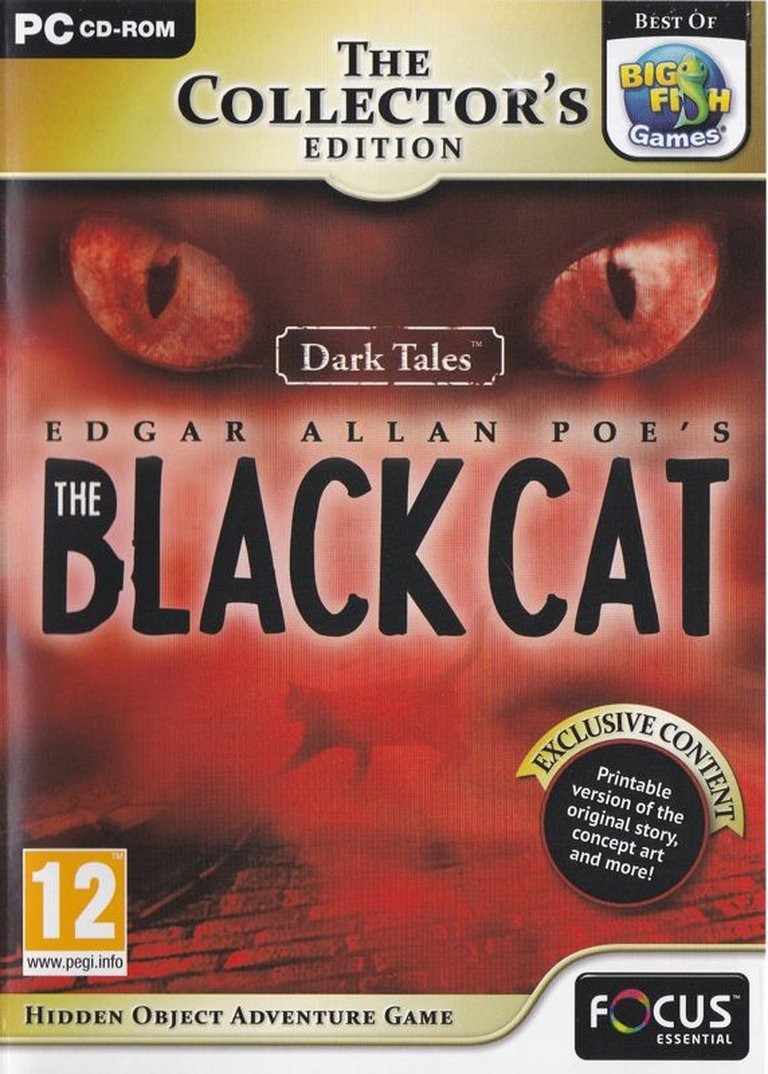
In ‘Dark Tales: Edgar Allan Poe’s The Black Cat,’ players step into the role of detective Auguste Dupin’s assistant in late 19th-century France to solve the mysterious disappearance of Madam Sara, the wife of a wealthy man. Set in a ruined mansion, the game blends hidden object challenges with point-and-click adventure elements, as players uncover clues tied to a sinister black cat and a ghostly woman. The gameplay involves collecting items, solving puzzles, and completing mini-games to progress through the eerie, Poe-inspired narrative.
Gameplay Videos
Dark Tales: Edgar Allan Poe’s The Black Cat Free Download
Dark Tales: Edgar Allan Poe’s The Black Cat Guides & Walkthroughs
Dark Tales: Edgar Allan Poe’s The Black Cat: A Masterclass in Gothic Adventure Gaming
Introduction: A Haunting Prelude to Mystery
Few games capture the eerie, psychological depth of Edgar Allan Poe’s literature as effectively as Dark Tales: Edgar Allan Poe’s The Black Cat. Released in 2010 by ERS G-Studio and published by Big Fish Games, this hidden object adventure (HOPA) game is a masterful adaptation of Poe’s 1843 short story, blending gothic horror, intricate puzzles, and a narrative that lingers like a specter. As the second installment in the Dark Tales series, it refines the formula established by its predecessor, Murders in the Rue Morgue, while carving its own niche in the pantheon of literary-inspired games.
The game’s premise is deceptively simple: Madame Sara Davies, wife of the wealthy Monsieur Davies, has vanished under mysterious circumstances. Players assume the role of an unnamed assistant to the legendary detective C. Auguste Dupin, tasked with unraveling the enigma of her disappearance. The investigation leads them through a labyrinthine estate, where every shadow seems to whisper secrets and a sinister black cat lurks as both guide and omen. The game’s genius lies in its ability to transform Poe’s themes—guilt, madness, and the supernatural—into an interactive experience that is as intellectually stimulating as it is unsettling.
At its core, The Black Cat is a testament to the power of atmospheric storytelling in gaming. It doesn’t rely on jump scares or gratuitous violence; instead, it weaves a tapestry of dread through its environment, sound design, and narrative pacing. This review will dissect the game’s development, narrative depth, gameplay mechanics, and artistic achievements, ultimately arguing that Dark Tales: Edgar Allan Poe’s The Black Cat is not just a standout title in the HOPA genre but a landmark in adapting classical literature into interactive media.
Development History & Context: The Birth of a Gothic Masterpiece
The Studio Behind the Shadows: ERS G-Studio
ERS G-Studio, a Ukrainian developer later rebranded as Amax Interactive, was already a formidable name in the casual gaming scene by 2010. Known for their meticulous attention to detail and innovative puzzle design, the studio had carved a niche in creating immersive hidden object games. The Black Cat was part of their broader Dark Tales series, which sought to adapt Poe’s works into interactive adventures. The first game, Murders in the Rue Morgue, had been well-received, setting the stage for a sequel that would push the boundaries of the genre.
The development team, led by producers Rouslan Pismenniy and Vladimir Savenkov, and game designer Alexander Grabovenko (Zander), approached The Black Cat with a clear vision: to create a game that was not just a loose adaptation of Poe’s story but a faithful homage to his themes and style. The challenge was to balance the constraints of the HOPA genre—often criticized for its repetitive gameplay—with the depth of Poe’s psychological horror.
Technological Constraints and Innovations
Released in the early 2010s, The Black Cat was developed during a transitional period in gaming. The rise of digital distribution platforms like Big Fish Games allowed smaller studios to reach wider audiences, but it also meant that games had to be optimized for a variety of systems, often with modest hardware requirements. The Black Cat was designed to run on Windows and Macintosh systems with minimal specs (1.5 GHz processor, 1GB RAM), ensuring accessibility without sacrificing visual fidelity.
The game’s engine, built using Lua scripting, facilitated the creation of intricate puzzles and interactive environments. The developers leveraged this to craft a game where every object and location felt purposeful, avoiding the pitfalls of filler content that plagued many HOPA titles of the era. The use of Lua also allowed for seamless integration of mini-games and hidden object scenes, ensuring a smooth and engaging player experience.
The Gaming Landscape in 2010
The late 2000s and early 2010s were a golden age for hidden object games, with titles like Mystery Case Files and Azada dominating the casual gaming market. However, the genre was often criticized for its formulaic approach: find objects, solve puzzles, repeat. Dark Tales: The Black Cat emerged as a breath of fresh air, offering a narrative-driven experience that elevated the genre beyond mere object-hunting.
The game’s release in October 2010 was strategic, capitalizing on the Halloween season’s appetite for horror-themed entertainment. It was marketed as a “chilling hidden object puzzle adventure,” a tagline that resonated with fans of both Poe’s literature and the HOPA genre. The game’s success would pave the way for future installments in the Dark Tales series, each exploring different Poe stories with the same level of care and attention to detail.
Narrative & Thematic Deep Dive: The Heart of Darkness
Plot Summary: A Mystery Wrapped in an Enigma
The Black Cat begins with a seemingly straightforward premise: Madame Sara Davies has vanished from her husband’s estate, leaving behind only whispers and a trail of cryptic clues. As Dupin’s assistant, the player is tasked with piecing together the events leading to her disappearance. The investigation quickly takes a sinister turn, as the estate reveals itself to be a labyrinth of secrets, filled with mechanical contraptions, hidden passages, and spectral apparitions.
The narrative unfolds through a series of interconnected puzzles and hidden object scenes, each revealing fragments of the larger mystery. The black cat, a recurring motif in Poe’s original story, serves as both a guide and a harbinger of doom. Its appearances are often accompanied by eerie occurrences, such as the ghostly figure of Sara Davies herself, who seems to be trapped in a liminal space between life and death.
The game’s climax is a masterstroke of gothic storytelling. As the player delves deeper into the estate’s secrets, they uncover a dark truth: Sara’s disappearance is tied to a series of illusions and deceptions orchestrated by her husband, Monsieur Davies. The final revelation—that Sara was murdered and her body concealed within the estate’s walls—is a chilling homage to Poe’s exploration of guilt and madness.
Character Analysis: Dupin and the Player’s Role
C. Auguste Dupin, Poe’s original detective, is a central figure in The Black Cat, though he remains largely in the background, guiding the player through cryptic notes and occasional appearances. This design choice is deliberate, allowing the player to embody the role of the investigator while still feeling the weight of Dupin’s legendary intellect. The dynamic between Dupin and the player is one of mentorship, with Dupin’s insights serving as a narrative compass.
The player’s character, though unnamed, is more than a mere avatar. Through their actions—solving puzzles, uncovering clues, and interacting with the environment—they become an active participant in the story. The game’s first-person perspective enhances this immersion, making the player feel as though they are truly stepping into the shoes of a 19th-century detective.
Themes: Guilt, Madness, and the Supernatural
The Black Cat is a thematic tour de force, drawing heavily from Poe’s exploration of the human psyche. The most prominent theme is guilt, embodied by Monsieur Davies’ desperate attempts to conceal his crime. The estate itself becomes a metaphor for his fractured mind, with its hidden passages and mechanical traps reflecting his psychological torment.
Madness is another key theme, manifested through the game’s surreal atmosphere. The black cat, a symbol of omens and superstition in Poe’s original story, serves as a constant reminder of the supernatural forces at play. Its appearances are often accompanied by ghostly visions of Sara, blurring the line between reality and hallucination.
The game also explores deception and illusion, both literally and metaphorically. The estate is filled with mechanical contraptions—roller organs, puzzles, and hidden compartments—that mirror the deceptions of its inhabitants. The final revelation, in which Sara’s body is found behind a false wall, is a literalization of the theme, underscoring the idea that truth is often hidden beneath layers of artifice.
Dialogue and Storytelling: A Literary Approach
One of the game’s most impressive achievements is its dialogue, which captures the cadence and tone of Poe’s prose. The journal entries, scattered throughout the game, are written in a style that evokes 19th-century gothic literature, immersing the player in the world of the story. The game’s narrative is delivered through a combination of environmental storytelling and textual clues, creating a sense of discovery that rewards careful exploration.
The game’s pacing is equally masterful. Unlike many HOPA titles, which rely on a linear progression of puzzles, The Black Cat unfolds organically, with each discovery leading to new questions and revelations. The player is never overwhelmed with information but is instead drawn deeper into the mystery through a series of carefully crafted breadcrumbs.
Gameplay Mechanics & Systems: The Art of Investigation
Core Gameplay Loop: Hidden Objects and Puzzles
At its heart, The Black Cat is a hidden object game, and its core gameplay loop revolves around finding items and using them to solve puzzles. The game’s approach to this formula, however, is anything but formulaic. Hidden object scenes are seamlessly integrated into the environment, with sparkling hotspots indicating interactive areas. These scenes are not just about finding random objects but about uncovering clues that advance the narrative.
The game’s inventory system is intuitive, with items appearing at the bottom of the screen and accessible via a scrollable tray. Players must combine objects to create tools—such as a razor attached to a branch to cut a dog’s leash—which are then used to overcome obstacles. This mechanic encourages experimentation and rewards creative thinking, a rarity in the HOPA genre.
Puzzle Design: A Masterclass in Variety
The Black Cat features a wide array of puzzles, each designed to challenge the player’s logic and observation skills. These range from simple sliding tile puzzles to complex mechanical challenges, such as repairing a boiler or solving a musical organ puzzle. The game’s puzzles are notable for their variety and integration into the narrative. For example, a puzzle involving a roller organ is not just a standalone challenge but a key to unlocking a hidden compartment that advances the story.
One of the game’s most innovative puzzles involves a maze and a mouse, where the player must guide a rodent through a labyrinth using pieces of cheese. This puzzle is not only engaging but also thematically appropriate, tying into the game’s motifs of deception and manipulation.
Mini-Games and Hidden Object Scenes
The game’s hidden object scenes are a cut above the standard fare. Rather than presenting the player with a static list of items to find, these scenes often require interaction with the environment. For example, players might need to open drawers, move objects, or combine items to reveal hidden clues. This dynamic approach keeps the gameplay fresh and engaging, even for veterans of the genre.
Mini-games, such as lock-picking and gear-assembly puzzles, are equally well-designed. These challenges are not just filler content but are integral to the game’s progression, often serving as gateways to new areas or revelations. The game’s hint system is generous but not overbearing, allowing players to seek assistance without breaking the immersion.
UI and Accessibility
The game’s user interface is clean and intuitive, with a journal that tracks clues and a map that helps players navigate the estate’s sprawling layout. The journal is particularly well-implemented, serving as both a narrative device and a gameplay aid. It automatically updates with new information as the player progresses, ensuring that they never feel lost or overwhelmed.
The game’s difficulty is well-balanced, offering a challenge without becoming frustrating. The hint system, which recharges over time, ensures that players can always find a way forward, while the skip button for mini-games allows those who prefer the narrative to bypass particularly challenging puzzles.
World-Building, Art & Sound: Crafting a Gothic Masterpiece
Setting and Atmosphere: A Haunted Estate
The game’s setting—a decaying 19th-century estate—is a character in its own right. The mansion is filled with gothic architecture, from ornate chandeliers to crumbling stone walls, each detail contributing to the game’s oppressive atmosphere. The estate is not just a backdrop but a living, breathing entity, with hidden passages, mechanical traps, and spectral apparitions that hint at its dark history.
The game’s art direction is a masterclass in gothic aesthetics. The color palette is dominated by muted tones—deep blues, grays, and blacks—with occasional splashes of red to evoke a sense of danger. The lighting is equally effective, with flickering candles and dimly lit corridors creating an atmosphere of unease.
Visual Design: A Feast for the Eyes
The game’s visuals are a testament to the developer’s attention to detail. Each location is meticulously crafted, from the cluttered study to the eerie gazebo, with objects that are not just decorative but interactive. The game’s use of perspective is particularly impressive, with first-person views that immerse the player in the environment.
The character designs, though minimal, are effective. The black cat, with its glowing eyes and spectral presence, is a standout, serving as both a guide and a symbol of the supernatural. The ghostly apparitions of Sara Davies are equally well-rendered, with a translucent quality that enhances their ethereal nature.
Sound Design: The Symphony of Dread
The game’s sound design is a crucial component of its atmosphere. The soundtrack, composed of haunting melodies and eerie ambient noises, sets the tone from the opening moments. The use of sound effects—creaking doors, distant whispers, and the occasional meow of the black cat—creates a sense of immersion that is rare in the HOPA genre.
The game’s voice acting, though minimal, is well-executed. Dupin’s occasional interjections are delivered with a gravitas that befits his literary origins, while the ghostly whispers of Sara Davies add to the game’s supernatural ambiance.
Reception & Legacy: A Lasting Impact
Critical and Commercial Reception
Upon its release, Dark Tales: Edgar Allan Poe’s The Black Cat was met with widespread acclaim. Critics praised its narrative depth, atmospheric design, and innovative puzzle mechanics. The game’s faithful adaptation of Poe’s themes was particularly noted, with many reviewers highlighting its ability to capture the essence of gothic horror.
Commercially, the game was a success, selling well on digital platforms and attracting a dedicated fanbase. Its popularity led to the development of a Collector’s Edition, which included bonus gameplay, a soundtrack, and additional puzzles. The game’s success also cemented the Dark Tales series as a staple of the HOPA genre, with subsequent installments exploring other Poe stories with the same level of care and attention to detail.
Influence on the Genre
The Black Cat had a significant impact on the hidden object genre, demonstrating that HOPA games could be more than just casual diversions. Its emphasis on narrative, atmosphere, and puzzle design set a new standard for the genre, influencing later titles such as The Raven and Grim Tales.
The game’s success also highlighted the potential of literary adaptations in gaming. By staying true to the themes and tone of Poe’s work, The Black Cat proved that classical literature could be effectively translated into interactive media, paving the way for future adaptations of works by authors like Arthur Conan Doyle and H.P. Lovecraft.
Evolution of the Dark Tales Series
The Black Cat was just the beginning of the Dark Tales series, which would go on to include 18 games, each exploring a different Poe story. While later installments would experiment with new mechanics and settings, The Black Cat remains a high-water mark for the series, thanks to its tight narrative focus and atmospheric design.
The series’ legacy is a testament to the enduring appeal of Poe’s work and the potential of interactive storytelling. By blending literary depth with engaging gameplay, Dark Tales has carved out a unique niche in the gaming landscape, attracting fans of both classic literature and modern adventure games.
Conclusion: A Timeless Masterpiece of Gothic Gaming
Dark Tales: Edgar Allan Poe’s The Black Cat is more than just a hidden object game—it is a masterclass in atmospheric storytelling, puzzle design, and gothic aesthetics. By faithfully adapting Poe’s themes of guilt, madness, and the supernatural, the game transcends the limitations of its genre, offering an experience that is as intellectually stimulating as it is emotionally resonant.
From its meticulously crafted environments to its haunting soundtrack, every element of The Black Cat works in harmony to create a sense of dread and discovery. The game’s puzzles are not just challenges to overcome but integral components of the narrative, each revealing a new layer of the mystery. Its characters, though few, are richly drawn, with Dupin’s presence serving as a guiding force that anchors the player in the story.
In the pantheon of hidden object games, The Black Cat stands as a landmark title, demonstrating the potential of the genre to deliver deep, narrative-driven experiences. Its influence can be seen in the many HOPA games that followed, but few have matched its level of craftsmanship and attention to detail.
For fans of Poe’s literature, adventure games, or gothic horror, Dark Tales: Edgar Allan Poe’s The Black Cat is an essential experience. It is a game that lingers in the mind long after the final puzzle is solved, a testament to the enduring power of storytelling in interactive media.
Final Verdict: 9.5/10 – A haunting, atmospheric masterpiece that redefines the hidden object genre.