
- Release Year: 2008
- Platforms: Nintendo DS, Wii, Windows
- Publisher: Electronic Arts, Inc., Nunchuck Games, Inc.
- Developer: Sanzaru Games Inc.
- Genre: Action
- Perspective: 1st-person
- Game Mode: Hotseat, Single-player
- Gameplay: Martial arts training, Meditation, Mini-games
- Setting: Martial arts, Zen
- Average Score: 65/100
Description
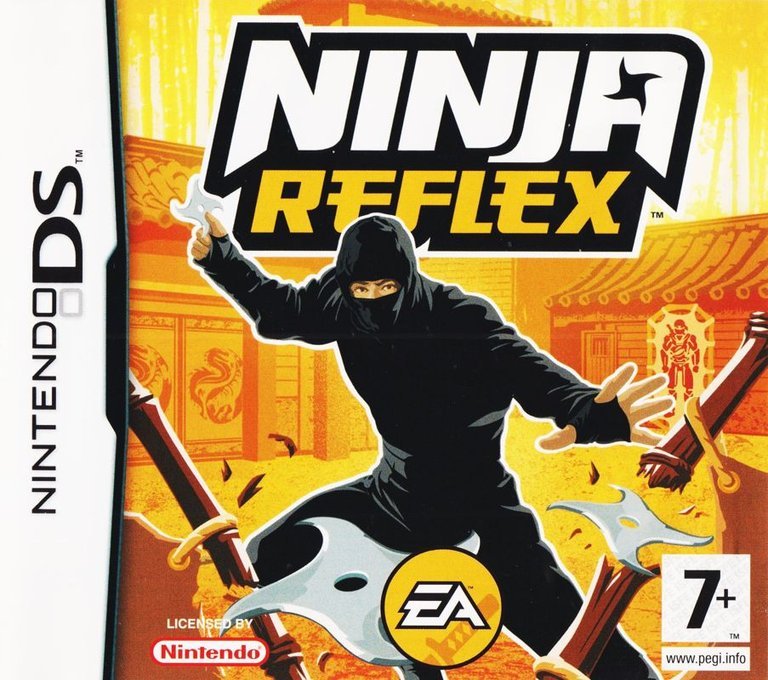
Ninja Reflex is a reaction-based game that challenges players’ speed and timing through a series of mini-games, including catching flies with chopsticks, snagging Koi fish, and training with martial arts weapons like shurikens and nunchaku. Players earn digital belts from a virtual sensei as they progress, while also engaging in guided meditation to improve focus. The game supports up to four players in multiplayer mode, allowing competitive tests of reflexes.
Gameplay Videos
Where to Buy Ninja Reflex
PC
Ninja Reflex Patches & Updates
Ninja Reflex Guides & Walkthroughs
Ninja Reflex Reviews & Reception
metacritic.com (49/100): Though it may be a simplistic goal, Ninja Reflex is a great game to play in small increments to try to improve your reaction time.
ign.com (60/100): The game is fun, well made, and an entertaining multiplayer distraction from more robust Wii experiences. In the end though, it’s just way too short.
gamepressure.com (88/100): Master the Art of Speed and become a Ninja Gamer! Ninja Reflex uses martial arts challenges to test your reflexes, sharpen your hand-eye coordination, and measure your reaction times to the millisecond.
Ninja Reflex Cheats & Codes
Nintendo DS (US)
These are Action Replay codes. Requires an Action Replay device to use.
| Code | Effect |
|---|---|
| 94000130 ffbb0000 02140a18 00063000 d2000000 00000000 |
SELECT+UP: 99 Points |
| 94000130 ff7b0000 02140a18 fff9d000 d2000000 00000000 |
SELECT+DOWN: -99 Points |
| 22140274 00000001 | Red Belt |
| 22140274 00000002 | Yellow Belt |
| 22140274 00000003 | Orange Belt |
| 22140274 00000004 | Blue Belt |
| 22140274 00000005 | Green Belt |
| 22140274 00000006 | Purple Belt |
| 22140274 00000007 | Brown Belt |
| 22140274 00000008 | Black Belt 1st Degree |
| 22140274 00000009 | Black Belt 2nd Degree |
| 94000130 fcfb0000 221403b2 00000001 d5000000 00000002 c0000000 00000001 d8000000 021403ac d2000000 00000000 |
White Belt (Shuriken Tests Complete) |
| 94000130 fcfb0000 221403b9 00000001 d5000000 00000002 c0000000 00000002 d8000000 021403b3 d2000000 00000000 |
Red Belt (Shuriken Tests Complete) |
| 94000130 fcfb0000 221403c0 00000001 d5000000 00000002 c0000000 00000003 d8000000 021403ba d2000000 00000000 |
Yellow Belt (Shuriken Tests Complete) |
| 94000130 fcfb0000 221403c7 00000001 d5000000 00000002 c0000000 00000004 d8000000 021403c1 d2000000 00000000 |
Orange Belt (Shuriken Tests Complete) |
| 94000130 fcfb0000 221403ce 00000001 d5000000 00000002 c0000000 00000005 d8000000 021403c8 d2000000 00000000 |
Blue Belt (Shuriken Tests Complete) |
| 94000130 fcfb0000 221403d5 00000001 d5000000 00000002 c0000000 00000005 d8000000 021403cf d2000000 00000000 |
Green Belt (Shuriken Tests Complete) |
| 94000130 fcfb0000 221403dc 00000001 d5000000 00000002 c0000000 00000005 d8000000 021403d6 d2000000 00000000 |
Purple Belt (Shuriken Tests Complete) |
| 94000130 fcfb0000 221403e3 00000001 d5000000 00000002 c0000000 00000005 d8000000 021403dd d2000000 00000000 |
Brown Belt (Shuriken Tests Complete) |
| 94000130 fcfb0000 221403ea 00000001 d5000000 00000002 c0000000 00000005 d8000000 021403e4 d2000000 00000000 |
Black Belt 1st Degree (Shuriken Tests Complete) |
| 94000130 fcfb0000 221403f1 00000001 d5000000 00000002 c0000000 00000005 d8000000 021403eb d2000000 00000000 |
Black Belt 2nd Degree (Shuriken Tests Complete) |
| 94000130 fcfb0000 22140318 00000001 d5000000 00000002 c0000000 00000001 d8000000 02140312 d2000000 00000000 |
White Belt (Koi Tests Complete) |
| 94000130 fcfb0000 2214031f 00000001 d5000000 00000002 c0000000 00000002 d8000000 02140319 d2000000 00000000 |
Red Belt (Koi Tests Complete) |
| 94000130 fcfb0000 22140326 00000001 d5000000 00000002 c0000000 00000003 d8000000 02140320 d2000000 00000000 |
Yellow Belt (Koi Tests Complete) |
| 94000130 fcfb0000 2214032d 00000001 d5000000 00000002 c0000000 00000004 d8000000 02140327 d2000000 00000000 |
Orange Belt (Koi Tests Complete) |
| 94000130 fcfb0000 22140334 00000001 d5000000 00000002 c0000000 00000005 d8000000 0214032e d2000000 00000000 |
Blue Belt (Koi Tests Complete) |
| 94000130 fcfb0000 2214033b 00000001 d5000000 00000002 c0000000 00000005 d8000000 02140335 d2000000 00000000 |
Green Belt (Koi Tests Complete) |
| 94000130 fcfb0000 22140342 00000001 d5000000 00000002 c0000000 00000005 d8000000 0214033c d2000000 00000000 |
Purple Belt (Koi Tests Complete) |
| 94000130 fcfb0000 22140349 00000001 d5000000 00000002 c0000000 00000005 d8000000 02140343 d2000000 00000000 |
Brown Belt (Koi Tests Complete) |
| 94000130 fcfb0000 22140350 00000001 d5000000 00000002 c0000000 00000005 d8000000 0214034a d2000000 00000000 |
Black Belt 1st Degree (Koi Tests Complete) |
| 94000130 fcfb0000 22140357 00000001 d5000000 00000002 c0000000 00000005 d8000000 02140351 d2000000 00000000 |
Black Belt 2nd Degree (Koi Tests Complete) |
| 94000130 fcfb0000 2214027e 00000001 d5000000 00000002 c0000000 00000001 d8000000 02140278 d2000000 00000000 |
White Belt (Hotaru Tests Complete) |
| 94000130 fcfb0000 22140285 00000001 d5000000 00000002 c0000000 00000002 d8000000 0214027f d2000000 00000000 |
Red Belt (Hotaru Tests Complete) |
| 94000130 fcfb0000 2214028c 00000001 d5000000 00000002 c0000000 00000003 d8000000 02140286 d2000000 00000000 |
Yellow Belt (Hotaru Tests Complete) |
Ninja Reflex: A Study in Minimalism and Missed Potential
Introduction
In the annals of video game history, few titles embody the duality of innovation and frustration quite like Ninja Reflex. Released in 2008 by Sanzaru Games and published by Electronic Arts and Nunchuck Games, Ninja Reflex arrived at a pivotal moment in gaming. The Nintendo Wii and DS were at the height of their popularity, and motion-controlled mini-game collections were flooding the market. Ninja Reflex sought to carve its niche by blending the allure of ninja culture with reflex-testing gameplay, promising to turn players into “ninja gamers” through a series of martial arts challenges. Yet, despite its charming presentation and novel concept, the game ultimately faltered due to its brevity and lack of depth. This review explores Ninja Reflex in exhaustive detail, examining its development, gameplay, reception, and legacy to understand its place in the pantheon of party games.
Development History & Context
The Studio and Vision
Sanzaru Games, the developer behind Ninja Reflex, was a relatively young studio at the time, founded in 2007 by former members of Z-Axis, a company known for its work on games like SOCOM: U.S. Navy SEALs. The studio’s leadership included Glen Egan as Executive Producer and Tin Guerrero as Creative Director, both of whom brought a wealth of experience in action and multiplayer games. Their vision for Ninja Reflex was clear: create a game that leveraged the unique control schemes of the Wii and DS to test and improve players’ reflexes, all while wrapping the experience in the mystique of ninja lore.
The game’s co-publisher, Nunchuck Games, was headed by David Luntz, another Z-Axis alum, which explains the seamless collaboration between the two entities. Electronic Arts, the other publisher, was riding the wave of casual and party games that had become a lucrative market thanks to the success of titles like Wii Sports and WarioWare: Smooth Moves. Ninja Reflex was positioned as a spiritual successor to these games, aiming to capitalize on the motion-control craze while offering something distinct.
Technological Constraints and Design Choices
The Wii and DS were revolutionary for their time, but they also presented unique challenges. The Wii’s motion controls, while innovative, were often imprecise, and Ninja Reflex had to account for this in its design. The game’s six mini-games were carefully crafted to utilize the Wii Remote’s capabilities without overcomplicating the controls. For example, the Shuriken challenge required players to flick the Wii Remote to throw stars, while Katana involved blocking and countering attacks with precise timing.
On the DS, the touchscreen was the primary input method, with challenges like Hashi (catching flies with chopsticks) relying on the stylus for pinching motions. The game’s minimalist design was partly a response to the hardware limitations, but it also reflected a deliberate choice to focus on simplicity and accessibility. The developers aimed to create a game that could be picked up and played by anyone, regardless of their gaming experience.
The Gaming Landscape in 2008
2008 was a banner year for party and casual games. The Wii was dominating the market, and titles like Mario Kart Wii, Wii Fit, and Boom Blox were showcasing the console’s versatility. The DS, too, was thriving with games like Brain Age and Nintendogs appealing to a broad audience. Ninja Reflex entered this crowded space with a unique selling point: it wasn’t just a party game; it was a “reflex trainer” that promised to improve players’ reaction times and hand-eye coordination.
However, the market was also becoming saturated with mini-game collections, many of which were criticized for their lack of depth. Ninja Reflex faced stiff competition from established franchises like Mario Party and WarioWare, which offered far more content for a similar price. This context is crucial for understanding the game’s reception and eventual legacy.
Narrative & Thematic Deep Dive
The Plot and Characters
Ninja Reflex is not a narrative-driven game in the traditional sense. There is no overarching story or complex characters. Instead, the game adopts a lighthearted, almost satirical approach to the ninja theme. Players assume the role of a novice ninja, guided by a Sensei who dispenses wisdom (and occasional nonsense) in a thick, exaggerated Asian accent. The Sensei, voiced by J. S. Gilbert, serves as the game’s primary narrative device, offering encouragement, criticism, and humorous commentary as players progress through the ranks.
The game’s “plot” revolves around the player’s journey from White Belt to Black Belt, 3rd Degree. Each belt rank is earned by completing a series of challenges, which are framed as tests of the player’s ninja skills. The Sensei’s dialogue is peppered with clichéd martial arts phrases, adding to the game’s tongue-in-cheek tone. For example, players might be told to “strike like the dragon” or “move like the tiger,” reinforcing the game’s playful take on ninja culture.
Themes and Tone
At its core, Ninja Reflex is a celebration of the ninja mythos, but it also subtly critiques the commodification of martial arts in popular culture. The game’s themes revolve around discipline, focus, and self-improvement, but it presents these ideas with a wink and a nod. The meditation mode, for instance, is a humorous take on the spiritual side of martial arts, with the Sensei guiding players through breathing exercises to “achieve greater mental focus.”
The game’s tone is consistently lighthearted, avoiding the gritty realism of titles like Ninja Gaiden. Instead, it embraces the campy, over-the-top aesthetic of 1980s ninja movies, complete with exaggerated sound effects and vibrant visuals. This approach makes Ninja Reflex accessible to a wide audience, but it also means the game lacks the depth and complexity of more narrative-driven titles.
Dialogue and Localization
The Sensei’s dialogue is a standout feature of Ninja Reflex, blending humor with motivational phrases. However, the game’s localization has been criticized for its reliance on stereotypes. The Sensei’s exaggerated accent and occasional “Engrish” phrases (“You have much to learn, grasshopper”) walk a fine line between homage and caricature. While some players found this endearing, others saw it as a missed opportunity to present a more authentic or nuanced portrayal of martial arts culture.
Gameplay Mechanics & Systems
Core Gameplay Loop
Ninja Reflex is structured around a series of six mini-games, each designed to test a different aspect of the player’s reflexes. The core gameplay loop involves selecting a challenge, completing it to earn points, and progressing through the belt ranks. The game’s simplicity is both its strength and its weakness: it’s easy to pick up and play, but it lacks the variety and depth to sustain long-term engagement.
The six mini-games are as follows:
- Shuriken: Players throw shuriken (throwing stars) at targets, testing their aim and timing.
- Hotaru: A reaction-time challenge where players must press a button when they see a firefly.
- Hashi: Players use chopsticks to catch flies, requiring precise stylus or Wii Remote movements.
- Koi: A fishing challenge where players must grab koi with their bare hands.
- Nunchaku: Players swing nunchucks to knock away incoming objects.
- Katana: A sword-fighting challenge where players block and counterattack.
Each mini-game has multiple variations, adding some replayability. For example, Shuriken might require players to hit moving targets or throw stars in rapid succession. However, these variations are minor, and the core mechanics remain largely unchanged.
Combat and Progression
Combat in Ninja Reflex is minimal, limited to the Katana and Nunchaku challenges. The Katana challenge, in particular, is the closest the game comes to traditional combat, with players blocking and countering attacks from oni (demons). However, the combat is simplistic, relying more on timing than strategy. The Nunchaku challenge is even more basic, requiring players to swing the Wii Remote in a figure-eight motion to knock away objects.
Progression is tied to the belt system, with players earning higher ranks by completing challenges and passing belt tests. These tests are randomized sets of challenges, adding a small degree of unpredictability. However, the progression feels shallow, as the challenges do not evolve significantly as players advance. The lack of a meaningful reward system beyond the belt ranks further diminishes the sense of accomplishment.
Multiplayer Mode
The multiplayer mode is one of Ninja Reflex‘s strongest features, allowing up to four players to compete in head-to-head challenges. The mode is designed for quick, competitive play, with each mini-game adapted for multiplayer. For example, Shuriken becomes a race to hit the most targets, while Koi challenges players to catch the most fish.
The multiplayer mode is where Ninja Reflex shines, as the competitive element adds excitement and replayability. However, the limited number of mini-games means that even multiplayer can become repetitive over time. The lack of online multiplayer also limits the game’s longevity, as players are restricted to local competitions.
UI and Accessibility
The user interface in Ninja Reflex is clean and intuitive, with a minimalist design that reflects the game’s Zen aesthetic. The main menu is straightforward, allowing players to quickly jump into challenges or multiplayer mode. The belt progression is clearly displayed, and the Sensei’s commentary provides constant feedback.
Accessibility is a mixed bag. The game’s simple controls make it easy for casual players to pick up, but the motion controls on the Wii can be finicky, leading to frustration. The DS version fares better in this regard, as the touchscreen controls are more precise. However, neither version offers significant customization options, which could have improved accessibility for players with different skill levels.
World-Building, Art & Sound
Setting and Atmosphere
Ninja Reflex is set in a stylized, cartoonish version of feudal Japan, with each mini-game taking place in a different location, such as a bamboo forest or a dojo. The game’s art style is vibrant and colorful, with a focus on simplicity and clarity. The environments are not particularly detailed, but they effectively convey the game’s lighthearted tone.
The atmosphere is one of playful competition, with the Sensei’s commentary and the game’s sound effects reinforcing the ninja theme. The meditation mode, in particular, stands out for its serene presentation, offering a stark contrast to the fast-paced challenges.
Visual Direction
The visual direction in Ninja Reflex is functional rather than groundbreaking. The game’s 2D animations are smooth and well-executed, but they lack the polish of more high-profile titles. The character designs are simple, with the Sensei and the player’s ninja avatar being the most detailed. The mini-games themselves are visually distinct, with each challenge featuring its own color palette and aesthetic.
The Wii version benefits from the console’s superior graphics, with smoother animations and more detailed environments. The DS version, while visually competent, suffers from the hardware’s limitations, with smaller sprites and less detail. Overall, the visuals are adequate but unremarkable, serving the gameplay without drawing attention to themselves.
Sound Design and Music
The sound design in Ninja Reflex is one of its strongest aspects. The game features a mix of traditional Japanese instruments and modern sound effects, creating a unique auditory experience. The Shuriken challenge, for example, is accompanied by the satisfying “whoosh” of throwing stars, while the Katana challenge features the clash of swords.
The music is similarly well-crafted, with a blend of traditional and contemporary tracks that enhance the game’s atmosphere. The meditation mode features soothing, ambient music, while the mini-games are accompanied by upbeat, rhythmic tunes. The Sensei’s voice acting is a highlight, with J. S. Gilbert delivering a performance that is both humorous and engaging.
Reception & Legacy
Critical Reception
Ninja Reflex received mixed to negative reviews upon release, with critics praising its presentation and multiplayer mode but criticizing its lack of content. The Wii version, in particular, was panned for its $40 price tag, which many felt was unjustified given the game’s brevity. Metacritic scores reflect this sentiment, with the Wii version earning a 49/100, the DS version a 54/100, and the PC version a 57/100.
Critics like IGN’s Mark Bozon noted that the game was “fun, well made, and an entertaining multiplayer distraction,” but ultimately “way too short.” GamePro called the DS version “a fun rental,” while Eurogamer criticized the Wii version for its lack of depth. The general consensus was that Ninja Reflex was a decent concept executed poorly, with too few mini-games to justify its price.
Commercial Performance
Commercial data for Ninja Reflex is scarce, but it’s clear that the game did not achieve significant sales. The lack of marketing and the game’s niche appeal likely contributed to its underperformance. While the game found a small audience among casual gamers and ninja enthusiasts, it failed to make a lasting impact on the market.
Influence and Legacy
Ninja Reflex is often remembered as a cautionary tale about the dangers of overpricing a minimalist game. Its legacy is one of missed potential, as the game’s core concept was sound but its execution was lacking. The game’s failure to resonate with critics and players alike highlights the importance of content depth in party games, a lesson that subsequent titles like WarioWare D.I.Y. and Mario Party 9 would take to heart.
Despite its flaws, Ninja Reflex remains a cult favorite among some players, who appreciate its charm and simplicity. The game’s meditation mode, in particular, has been praised for its uniqueness, and the Sensei’s dialogue continues to entertain. However, the game’s legacy is ultimately overshadowed by its shortcomings, serving as a reminder of the challenges faced by developers in the crowded party game market.
Conclusion
Ninja Reflex is a game of contradictions. It is charming yet shallow, innovative yet repetitive, and ambitious yet underwhelming. Its strengths lie in its accessibility, multiplayer mode, and playful take on ninja culture, but these are undermined by its lack of content and high price point. The game’s reception and legacy reflect these contradictions, with critics and players alike recognizing its potential while lamenting its execution.
In the grand tapestry of video game history, Ninja Reflex occupies a modest but notable place. It is a relic of the motion-control era, a time when developers were experimenting with new ways to engage players. While it may not have achieved the success of its contemporaries, it remains a fascinating case study in game design, marketing, and the challenges of balancing innovation with player expectations. For those willing to look past its flaws, Ninja Reflex offers a brief but enjoyable glimpse into the world of ninja reflex training. For everyone else, it serves as a reminder of the importance of depth and value in game design.
Final Verdict: 6/10 – A flawed but charming experiment in reflex training, best enjoyed in short bursts with friends.